 Add to Chrome
 Add to Firefox
 Add to Edge
Physics-Guided Neural Airy Beamforming for Near-Field Blockage Mitigation
Aug 05, 2026
High-frequency communication systems heavily rely on line-of-sight(LoS) paths, so blockage of the LoS path can cause severe performance loss. Near-field Airy beams with curved trajectories can steer energy around obstacles, offering a promising solution for blockage mitigation. However, existing methods for selecting a near-optimal Airy beam trajectory either rely on high-overhead beam training, or employ data-driven learning without a clear, physically interpretable rule. To address this problem, we propose a physics-guided neural Airy beamforming framework that selects a near-optimal trajectory in one shot with clear physical interpretability. Specifically, we first formulate a single-edge representation of the blocker model in 3GPP TR 38.901 and reveal the trajectory--edge coupling mechanism. This analysis yields a trajectory-selection optimality condition that defines the candidate trajectories. Although these trajectories generally cannot be expressed in closed form, we show that they form a continuous structure. This continuous structure is then exploited to construct a compact physics-defined region that captures near-optimal trajectories. Guided by this region, a lightweight neural predictor is finally designed to directly select a near-optimal trajectory without beam training. Simulations show that the compact physics-defined region effectively captures near-optimal trajectories, while occupying only about 6% of the candidate-space area on average. The proposed framework retains 99.7% of the reference rate obtained through numerical optimization, and nearly matches the rate of the data-driven method despite using approximately 112\times fewer neural-network parameters.

Near-Field Communications with Grating Lobes for Quasi-Distributed Arrays: From ULA to MRA
Jul 31, 2026Extremely large-scale antenna array (ELAA) has emerged as a common feature of many key candidate technologies for 6G, where the near-field characteristics become dominant. The quasi-distributed array can further extend the near-field range and utilize the near-field benefits to improve the system performance. However, its typical implementation with modular arrays suffers from severe grating lobes that cause non-negligible inter-user interferences. To solve this problem, we propose the modular minimum-redundancy array (M-MRA) to suppress near-field grating lobes by redesigning the subarray configuration. Specifically, we first characterize the beam pattern of the conventional modular uniform linear array (M-ULA). Contrary to the common belief that grating lobes only exist in the angle domain, we reveal that near-field grating lobes may also occur in the distance domain. We further analyze how to suppress near-field grating lobes for the M-ULA. The results demonstrate that increasing the number of antennas per module can suppress grating lobes. In particular, the number of antennas required grows linearly with the inter-module spacing, thus the grating lobe interferences are severe under a limited number of antennas. This limitation inspires us to propose the M-MRA by redesigning the subarray structure. For M-MRA, the nonuniform antenna spacing within each subarray provides a narrower spatial envelope, allowing it to suppress near-field grating lobes in the angle and distance domains simultaneously. Simulation results verify that the proposed M-MRA can significantly improve the spectrum efficiency of multi-user near-field communications under the same number of antennas.
Blockage-Robust Beamforming for Near-Field Communications: From Single-Airy to Multi-Airy
Jul 08, 2026High-frequency communications strongly depend on the line-of-sight (LoS) path, and obstacle blockage can severely degrade the received signal power and achievable rate. Near-field Airy beams with curved trajectories can circumvent obstacles, offering a promising way to alleviate blockage. However, since an Airy beam carries most useful energy along a single curved trajectory, existing Airy beamforming methods are highly sensitive to estimation errors of transmitter-obstacle-receiver geometry. That is to say, even a small error in the estimated geometry may cause the mismatched Airy trajectory, leading to severe performance loss. To address this problem, we propose a multi-Airy beamforming scheme for blockage-robust near-field communications. Specifically, we first reveal and analyze the sensitivity mechanism of single-Airy beamforming. This mechanism motivates us to extend the single-Airy generation method to a coordinated multi-Airy generation method by deriving the phase offsets required to coherently combine multiple Airy beams at the target user. Based on this coordinated generation method, we partition the transmit array into multiple sub-arrays and configure a tailored Airy beam for each sub-array, so that the resulting Airy beams formed by multiple curved trajectories can be coherently combined at the target user. Simulation results verify the sensitivity of single-Airy beamforming and the robustness of multi-Airy beamforming under estimation errors of transmitter-obstacle-receiver geometry. Moreover, the proposed scheme achieves higher achievable rates than single-Airy beamforming in blocked scenarios without geometry estimation errors.
Near-field Beam Training under Multi-path Channels: A Hybrid Learning-and-Optimization Approach
Mar 26, 2026For extremely large-scale arrays (XL-arrays), the discrete Fourier transform (DFT) codebook, conventionally used in the far-field, has recently been employed for near-field beam training. However, most existing methods rely on the line-of-sight (LoS) dominant channel assumption, which may suffer degraded communication performance when applied to the general multi-path scenario due to the more complex received signal power pattern at the user. To address this issue, we propose in this paper a new hybrid learning-and-optimization-based beam training method that first leverages deep learning (DL) to obtain coarse channel parameter estimates, and then refines them via a model-based optimization algorithm, hence achieving high-accuracy estimation with low computational complexity. Specifically, in the first stage, a tailored U-Net architecture is developed to learn the non-linear mapping from the received power pattern to coarse estimates of the angles and ranges of multi-path components. In particular, the inherent permutation ambiguity in multi-path parameter matching is effectively resolved by a permutation invariant training (PIT) strategy, while the unknown number of paths is estimated based on defined path existence logits. In the second stage, we further propose an efficient particle swarm optimization method to refine the angular and range parameters within a confined search region; in the meanwhile, a Gerchberg-Saxton algorithm is used to retrieve multi-path channel gains from the received power pattern. Last, numerical results demonstrate that the proposed hybrid design significantly outperforms various benchmarks in terms of parameter estimation accuracy and achievable rate, yet with low computational complexity.
RAQ-MIMO: MIMO for Multi-Band Rydberg Atomic Quantum Receiver
Sep 09, 2025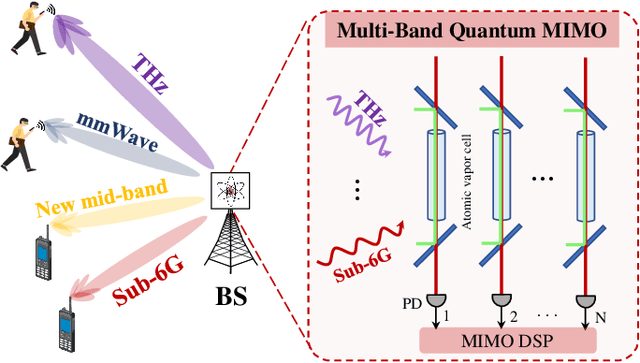
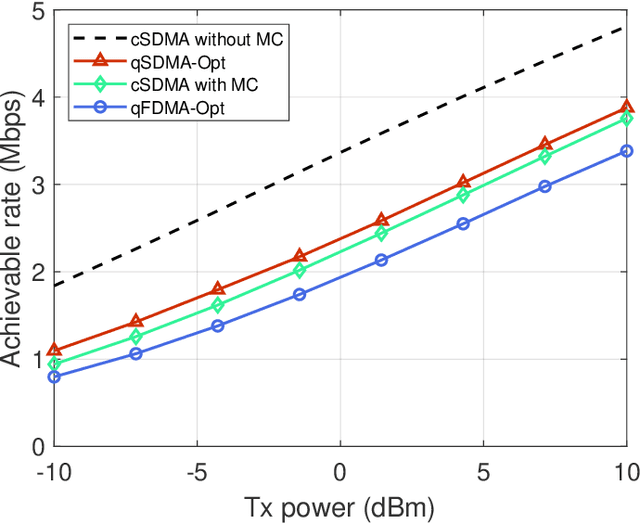
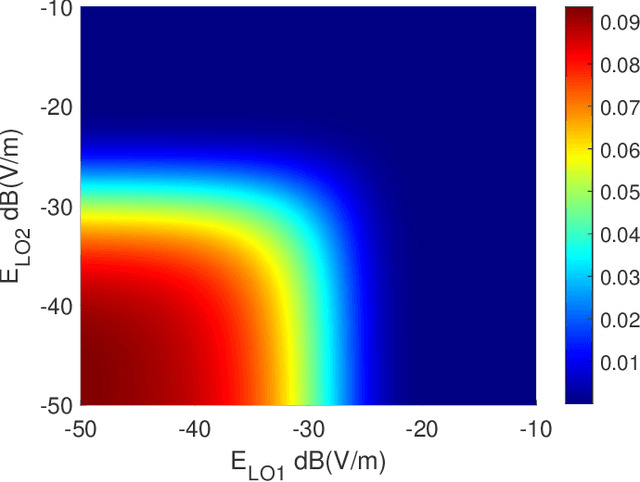
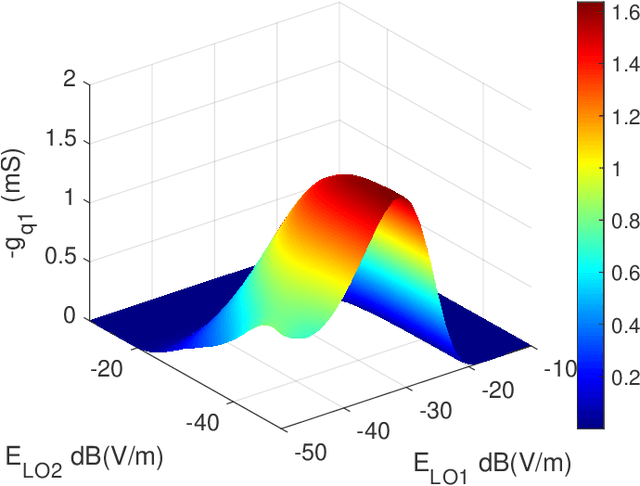
Rydberg atomic quantum receivers (RAQRs) are capable of receiving multi-band radio-frequency (RF) signals simultaneously, which are expected to break Chu's limit for classical electronic antennas. However, signals from different users will interfere with each other in the optical intermediate frequency (IF) domain of the multi-band quantum receiver, which is termed the IF interference (IFI) problem. To address this problem, in this paper, we propose a multi-input multi-output (MIMO) architecture for Rydberg atomic quantum receiver (RAQ-MIMO) by exploiting the additional spatial diversity of MIMO receivers. Specifically, by applying the dynamic signal model of RAQRs, we clarify the physical relationship between the quantum local oscillator (LO) configurations and the multi-band gains with the concept of quantum transconductance. Then, with the quantum transconductance-based signal model, we formulate the spectral efficiency (SE) maximization problem and further propose the quantum weighted minimum mean square error (qWMMSE) algorithm, which jointly optimizes the quantum LO configurations and the classical precoder/combiner matrices. Furthermore, we test the qWMMSE algorithm within the standard space division multiple access (SDMA) scheme and the frequency division multiple access (FDMA) scheme. Simulation results demonstrate that the qWMMSE optimization framework can significantly improve the SE of RAQ-MIMO systems for both multiple access schemes, and that RAQ-MIMO systems can outperform classical electronic receiver-based multi-user MIMO systems by eliminating the mutual coupling effect between classical antennas.
Near-Field Challenges in Ultra-Wideband ISAC: Beamforming Strategies and System Insights
Aug 26, 2025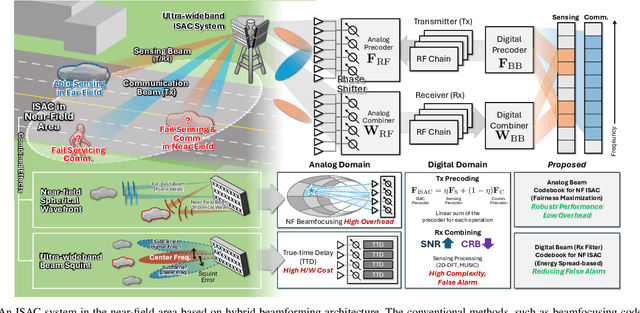
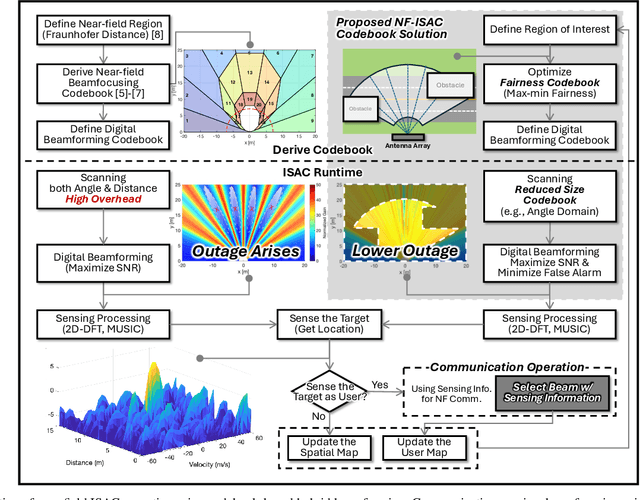
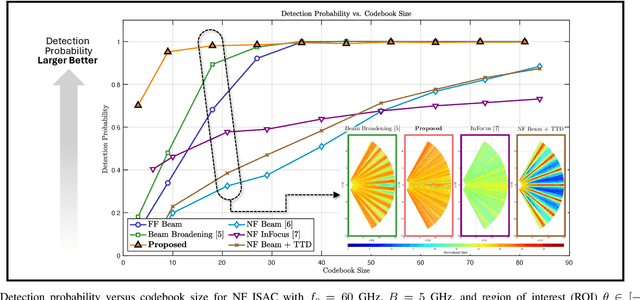
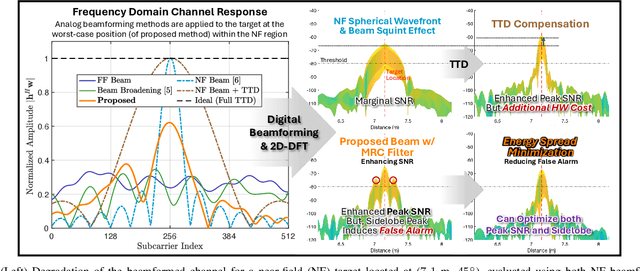
The shift toward sixth-generation (6G) wireless networks places integrated sensing and communications (ISAC) at the core of future applications such as autonomous driving, extended reality, and smart manufacturing. However, the combination of large antenna arrays and ultra-wide bandwidths brings near-field propagation effects and beam squint to the forefront, fundamentally challenging traditional far-field designs. True time delay units (TTDs) offer a potential solution, but their cost and hardware complexity limit scalability. In this article, we present practical beamforming strategies for near-field ultra-wideband ISAC systems. We explore codebook designs across analog and digital domains that mitigate beam squint, ensure reliable user coverage, and enhance sensing accuracy. We further validate these approaches through large-scale system-level simulations, including 3D map-based evaluations that reflect real-world urban environments. Our results demonstrate how carefully designed beamforming can balance communication throughput with sensing performance, achieving reliable coverage and efficient resource use even under severe near-field conditions. We conclude by highlighting open challenges in hardware, algorithms, and system integration, pointing toward research directions that will shape the deployment of 6G-ready ISAC networks.
Decoding for Punctured Convolutional and Turbo Codes: A Deep Learning Solution for Protocols Compliance
Feb 21, 2025Neural network-based decoding methods have shown promise in enhancing error correction performance, but traditional approaches struggle with the challenges posed by punctured codes. In particular, these methods fail to address the complexities of variable code rates and the need for protocol compatibility. This paper presents a unified Long Short-Term Memory (LSTM)-based decoding architecture specifically designed to overcome these challenges. The proposed method unifies punctured convolutional and Turbo codes. A puncture embedding mechanism integrates puncturing patterns directly into the network, enabling seamless adaptation to varying code rates, while balanced bit error rate training ensures robustness across different code lengths, rates, and channels, maintaining protocol flexibility. Extensive simulations in Additive White Gaussian Noise and Rayleigh fading channels demonstrate that the proposed approach outperforms conventional decoding techniques, providing significant improvements in decoding accuracy and robustness. These results underscore the potential of LSTM-based decoding as a promising solution for next-generation artificial intelligence powered communication systems.
Large Language Model Enabled Multi-Task Physical Layer Network
Dec 30, 2024The recent advance of Artificial Intelligence (AI) is continuously reshaping the future 6G wireless communications. Recently, the development of Large Language Models (LLMs) offers a promising approach to effectively improve the performance and generalization for different physical layer tasks. However, most existing works finetune dedicated LLM networks for a single wireless communication task separately. Thus performing diverse physical layer tasks introduces extremely high training resources, memory usage, and deployment costs. To solve the problem, we propose a LLM-enabled multi-task physical layer network to unify multiple tasks with a single LLM. Specifically, we first propose a multi-task LLM framework, which finetunes LLM to perform multi-user precoding, signal detection and channel prediction simultaneously. Besides, multi-task instruction module, input encoders, as well as output decoders, are elaborately designed to distinguish multiple tasks and adapted the features of different formats of wireless data for the features of LLM. Numerical simulations are also displayed to verify the effectiveness of the proposed method.
Spatio-Temporal Electromagnetic Kernel Learning for Channel Prediction
Dec 23, 2024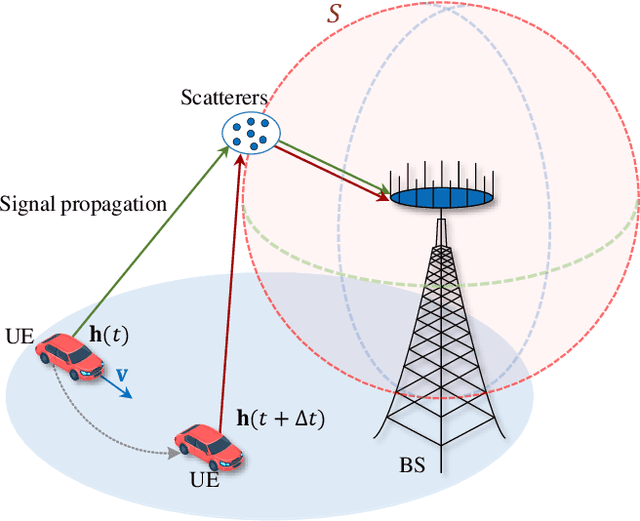
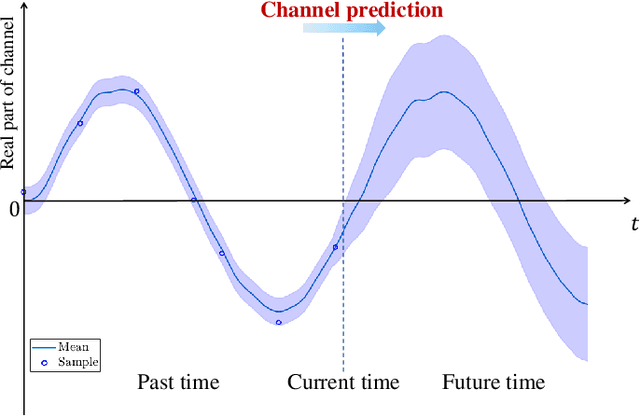
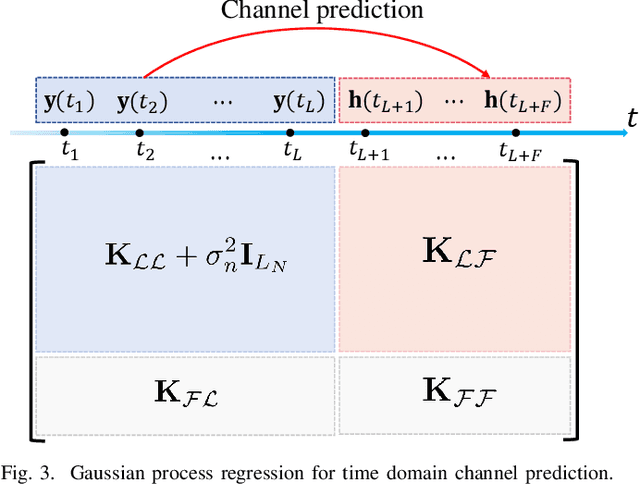
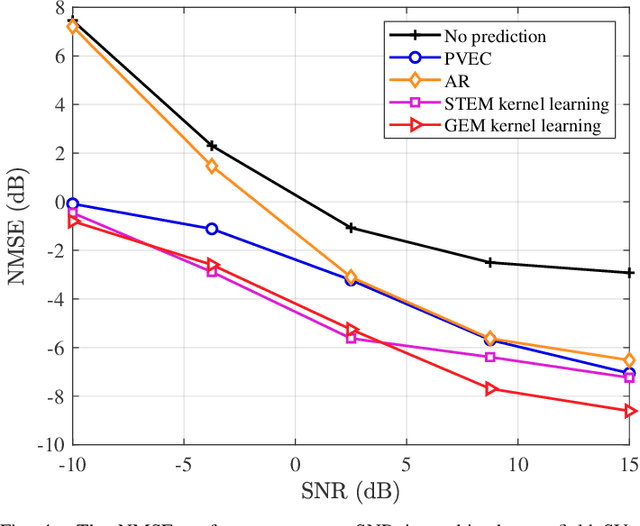
Accurate channel prediction is essential for addressing channel aging caused by user mobility. However, the actual channel variations over time are highly complex in high-mobility scenarios, which makes it difficult for existing predictors to obtain future channels accurately. The low accuracy of channel predictors leads to difficulties in supporting reliable communication. To overcome this challenge, we propose a channel predictor based on spatio-temporal electromagnetic (EM) kernel learning (STEM-KL). Specifically, inspired by recent advancements in EM information theory (EIT), the STEM kernel function is derived. The velocity and the concentration kernel parameters are designed to reflect the time-varying propagation of the wireless signal. We obtain the parameters through kernel learning. Then, the future channels are predicted by computing their Bayesian posterior, with the STEM kernel acting as the prior. To further improve the stability and model expressibility, we propose a grid-based EM mixed kernel learning (GEM-KL) scheme. We design the mixed kernel to be a convex combination of multiple sub-kernels, where each of the sub-kernel corresponds to a grid point in the set of pre-selected parameters. This approach transforms non-convex STEM kernel learning problem into a convex grid-based problem that can be easily solved by weight optimization. Finally, simulation results verify that the proposed STEM-KL and GEM-KL schemes can achieve more accurate channel prediction. This indicates that EIT can improve the performance of wireless system efficiently.
AI and Deep Learning for THz Ultra-Massive MIMO: From Model-Driven Approaches to Foundation Models
Dec 13, 2024In this paper, we explore the potential of artificial intelligence (AI) to address the challenges posed by terahertz ultra-massive multiple-input multiple-output (THz UM-MIMO) systems. We begin by outlining the characteristics of THz UM-MIMO systems, and identify three primary challenges for the transceiver design: 'hard to compute', 'hard to model', and 'hard to measure'. We argue that AI can provide a promising solution to these challenges. We then propose two systematic research roadmaps for developing AI algorithms tailored for THz UM-MIMO systems. The first roadmap, called model-driven deep learning (DL), emphasizes the importance to leverage available domain knowledge and advocates for adopting AI only to enhance the bottleneck modules within an established signal processing or optimization framework. We discuss four essential steps to make it work, including algorithmic frameworks, basis algorithms, loss function design, and neural architecture design. Afterwards, we present a forward-looking vision through the second roadmap, i.e., physical layer foundation models. This approach seeks to unify the design of different transceiver modules by focusing on their common foundation, i.e., the wireless channel. We propose to train a single, compact foundation model to estimate the score function of wireless channels, which can serve as a versatile prior for designing a wide variety of transceiver modules. We will also guide the readers through four essential steps, including general frameworks, conditioning, site-specific adaptation, and the joint design of foundation models and model-driven DL.