 Add to Chrome
 Add to Firefox
 Add to Edge
ViSTR-Bench: Can MLLMs Reason from Continuous Visual Cues in Dynamic Scenes?
Jul 23, 2026
Multimodal Large Language Models (MLLMs) have achieved remarkable success across diverse expert-level tasks, but they still struggle with fundamental abilities that humans naturally develop through continuous observation of the real world, such as spatial perception and dynamic reasoning. Recent studies have recognized this gap and introduced dedicated benchmarks to evaluate the spatial-temporal capabilities of MLLMs. However, existing benchmarks mostly focus on static scenes or require exact quantitative predictions, leaving intuitive reasoning from temporal cues largely underexplored. In this paper, we introduce the Visual Spatial-Temporal Reasoning Benchmark (ViSTR-Bench), a novel evaluation suite designed to systematically assess whether MLLMs can perform qualitative reasoning from continuous visual cues in dynamic scenes. Guided by the principles of temporal emphasis, reasoning orientation, and qualitative evaluation, ViSTR-Bench establishes a comprehensive four-dimensional evaluations covering Motion Perception, Spatial Relations, Outcome Prediction, and Physical Dynamics. The benchmark comprises 15 distinct subtasks and 1,340 high-quality video question-answer pairs spanning diverse tabletop, indoor, and outdoor scenarios. Extensive evaluations of a broad spectrum of state-of-the-art proprietary, open-source, and specialized spatial MLLMs reveal that, despite their strong general video understanding capabilities, current models still face substantial bottlenecks in complex spatial-temporal reasoning and remain far below human performance.

MemNovo: Look Back at the Spectrum for Balanced De Novo Peptide Sequencing from Mass Spectrometry
Jun 10, 2026De novo peptide sequencing from tandem mass spectrometry is pivotal in proteomics, enabling identification of novel peptides without reference databases. While recent Transformer-based encoder-decoder models have achieved remarkable performance, we uncover a critical pathology in their inference dynamics. Through comprehensive feature scaling experiments, we demonstrate that existing auto-regressive peptide decoders tend to over-rely on generated-sequence priors while progressively under-utilizing fine-grained physical evidence from the input mass spectrum. This phenomenon leads to suboptimal results, where generated peptide sequences are biologically plausible yet not faithful to the input spectrum. To rectify this, we propose MemNovo, a training-free and plug-and-play mechanism that re-balances peptide and spectral contributions at inference time. MemNovo alleviates the information bottleneck by establishing a persistent spectral memory bank and injecting retrieved features directly into the final decoding stage via an ultra-conservative residual connection. Theoretical analysis confirms that this mechanism restores the mutual information between the decoder state and the raw spectrum. Extensive experiments on the Nine Species benchmark with two representative baselines, Casanovo and InstaNovo, demonstrate that MemNovo consistently improves both amino acid precision and peptide precision, achieving up to 39.1% relative improvement in peptide precision for Casanovo and up to 3.9% for InstaNovo, with negligible computational overhead.
* Code: https://github.com/AIMS-Lab-HKUSTGZ/MemNovo
GaussiAnimate: Reconstruct and Rig Animatable Categories with Level of Dynamics
Apr 09, 2026Free-form bones, that conform closely to the surface, can effectively capture non-rigid deformations, but lack a kinematic structure necessary for intuitive control. Thus, we propose a Scaffold-Skin Rigging System, termed "Skelebones", with three key steps: (1) Bones: compress temporally-consistent deformable Gaussians into free-form bones, approximating non-rigid surface deformations; (2) Skeleton: extract a Mean Curvature Skeleton from canonical Gaussians and refine it temporally, ensuring a category-agnostic, motion-adaptive, and topology-correct kinematic structure; (3) Binding: bind the skeleton and bones via non-parametric partwise motion matching (PartMM), synthesizing novel bone motions by matching, retrieving, and blending existing ones. Collectively, these three steps enable us to compress the Level of Dynamics of 4D shapes into compact skelebones that are both controllable and expressive. We validate our approach on both synthetic and real-world datasets, achieving significant improvements in reanimation performance across unseen poses-with 17.3% PSNR gains over Linear Blend Skinning (LBS) and 21.7% over Bag-of-Bones (BoB)-while maintaining excellent reconstruction fidelity, particularly for characters exhibiting complex non-rigid surface dynamics. Our Partwise Motion Matching algorithm demonstrates strong generalization to both Gaussian and mesh representations, especially under low-data regime (~1000 frames), achieving 48.4% RMSE improvement over robust LBS and outperforming GRU- and MLP-based learning methods by >20%. Code will be made publicly available for research purposes at cookmaker.cn/gaussianimate.
Depth3DLane: Monocular 3D Lane Detection via Depth Prior Distillation
Apr 25, 2025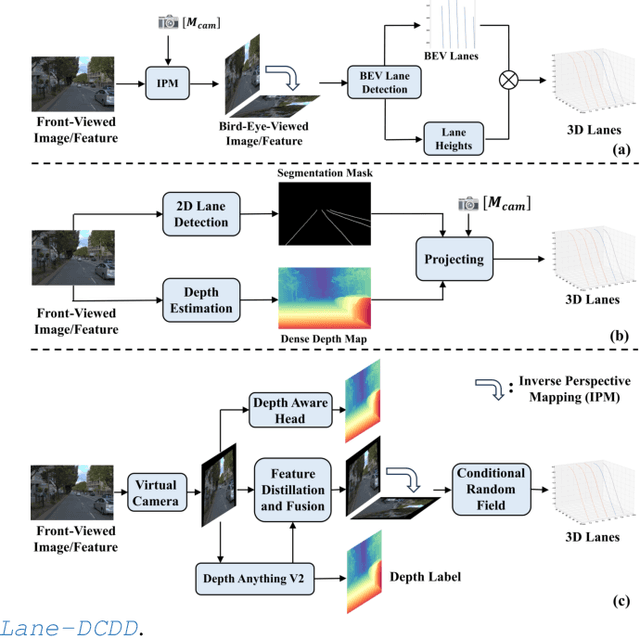
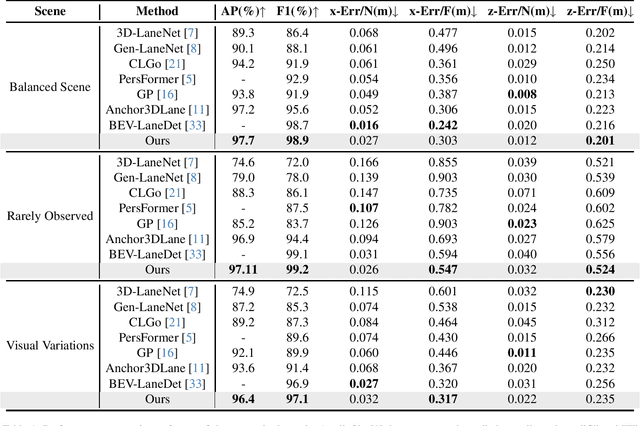
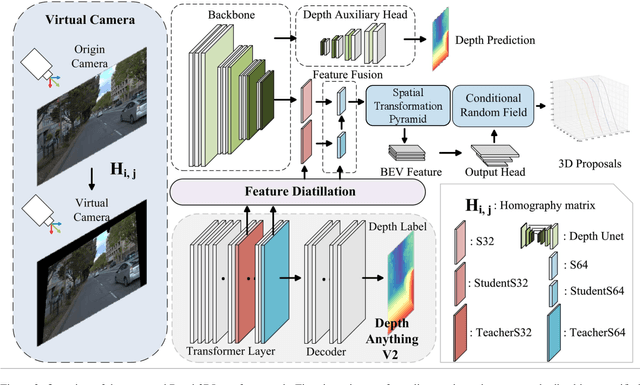
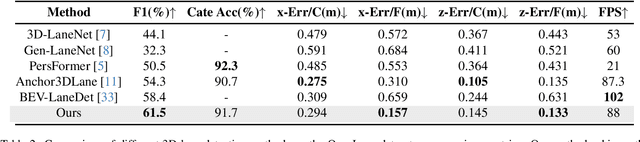
Monocular 3D lane detection is challenging due to the difficulty in capturing depth information from single-camera images. A common strategy involves transforming front-view (FV) images into bird's-eye-view (BEV) space through inverse perspective mapping (IPM), facilitating lane detection using BEV features. However, IPM's flat-ground assumption and loss of contextual information lead to inaccuracies in reconstructing 3D information, especially height. In this paper, we introduce a BEV-based framework to address these limitations and improve 3D lane detection accuracy. Our approach incorporates a Hierarchical Depth-Aware Head that provides multi-scale depth features, mitigating the flat-ground assumption by enhancing spatial awareness across varying depths. Additionally, we leverage Depth Prior Distillation to transfer semantic depth knowledge from a teacher model, capturing richer structural and contextual information for complex lane structures. To further refine lane continuity and ensure smooth lane reconstruction, we introduce a Conditional Random Field module that enforces spatial coherence in lane predictions. Extensive experiments validate that our method achieves state-of-the-art performance in terms of z-axis error and outperforms other methods in the field in overall performance. The code is released at: https://anonymous.4open.science/r/Depth3DLane-DCDD.
Peer Review as A Multi-Turn and Long-Context Dialogue with Role-Based Interactions
Jun 09, 2024Large Language Models (LLMs) have demonstrated wide-ranging applications across various fields and have shown significant potential in the academic peer-review process. However, existing applications are primarily limited to static review generation based on submitted papers, which fail to capture the dynamic and iterative nature of real-world peer reviews. In this paper, we reformulate the peer-review process as a multi-turn, long-context dialogue, incorporating distinct roles for authors, reviewers, and decision makers. We construct a comprehensive dataset containing over 26,841 papers with 92,017 reviews collected from multiple sources, including the top-tier conference and prestigious journal. This dataset is meticulously designed to facilitate the applications of LLMs for multi-turn dialogues, effectively simulating the complete peer-review process. Furthermore, we propose a series of metrics to evaluate the performance of LLMs for each role under this reformulated peer-review setting, ensuring fair and comprehensive evaluations. We believe this work provides a promising perspective on enhancing the LLM-driven peer-review process by incorporating dynamic, role-based interactions. It aligns closely with the iterative and interactive nature of real-world academic peer review, offering a robust foundation for future research and development in this area. We open-source the dataset at https://github.com/chengtan9907/ReviewMT.