 Add to Chrome
 Add to Firefox
 Add to Edge
Neurosymbolic Embodied Agents
Aug 17, 2026
Language and vision-language models generate plausible embodied plans but do not guarantee executability, as their outputs can violate environment dynamics or act on incorrectly grounded entities. We present a neurosymbolic agent that factors long-horizon household tasks into task-directed visual exploration and constrained symbolic planning. In the first phase, a vision-language model and exploration harness acquire goal-relevant predicates and instance bindings from egocentric observations and grounded interactions, producing a symbolic initial state. In the second, a PDDL transition model restricts decoding to tokens that extend applicable actions. Monte Carlo tree search then evaluates executable continuations using a domain-independent planning heuristic. The resulting plans are executable by construction under the transition model, with transfer to the environment conditioned on correct visual grounding. On VirtualHome and ALFWorld, open 4B-27B models exceed 90% success in both environments, and our smallest agent substantially outperforms a 27B direct visual policy in each. Constraints and search prove complementary rather than interchangeable: in ALFWorld either alone solves under a third of tasks, whereas their combination solves over 95%. The method also uses several times fewer generated tokens than extended thinking and far fewer model-visible images than direct interaction, and residual failures localize to state acquisition rather than plan generation without any specialized training.

Does the Proof Prove It That Way? Faithful Formalization of Elements Proofs
Aug 15, 2026In formal verification, both the autoformalization of statements and automated proof search have been studied extensively. While automated proof search can produce a formal proof that compiles, the generated proof does not necessarily reflect how the natural-language argument arrives at its conclusion--a property we refer to as faithfulness. With faithfully formalized proofs, one can check the reasoning behind a human- or AI-written argument, and assist mathematicians in formalizing their proof sketches. However, it is particularly challenging due to misalignment of formal proof tactics and natural language reasoning. In this work, we rigorously describe a set of five necessary conditions a faithful formal proof must satisfy, and introduce Pistis, an agentic, oracle-guided proof search that produces formal Lean proofs that satisfy them. At its core is a novel faithfulness-preserving divide-and-conquer search, which we name OrderDecompose, that tracks citation dependencies and blocks unfaithful shortcuts, paired with a refutation search, that surfaces gaps and errors in the natural language proof source. OrderDecompose completes proofs that baselines cannot close even within a 12-hour budget, and its artifacts compile over 33$\times$ as fast as prior work's. We apply Pistis on the first three books of Euclid's Elements, producing high-quality artifacts containing faithful formal proofs. Under a blinded human study and an LLM-as-a-judge protocol on rigorous rubrics, Pistis-generated proofs are favored over prior works--2.89$\times$ and 5.2$\times$ as often by human reviewers and the LLM judge, respectively. It further uncovers gaps in Euclid's proofs and their translation, and can accept or refute natural language proofs written by humans or AI, demonstrating that faithful formalization is useful as a proof-checking tool.
Theory-Scale Auto-Formalization of Logics for Computer Science
Jun 25, 2026Auto-formalization is critical for scalable formal verification, but existing progress largely focuses on isolated statements, while theory-scale auto-formalization, which coherently translates hundreds of interdependent definitions, lemmas, and theorems, remains open due to challenges in consistency, faithfulness, scalability, and correctness. In this paper, we introduce LCS-Bench, a stand-alone, theory-scale benchmark based on Logics for Computer Science. LCS-Bench is built through a novel semi-automated agentic pipeline that leverages concept graphs, formal signature planning, issue tracking, sorry-filling with counter-example search, complemented by faithfulness review from human experts. The resulting artifact covers 327 textbook items, over 4,076 Lean declarations, and more than 85K lines of Lean code. The dataset supports broad evaluation through a data engine that automatically derives five tracks of evaluation benchmarks, measuring different aspects of auto-formalization and theorem-proving capabilities. We also introduce a novel evaluation protocol featuring definitional equivalence checkers, enabling more fine-grained and faithful assessment. Through extensive evaluation on 14 models, we demonstrate that (1) LCS-Bench is of high quality, consistent, and faithful; (2) the benchmark is challenging, with state-of-the-art models achieving only 20.1% on auto-formalization tasks; and (3) our analysis reveals key findings regarding theory-scale auto-formalization and suggests promising directions for future work.
An Empirical Study of SFT-DPO Interaction and Parameterization in Small Language Models
Mar 20, 2026Direct Preference Optimization (DPO) is widely used after supervised fine-tuning (SFT) to align language models, yet empirical behavior under small backbones and modest data is under-specified. We systematically compare SFT-only, DPO-only, and staged SFT-to-DPO training alongside full fine-tuning (FFT) versus LoRA on a GPT-2-scale decoder, evaluating paraphrase detection and Shakespearean sonnet continuation. DPO yields small, task-dependent gains over strong SFT and can match competitive SFT accuracy without a warm start when the preference construction closely parallels the supervised objective. In contrast, parameterization dominates: FFT consistently outperforms LoRA at matched training depth, and LoRA does not reduce wall-clock time on our hardware. These findings indicate that, in this small-scale regime, supervised full-parameter adaptation remains the primary performance lever, while preference optimization and low-rank adaptation provide limited marginal returns.
NoveltyRank: Estimating Conceptual Novelty of AI Papers
Dec 12, 2025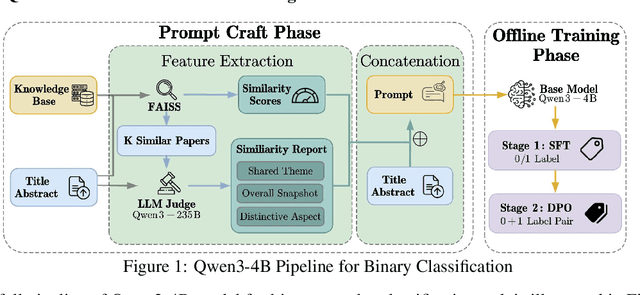
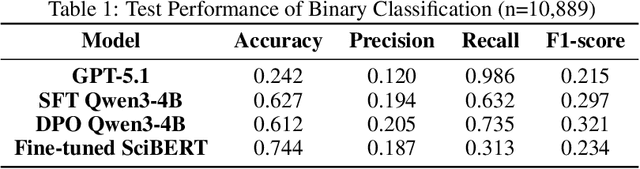
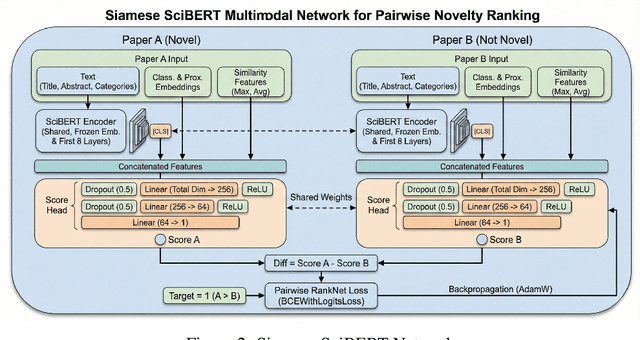

With the growing ease of academic publishing, the volume of research papers, especially in AI-related fields, has surged dramatically. This flood of publications makes it difficult for truly novel and impactful work to stand out, and manual novelty assessment is often unstable and time-consuming. Our project aims to develop a model that estimates and ranks the conceptual novelty of AI papers, enabling a data-driven and scalable assessment of research originality. Such a system can help researchers efficiently identify submissions that introduce genuinely innovative ideas rather than minor variants, and provide conference reviewers with a quantitative and consistent signal of novelty. Our approach evaluates novelty primarily through a paper's title, abstract, and semantic similarity to prior literature. Given the motivation of novelty estimation, we explore two task formulations with different modeling objectives, each offering a different perspective: (1) binary classification, which predicts the paper's absolute novelty from learned patterns of prior novel works, and (2) pairwise novelty comparison, which learns to distinguish papers by relative novelty over others. We fine-tune Qwen3-4B-Instruct-2507 and SciBERT on both tasks, benchmarking against GPT-5.1 to analyze how task formulation and modeling choices affect performance. The implementation is publicly available at https://github.com/ZhengxuYan/NoveltyRank.
SUMFORU: An LLM-Based Review Summarization Framework for Personalized Purchase Decision Support
Dec 12, 2025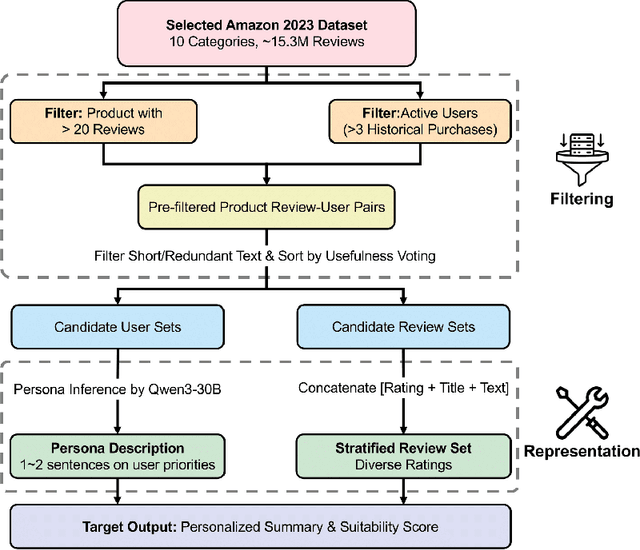
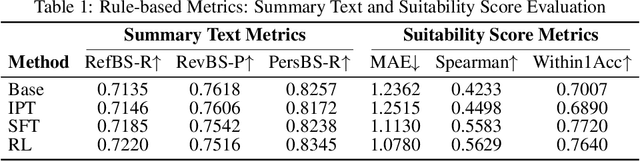
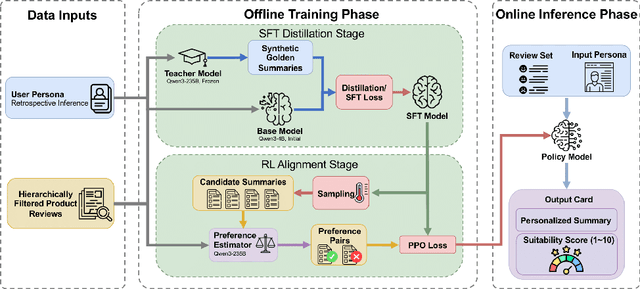
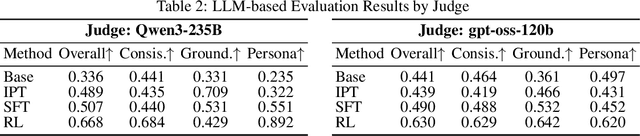
Online product reviews contain rich but noisy signals that overwhelm users and hinder effective decision-making. Existing LLM-based summarizers remain generic and fail to account for individual preferences, limiting their practical utility. We propose SUMFORU, a steerable review summarization framework that aligns outputs with explicit user personas to support personalized purchase decisions. Our approach integrates a high-quality data pipeline built from the Amazon 2023 Review Dataset with a two-stage alignment procedure: (1) persona-aware Supervised Fine-Tuning (SFT) via asymmetric knowledge distillation, and (2) Reinforcement Learning with AI Feedback (RLAIF) using a preference estimator to capture fine-grained, persona-relevant signals. We evaluate the model across rule-based, LLM-based, and human-centered metrics, demonstrating consistent improvements in consistency, grounding, and preference alignment. Our framework achieves the highest performance across all evaluation settings and generalizes effectively to unseen product categories. Our results highlight the promise of steerable pluralistic alignment for building next-generation personalized decision-support systems.
MotionWavelet: Human Motion Prediction via Wavelet Manifold Learning
Nov 25, 2024Modeling temporal characteristics and the non-stationary dynamics of body movement plays a significant role in predicting human future motions. However, it is challenging to capture these features due to the subtle transitions involved in the complex human motions. This paper introduces MotionWavelet, a human motion prediction framework that utilizes Wavelet Transformation and studies human motion patterns in the spatial-frequency domain. In MotionWavelet, a Wavelet Diffusion Model (WDM) learns a Wavelet Manifold by applying Wavelet Transformation on the motion data therefore encoding the intricate spatial and temporal motion patterns. Once the Wavelet Manifold is built, WDM trains a diffusion model to generate human motions from Wavelet latent vectors. In addition to the WDM, MotionWavelet also presents a Wavelet Space Shaping Guidance mechanism to refine the denoising process to improve conformity with the manifold structure. WDM also develops Temporal Attention-Based Guidance to enhance prediction accuracy. Extensive experiments validate the effectiveness of MotionWavelet, demonstrating improved prediction accuracy and enhanced generalization across various benchmarks. Our code and models will be released upon acceptance.
Learning Multi-Agent Loco-Manipulation for Long-Horizon Quadrupedal Pushing
Nov 14, 2024Recently, quadrupedal locomotion has achieved significant success, but their manipulation capabilities, particularly in handling large objects, remain limited, restricting their usefulness in demanding real-world applications such as search and rescue, construction, industrial automation, and room organization. This paper tackles the task of obstacle-aware, long-horizon pushing by multiple quadrupedal robots. We propose a hierarchical multi-agent reinforcement learning framework with three levels of control. The high-level controller integrates an RRT planner and a centralized adaptive policy to generate subgoals, while the mid-level controller uses a decentralized goal-conditioned policy to guide the robots toward these sub-goals. A pre-trained low-level locomotion policy executes the movement commands. We evaluate our method against several baselines in simulation, demonstrating significant improvements over baseline approaches, with 36.0% higher success rates and 24.5% reduction in completion time than the best baseline. Our framework successfully enables long-horizon, obstacle-aware manipulation tasks like Push-Cuboid and Push-T on Go1 robots in the real world.
Collaborative Planar Pushing of Polytopic Objects with Multiple Robots in Complex Scenes
May 13, 2024Pushing is a simple yet effective skill for robots to interact with and further change the environment. Related work has been mostly focused on utilizing it as a non-prehensile manipulation primitive for a robotic manipulator. However, it can also be beneficial for low-cost mobile robots that are not equipped with a manipulator. This work tackles the general problem of controlling a team of mobile robots to push collaboratively polytopic objects within complex obstacle-cluttered environments. It incorporates several characteristic challenges for contact-rich tasks such as the hybrid switching among different contact modes and under-actuation due to constrained contact forces. The proposed method is based on hybrid optimization over a sequence of possible modes and the associated pushing forces, where (i) a set of sufficient modes is generated with a multi-directional feasibility estimation, based on quasi-static analyses for general objects and any number of robots; (ii) a hierarchical hybrid search algorithm is designed to iteratively decompose the navigation path via arch segments and select the optimal parameterized mode; and (iii) a nonlinear model predictive controller is proposed to track the desired pushing velocities adaptively online for each robot. The proposed framework is complete under mild assumptions. Its efficiency and effectiveness are validated in high-fidelity simulations and hardware experiments. Robustness to motion and actuation uncertainties is also demonstrated.