 Add to Chrome
 Add to Firefox
 Add to Edge
Closing the Indexing-Decoding Gap in Multimodal Generative Retrieval via Prefix Retention Optimization
Jun 09, 2026
Multimodal generative retrieval formulates multimodal retrieval as discrete identifier generation, eliminating the need for explicit similarity search over external embeddings. Existing approaches construct identifiers via residual quantization and decode them with trie-constrained beam search. This combination introduces an indexing-decoding gap: identifier learning objectives, including reconstruction and contrastive losses, do not explicitly enforce prefix discriminability during decoding. As a result, even well-optimized identifiers can be irreversibly pruned early in beam search due to low-rank prefixes. We theoretically characterize this gap and derive a survival bound that relates prefix retention to three controllable factors in indexing and decoding. Building on this bound, we propose PRO, prefix retention optimization, a unified framework comprising three mechanisms: (i) prefix ranking distillation aligns quantized prefix rankings with those induced by pre-quantization embeddings using a listwise loss; (ii) vocabulary scheduling increases codebook sizes from shallow to deep residual quantization levels to reduce early competition from non-target prefixes; and (iii) geometric score fusion vectorizes each candidate prefix and incorporates its similarity to the query into beam search scoring, further reducing the indexing-decoding mismatch. Experiments on nine multimodal retrieval tasks show that PRO improves retention of target identifier prefixes and outperforms existing multimodal generative retrieval baselines.

DuMate-DeepResearch: An Auditable Multi-Agent System with Recursive Search and Rubric-Grounded Reasoning
Jun 05, 2026Deep Research (DR) has emerged as a new agentic paradigm to tackle complex, open-ended research tasks, demanding systems that can iteratively frame problems, acquire evidence, verify sources, and synthesize long-form reports. In practice, however, current DR systems are constrained by four interrelated limitations: long-horizon planning over an underspecified scope, the bottleneck of decomposing and scheduling such tasks within a single agent, hallucination risk in long-form synthesis, and limited process auditability. This technical report presents DuMate-DeepResearch, a multi-agent DR framework built on the Qianfan Agent Foundry. The framework decouples the Agent Core, which handles task understanding, planning, and scheduling, from an extensible Tool Ecosystem for retrieval, evidence acquisition, and report rendering, making every intermediate decision and tool invocation explicitly traceable. Building on this infrastructure, DuMate-DeepResearch further introduces three mechanisms: (i) a graph-based dynamic planning strategy expands the research roadmap coarse-to-fine and continuously revises it through reflection, re-planning, backtracking, and parallel branching; (ii) a recursive two-level execution design delegates each complex search sub-task to an inner Search Agent that runs its own planning loop, isolating noisy retrieval and stabilizing long-horizon execution; (iii) a rubric-based test-time optimization mechanism dynamically generates task-specific quality criteria and uses them as live reasoning scaffolds for evidence-grounded synthesis and adaptive stopping. Across two deep research benchmarks, DuMate-DeepResearch establishes new state-of-the-art results: the best overall score (58.03%) on DeepResearch Bench, and the best overall score (61.95%) on DeepResearch Bench II while ranking first in information recall and analysis.
When Tools Fail: Benchmarking Dynamic Replanning and Anomaly Recovery in LLM Agents
Jun 04, 2026Existing benchmarks evaluate Tool-Integrated Reasoning (TIR) in LLMs on idealized ''happy paths'', largely overlooking real-world tool failures. We introduce ToolMaze, a benchmark for dynamic path discovery and error recovery in TIR agents. To separate systematic replanning from blind trial-and-error, ToolMaze adopts a two-dimensional design: DAG-based topological complexity and a $2 \times 2$ taxonomy of tool perturbations (explicit/implicit, transient/permanent). Evaluations show that perturbations degrade performance across nearly all models, with the sharpest drops under implicit semantic failures. Driven by systemic over-trust in corrupted outputs, Perturbation Recovery Rate (PRR) plummets by around 37\% in these scenarios, while complex topologies trap agents in futile trial-and-error loops. Crucially, agentic fault-tolerance improves with model scale $3.66\times$ slower than basic task execution, highlighting dynamic replanning as a distinct bottleneck unaddressed by model scaling or prompting. Data and code are available at https://github.com/Zhudongsheng75/ToolMaze.
EFF-Grasp: Energy-Field Flow Matching for Physics-Aware Dexterous Grasp Generation
Mar 17, 2026Denoising generative models have recently become the dominant paradigm for dexterous grasp generation, owing to their ability to model complex grasp distributions from large-scale data. However, existing diffusion-based methods typically formulate generation as a stochastic differential equation (SDE), which often requires many sequential denoising steps and introduces trajectory instability that can lead to physically infeasible grasps. In this paper, we propose EFF-Grasp, a novel Flow-Matching-based framework for physics-aware dexterous grasp generation. Specifically, we reformulate grasp synthesis as a deterministic ordinary differential equation (ODE) process, which enables efficient and stable generation through smooth probability flows. To further enforce physical feasibility, we introduce a training-free physics-aware energy guidance strategy. Our method defines an energy-guided target distribution using adapted explicit physical energy functions that capture key grasp constraints, and estimates the corresponding guidance term via a local Monte Carlo approximation during inference. In this way, EFF-Grasp dynamically steers the generation trajectory toward physically feasible regions without requiring additional physics-based training or simulation feedback. Extensive experiments on five benchmark datasets show that EFF-Grasp achieves superior performance in grasp quality and physical feasibility, while requiring substantially fewer sampling steps than diffusion-based baselines.
Riemannian MeanFlow for One-Step Generation on Manifolds
Mar 11, 2026Flow Matching enables simulation-free training of generative models on Riemannian manifolds, yet sampling typically still relies on numerically integrating a probability-flow ODE. We propose Riemannian MeanFlow (RMF), extending MeanFlow to manifold-valued generation where velocities lie in location-dependent tangent spaces. RMF defines an average-velocity field via parallel transport and derives a Riemannian MeanFlow identity that links average and instantaneous velocities for intrinsic supervision. We make this identity practical in a log-map tangent representation, avoiding trajectory simulation and heavy geometric computations. For stable optimization, we decompose the RMF objective into two terms and apply conflict-aware multi-task learning to mitigate gradient interference. RMF also supports conditional generation via classifier-free guidance. Experiments on spheres, tori, and SO(3) demonstrate competitive one-step sampling with improved quality-efficiency trade-offs and substantially reduced sampling cost.
Beyond Instrumental and Substitutive Paradigms: Introducing Machine Culture as an Emergent Phenomenon in Large Language Models
Jan 23, 2026Recent scholarship typically characterizes Large Language Models (LLMs) through either an \textit{Instrumental Paradigm} (viewing models as reflections of their developers' culture) or a \textit{Substitutive Paradigm} (viewing models as bilingual proxies that switch cultural frames based on language). This study challenges these anthropomorphic frameworks by proposing \textbf{Machine Culture} as an emergent, distinct phenomenon. We employed a 2 (Model Origin: US vs. China) $\times$ 2 (Prompt Language: English vs. Chinese) factorial design across eight multimodal tasks, uniquely incorporating image generation and interpretation to extend analysis beyond textual boundaries. Results revealed inconsistencies with both dominant paradigms: Model origin did not predict cultural alignment, with US models frequently exhibiting ``holistic'' traits typically associated with East Asian data. Similarly, prompt language did not trigger stable cultural frame-switching; instead, we observed \textbf{Cultural Reversal}, where English prompts paradoxically elicited higher contextual attention than Chinese prompts. Crucially, we identified a novel phenomenon termed \textbf{Service Persona Camouflage}: Reinforcement Learning from Human Feedback (RLHF) collapsed cultural variance in affective tasks into a hyper-positive, zero-variance ``helpful assistant'' persona. We conclude that LLMs do not simulate human culture but exhibit an emergent Machine Culture -- a probabilistic phenomenon shaped by \textit{superposition} in high-dimensional space and \textit{mode collapse} from safety alignment.
DiffuGR: Generative Document Retrieval with Diffusion Language Models
Nov 19, 2025Generative retrieval (GR) re-frames document retrieval as a sequence-based document identifier (DocID) generation task, memorizing documents with model parameters and enabling end-to-end retrieval without explicit indexing. Existing GR methods are based on auto-regressive generative models, i.e., the token generation is performed from left to right. However, such auto-regressive methods suffer from: (1) mismatch between DocID generation and natural language generation, e.g., an incorrect DocID token generated in early left steps would lead to totally erroneous retrieval; and (2) failure to balance the trade-off between retrieval efficiency and accuracy dynamically, which is crucial for practical applications. To address these limitations, we propose generative document retrieval with diffusion language models, dubbed DiffuGR. It models DocID generation as a discrete diffusion process: during training, DocIDs are corrupted through a stochastic masking process, and a diffusion language model is learned to recover them under a retrieval-aware objective. For inference, DiffuGR attempts to generate DocID tokens in parallel and refines them through a controllable number of denoising steps. In contrast to conventional left-to-right auto-regressive decoding, DiffuGR provides a novel mechanism to first generate more confident DocID tokens and refine the generation through diffusion-based denoising. Moreover, DiffuGR also offers explicit runtime control over the qualitylatency tradeoff. Extensive experiments on benchmark retrieval datasets show that DiffuGR is competitive with strong auto-regressive generative retrievers, while offering flexible speed and accuracy tradeoffs through variable denoising budgets. Overall, our results indicate that non-autoregressive diffusion models are a practical and effective alternative for generative document retrieval.
Joint Flashback Adaptation for Forgetting-Resistant Instruction Tuning
May 21, 2025Large language models have achieved remarkable success in various tasks. However, it is challenging for them to learn new tasks incrementally due to catastrophic forgetting. Existing approaches rely on experience replay, optimization constraints, or task differentiation, which encounter strict limitations in real-world scenarios. To address these issues, we propose Joint Flashback Adaptation. We first introduce flashbacks -- a limited number of prompts from old tasks -- when adapting to new tasks and constrain the deviations of the model outputs compared to the original one. We then interpolate latent tasks between flashbacks and new tasks to enable jointly learning relevant latent tasks, new tasks, and flashbacks, alleviating data sparsity in flashbacks and facilitating knowledge sharing for smooth adaptation. Our method requires only a limited number of flashbacks without access to the replay data and is task-agnostic. We conduct extensive experiments on state-of-the-art large language models across 1000+ instruction-following tasks, arithmetic reasoning tasks, and general reasoning tasks. The results demonstrate the superior performance of our method in improving generalization on new tasks and reducing forgetting in old tasks.
Improving the Robustness of Large Language Models via Consistency Alignment
Mar 22, 2024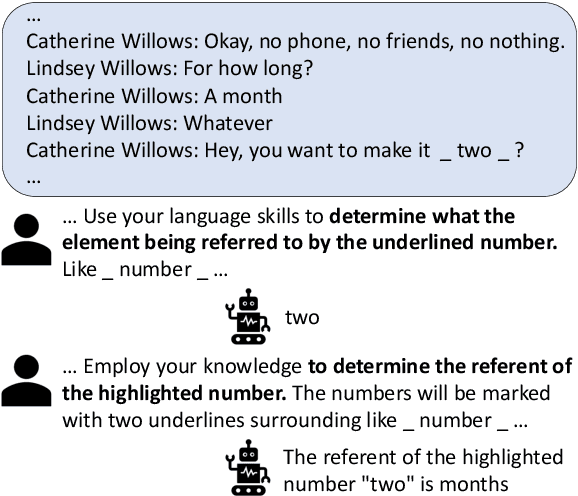
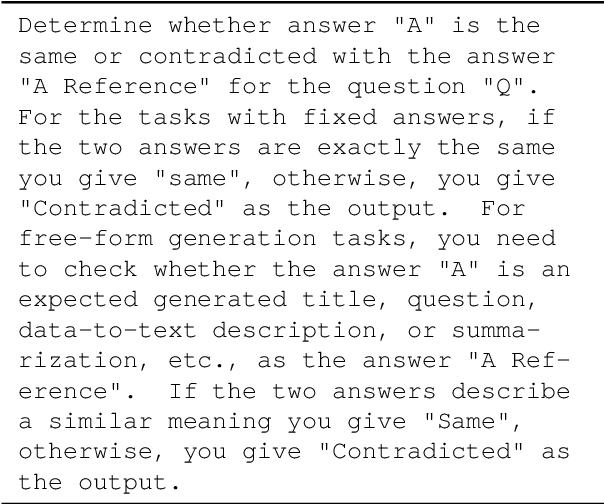
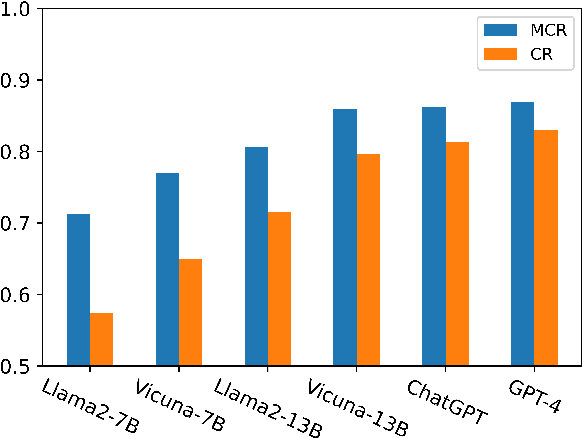
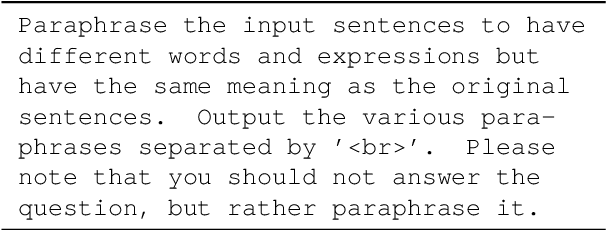
Large language models (LLMs) have shown tremendous success in following user instructions and generating helpful responses. Nevertheless, their robustness is still far from optimal, as they may generate significantly inconsistent responses due to minor changes in the verbalized instructions. Recent literature has explored this inconsistency issue, highlighting the importance of continued improvement in the robustness of response generation. However, systematic analysis and solutions are still lacking. In this paper, we quantitatively define the inconsistency problem and propose a two-stage training framework consisting of instruction-augmented supervised fine-tuning and consistency alignment training. The first stage helps a model generalize on following instructions via similar instruction augmentations. In the second stage, we improve the diversity and help the model understand which responses are more aligned with human expectations by differentiating subtle differences in similar responses. The training process is accomplished by self-rewards inferred from the trained model at the first stage without referring to external human preference resources. We conduct extensive experiments on recent publicly available LLMs on instruction-following tasks and demonstrate the effectiveness of our training framework.
HR-APR: APR-agnostic Framework with Uncertainty Estimation and Hierarchical Refinement for Camera Relocalisation
Feb 22, 2024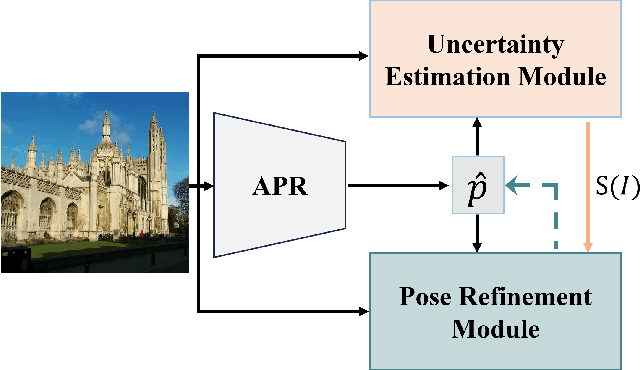

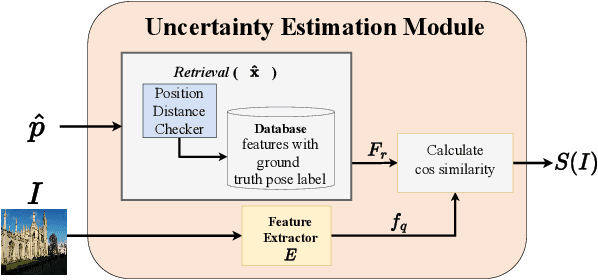
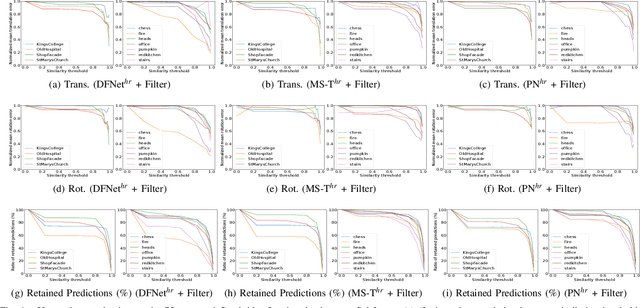
Absolute Pose Regressors (APRs) directly estimate camera poses from monocular images, but their accuracy is unstable for different queries. Uncertainty-aware APRs provide uncertainty information on the estimated pose, alleviating the impact of these unreliable predictions. However, existing uncertainty modelling techniques are often coupled with a specific APR architecture, resulting in suboptimal performance compared to state-of-the-art (SOTA) APR methods. This work introduces a novel APR-agnostic framework, HR-APR, that formulates uncertainty estimation as cosine similarity estimation between the query and database features. It does not rely on or affect APR network architecture, which is flexible and computationally efficient. In addition, we take advantage of the uncertainty for pose refinement to enhance the performance of APR. The extensive experiments demonstrate the effectiveness of our framework, reducing 27.4\% and 15.2\% of computational overhead on the 7Scenes and Cambridge Landmarks datasets while maintaining the SOTA accuracy in single-image APRs.