 Add to Chrome
 Add to Firefox
 Add to Edge
PCA-guided Activation Scaling for Monotonic Bidirectional Control over LLM Sycophancy
Aug 17, 2026
Large language models (LLMs) exhibit sycophancy, a tendency to agree with user beliefs regardless of factual accuracy. This can reinforce misconceptions, but eliminating it entirely risks over-correction against valid opinions. Effective control must therefore both reduce and increase sycophancy with predictable and gradual effect. Yet, existing methods fail to ensure a bidirectional and monotonic relationship between steering strength and behavioral outcome across models and datasets. We introduce PCA-guided Activation Scaling (PAS), an activation steering framework that decomposes residual stream activations into a PCA-identified sycophancy-honesty subspace and an orthogonal residual, then applies distinct scaling exponents to achieve monotonic, bidirectional control. Across three LLMs and three datasets, PAS achieves strong monotonicity (Spearman $ρ$ = +0.92) and an average shift of 15.4% per direction, compared with 8.7% for the baselines. Ablation studies confirm that the decomposition, asymmetric exponents, and layer selection are each essential for maintaining monotonic control. The data and code are available at https://github.com/Bellafc/PCS.

Know It, Act on It: Investigating Memory Utilization in LLM Personalization
Jul 31, 2026As large language model (LLM) agents evolve into personalized companions, memory has emerged as a core capability. However, LLMs face a knowledge utilization problem: they may fail to act on relevant user preferences even when they are fully present in context. When an agent fails to tailor its response in a context where previously shared user preferences should matter, it is unclear whether the model failed to remember that information or remembered it but failed to use it. To isolate this breakdown, we introduce a decoupled evaluation paradigm that administers paired Know and Act tests to the same user preference. We conduct large-scale experiments across 16 systems and five memory architectures, evaluating 1,000 preferences embedded at three levels of expression strength. Our results show a large gap between Know and Act outcomes: agents often pass the recall test for a user preference but fail to reflect that same preference in the paired behavioral scenario. While memory architectures reduce this gap, utilization remains especially weak for health and therapy-related preferences, where failures to act carry the greatest real-world stakes.
Every Time I Hire a Linguist, Inference Costs Go Down: On Linguistic Rules as Effective Prompt Compressors
Jul 29, 2026Prompt compression shortens LLM input to reduce inference cost, yet existing methods score token importance through LM forward passes. It remains questionable whether such nuanced, costly token selection is necessary. Compression requires identifying informative content, a problem that linguistic research has long addressed through cues that can be operationalized as deterministic rules. We therefore ask: can \textbf{linguistic rules alone} serve as effective prompt compressors, without LM-based scoring at compression time? To address this, we conduct offline evolutionary search over lexical, syntactic, semantic, and discourse seeds to find competitive rule combinations. The resulting linguistic compressor requires no LM forward pass at deployment and uses only CPU-side processing for compression. We evaluate it with a dual-path protocol to balance compression quality and reconstruction fidelity. Across short passages, multi-document reasoning, and dialogue-memory QA datasets, evolved compressors achieve performance similar to that of recent advanced prompt-compression strategies. Performance is strongest under light-to-moderate compression and degrades as compression becomes more aggressive, while the Direct and Reconstruction paths exhibit distinct patterns. Evolutionary analysis reveals that effective compression fuses signals across linguistic levels and, as the compression ratio increases, rules shift from token pruning to sentence extraction.
Do LLMs Capture Embodied Cognition and Cultural Variation? Cross-Linguistic Evidence from Demonstratives
Apr 28, 2026Do large language models (LLMs) truly acquire embodied cognition and cultural conventions from text? We introduce demonstratives, fundamental spatial expressions like "this/that" in English and "zhè/nà" in Chinese, as a novel probe for grounded knowledge. Using 6,400 responses from 320 native speakers, we establish a human baseline: English speakers reliably distinguish proximal-distal referents but struggle with perspective-taking, while Chinese speakers switch perspectives fluently but tolerate distal ambiguity. In contrast, five state-of-the-art LLMs fail to inherently understand the proximal-distal contrast and show no cultural differences, defaulting to English-centric reasoning. Our study contributes (i) a new task, based on demonstratives, as a new lens for evaluating embodied cognition and cultural conventions; (ii) empirical evidence of cross-cultural asymmetries in human interpretation; (iii) a new perspective on the egocentric-sociocentric debate, showing both orientations coexist but vary across languages; and (iv) a call to address individual variation in future model design.
Good Arguments Against the People Pleasers: How Reasoning Mitigates (Yet Masks) LLM Sycophancy
Mar 17, 2026Alignment techniques often inadvertently induce sycophancy in LLMs. While prior studies studied this behaviour in direct-answer settings, the role of Chain-of-Thought (CoT) reasoning remains under-explored: does it serve as a logical constraint that mitigates sycophancy, or a tool for post-hoc rationalization that masks it? We evaluate a range of models across objective and subjective tasks to investigate the issue. Results show that reasoning generally reduces sycophancy in final decisions but also masks sycophancy in some samples, where models construct deceptive justifications through logical inconsistencies, calculation errors, and one-sided arguments etc. Furthermore, LLMs are more prone to sycophancy in subjective tasks and under authority-bias. Our mechanistic analysis on three open-source models reveals that the tendency of sycophancy is dynamic during the reasoning process rather than being pre-determined at the input stage.
Is Length Really A Liability? An Evaluation of Multi-turn LLM Conversations using BoolQ
Jan 23, 2026Single-prompt evaluations dominate current LLM benchmarking, yet they fail to capture the conversational dynamics where real-world harm occurs. In this study, we examined whether conversation length affects response veracity by evaluating LLM performance on the BoolQ dataset under varying length and scaffolding conditions. Our results across three distinct LLMs revealed model-specific vulnerabilities that are invisible under single-turn testing. The length-dependent and scaffold-specific effects we observed demonstrate a fundamental limitation of static evaluations, as deployment-relevant vulnerabilities could only be spotted in a multi-turn conversational setting.
Can Large Language Models Understand, Reason About, and Generate Code-Switched Text?
Jan 12, 2026Code-switching is a pervasive phenomenon in multilingual communication, yet the robustness of large language models (LLMs) in mixed-language settings remains insufficiently understood. In this work, we present a comprehensive evaluation of LLM capabilities in understanding, reasoning over, and generating code-switched text. We introduce CodeMixQA a novel benchmark with high-quality human annotations, comprising 16 diverse parallel code-switched language-pair variants that span multiple geographic regions and code-switching patterns, and include both original scripts and their transliterated forms. Using this benchmark, we analyze the reasoning behavior of LLMs on code-switched question-answering tasks, shedding light on how models process and reason over mixed-language inputs. We further conduct a systematic evaluation of LLM-generated synthetic code-switched text, focusing on both naturalness and semantic fidelity, and uncover key limitations in current generation capabilities. Our findings reveal persistent challenges in both reasoning and generation under code-switching conditions and provide actionable insights for building more robust multilingual LLMs. We release the dataset and code as open source.
Learning to Look at the Other Side: A Semantic Probing Study of Word Embeddings in LLMs with Enabled Bidirectional Attention
Oct 02, 2025Autoregressive Large Language Models (LLMs) demonstrate exceptional performance in language understanding and generation. However, their application in text embedding tasks has been relatively slow, along with the analysis of their semantic representation in probing tasks, due to the constraints of the unidirectional attention mechanism. This paper aims to explore whether such constraints can be overcome by enabling bidirectional attention in LLMs. We tested different variants of the Llama architecture through additional training steps, progressively enabling bidirectional attention and unsupervised/supervised contrastive learning.
From BERT to LLMs: Comparing and Understanding Chinese Classifier Prediction in Language Models
Aug 25, 2025Classifiers are an important and defining feature of the Chinese language, and their correct prediction is key to numerous educational applications. Yet, whether the most popular Large Language Models (LLMs) possess proper knowledge the Chinese classifiers is an issue that has largely remain unexplored in the Natural Language Processing (NLP) literature. To address such a question, we employ various masking strategies to evaluate the LLMs' intrinsic ability, the contribution of different sentence elements, and the working of the attention mechanisms during prediction. Besides, we explore fine-tuning for LLMs to enhance the classifier performance. Our findings reveal that LLMs perform worse than BERT, even with fine-tuning. The prediction, as expected, greatly benefits from the information about the following noun, which also explains the advantage of models with a bidirectional attention mechanism such as BERT.
Sparse Brains are Also Adaptive Brains: Cognitive-Load-Aware Dynamic Activation for LLMs
Feb 26, 2025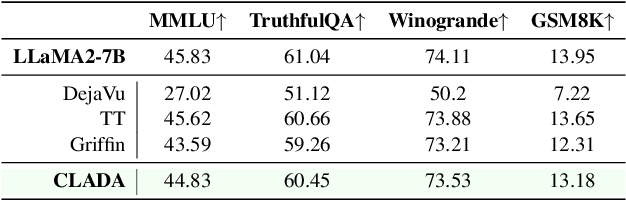
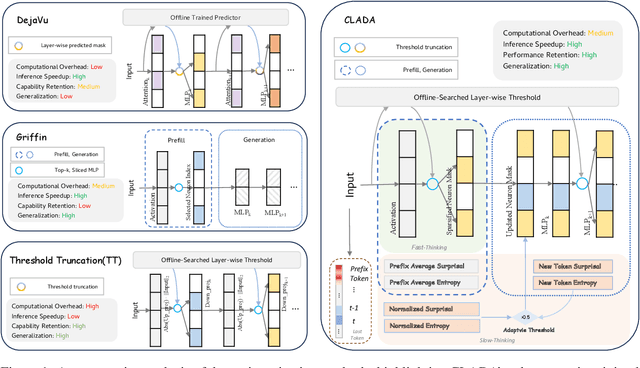
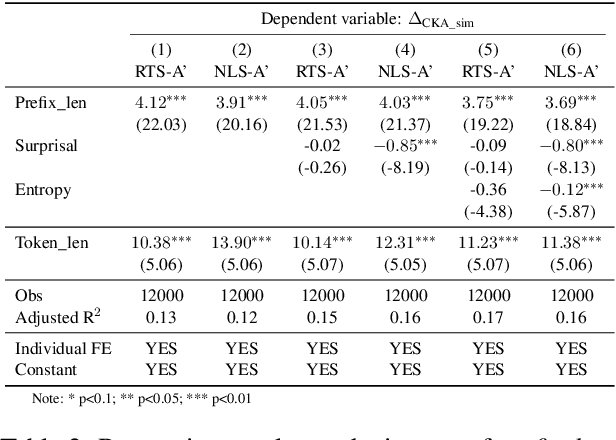
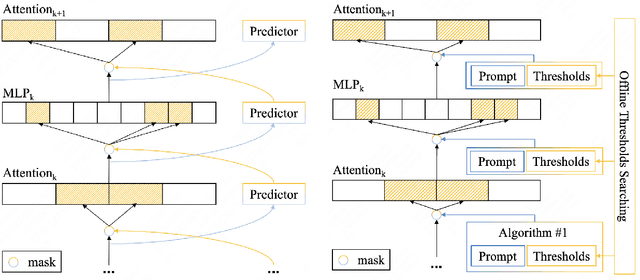
Dense large language models(LLMs) face critical efficiency bottlenecks as they rigidly activate all parameters regardless of input complexity. While existing sparsity methods(static pruning or dynamic activation) address this partially, they either lack adaptivity to contextual or model structural demands or incur prohibitive computational overhead. Inspired by human brain's dual-process mechanisms - predictive coding (N400) for backbone sparsity and structural reanalysis (P600) for complex context - we propose CLADA, a \textit{\textbf{C}ognitive-\textbf{L}oad-\textbf{A}ware \textbf{D}ynamic \textbf{A}ctivation} framework that synergizes statistical sparsity with semantic adaptability. Our key insight is that LLM activations exhibit two complementary patterns: 1) \textit{Global statistical sparsity} driven by sequence-level prefix information, and 2) \textit{Local semantic adaptability} modulated by cognitive load metrics(e.g., surprisal and entropy). CLADA employs a hierarchical thresholding strategy: a baseline from offline error-controlled optimization ensures 40\%+ sparsity, dynamically adjusted by real-time cognitive signals. Evaluations across six mainstream LLMs and nine benchmarks demonstrate that CLADA achieves \textbf{~20\% average speedup with <2\% accuracy drop}, outperforming Griffin (5\%+ degradation) and TT (negligible speedup). Crucially, we establish the first formal connection between neurolinguistic event-related potential (ERP) components and LLM efficiency mechanisms through multi-level regression analysis ($R^2=0.17$ for sparsity-adaptation synergy). Requiring no retraining or architectural changes, CLADA offers a deployable solution for resource-aware LLM inference while advancing biologically-inspired AI design. Our code is available at \href{https://github.com/Oldify/CLADA}{CLADA}.