 Add to Chrome
 Add to Firefox
 Add to Edge
Beyond the Trace: Coupling an Interpretable Reasoning-State Readout to Native MoE Routing
Aug 18, 2026
What a reasoning model writes is only a partial record of the process that produces it. We introduce a two-level internal readout for mixture-of-experts reasoning. We first distill vocabulary-scale J-space into J64, a 64-axis semantic frame learned from the model's own reasoning states. J64 reveals readable process state that the emitted trace does not show: it separates inference effort from problem-induced strain. It also adds 0.096 to 0.135 held-out AUC over a baseline that reads the same rollout as token occupancy and aggregates it in exactly the same way. We then reconstruct J64 from native expert-routing statistics. The result is R64, a low-overhead proxy: its median per-axis correlation with J64 is 0.69 to 0.86 across three models and two families, and on gpt-oss-20b it preserves 95 to 100% of J64's predictive gain. The readout supports test-time decisions at two temporal resolutions. Over completed candidate sets, J64 and R64 improve single-branch selection, and R64-weighted voting improves plain majority voting in seven of eight settings. During generation, rolling readout windows drive a cumulative stop-and-resample policy whose operating point is fixed on training questions alone. J64 improves accuracy by 1.1 to 5.9 points over a sibling-permuted control, and the routing-only R64 proxy retains 0.9 to 3.2 of those points. Finally, router edits aimed at the mechanism J64 names induce the predicted reasoning behaviors and shift a diagnosed stall from numerical guessing toward exact symbolic execution. Together, J64 makes latent process state readable, while routing makes it deployable and actionable.

Does the Same Token Mean the Same State? MoE Routing as Signal for Reasoning Control
Jun 22, 2026In sparse Mixture-of-Experts language models, does the same token id imply the same router state and the same experts producing it? Holding the emitted token id fixed at repeated anchors, we find it does not: the experts that produce it still separate task context, trajectory history, and reasoning-effort mode. This residual structure supports test-time control: near \emph{boundary} anchors (the final-response transition) and \emph{delimiter} anchors (which open the answer, e.g.\ \texttt{\textbackslash boxed\{} or code fences), routing neighborhoods already align with final-answer basins at a marker-only readout and strongest when the routing is read at the answer opening. We operationalize this as \textbf{RAD} (Routing Agreement Decoding), an answer-string-free multi-rollout selector: it locates a fixed anchor, represents each rollout by its anchor-window MoE routing states, and returns the densest Weighted-Jaccard $K$-NN route-basin center, without parsing, normalizing, executing, or voting over answer strings. Across 10 sparse-MoE configurations (gpt-oss, Qwen3-MoE) and 6 datasets spanning math, GPQA, and code, RAD is on par with Majority where string voting is well-posed, with small positive paired deltas (RAD $73.9$ / RAD+DC $74.2$ vs.\ Majority $73.6$). Like majority voting, RAD is not a verifier: a dense \emph{wrong} basin can still win. Its value is the interface: the same selector gives direct pass@1 on code, where exact-string voting is ill-defined, and the same routing-density principle, re-anchored to the agentic boundary, improves best-of-16 patch selection on SWE-bench Verified over random, where patches have no answer string to vote on.
TraceGraph: Shared Decision Landscapes for Diagnosing and Improving Agent Trajectories
May 29, 2026Agent benchmarks increasingly record rich interaction trajectories, yet evaluation often reduces each rollout to a pass rate or reward score. We introduce TraceGraph, a graph-based framework that turns released multi-model agent trajectories into shared decision landscapes. For each task, TraceGraph builds a graph over observable action-observation states from pooled rollouts before model identity is introduced. It then overlays outcome-informed productive cores and trap regions, and summarizes each rollout with three events: Access, Trap exposure, and Repair. Across trajectories spanning five benchmark splits, TraceGraph profiles reveal navigation differences hidden by aggregate scores and show that splits differ in whether they reward avoiding traps or recovering from them. The same TraceGraph landscape also motivates a trap-aware recovery pipeline for SWE-bench: aruntime detector fires on states matching historical trap regions, then lightweight continuation policies are evaluated from the same prefix. On fired states, the best pooled single-factor policy raises official resolved rate from 40.4% to 43.5% on the per-provider fired subset and from 41.0% to 44.8% on common-fired instances, with provider-specific active components. Overall, TraceGraph provides a process vocabulary for asking what agent benchmarks test, where models diverge on a shared landscape, and how failure regions can guide downstream improvement.
SliceGraph: Mapping Process Isomers in Multi-Run Chain-of-Thought Reasoning
May 14, 2026Multi-run chain-of-thought reasoning is usually collapsed to final-answer aggregates, which discard howsampled trajectories share, split, and rejoin through intermediate computation. We propose SliceGraph, a post-hoc problem-model-cell graph built by mutual-kNN over sparse activation-key Jaccard similarity between CoT slices, and treat it as a measurement object for process geometry rather than as a decoding program. Across sampled CoT ensembles from three primary 4B/8B models on math and science benchmarks, blinded annotation supports SliceGraph biconnected components as shared reasoning-state units and process families as within-family strategy-coherent route units. In 85.5% of 954 problem-model cells, correct CoTs sharing the same normalized answer split into multiple process families; among cells with at least two such runs, 76.6% of run pairs are cross-family on average. We call such same-answer, family-divergent correct trajectories process isomers. A label-seeded reward field provides a separate value-landscape layer: success-associated regions often split into disconnected high-value cores, and route families specialize over these core footprints rather than merely duplicating one another. A typed-state transition analysis further shows that process families navigate the same atlas with distinct transition kernels under matched null controls. Representation ablations, a cross-architecture replication, and two cross-scale replications support the robustness of the route-family scaffold, showing that final-answer aggregation overlooks this structured multi-route process geometry.
AI Can Learn Scientific Taste
Mar 15, 2026Great scientists have strong judgement and foresight, closely tied to what we call scientific taste. Here, we use the term to refer to the capacity to judge and propose research ideas with high potential impact. However, most relative research focuses on improving an AI scientist's executive capability, while enhancing an AI's scientific taste remains underexplored. In this work, we propose Reinforcement Learning from Community Feedback (RLCF), a training paradigm that uses large-scale community signals as supervision, and formulate scientific taste learning as a preference modeling and alignment problem. For preference modeling, we train Scientific Judge on 700K field- and time-matched pairs of high- vs. low-citation papers to judge ideas. For preference alignment, using Scientific Judge as a reward model, we train a policy model, Scientific Thinker, to propose research ideas with high potential impact. Experiments show Scientific Judge outperforms SOTA LLMs (e.g., GPT-5.2, Gemini 3 Pro) and generalizes to future-year test, unseen fields, and peer-review preference. Furthermore, Scientific Thinker proposes research ideas with higher potential impact than baselines. Our findings show that AI can learn scientific taste, marking a key step toward reaching human-level AI scientists.
ARM: Role-Conditioned Neuron Transplantation for Training-Free Generalist LLM Agent Merging
Jan 12, 2026Interactive large language model agents have advanced rapidly, but most remain specialized to a single environment and fail to adapt robustly to other environments. Model merging offers a training-free alternative by integrating multiple experts into a single model. In this paper, we propose Agent-Role Merging (ARM), an activation-guided, role-conditioned neuron transplantation method for model merging in LLM agents. ARM improves existing merging methods from static natural language tasks to multi-turn agent scenarios, and over the generalization ability across various interactive environments. This is achieved with a well designed 3-step framework: 1) constructing merged backbones, 2) selection based on its role-conditioned activation analysis, and 3) neuron transplantation for fine-grained refinements. Without gradient-based optimization, ARM improves cross-benchmark generalization while enjoying efficiency. Across diverse domains, the model obtained via ARM merging outperforms prior model merging methods and domain-specific expert models, while demonstrating strong out-of-domain generalization.
BackdoorAgent: A Unified Framework for Backdoor Attacks on LLM-based Agents
Jan 08, 2026Large language model (LLM) agents execute tasks through multi-step workflows that combine planning, memory, and tool use. While this design enables autonomy, it also expands the attack surface for backdoor threats. Backdoor triggers injected into specific stages of an agent workflow can persist through multiple intermediate states and adversely influence downstream outputs. However, existing studies remain fragmented and typically analyze individual attack vectors in isolation, leaving the cross-stage interaction and propagation of backdoor triggers poorly understood from an agent-centric perspective. To fill this gap, we propose \textbf{BackdoorAgent}, a modular and stage-aware framework that provides a unified, agent-centric view of backdoor threats in LLM agents. BackdoorAgent structures the attack surface into three functional stages of agentic workflows, including \textbf{planning attacks}, \textbf{memory attacks}, and \textbf{tool-use attacks}, and instruments agent execution to enable systematic analysis of trigger activation and propagation across different stages. Building on this framework, we construct a standardized benchmark spanning four representative agent applications: \textbf{Agent QA}, \textbf{Agent Code}, \textbf{Agent Web}, and \textbf{Agent Drive}, covering both language-only and multimodal settings. Our empirical analysis shows that \textit{triggers implanted at a single stage can persist across multiple steps and propagate through intermediate states.} For instance, when using a GPT-based backbone, we observe trigger persistence in 43.58\% of planning attacks, 77.97\% of memory attacks, and 60.28\% of tool-stage attacks, highlighting the vulnerabilities of the agentic workflow itself to backdoor threats. To facilitate reproducibility and future research, our code and benchmark are publicly available at GitHub.
HumanoidGen: Data Generation for Bimanual Dexterous Manipulation via LLM Reasoning
Jul 01, 2025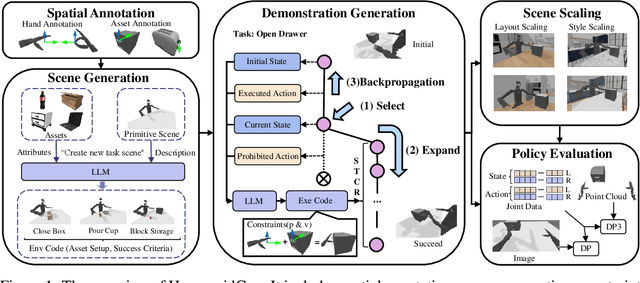
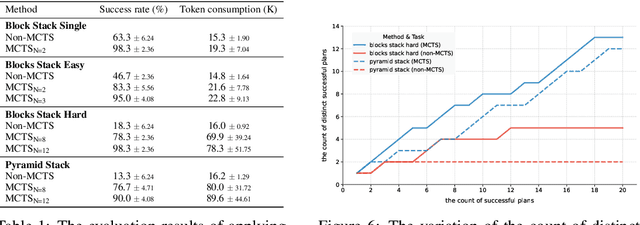
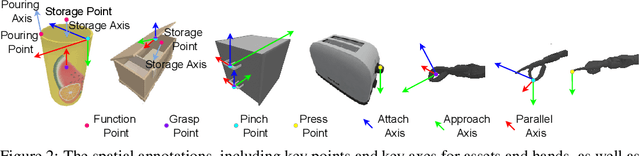
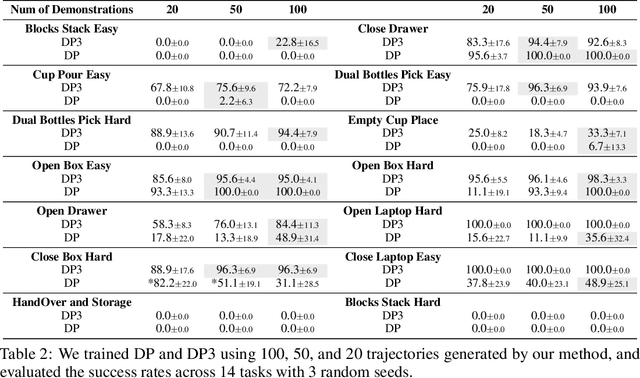
For robotic manipulation, existing robotics datasets and simulation benchmarks predominantly cater to robot-arm platforms. However, for humanoid robots equipped with dual arms and dexterous hands, simulation tasks and high-quality demonstrations are notably lacking. Bimanual dexterous manipulation is inherently more complex, as it requires coordinated arm movements and hand operations, making autonomous data collection challenging. This paper presents HumanoidGen, an automated task creation and demonstration collection framework that leverages atomic dexterous operations and LLM reasoning to generate relational constraints. Specifically, we provide spatial annotations for both assets and dexterous hands based on the atomic operations, and perform an LLM planner to generate a chain of actionable spatial constraints for arm movements based on object affordances and scenes. To further improve planning ability, we employ a variant of Monte Carlo tree search to enhance LLM reasoning for long-horizon tasks and insufficient annotation. In experiments, we create a novel benchmark with augmented scenarios to evaluate the quality of the collected data. The results show that the performance of the 2D and 3D diffusion policies can scale with the generated dataset. Project page is https://openhumanoidgen.github.io.
Revisiting LLM Evaluation through Mechanism Interpretability: a New Metric and Model Utility Law
Apr 10, 2025
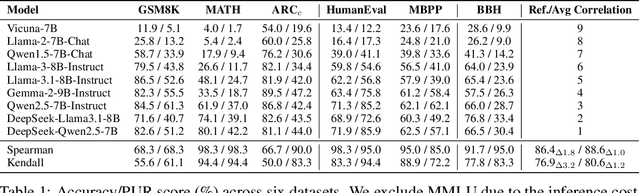


Large Language Models (LLMs) have become indispensable across academia, industry, and daily applications, yet current evaluation methods struggle to keep pace with their rapid development. In this paper, we analyze the core limitations of traditional evaluation pipelines and propose a novel metric, the Model Utilization Index (MUI), which introduces mechanism interpretability techniques to complement traditional performance metrics. MUI quantifies the extent to which a model leverages its capabilities to complete tasks. The core idea is that to assess an LLM's overall ability, we must evaluate not only its task performance but also the effort expended to achieve the outcome. Our extensive experiments reveal an inverse relationship between MUI and performance, from which we deduce a common trend observed in popular LLMs, which we term the Utility Law. Based on this, we derive four corollaries that address key challenges, including training judgement, the issue of data contamination, fairness in model comparison, and data diversity. We hope that our survey, novel metric, and utility law will foster mutual advancement in both evaluation and mechanism interpretability. Our code can be found at https://github.com/ALEX-nlp/MUI-Eva.
EvoWiki: Evaluating LLMs on Evolving Knowledge
Dec 18, 2024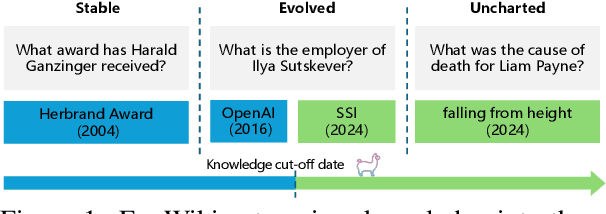
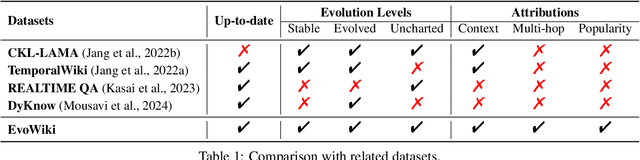
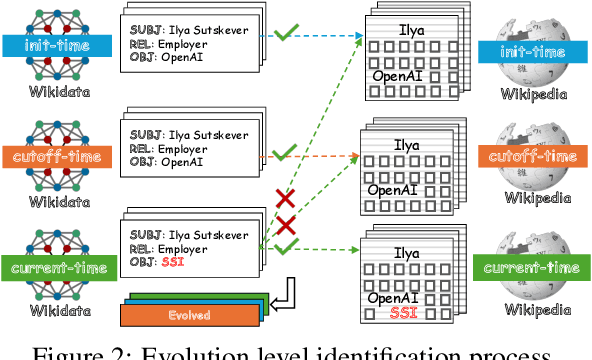
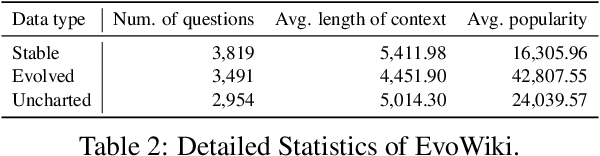
Knowledge utilization is a critical aspect of LLMs, and understanding how they adapt to evolving knowledge is essential for their effective deployment. However, existing benchmarks are predominantly static, failing to capture the evolving nature of LLMs and knowledge, leading to inaccuracies and vulnerabilities such as contamination. In this paper, we introduce EvoWiki, an evolving dataset designed to reflect knowledge evolution by categorizing information into stable, evolved, and uncharted states. EvoWiki is fully auto-updatable, enabling precise evaluation of continuously changing knowledge and newly released LLMs. Through experiments with Retrieval-Augmented Generation (RAG) and Contunual Learning (CL), we evaluate how effectively LLMs adapt to evolving knowledge. Our results indicate that current models often struggle with evolved knowledge, frequently providing outdated or incorrect responses. Moreover, the dataset highlights a synergistic effect between RAG and CL, demonstrating their potential to better adapt to evolving knowledge. EvoWiki provides a robust benchmark for advancing future research on the knowledge evolution capabilities of large language models.