 Add to Chrome
 Add to Firefox
 Add to Edge
On the Robustness of Segment Anything
May 25, 2023
Segment anything model (SAM) has presented impressive objectness identification capability with the idea of prompt learning and a new collected large-scale dataset. Given a prompt (e.g., points, bounding boxes, or masks) and an input image, SAM is able to generate valid segment masks for all objects indicated by the prompts, presenting high generalization across diverse scenarios and being a general method for zero-shot transfer to downstream vision tasks. Nevertheless, it remains unclear whether SAM may introduce errors in certain threatening scenarios. Clarifying this is of significant importance for applications that require robustness, such as autonomous vehicles. In this paper, we aim to study the testing-time robustness of SAM under adversarial scenarios and common corruptions. To this end, we first build a testing-time robustness evaluation benchmark for SAM by integrating existing public datasets. Second, we extend representative adversarial attacks against SAM and study the influence of different prompts on robustness. Third, we study the robustness of SAM under diverse corruption types by evaluating SAM on corrupted datasets with different prompts. With experiments conducted on SA-1B and KITTI datasets, we find that SAM exhibits remarkable robustness against various corruptions, except for blur-related corruption. Furthermore, SAM remains susceptible to adversarial attacks, particularly when subjected to PGD and BIM attacks. We think such a comprehensive study could highlight the importance of the robustness issues of SAM and trigger a series of new tasks for SAM as well as downstream vision tasks.

Zero-Shot Video Editing Using Off-The-Shelf Image Diffusion Models
Apr 13, 2023
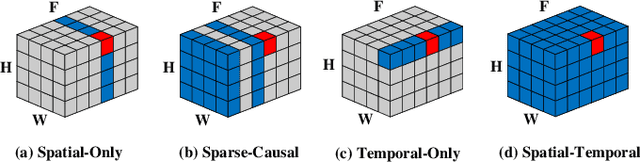
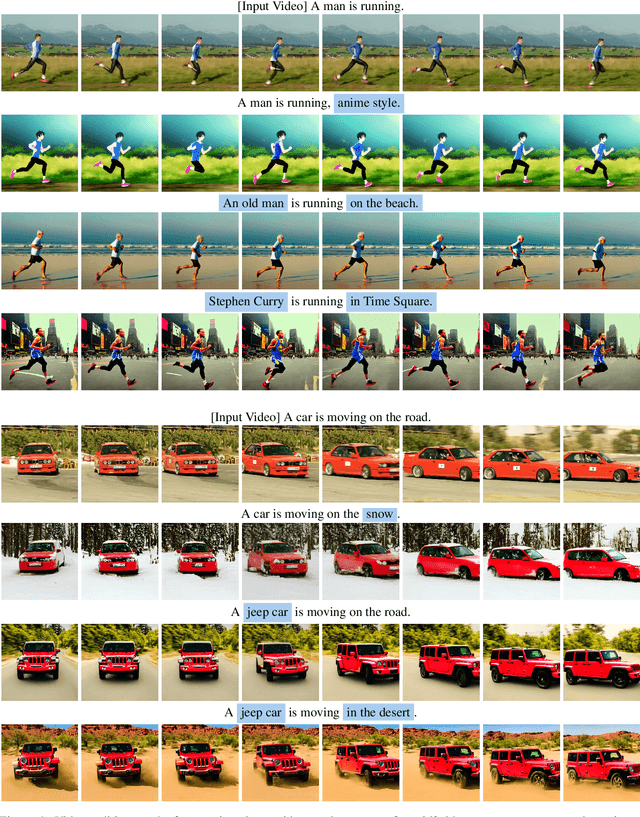
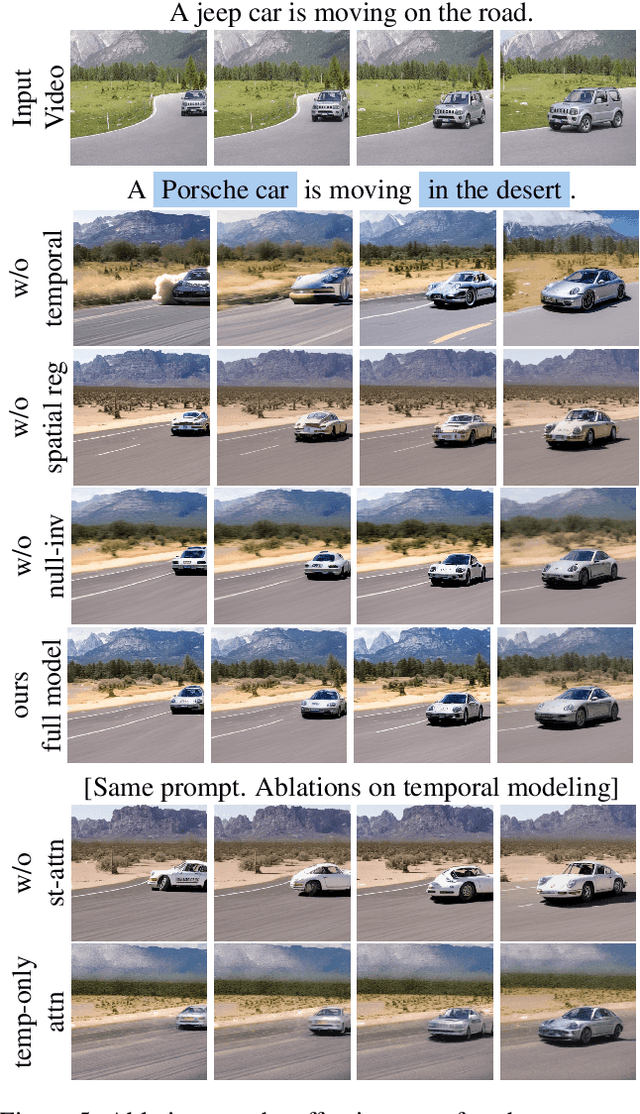
Large-scale text-to-image diffusion models achieve unprecedented success in image generation and editing. However, how to extend such success to video editing is unclear. Recent initial attempts at video editing require significant text-to-video data and computation resources for training, which is often not accessible. In this work, we propose vid2vid-zero, a simple yet effective method for zero-shot video editing. Our vid2vid-zero leverages off-the-shelf image diffusion models, and doesn't require training on any video. At the core of our method is a null-text inversion module for text-to-video alignment, a cross-frame modeling module for temporal consistency, and a spatial regularization module for fidelity to the original video. Without any training, we leverage the dynamic nature of the attention mechanism to enable bi-directional temporal modeling at test time. Experiments and analyses show promising results in editing attributes, subjects, places, etc., in real-world videos. Code is made available at \url{https://github.com/baaivision/vid2vid-zero}.
SegGPT: Segmenting Everything In Context
Apr 06, 2023We present SegGPT, a generalist model for segmenting everything in context. We unify various segmentation tasks into a generalist in-context learning framework that accommodates different kinds of segmentation data by transforming them into the same format of images. The training of SegGPT is formulated as an in-context coloring problem with random color mapping for each data sample. The objective is to accomplish diverse tasks according to the context, rather than relying on specific colors. After training, SegGPT can perform arbitrary segmentation tasks in images or videos via in-context inference, such as object instance, stuff, part, contour, and text. SegGPT is evaluated on a broad range of tasks, including few-shot semantic segmentation, video object segmentation, semantic segmentation, and panoptic segmentation. Our results show strong capabilities in segmenting in-domain and out-of-domain targets, either qualitatively or quantitatively.
EVA-CLIP: Improved Training Techniques for CLIP at Scale
Mar 27, 2023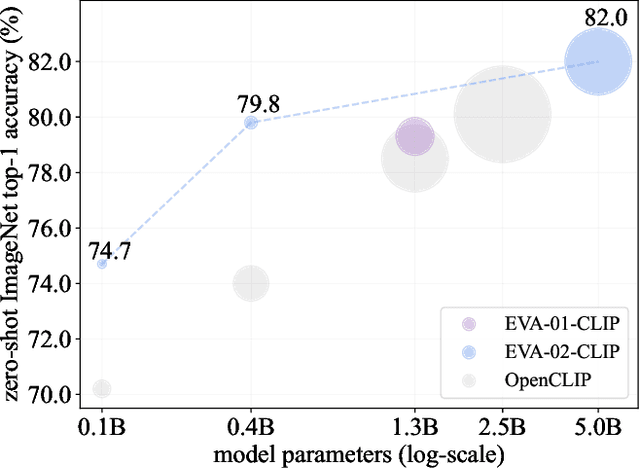
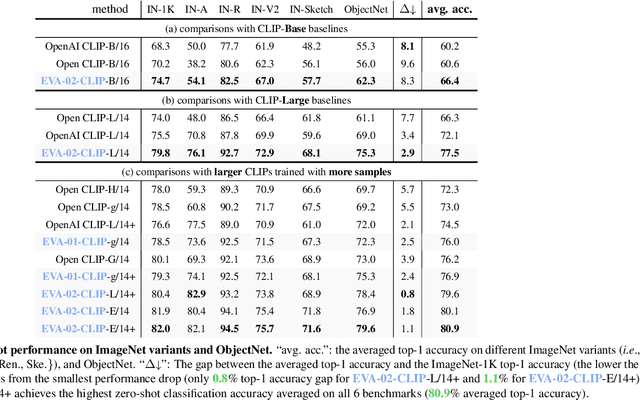
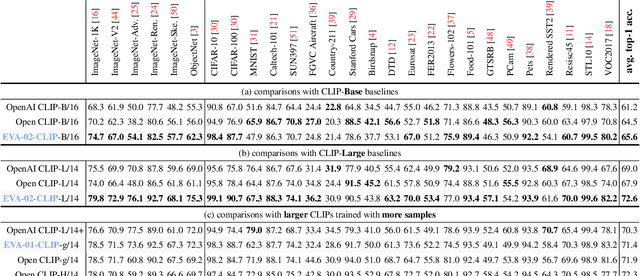
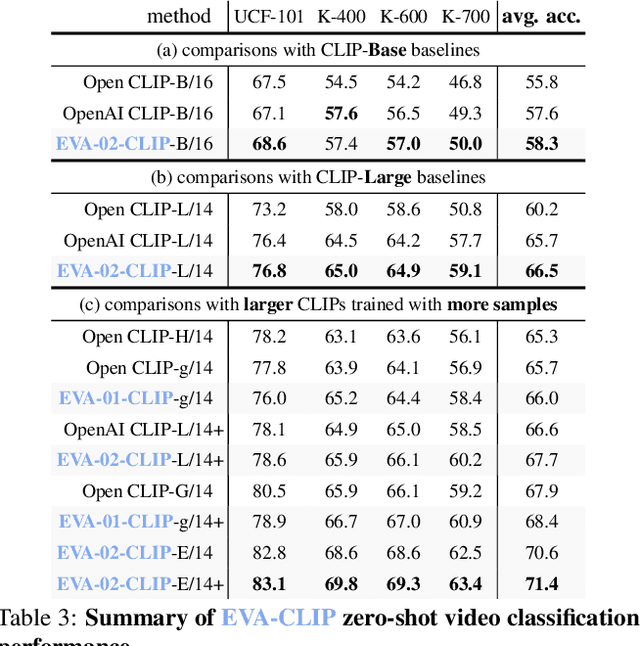
Contrastive language-image pre-training, CLIP for short, has gained increasing attention for its potential in various scenarios. In this paper, we propose EVA-CLIP, a series of models that significantly improve the efficiency and effectiveness of CLIP training. Our approach incorporates new techniques for representation learning, optimization, and augmentation, enabling EVA-CLIP to achieve superior performance compared to previous CLIP models with the same number of parameters but significantly smaller training costs. Notably, our largest 5.0B-parameter EVA-02-CLIP-E/14+ with only 9 billion seen samples achieves 82.0 zero-shot top-1 accuracy on ImageNet-1K val. A smaller EVA-02-CLIP-L/14+ with only 430 million parameters and 6 billion seen samples achieves 80.4 zero-shot top-1 accuracy on ImageNet-1K val. To facilitate open access and open research, we release the complete suite of EVA-CLIP to the community at https://github.com/baaivision/EVA/tree/master/EVA-CLIP.
EVA-02: A Visual Representation for Neon Genesis
Mar 22, 2023We launch EVA-02, a next-generation Transformer-based visual representation pre-trained to reconstruct strong and robust language-aligned vision features via masked image modeling. With an updated plain Transformer architecture as well as extensive pre-training from an open & accessible giant CLIP vision encoder, EVA-02 demonstrates superior performance compared to prior state-of-the-art approaches across various representative vision tasks, while utilizing significantly fewer parameters and compute budgets. Notably, using exclusively publicly accessible training data, EVA-02 with only 304M parameters achieves a phenomenal 90.0 fine-tuning top-1 accuracy on ImageNet-1K val set. Additionally, our EVA-02-CLIP can reach up to 80.4 zero-shot top-1 on ImageNet-1K, outperforming the previous largest & best open-sourced CLIP with only ~1/6 parameters and ~1/6 image-text training data. We offer four EVA-02 variants in various model sizes, ranging from 6M to 304M parameters, all with impressive performance. To facilitate open access and open research, we release the complete suite of EVA-02 to the community at https://github.com/baaivision/EVA/tree/master/EVA-02.
One Transformer Fits All Distributions in Multi-Modal Diffusion at Scale
Mar 12, 2023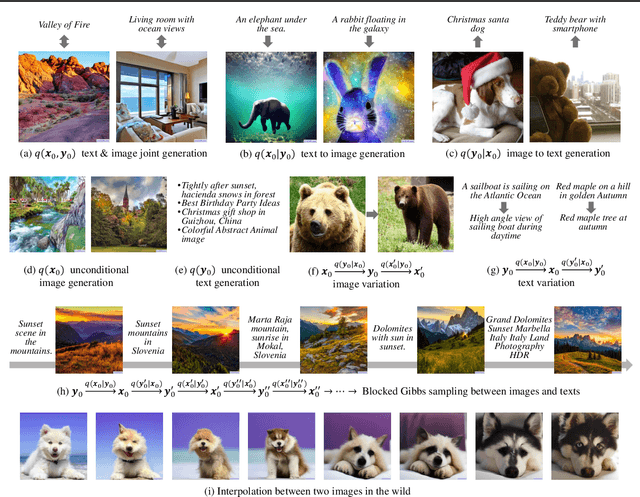
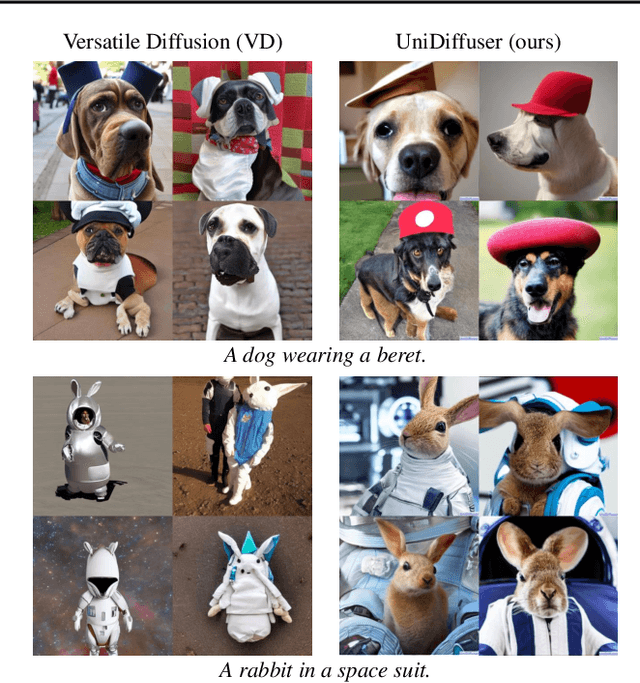

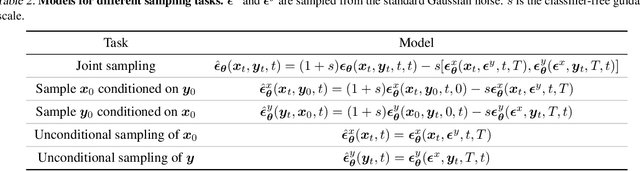
This paper proposes a unified diffusion framework (dubbed UniDiffuser) to fit all distributions relevant to a set of multi-modal data in one model. Our key insight is -- learning diffusion models for marginal, conditional, and joint distributions can be unified as predicting the noise in the perturbed data, where the perturbation levels (i.e. timesteps) can be different for different modalities. Inspired by the unified view, UniDiffuser learns all distributions simultaneously with a minimal modification to the original diffusion model -- perturbs data in all modalities instead of a single modality, inputs individual timesteps in different modalities, and predicts the noise of all modalities instead of a single modality. UniDiffuser is parameterized by a transformer for diffusion models to handle input types of different modalities. Implemented on large-scale paired image-text data, UniDiffuser is able to perform image, text, text-to-image, image-to-text, and image-text pair generation by setting proper timesteps without additional overhead. In particular, UniDiffuser is able to produce perceptually realistic samples in all tasks and its quantitative results (e.g., the FID and CLIP score) are not only superior to existing general-purpose models but also comparable to the bespoken models (e.g., Stable Diffusion and DALL-E 2) in representative tasks (e.g., text-to-image generation).
Robot Behavior-Tree-Based Task Generation with Large Language Models
Feb 24, 2023Nowadays, the behavior tree is gaining popularity as a representation for robot tasks due to its modularity and reusability. Designing behavior-tree tasks manually is time-consuming for robot end-users, thus there is a need for investigating automatic behavior-tree-based task generation. Prior behavior-tree-based task generation approaches focus on fixed primitive tasks and lack generalizability to new task domains. To cope with this issue, we propose a novel behavior-tree-based task generation approach that utilizes state-of-the-art large language models. We propose a Phase-Step prompt design that enables a hierarchical-structured robot task generation and further integrate it with behavior-tree-embedding-based search to set up the appropriate prompt. In this way, we enable an automatic and cross-domain behavior-tree task generation. Our behavior-tree-based task generation approach does not require a set of pre-defined primitive tasks. End-users only need to describe an abstract desired task and our proposed approach can swiftly generate the corresponding behavior tree. A full-process case study is provided to demonstrate our proposed approach. An ablation study is conducted to evaluate the effectiveness of our Phase-Step prompts. Assessment on Phase-Step prompts and the limitation of large language models are presented and discussed.
Revisiting Discriminative vs. Generative Classifiers: Theory and Implications
Feb 05, 2023
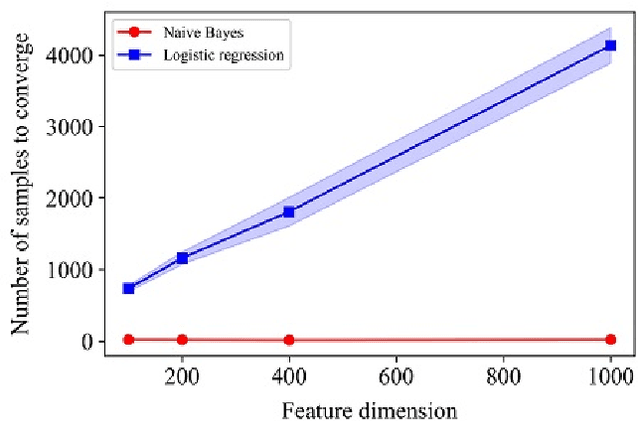


A large-scale deep model pre-trained on massive labeled or unlabeled data transfers well to downstream tasks. Linear evaluation freezes parameters in the pre-trained model and trains a linear classifier separately, which is efficient and attractive for transfer. However, little work has investigated the classifier in linear evaluation except for the default logistic regression. Inspired by the statistical efficiency of naive Bayes, the paper revisits the classical topic on discriminative vs. generative classifiers. Theoretically, the paper considers the surrogate loss instead of the zero-one loss in analyses and generalizes the classical results from binary cases to multiclass ones. We show that, under mild assumptions, multiclass naive Bayes requires $O(\log n)$ samples to approach its asymptotic error while the corresponding multiclass logistic regression requires $O(n)$ samples, where $n$ is the feature dimension. To establish it, we present a multiclass $\mathcal{H}$-consistency bound framework and an explicit bound for logistic loss, which are of independent interests. Simulation results on a mixture of Gaussian validate our theoretical findings. Experiments on various pre-trained deep vision models show that naive Bayes consistently converges faster as the number of data increases. Besides, naive Bayes shows promise in few-shot cases and we observe the ``two regimes'' phenomenon in pre-trained supervised models. Our code is available at https://github.com/ML-GSAI/Revisiting-Dis-vs-Gen-Classifiers.
Deep Model Assembling
Dec 08, 2022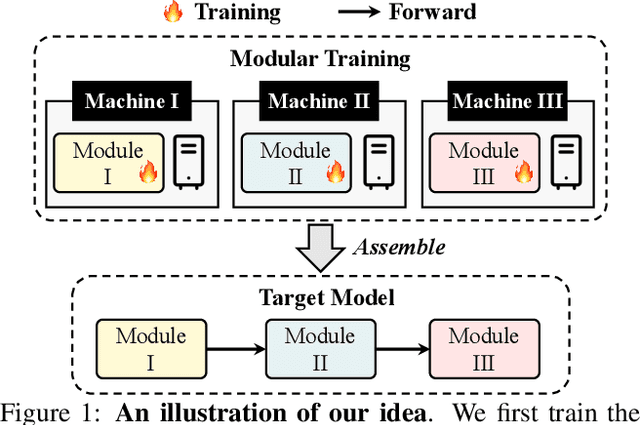

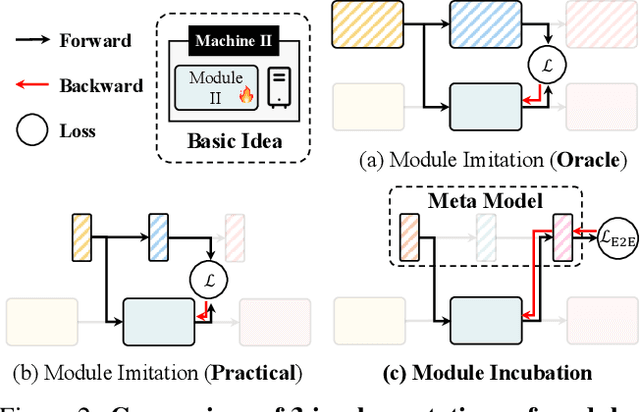
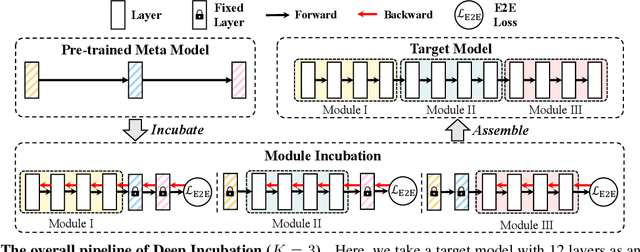
Large deep learning models have achieved remarkable success in many scenarios. However, training large models is usually challenging, e.g., due to the high computational cost, the unstable and painfully slow optimization procedure, and the vulnerability to overfitting. To alleviate these problems, this work studies a divide-and-conquer strategy, i.e., dividing a large model into smaller modules, training them independently, and reassembling the trained modules to obtain the target model. This approach is promising since it avoids directly training large models from scratch. Nevertheless, implementing this idea is non-trivial, as it is difficult to ensure the compatibility of the independently trained modules. In this paper, we present an elegant solution to address this issue, i.e., we introduce a global, shared meta model to implicitly link all the modules together. This enables us to train highly compatible modules that collaborate effectively when they are assembled together. We further propose a module incubation mechanism that enables the meta model to be designed as an extremely shallow network. As a result, the additional overhead introduced by the meta model is minimalized. Though conceptually simple, our method significantly outperforms end-to-end (E2E) training in terms of both final accuracy and training efficiency. For example, on top of ViT-Huge, it improves the accuracy by 2.7% compared to the E2E baseline on ImageNet-1K, while saving the training cost by 43% in the meantime. Code is available at https://github.com/LeapLabTHU/Model-Assembling.
Images Speak in Images: A Generalist Painter for In-Context Visual Learning
Dec 05, 2022In-context learning, as a new paradigm in NLP, allows the model to rapidly adapt to various tasks with only a handful of prompts and examples. But in computer vision, the difficulties for in-context learning lie in that tasks vary significantly in the output representations, thus it is unclear how to define the general-purpose task prompts that the vision model can understand and transfer to out-of-domain tasks. In this work, we present Painter, a generalist model which addresses these obstacles with an "image"-centric solution, that is, to redefine the output of core vision tasks as images, and specify task prompts as also images. With this idea, our training process is extremely simple, which performs standard masked image modeling on the stitch of input and output image pairs. This makes the model capable of performing tasks conditioned on visible image patches. Thus, during inference, we can adopt a pair of input and output images from the same task as the input condition, to indicate which task to perform. Without bells and whistles, our generalist Painter can achieve competitive performance compared to well-established task-specific models, on seven representative vision tasks ranging from high-level visual understanding to low-level image processing. Painter significantly outperforms recent generalist models on several challenging tasks. Surprisingly, our model shows capabilities of completing out-of-domain tasks, which do not exist in the training data, such as open-category keypoint detection and object segmentation, validating the powerful task transferability of in-context learning.