 Add to Chrome
 Add to Firefox
 Add to Edge
ASPIRE: Agentic /Skills Discovery for Robotics
Jun 30, 2026
Traditional robot programming is challenging: it requires orchestrating multimodal perception, managing physical contact dynamics, and handling diverse configurations and execution failures. We introduce ASPIRE (Agentic Skill Programming through Iterative Robot Exploration), a continual learning system that autonomously writes and refines robot control programs in a code-as-policy paradigm while compounding experience into a reusable skill library. ASPIRE discovers skills that persist across tasks, simulation and real-world settings, and embodiments. It operates in an open-ended loop with three components: (1) a closed-loop robot execution engine that exposes fine-grained multimodal traces, enabling autonomous failure diagnosis, repair synthesis, and validation; (2) a continually expanding skill library that distills validated fixes into reusable, transferable knowledge; and (3) evolutionary search that generates diverse task sequences and control programs to explore beyond single-trajectory refinement. ASPIRE surpasses prior methods by up to 77% on LIBERO-Pro manipulation under perturbation, 72% on Robosuite bimanual handover, and 32% on BEHAVIOR-1K long-horizon household tasks. Its accumulated library also enables zero-shot generalization to unseen long-horizon tasks: on LIBERO-Pro Long, ASPIRE achieves 31% success versus 4% for prior methods despite their use of test-time reasoning and retries. Finally, simulation-discovered skills provide initial evidence of sim-to-real transfer, substantially reducing real-robot programming effort across different embodiments and robot APIs.

RAGDiffusion: Faithful Cloth Generation via External Knowledge Assimilation
Nov 29, 2024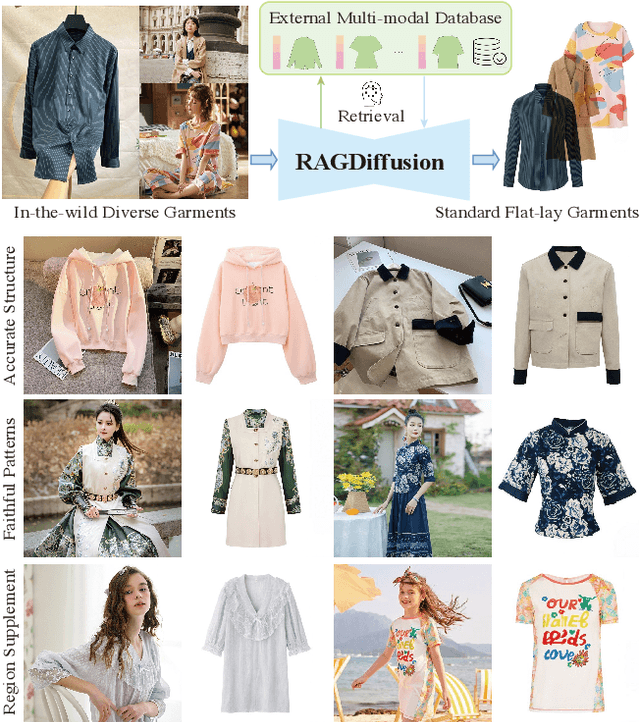
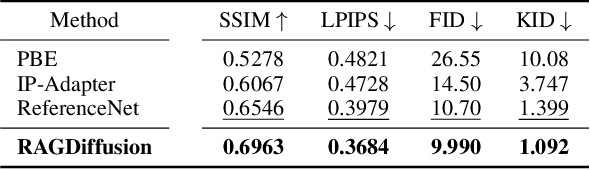
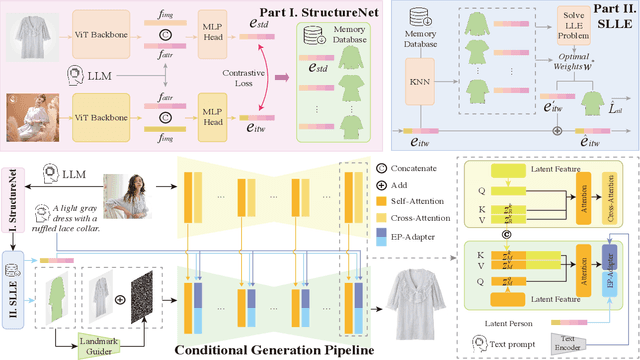
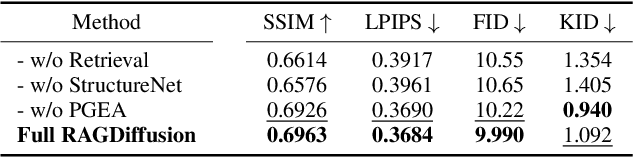
Standard clothing asset generation involves creating forward-facing flat-lay garment images displayed on a clear background by extracting clothing information from diverse real-world contexts, which presents significant challenges due to highly standardized sampling distributions and precise structural requirements in the generated images. Existing models have limited spatial perception and often exhibit structural hallucinations in this high-specification generative task. To address this issue, we propose a novel Retrieval-Augmented Generation (RAG) framework, termed RAGDiffusion, to enhance structure determinacy and mitigate hallucinations by assimilating external knowledge from LLM and databases. RAGDiffusion consists of two core processes: (1) Retrieval-based structure aggregation, which employs contrastive learning and a Structure Locally Linear Embedding (SLLE) to derive global structure and spatial landmarks, providing both soft and hard guidance to counteract structural ambiguities; and (2) Omni-level faithful garment generation, which introduces a three-level alignment that ensures fidelity in structural, pattern, and decoding components within the diffusing. Extensive experiments on challenging real-world datasets demonstrate that RAGDiffusion synthesizes structurally and detail-faithful clothing assets with significant performance improvements, representing a pioneering effort in high-specification faithful generation with RAG to confront intrinsic hallucinations and enhance fidelity.
Combining Attention with Flow for Person Image Synthesis
Aug 04, 2021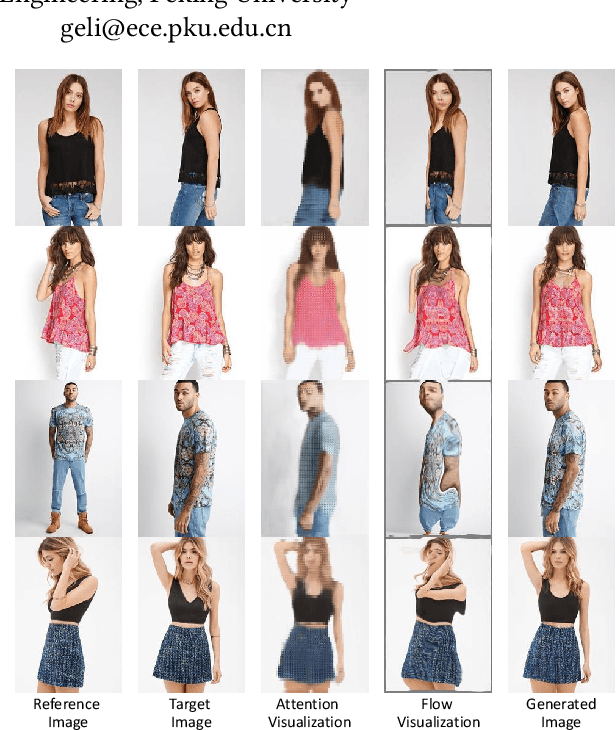

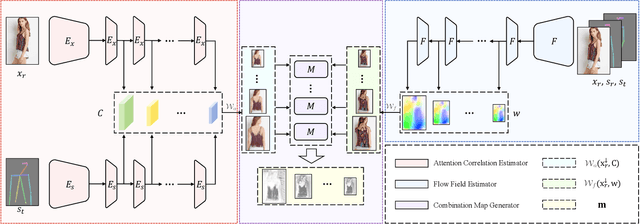
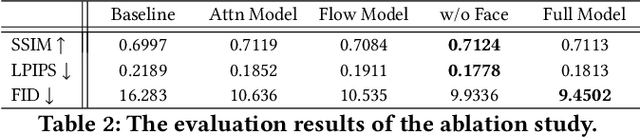
Pose-guided person image synthesis aims to synthesize person images by transforming reference images into target poses. In this paper, we observe that the commonly used spatial transformation blocks have complementary advantages. We propose a novel model by combining the attention operation with the flow-based operation. Our model not only takes the advantage of the attention operation to generate accurate target structures but also uses the flow-based operation to sample realistic source textures. Both objective and subjective experiments demonstrate the superiority of our model. Meanwhile, comprehensive ablation studies verify our hypotheses and show the efficacy of the proposed modules. Besides, additional experiments on the portrait image editing task demonstrate the versatility of the proposed combination.