 Add to Chrome
 Add to Firefox
 Add to Edge
ASPIRE: Agentic /Skills Discovery for Robotics
Jun 30, 2026
Traditional robot programming is challenging: it requires orchestrating multimodal perception, managing physical contact dynamics, and handling diverse configurations and execution failures. We introduce ASPIRE (Agentic Skill Programming through Iterative Robot Exploration), a continual learning system that autonomously writes and refines robot control programs in a code-as-policy paradigm while compounding experience into a reusable skill library. ASPIRE discovers skills that persist across tasks, simulation and real-world settings, and embodiments. It operates in an open-ended loop with three components: (1) a closed-loop robot execution engine that exposes fine-grained multimodal traces, enabling autonomous failure diagnosis, repair synthesis, and validation; (2) a continually expanding skill library that distills validated fixes into reusable, transferable knowledge; and (3) evolutionary search that generates diverse task sequences and control programs to explore beyond single-trajectory refinement. ASPIRE surpasses prior methods by up to 77% on LIBERO-Pro manipulation under perturbation, 72% on Robosuite bimanual handover, and 32% on BEHAVIOR-1K long-horizon household tasks. Its accumulated library also enables zero-shot generalization to unseen long-horizon tasks: on LIBERO-Pro Long, ASPIRE achieves 31% success versus 4% for prior methods despite their use of test-time reasoning and retries. Finally, simulation-discovered skills provide initial evidence of sim-to-real transfer, substantially reducing real-robot programming effort across different embodiments and robot APIs.

CaP-X: A Framework for Benchmarking and Improving Coding Agents for Robot Manipulation
Mar 23, 2026"Code-as-Policy" considers how executable code can complement data-intensive Vision-Language-Action (VLA) methods, yet their effectiveness as autonomous controllers for embodied manipulation remains underexplored. We present CaP-X, an open-access framework for systematically studying Code-as-Policy agents in robot manipulation. At its core is CaP-Gym, an interactive environment in which agents control robots by synthesizing and executing programs that compose perception and control primitives. Building on this foundation, CaP-Bench evaluates frontier language and vision-language models across varying levels of abstraction, interaction, and perceptual grounding. Across 12 models, CaP-Bench reveals a consistent trend: performance improves with human-crafted abstractions but degrades as these priors are removed, exposing a dependence on designer scaffolding. At the same time, we observe that this gap can be mitigated through scaling agentic test-time computation--through multi-turn interaction, structured execution feedback, visual differencing, automatic skill synthesis, and ensembled reasoning--substantially improves robustness even when agents operate over low-level primitives. These findings allow us to derive CaP-Agent0, a training-free framework that recovers human-level reliability on several manipulation tasks in simulation and on real embodiments. We further introduce CaP-RL, showing reinforcement learning with verifiable rewards improves success rates and transfers from sim2real with minimal gap. Together, CaP-X provides a principled, open-access platform for advancing embodied coding agents.
Enhancing Autonomous Vehicle Perception in Adverse Weather through Image Augmentation during Semantic Segmentation Training
Aug 14, 2024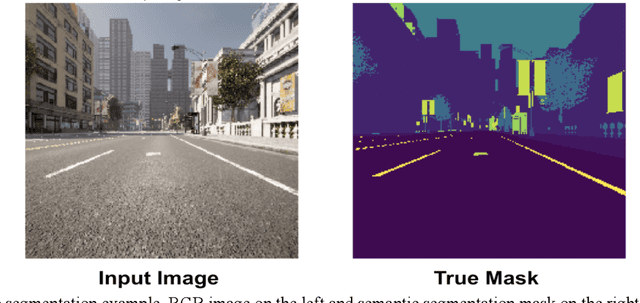
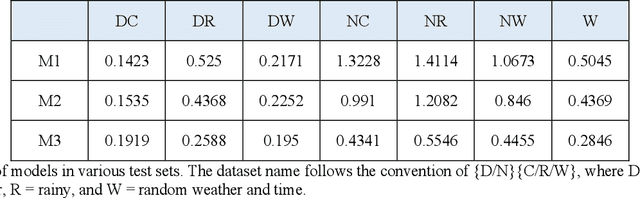
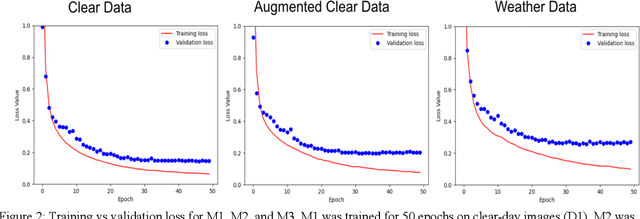
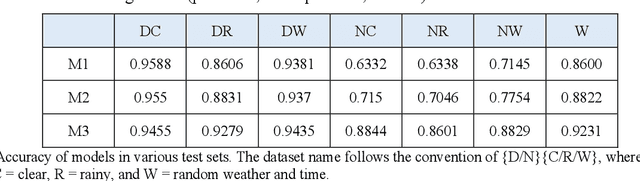
Robust perception is crucial in autonomous vehicle navigation and localization. Visual processing tasks, like semantic segmentation, should work in varying weather conditions and during different times of day. Semantic segmentation is where each pixel is assigned a class, which is useful for locating overall features (1). Training a segmentation model requires large amounts of data, and the labeling process for segmentation data is especially tedious. Additionally, many large datasets include only images taken in clear weather. This is a problem because training a model exclusively on clear weather data hinders performance in adverse weather conditions like fog or rain. We hypothesize that given a dataset of only clear days images, applying image augmentation (such as random rain, fog, and brightness) during training allows for domain adaptation to diverse weather conditions. We used CARLA, a 3D realistic autonomous vehicle simulator, to collect 1200 images in clear weather composed of 29 classes from 10 different towns (2). We also collected 1200 images of random weather effects. We trained encoder-decoder UNet models to perform semantic segmentation. Applying augmentations significantly improved segmentation under weathered night conditions (p < 0.001). However, models trained on weather data have significantly lower losses than those trained on augmented data in all conditions except for clear days. This shows there is room for improvement in the domain adaptation approach. Future work should test more types of augmentations and also use real-life images instead of CARLA. Ideally, the augmented model meets or exceeds the performance of the weather model.
Extended Kalman Filter State Estimation for Autonomous Competition Robots
Oct 05, 2023Autonomous mobile robot competitions judge based on a robot's ability to quickly and accurately navigate the game field. This means accurate localization is crucial for creating an autonomous competition robot. Two common localization methods are odometry and computer vision landmark detection. Odometry provides frequent velocity measurements, while landmark detection provides infrequent position measurements. The state can also be predicted with a physics model. These three types of localization can be "fused" to create a more accurate state estimate using an Extended Kalman Filter (EKF). The EKF is a nonlinear full-state estimator that approximates the state estimate with the lowest covariance error when given the sensor measurements, the model prediction, and their variances. In this paper, we demonstrate the effectiveness of the EKF by implementing it on a 4-wheel mecanum-drive robot simulation. The position and velocity accuracy of fusing together various combinations of these three data sources are compared. We also discuss the assumptions and limitations of an EKF.