 Add to Chrome
 Add to Firefox
 Add to Edge
SIM1: Physics-Aligned Simulator as Zero-Shot Data Scaler in Deformable Worlds
Apr 09, 2026
Robotic manipulation with deformable objects represents a data-intensive regime in embodied learning, where shape, contact, and topology co-evolve in ways that far exceed the variability of rigids. Although simulation promises relief from the cost of real-world data acquisition, prevailing sim-to-real pipelines remain rooted in rigid-body abstractions, producing mismatched geometry, fragile soft dynamics, and motion primitives poorly suited for cloth interaction. We posit that simulation fails not for being synthetic, but for being ungrounded. To address this, we introduce SIM1, a physics-aligned real-to-sim-to-real data engine that grounds simulation in the physical world. Given limited demonstrations, the system digitizes scenes into metric-consistent twins, calibrates deformable dynamics through elastic modeling, and expands behaviors via diffusion-based trajectory generation with quality filtering. This pipeline transforms sparse observations into scaled synthetic supervision with near-demonstration fidelity. Experiments show that policies trained on purely synthetic data achieve parity with real-data baselines at a 1:15 equivalence ratio, while delivering 90% zero-shot success and 50% generalization gains in real-world deployment. These results validate physics-aligned simulation as scalable supervision for deformable manipulation and a practical pathway for data-efficient policy learning.

Generalizable Human Gaussians for Sparse View Synthesis
Jul 17, 2024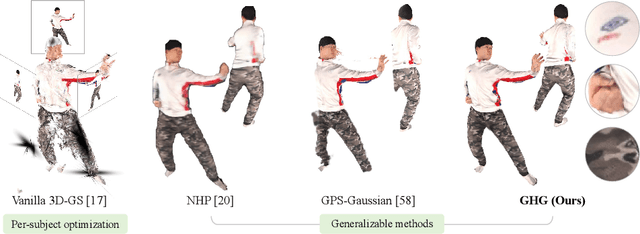

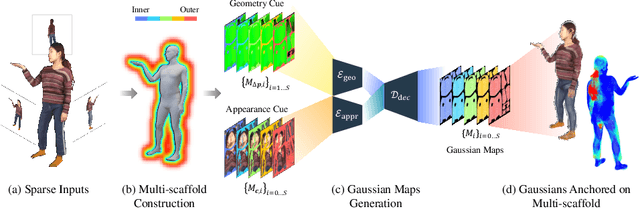
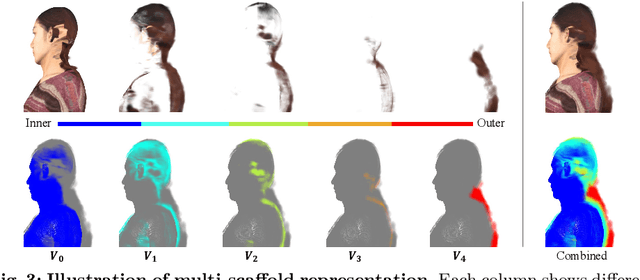
Recent progress in neural rendering has brought forth pioneering methods, such as NeRF and Gaussian Splatting, which revolutionize view rendering across various domains like AR/VR, gaming, and content creation. While these methods excel at interpolating {\em within the training data}, the challenge of generalizing to new scenes and objects from very sparse views persists. Specifically, modeling 3D humans from sparse views presents formidable hurdles due to the inherent complexity of human geometry, resulting in inaccurate reconstructions of geometry and textures. To tackle this challenge, this paper leverages recent advancements in Gaussian Splatting and introduces a new method to learn generalizable human Gaussians that allows photorealistic and accurate view-rendering of a new human subject from a limited set of sparse views in a feed-forward manner. A pivotal innovation of our approach involves reformulating the learning of 3D Gaussian parameters into a regression process defined on the 2D UV space of a human template, which allows leveraging the strong geometry prior and the advantages of 2D convolutions. In addition, a multi-scaffold is proposed to effectively represent the offset details. Our method outperforms recent methods on both within-dataset generalization as well as cross-dataset generalization settings.