 Add to Chrome
 Add to Firefox
 Add to Edge
Spotlight Attention: Robust Object-Centric Learning With a Spatial Locality Prior
May 31, 2023
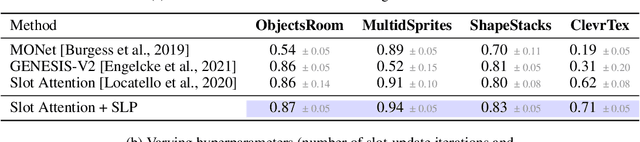
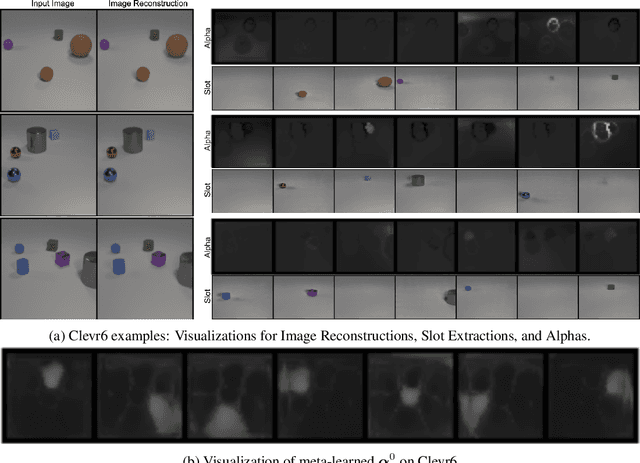

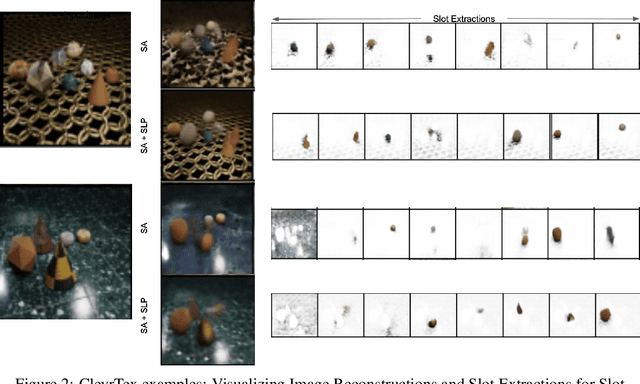
The aim of object-centric vision is to construct an explicit representation of the objects in a scene. This representation is obtained via a set of interchangeable modules called \emph{slots} or \emph{object files} that compete for local patches of an image. The competition has a weak inductive bias to preserve spatial continuity; consequently, one slot may claim patches scattered diffusely throughout the image. In contrast, the inductive bias of human vision is strong, to the degree that attention has classically been described with a spotlight metaphor. We incorporate a spatial-locality prior into state-of-the-art object-centric vision models and obtain significant improvements in segmenting objects in both synthetic and real-world datasets. Similar to human visual attention, the combination of image content and spatial constraints yield robust unsupervised object-centric learning, including less sensitivity to model hyperparameters.

Joint Bayesian Inference of Graphical Structure and Parameters with a Single Generative Flow Network
May 30, 2023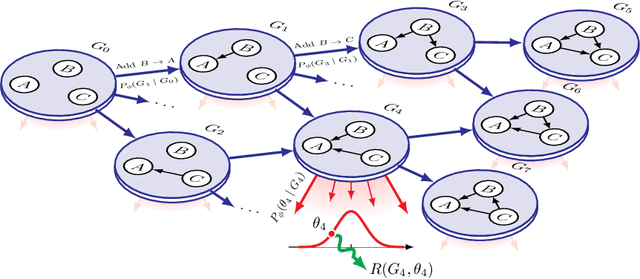

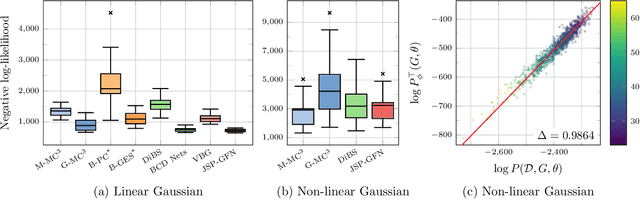

Generative Flow Networks (GFlowNets), a class of generative models over discrete and structured sample spaces, have been previously applied to the problem of inferring the marginal posterior distribution over the directed acyclic graph (DAG) of a Bayesian Network, given a dataset of observations. Based on recent advances extending this framework to non-discrete sample spaces, we propose in this paper to approximate the joint posterior over not only the structure of a Bayesian Network, but also the parameters of its conditional probability distributions. We use a single GFlowNet whose sampling policy follows a two-phase process: the DAG is first generated sequentially one edge at a time, and then the corresponding parameters are picked once the full structure is known. Since the parameters are included in the posterior distribution, this leaves more flexibility for the local probability models of the Bayesian Network, making our approach applicable even to non-linear models parametrized by neural networks. We show that our method, called JSP-GFN, offers an accurate approximation of the joint posterior, while comparing favorably against existing methods on both simulated and real data.
Let the Flows Tell: Solving Graph Combinatorial Optimization Problems with GFlowNets
May 26, 2023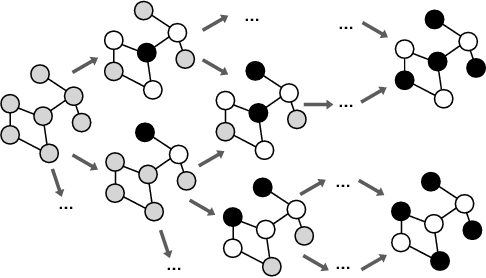
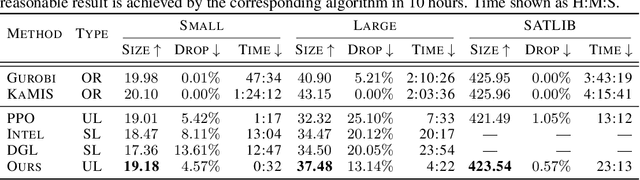
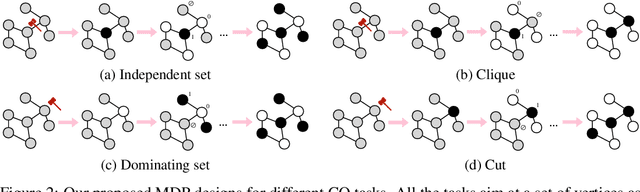
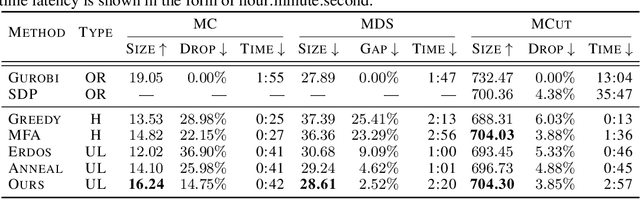
Combinatorial optimization (CO) problems are often NP-hard and thus out of reach for exact algorithms, making them a tempting domain to apply machine learning methods. The highly structured constraints in these problems can hinder either optimization or sampling directly in the solution space. On the other hand, GFlowNets have recently emerged as a powerful machinery to efficiently sample from composite unnormalized densities sequentially and have the potential to amortize such solution-searching processes in CO, as well as generate diverse solution candidates. In this paper, we design Markov decision processes (MDPs) for different combinatorial problems and propose to train conditional GFlowNets to sample from the solution space. Efficient training techniques are also developed to benefit long-range credit assignment. Through extensive experiments on a variety of different CO tasks with synthetic and realistic data, we demonstrate that GFlowNet policies can efficiently find high-quality solutions.
Model evaluation for extreme risks
May 24, 2023
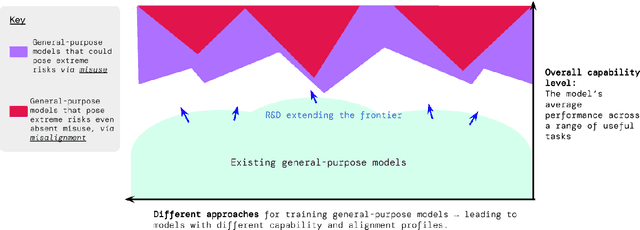
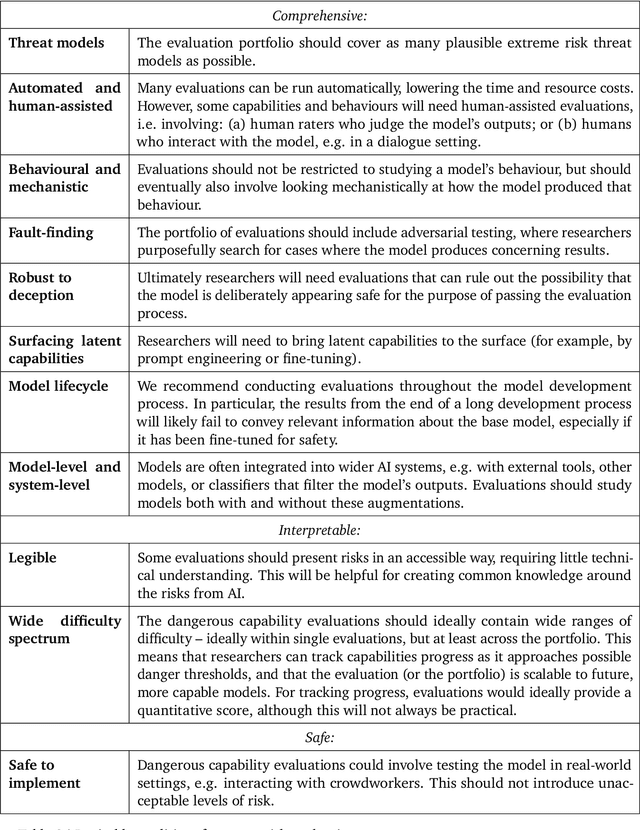

Current approaches to building general-purpose AI systems tend to produce systems with both beneficial and harmful capabilities. Further progress in AI development could lead to capabilities that pose extreme risks, such as offensive cyber capabilities or strong manipulation skills. We explain why model evaluation is critical for addressing extreme risks. Developers must be able to identify dangerous capabilities (through "dangerous capability evaluations") and the propensity of models to apply their capabilities for harm (through "alignment evaluations"). These evaluations will become critical for keeping policymakers and other stakeholders informed, and for making responsible decisions about model training, deployment, and security.
Constant Memory Attentive Neural Processes
May 23, 2023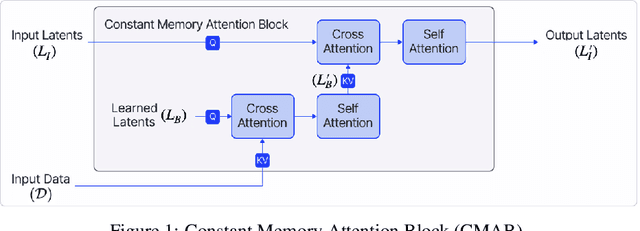
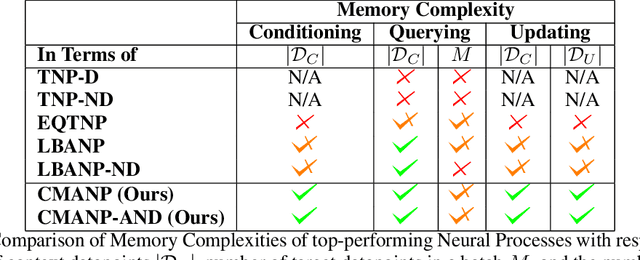
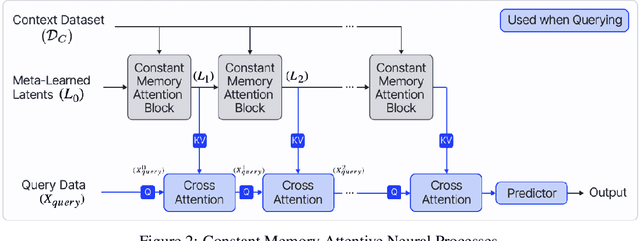
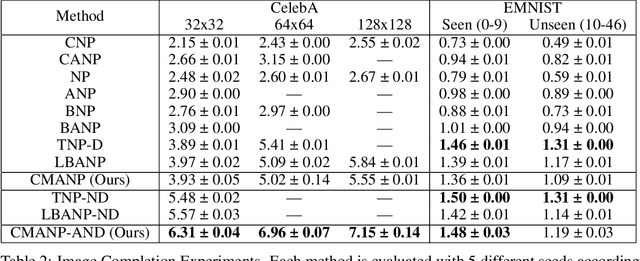
Neural Processes (NPs) are efficient methods for estimating predictive uncertainties. NPs comprise of a conditioning phase where a context dataset is encoded, a querying phase where the model makes predictions using the context dataset encoding, and an updating phase where the model updates its encoding with newly received datapoints. However, state-of-the-art methods require additional memory which scales linearly or quadratically with the size of the dataset, limiting their applications, particularly in low-resource settings. In this work, we propose Constant Memory Attentive Neural Processes (CMANPs), an NP variant which only requires constant memory for the conditioning, querying, and updating phases. In building CMANPs, we propose Constant Memory Attention Block (CMAB), a novel general-purpose attention block that can compute its output in constant memory and perform updates in constant computation. Empirically, we show CMANPs achieve state-of-the-art results on meta-regression and image completion tasks while being (1) significantly more memory efficient than prior methods and (2) more scalable to harder settings.
FAENet: Frame Averaging Equivariant GNN for Materials Modeling
Apr 28, 2023Applications of machine learning techniques for materials modeling typically involve functions known to be equivariant or invariant to specific symmetries. While graph neural networks (GNNs) have proven successful in such tasks, they enforce symmetries via the model architecture, which often reduces their expressivity, scalability and comprehensibility. In this paper, we introduce (1) a flexible framework relying on stochastic frame-averaging (SFA) to make any model E(3)-equivariant or invariant through data transformations. (2) FAENet: a simple, fast and expressive GNN, optimized for SFA, that processes geometric information without any symmetrypreserving design constraints. We prove the validity of our method theoretically and empirically demonstrate its superior accuracy and computational scalability in materials modeling on the OC20 dataset (S2EF, IS2RE) as well as common molecular modeling tasks (QM9, QM7-X). A package implementation is available at https://faenet.readthedocs.io.
Hyena Hierarchy: Towards Larger Convolutional Language Models
Mar 06, 2023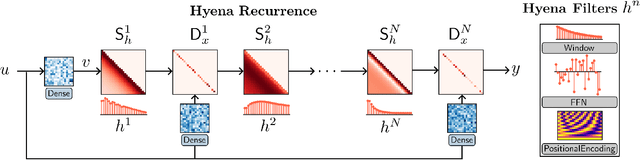
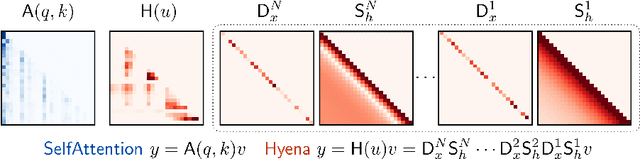

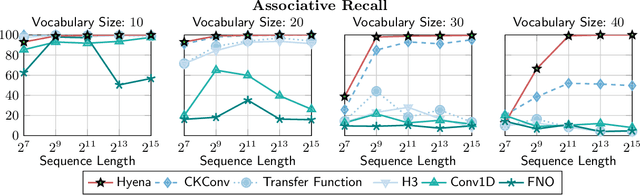
Recent advances in deep learning have relied heavily on the use of large Transformers due to their ability to learn at scale. However, the core building block of Transformers, the attention operator, exhibits quadratic cost in sequence length, limiting the amount of context accessible. Existing subquadratic methods based on low-rank and sparse approximations need to be combined with dense attention layers to match Transformers, indicating a gap in capability. In this work, we propose Hyena, a subquadratic drop-in replacement for attention constructed by interleaving implicitly parametrized long convolutions and data-controlled gating. In recall and reasoning tasks on sequences of thousands to hundreds of thousands of tokens, Hyena improves accuracy by more than 50 points over operators relying on state-spaces and other implicit and explicit methods, matching attention-based models. We set a new state-of-the-art for dense-attention-free architectures on language modeling in standard datasets (WikiText103 and The Pile), reaching Transformer quality with a 20% reduction in training compute required at sequence length 2K. Hyena operators are twice as fast as highly optimized attention at sequence length 8K, and 100x faster at sequence length 64K.
Sources of Richness and Ineffability for Phenomenally Conscious States
Mar 01, 2023
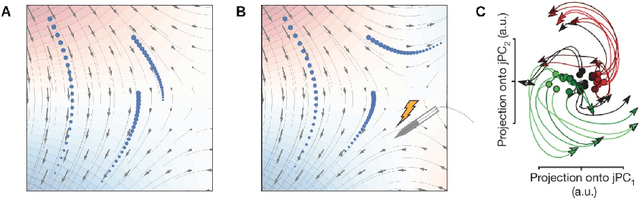


Conscious states (states that there is something it is like to be in) seem both rich or full of detail, and ineffable or hard to fully describe or recall. The problem of ineffability, in particular, is a longstanding issue in philosophy that partly motivates the explanatory gap: the belief that consciousness cannot be reduced to underlying physical processes. Here, we provide an information theoretic dynamical systems perspective on the richness and ineffability of consciousness. In our framework, the richness of conscious experience corresponds to the amount of information in a conscious state and ineffability corresponds to the amount of information lost at different stages of processing. We describe how attractor dynamics in working memory would induce impoverished recollections of our original experiences, how the discrete symbolic nature of language is insufficient for describing the rich and high-dimensional structure of experiences, and how similarity in the cognitive function of two individuals relates to improved communicability of their experiences to each other. While our model may not settle all questions relating to the explanatory gap, it makes progress toward a fully physicalist explanation of the richness and ineffability of conscious experience: two important aspects that seem to be part of what makes qualitative character so puzzling.
Reusable Slotwise Mechanisms
Feb 21, 2023Agents that can understand and reason over the dynamics of objects can have a better capability to act robustly and generalize to novel scenarios. Such an ability, however, requires a suitable representation of the scene as well as an understanding of the mechanisms that govern the interactions of different subsets of objects. To address this problem, we propose RSM, or Reusable Slotwise Mechanisms, that jointly learns a slotwise representation of the scene and a modular architecture that dynamically chooses one mechanism among a set of reusable mechanisms to predict the next state of each slot. RSM crucially takes advantage of a \textit{Central Contextual Information (CCI)}, which lets each selected reusable mechanism access the rest of the slots through a bottleneck, effectively allowing for modeling higher order and complex interactions that might require a sparse subset of objects. We show how this model outperforms state-of-the-art methods in a variety of next-step prediction tasks ranging from grid-world environments to Atari 2600 games. Particularly, we challenge methods that model the dynamics with Graph Neural Networks (GNNs) on top of slotwise representations, and modular architectures that restrict the interactions to be only pairwise. Finally, we show that RSM is able to generalize to scenes with objects varying in number and shape, highlighting its out-of-distribution generalization capabilities. Our implementation is available online\footnote{\hyperlink{https://github.com/trangnnp/RSM}{github.com/trangnnp/RSM}}.
Stochastic Generative Flow Networks
Feb 19, 2023Generative Flow Networks (or GFlowNets for short) are a family of probabilistic agents that learn to sample complex combinatorial structures through the lens of "inference as control". They have shown great potential in generating high-quality and diverse candidates from a given energy landscape. However, existing GFlowNets can be applied only to deterministic environments, and fail in more general tasks with stochastic dynamics, which can limit their applicability. To overcome this challenge, this paper introduces Stochastic GFlowNets, a new algorithm that extends GFlowNets to stochastic environments. By decomposing state transitions into two steps, Stochastic GFlowNets isolate environmental stochasticity and learn a dynamics model to capture it. Extensive experimental results demonstrate that Stochastic GFlowNets offer significant advantages over standard GFlowNets as well as MCMC- and RL-based approaches, on a variety of standard benchmarks with stochastic dynamics.