 Add to Chrome
 Add to Firefox
 Add to Edge
Search Your Block Floating Point Scales!
May 12, 2026
Quantization has emerged as a standard technique for accelerating inference for generative models by enabling faster low-precision computations and reduced memory transfers. Recently, GPU accelerators have added first-class support for microscaling Block Floating Point (BFP) formats. Standard BFP algorithms use a fixed scale based on the maximum magnitude of the block. We observe that this scale choice can be suboptimal with respect to quantization errors. In this work, we propose ScaleSearch, an alternative strategy for selecting these scale factors: using a fine-grained search leveraging the mantissa bits in microscaling formats to minimize the quantization error for the given distribution. ScaleSearch can be integrated with existing quantization methods such as Post Training Quantization and low-precision attention, and is shown to improve their performance. Additionally, we introduce ScaleSearchAttention, an accelerated NVFP4-based attention algorithm, which uses ScaleSearch and adapted prior techniques to ensure near-0 performance loss for causal language modeling. Experiments show that ScaleSearch reduces quantization error by 27% for NVFP4 and improves language model PTQ by up to 15 points for MATH500 (Qwen3-8B), while ScaleSearchAttention improves Wikitext-2 PPL by upto 0.77 points for Llama 3.1 70B. The proposed methods closely match baseline performance while providing quantization accuracy improvements.

Parcae: Scaling Laws For Stable Looped Language Models
Apr 14, 2026Traditional fixed-depth architectures scale quality by increasing training FLOPs, typically through increased parameterization, at the expense of a higher memory footprint, or data. A potential alternative is looped architectures, which instead increase FLOPs by sending activations through a block of layers in a loop. While promising, existing recipes for training looped architectures can be unstable, suffering from residual explosion and loss spikes. We address these challenges by recasting looping as a nonlinear time-variant dynamical system over the residual stream. Via a linear approximation to this system, we find that instability occurs in existing looped architectures as a result of large spectral norms in their injection parameters. To address these instability issues, we propose Parcae, a novel stable, looped architecture that constrains the spectral norm of the injection parameters via discretization of a negative diagonal parameterization. As a result, Parcae achieves up to 6.3% lower validation perplexity over prior large-scale looped models. Using our stable looped architecture, we investigate the scaling properties of looping as a medium to improve quality by increasing FLOPs in training and test-time. For training, we derive predictable power laws to scale FLOPs while keeping parameter count fixed. Our initial scaling laws suggest that looping and data should be increased in tandem, given a fixed FLOP budget. At test-time, we find that Parcae can use looping to scale compute, following a predictable, saturating exponential decay. When scaled up to 1.3B parameters, we find that Parcae improves CORE and Core-Extended quality by 2.99 and 1.18 points when compared to strong Transformer baselines under a fixed parameter and data budget, achieving a relative quality of up to 87.5% a Transformer twice the size.
HipKittens: Fast and Furious AMD Kernels
Nov 11, 2025AMD GPUs offer state-of-the-art compute and memory bandwidth; however, peak performance AMD kernels are written in raw assembly. To address the difficulty of mapping AI algorithms to hardware, recent work proposes C++ embedded and PyTorch-inspired domain-specific languages like ThunderKittens (TK) to simplify high performance AI kernel development on NVIDIA hardware. We explore the extent to which such primitives -- for explicit tile-based programming with optimized memory accesses and fine-grained asynchronous execution across workers -- are NVIDIA-specific or general. We provide the first detailed study of the programming primitives that lead to performant AMD AI kernels, and we encapsulate these insights in the HipKittens (HK) programming framework. We find that tile-based abstractions used in prior DSLs generalize to AMD GPUs, however we need to rethink the algorithms that instantiate these abstractions for AMD. We validate the HK primitives across CDNA3 and CDNA4 AMD platforms. In evaluations, HK kernels compete with AMD's hand-optimized assembly kernels for GEMMs and attention, and consistently outperform compiler baselines. Moreover, assembly is difficult to scale to the breadth of AI workloads; reflecting this, in some settings HK outperforms all available kernel baselines by $1.2-2.4\times$ (e.g., $d=64$ attention, GQA backwards, memory-bound kernels). These findings help pave the way for a single, tile-based software layer for high-performance AI kernels that translates across GPU vendors. HipKittens is released at: https://github.com/HazyResearch/HipKittens.
Exploring Diffusion Transformer Designs via Grafting
Jun 06, 2025Designing model architectures requires decisions such as selecting operators (e.g., attention, convolution) and configurations (e.g., depth, width). However, evaluating the impact of these decisions on model quality requires costly pretraining, limiting architectural investigation. Inspired by how new software is built on existing code, we ask: can new architecture designs be studied using pretrained models? To this end, we present grafting, a simple approach for editing pretrained diffusion transformers (DiTs) to materialize new architectures under small compute budgets. Informed by our analysis of activation behavior and attention locality, we construct a testbed based on the DiT-XL/2 design to study the impact of grafting on model quality. Using this testbed, we develop a family of hybrid designs via grafting: replacing softmax attention with gated convolution, local attention, and linear attention, and replacing MLPs with variable expansion ratio and convolutional variants. Notably, many hybrid designs achieve good quality (FID: 2.38-2.64 vs. 2.27 for DiT-XL/2) using <2% pretraining compute. We then graft a text-to-image model (PixArt-Sigma), achieving a 1.43x speedup with less than a 2% drop in GenEval score. Finally, we present a case study that restructures DiT-XL/2 by converting every pair of sequential transformer blocks into parallel blocks via grafting. This reduces model depth by 2x and yields better quality (FID: 2.77) than other models of comparable depth. Together, we show that new diffusion model designs can be explored by grafting pretrained DiTs, with edits ranging from operator replacement to architecture restructuring. Code and grafted models: https://grafting.stanford.edu
HMAR: Efficient Hierarchical Masked Auto-Regressive Image Generation
Jun 04, 2025Visual Auto-Regressive modeling (VAR) has shown promise in bridging the speed and quality gap between autoregressive image models and diffusion models. VAR reformulates autoregressive modeling by decomposing an image into successive resolution scales. During inference, an image is generated by predicting all the tokens in the next (higher-resolution) scale, conditioned on all tokens in all previous (lower-resolution) scales. However, this formulation suffers from reduced image quality due to the parallel generation of all tokens in a resolution scale; has sequence lengths scaling superlinearly in image resolution; and requires retraining to change the sampling schedule. We introduce Hierarchical Masked Auto-Regressive modeling (HMAR), a new image generation algorithm that alleviates these issues using next-scale prediction and masked prediction to generate high-quality images with fast sampling. HMAR reformulates next-scale prediction as a Markovian process, wherein the prediction of each resolution scale is conditioned only on tokens in its immediate predecessor instead of the tokens in all predecessor resolutions. When predicting a resolution scale, HMAR uses a controllable multi-step masked generation procedure to generate a subset of the tokens in each step. On ImageNet 256x256 and 512x512 benchmarks, HMAR models match or outperform parameter-matched VAR, diffusion, and autoregressive baselines. We develop efficient IO-aware block-sparse attention kernels that allow HMAR to achieve faster training and inference times over VAR by over 2.5x and 1.75x respectively, as well as over 3x lower inference memory footprint. Finally, HMAR yields additional flexibility over VAR; its sampling schedule can be changed without further training, and it can be applied to image editing tasks in a zero-shot manner.
ThunderKittens: Simple, Fast, and Adorable AI Kernels
Oct 27, 2024The challenge of mapping AI architectures to GPU hardware is creating a critical bottleneck in AI progress. Despite substantial efforts, hand-written custom kernels fail to meet their theoretical performance thresholds, even on well-established operations like linear attention. The diverse hardware capabilities of GPUs might suggest that we need a wide variety of techniques to achieve high performance. However, our work explores whether a small number of key abstractions can drastically simplify the process. We present ThunderKittens (TK), a framework for writing performant AI kernels while remaining easy to use and maintain. Our abstractions map to the three levels of the GPU hierarchy: (1) at the warp-level, we provide 16x16 matrix tiles as basic data structures and PyTorch-like parallel compute operations over tiles, (2) at the thread-block level, we provide a template for overlapping asynchronous operations across parallel warps, and (3) at the grid-level, we provide support to help hide the block launch and tear-down, and memory costs. We show the value of TK by providing kernels that match or outperform prior kernels for a range of AI operations. We match CuBLAS and FlashAttention-3 on GEMM and attention inference performance and outperform the strongest baselines by $10-40\%$ on attention backwards, $8\times$ on state space models, and $14\times$ on linear attention.
Benchmarking and Building Long-Context Retrieval Models with LoCo and M2-BERT
Feb 14, 2024Retrieval pipelines-an integral component of many machine learning systems-perform poorly in domains where documents are long (e.g., 10K tokens or more) and where identifying the relevant document requires synthesizing information across the entire text. Developing long-context retrieval encoders suitable for these domains raises three challenges: (1) how to evaluate long-context retrieval performance, (2) how to pretrain a base language model to represent both short contexts (corresponding to queries) and long contexts (corresponding to documents), and (3) how to fine-tune this model for retrieval under the batch size limitations imposed by GPU memory constraints. To address these challenges, we first introduce LoCoV1, a novel 12 task benchmark constructed to measure long-context retrieval where chunking is not possible or not effective. We next present the M2-BERT retrieval encoder, an 80M parameter state-space encoder model built from the Monarch Mixer architecture, capable of scaling to documents up to 32K tokens long. We describe a pretraining data mixture which allows this encoder to process both short and long context sequences, and a finetuning approach that adapts this base model to retrieval with only single-sample batches. Finally, we validate the M2-BERT retrieval encoder on LoCoV1, finding that it outperforms competitive Transformer-based models by at least 23.3 points, despite containing upwards of 90x fewer parameters.
Hydragen: High-Throughput LLM Inference with Shared Prefixes
Feb 07, 2024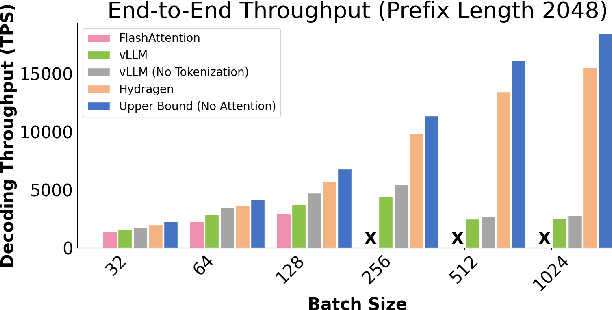
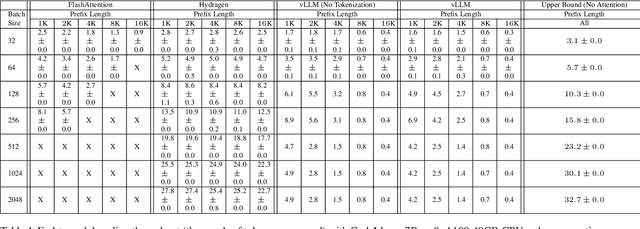
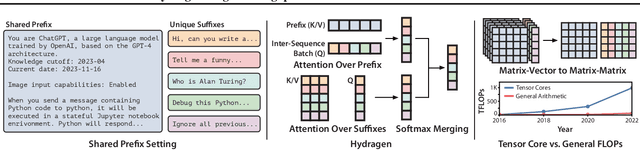
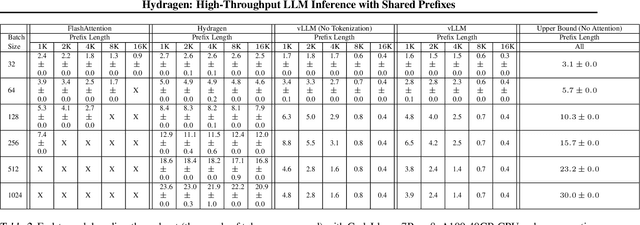
Transformer-based large language models (LLMs) are now deployed to hundreds of millions of users. LLM inference is commonly performed on batches of sequences that share a prefix, such as few-shot examples or a chatbot system prompt. Decoding in this large-batch setting can be bottlenecked by the attention operation, which reads large key-value (KV) caches from memory and computes inefficient matrix-vector products for every sequence in the batch. In this work, we introduce Hydragen, a hardware-aware exact implementation of attention with shared prefixes. Hydragen computes attention over the shared prefix and unique suffixes separately. This decomposition enables efficient prefix attention by batching queries together across sequences, reducing redundant memory reads and enabling the use of hardware-friendly matrix multiplications. Our method can improve end-to-end LLM throughput by up to 32x against competitive baselines, with speedup growing with the batch size and shared prefix length. Hydragen also enables the use of very long shared contexts: with a high batch size, increasing the prefix length from 1K to 16K tokens decreases Hydragen throughput by less than 15%, while the throughput of baselines drops by over 90%. Hydragen generalizes beyond simple prefix-suffix decomposition and can be applied to tree-based prompt sharing patterns, allowing us to further reduce inference time on competitive programming problems by 55%.
FlashFFTConv: Efficient Convolutions for Long Sequences with Tensor Cores
Nov 10, 2023


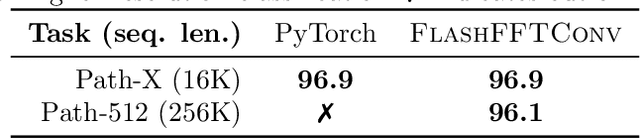
Convolution models with long filters have demonstrated state-of-the-art reasoning abilities in many long-sequence tasks but lag behind the most optimized Transformers in wall-clock time. A major bottleneck is the Fast Fourier Transform (FFT)--which allows long convolutions to run in $O(N logN)$ time in sequence length $N$ but has poor hardware utilization. In this paper, we study how to optimize the FFT convolution. We find two key bottlenecks: the FFT does not effectively use specialized matrix multiply units, and it incurs expensive I/O between layers of the memory hierarchy. In response, we propose FlashFFTConv. FlashFFTConv uses a matrix decomposition that computes the FFT using matrix multiply units and enables kernel fusion for long sequences, reducing I/O. We also present two sparse convolution algorithms--1) partial convolutions and 2) frequency-sparse convolutions--which can be implemented simply by skipping blocks in the matrix decomposition, enabling further opportunities for memory and compute savings. FlashFFTConv speeds up exact FFT convolutions by up to 7.93$\times$ over PyTorch and achieves up to 4.4$\times$ speedup end-to-end. Given the same compute budget, FlashFFTConv allows Hyena-GPT-s to achieve 2.3 points better perplexity on the PILE and M2-BERT-base to achieve 3.3 points higher GLUE score--matching models with twice the parameter count. FlashFFTConv also achieves 96.1% accuracy on Path-512, a high-resolution vision task where no model had previously achieved better than 50%. Furthermore, partial convolutions enable longer-sequence models--yielding the first DNA model that can process the longest human genes (2.3M base pairs)--and frequency-sparse convolutions speed up pretrained models while maintaining or improving model quality.
Laughing Hyena Distillery: Extracting Compact Recurrences From Convolutions
Oct 28, 2023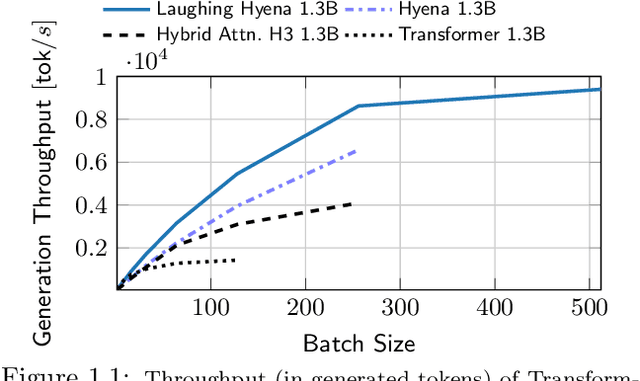
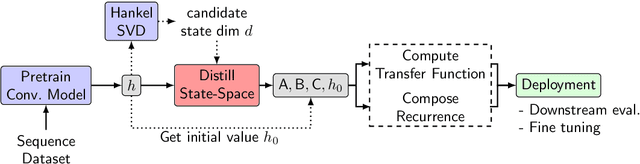
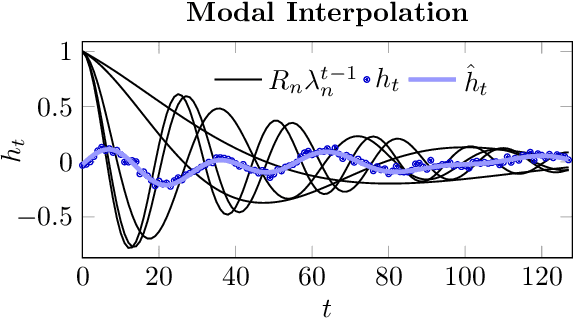
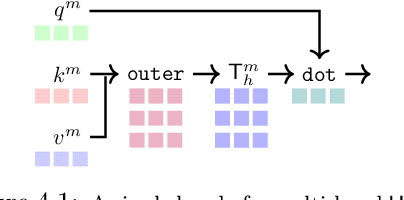
Recent advances in attention-free sequence models rely on convolutions as alternatives to the attention operator at the core of Transformers. In particular, long convolution sequence models have achieved state-of-the-art performance in many domains, but incur a significant cost during auto-regressive inference workloads -- naively requiring a full pass (or caching of activations) over the input sequence for each generated token -- similarly to attention-based models. In this paper, we seek to enable $\mathcal O(1)$ compute and memory cost per token in any pre-trained long convolution architecture to reduce memory footprint and increase throughput during generation. Concretely, our methods consist in extracting low-dimensional linear state-space models from each convolution layer, building upon rational interpolation and model-order reduction techniques. We further introduce architectural improvements to convolution-based layers such as Hyena: by weight-tying the filters across channels into heads, we achieve higher pre-training quality and reduce the number of filters to be distilled. The resulting model achieves 10x higher throughput than Transformers and 1.5x higher than Hyena at 1.3B parameters, without any loss in quality after distillation.