 Add to Chrome
 Add to Firefox
 Add to Edge
Improving Dialogue Agents by Decomposing One Global Explicit Annotation with Local Implicit Multimodal Feedback
Mar 17, 2024
We describe an approach for aligning an LLM-based dialogue agent based on global (i.e., dialogue-level) rewards, while also taking into account naturally-occurring multimodal signals. At a high level, our approach (dubbed GELI) learns a local, turn-level reward model by decomposing the human-provided Global Explicit (GE) session-level reward, using Local Implicit (LI} multimodal reward signals to crossmodally shape the reward decomposition step. This decomposed reward model is then used as part of the standard RHLF pipeline improve an LLM-based dialog agent. We run quantitative and qualitative human studies to evaluate the performance of our GELI approach, and find that it shows consistent improvements across various conversational metrics compared to baseline methods.

Learning to Decode Collaboratively with Multiple Language Models
Mar 06, 2024
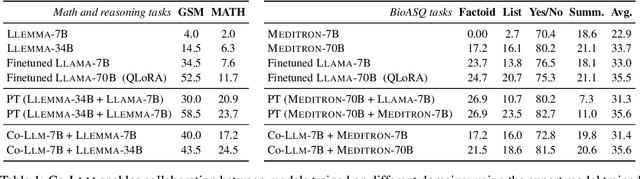
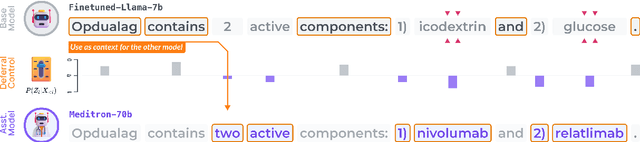

We propose a method to teach multiple large language models (LLM) to collaborate by interleaving their generations at the token level. We model the decision of which LLM generates the next token as a latent variable. By optimizing the marginal likelihood of a training set under our latent variable model, the base LLM automatically learns when to generate itself and when to call on one of the ``assistant'' language models to generate, all without direct supervision. Token-level collaboration during decoding allows for a fusion of each model's expertise in a manner tailored to the specific task at hand. Our collaborative decoding is especially useful in cross-domain settings where a generalist base LLM learns to invoke domain expert models. On instruction-following, domain-specific QA, and reasoning tasks, we show that the performance of the joint system exceeds that of the individual models. Through qualitative analysis of the learned latent decisions, we show models trained with our method exhibit several interesting collaboration patterns, e.g., template-filling. Our code is available at https://github.com/clinicalml/co-llm.
Can You Learn Semantics Through Next-Word Prediction? The Case of Entailment
Feb 29, 2024
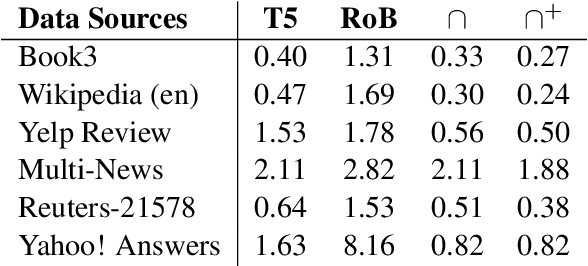

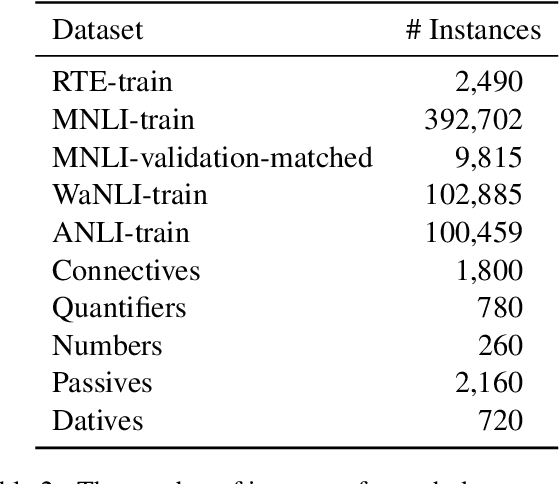
Do LMs infer the semantics of text from co-occurrence patterns in their training data? Merrill et al. (2022) argue that, in theory, probabilities predicted by an optimal LM encode semantic information about entailment relations, but it is unclear whether neural LMs trained on corpora learn entailment in this way because of strong idealizing assumptions made by Merrill et al. In this work, we investigate whether their theory can be used to decode entailment judgments from neural LMs. We find that a test similar to theirs can decode entailment relations between natural sentences, well above random chance, though not perfectly, across many datasets and LMs. This suggests LMs implicitly model aspects of semantics to predict semantic effects on sentence co-occurrence patterns. However, we find the test that predicts entailment in practice works in the opposite direction to the theoretical test. We thus revisit the assumptions underlying the original test, finding its derivation did not adequately account for redundancy in human-written text. We argue that correctly accounting for redundancy related to explanations might derive the observed flipped test and, more generally, improve linguistic theories of human speakers.
Leveraging Large Language Models for Learning Complex Legal Concepts through Storytelling
Feb 26, 2024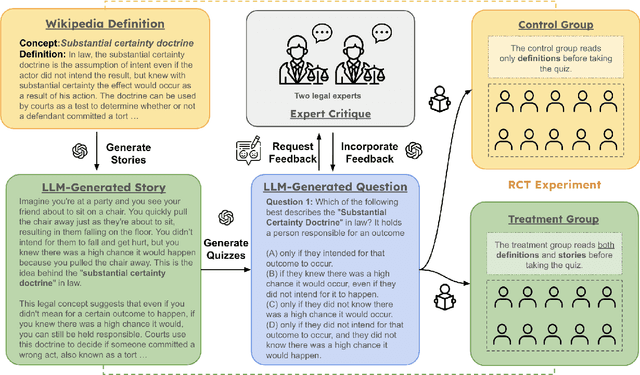

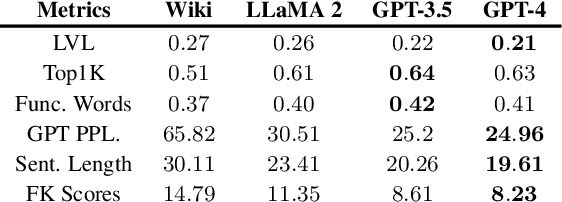
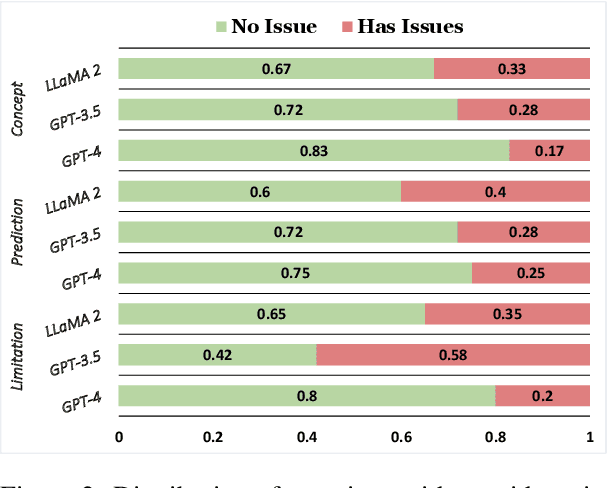
Making legal knowledge accessible to non-experts is crucial for enhancing general legal literacy and encouraging civic participation in democracy. However, legal documents are often challenging to understand for people without legal backgrounds. In this paper, we present a novel application of large language models (LLMs) in legal education to help non-experts learn intricate legal concepts through storytelling, an effective pedagogical tool in conveying complex and abstract concepts. We also introduce a new dataset LegalStories, which consists of 295 complex legal doctrines, each accompanied by a story and a set of multiple-choice questions generated by LLMs. To construct the dataset, we experiment with various LLMs to generate legal stories explaining these concepts. Furthermore, we use an expert-in-the-loop method to iteratively design multiple-choice questions. Then, we evaluate the effectiveness of storytelling with LLMs through an RCT experiment with legal novices on 10 samples from the dataset. We find that LLM-generated stories enhance comprehension of legal concepts and interest in law among non-native speakers compared to only definitions. Moreover, stories consistently help participants relate legal concepts to their lives. Finally, we find that learning with stories shows a higher retention rate for non-native speakers in the follow-up assessment. Our work has strong implications for using LLMs in promoting teaching and learning in the legal field and beyond.
What Do Language Models Hear? Probing for Auditory Representations in Language Models
Feb 26, 2024This work explores whether language models encode meaningfully grounded representations of sounds of objects. We learn a linear probe that retrieves the correct text representation of an object given a snippet of audio related to that object, where the sound representation is given by a pretrained audio model. This probe is trained via a contrastive loss that pushes the language representations and sound representations of an object to be close to one another. After training, the probe is tested on its ability to generalize to objects that were not seen during training. Across different language models and audio models, we find that the probe generalization is above chance in many cases, indicating that despite being trained only on raw text, language models encode grounded knowledge of sounds for some objects.
Improving Black-box Robustness with In-Context Rewriting
Feb 15, 2024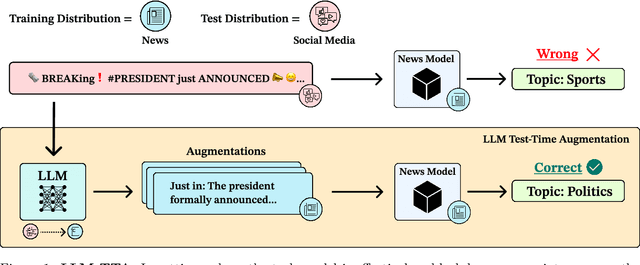

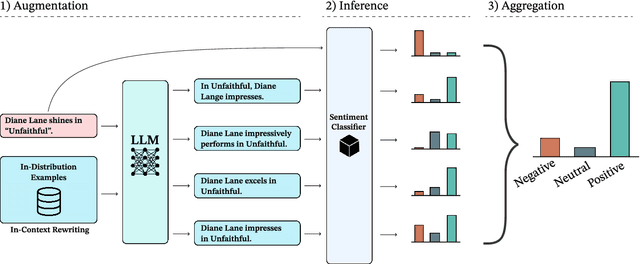
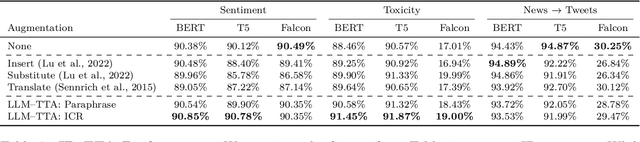
Machine learning models often excel on in-distribution (ID) data but struggle with unseen out-of-distribution (OOD) inputs. Most techniques for improving OOD robustness are not applicable to settings where the model is effectively a black box, such as when the weights are frozen, retraining is costly, or the model is leveraged via an API. Test-time augmentation (TTA) is a simple post-hoc technique for improving robustness that sidesteps black-box constraints by aggregating predictions across multiple augmentations of the test input. TTA has seen limited use in NLP due to the challenge of generating effective natural language augmentations. In this work, we propose LLM-TTA, which uses LLM-generated augmentations as TTA's augmentation function. LLM-TTA outperforms conventional augmentation functions across sentiment, toxicity, and news classification tasks for BERT and T5 models, with BERT's OOD robustness improving by an average of 4.30 percentage points without regressing average ID performance. We explore selectively augmenting inputs based on prediction entropy to reduce the rate of expensive LLM augmentations, allowing us to maintain performance gains while reducing the average number of generated augmentations by 57.76%. LLM-TTA is agnostic to the task model architecture, does not require OOD labels, and is effective across low and high-resource settings. We share our data, models, and code for reproducibility.
Data Engineering for Scaling Language Models to 128K Context
Feb 15, 2024We study the continual pretraining recipe for scaling language models' context lengths to 128K, with a focus on data engineering. We hypothesize that long context modeling, in particular \textit{the ability to utilize information at arbitrary input locations}, is a capability that is mostly already acquired through large-scale pretraining, and that this capability can be readily extended to contexts substantially longer than seen during training~(e.g., 4K to 128K) through lightweight continual pretraining on appropriate data mixture. We investigate the \textit{quantity} and \textit{quality} of the data for continual pretraining: (1) for quantity, we show that 500 million to 5 billion tokens are enough to enable the model to retrieve information anywhere within the 128K context; (2) for quality, our results equally emphasize \textit{domain balance} and \textit{length upsampling}. Concretely, we find that naively upsampling longer data on certain domains like books, a common practice of existing work, gives suboptimal performance, and that a balanced domain mixture is important. We demonstrate that continual pretraining of the full model on 1B-5B tokens of such data is an effective and affordable strategy for scaling the context length of language models to 128K. Our recipe outperforms strong open-source long-context models and closes the gap to frontier models like GPT-4 128K.
Diversity Measurement and Subset Selection for Instruction Tuning Datasets
Feb 04, 2024We aim to select data subsets for the fine-tuning of large language models to more effectively follow instructions. Prior work has emphasized the importance of diversity in dataset curation but relied on heuristics such as the number of tasks. In this paper, we use determinantal point processes to capture the diversity and quality of instruction tuning datasets for subset selection. We propose to measure dataset diversity with log determinant distance that is the distance between the dataset of interest and a maximally diverse reference dataset. Our experiments demonstrate that the proposed diversity measure in the normalized weight gradient space is correlated with downstream instruction-following performance. Consequently, it can be used to inform when data selection is the most helpful and to analyze dataset curation strategies. We demonstrate the utility of our approach on various instruction tuning datasets.
In-Context Language Learning: Architectures and Algorithms
Jan 30, 2024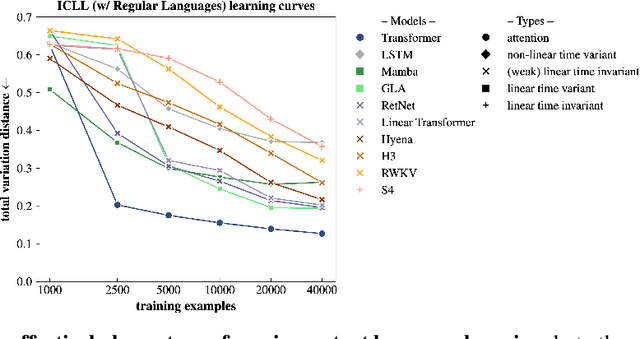
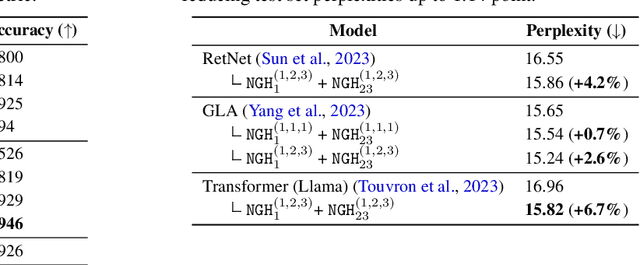

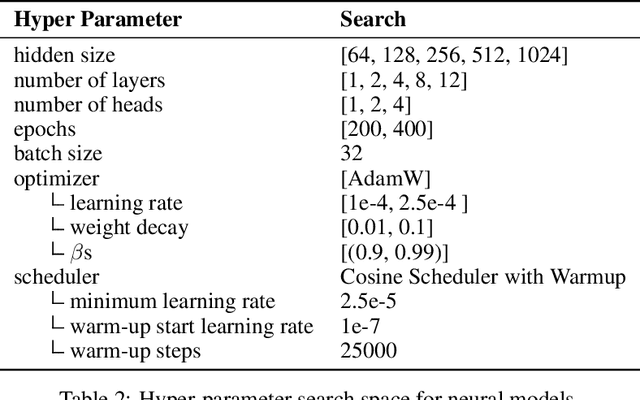
Large-scale neural language models exhibit a remarkable capacity for in-context learning (ICL): they can infer novel functions from datasets provided as input. Most of our current understanding of when and how ICL arises comes from LMs trained on extremely simple learning problems like linear regression and associative recall. There remains a significant gap between these model problems and the "real" ICL exhibited by LMs trained on large text corpora, which involves not just retrieval and function approximation but free-form generation of language and other structured outputs. In this paper, we study ICL through the lens of a new family of model problems we term in context language learning (ICLL). In ICLL, LMs are presented with a set of strings from a formal language, and must generate additional strings from the same language. We focus on in-context learning of regular languages generated by random finite automata. We evaluate a diverse set of neural sequence models (including several RNNs, Transformers, and state-space model variants) on regular ICLL tasks, aiming to answer three questions: (1) Which model classes are empirically capable of ICLL? (2) What algorithmic solutions do successful models implement to perform ICLL? (3) What architectural changes can improve ICLL in less performant models? We first show that Transformers significantly outperform neural sequence models with recurrent or convolutional representations on ICLL tasks. Next, we provide evidence that their ability to do so relies on specialized "n-gram heads" (higher-order variants of induction heads) that compute input-conditional next-token distributions. Finally, we show that hard-wiring these heads into neural models improves performance not just on ICLL, but natural language modeling -- improving the perplexity of 340M-parameter models by up to 1.14 points (6.7%) on the SlimPajama dataset.
Structured Code Representations Enable Data-Efficient Adaptation of Code Language Models
Jan 19, 2024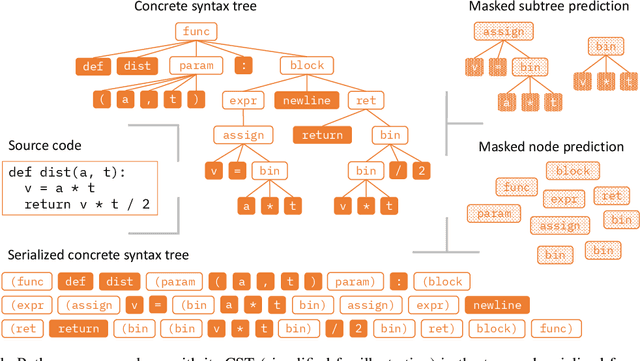
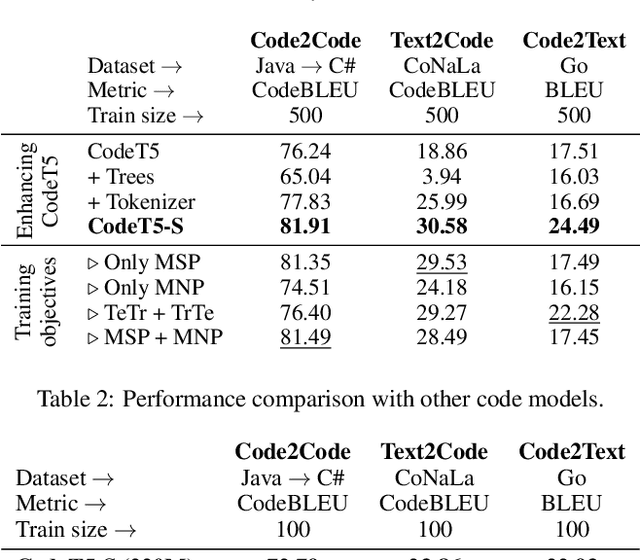
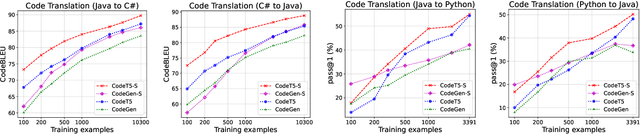
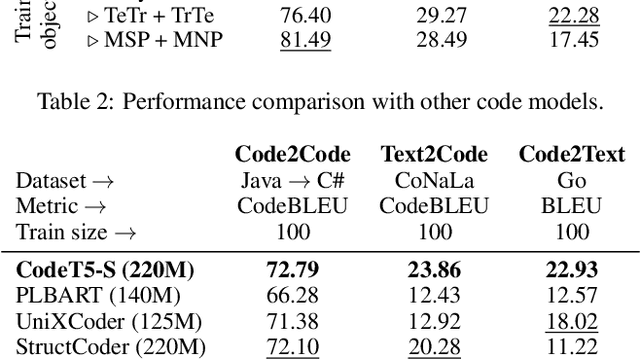
Current language models tailored for code tasks often adopt the pre-training-then-fine-tuning paradigm from natural language processing, modeling source code as plain text. This approach, however, overlooks the unambiguous structures inherent in programming languages. In this work, we explore data-efficient adaptation of pre-trained code models by further pre-training and fine-tuning them with program structures. Specifically, we represent programs as parse trees -- also known as concrete syntax trees (CSTs) -- and adapt pre-trained models on serialized CSTs. Although the models that we adapt have been pre-trained only on the surface form of programs, we find that a small amount of continual pre-training and fine-tuning on CSTs without changing the model architecture yields improvements over the baseline approach across various code tasks. The improvements are found to be particularly significant when there are limited training examples, demonstrating the effectiveness of integrating program structures with plain-text representation even when working with backbone models that have not been pre-trained with structures.