 Add to Chrome
 Add to Firefox
 Add to Edge
PIDP-Attack: Combining Prompt Injection with Database Poisoning Attacks on Retrieval-Augmented Generation Systems
Mar 26, 2026
Large Language Models (LLMs) have demonstrated remarkable performance across a wide range of applications. However, their practical deployment is often hindered by issues such as outdated knowledge and the tendency to generate hallucinations. To address these limitations, Retrieval-Augmented Generation (RAG) systems have been introduced, enhancing LLMs with external, up-to-date knowledge sources. Despite their advantages, RAG systems remain vulnerable to adversarial attacks, with data poisoning emerging as a prominent threat. Existing poisoning-based attacks typically require prior knowledge of the user's specific queries, limiting their flexibility and real-world applicability. In this work, we propose PIDP-Attack, a novel compound attack that integrates prompt injection with database poisoning in RAG. By appending malicious characters to queries at inference time and injecting a limited number of poisoned passages into the retrieval database, our method can effectively manipulate LLM response to arbitrary query without prior knowledge of the user's actual query. Experimental evaluations across three benchmark datasets (Natural Questions, HotpotQA, MS-MARCO) and eight LLMs demonstrate that PIDP-Attack consistently outperforms the original PoisonedRAG. Specifically, our method improves attack success rates by 4% to 16% on open-domain QA tasks while maintaining high retrieval precision, proving that the compound attack strategy is both necessary and highly effective.

Multi-Physics: A Comprehensive Benchmark for Multimodal LLMs Reasoning on Chinese Multi-Subject Physics Problems
Sep 19, 2025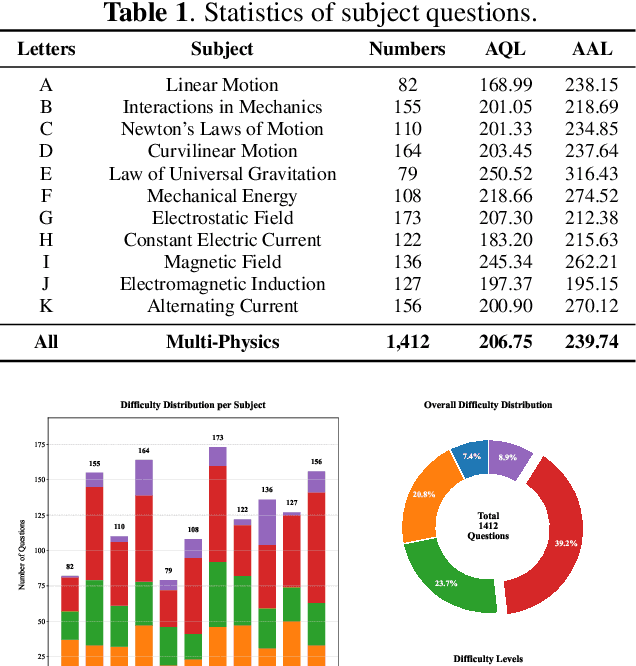
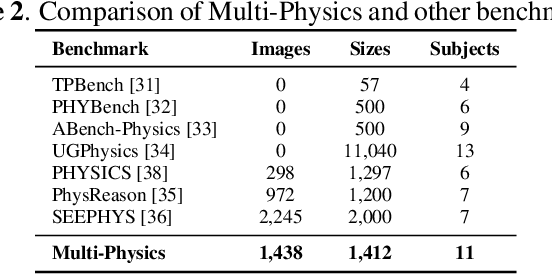
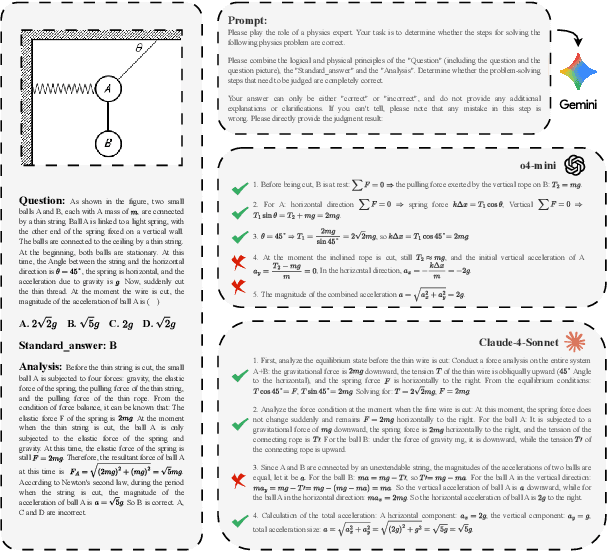
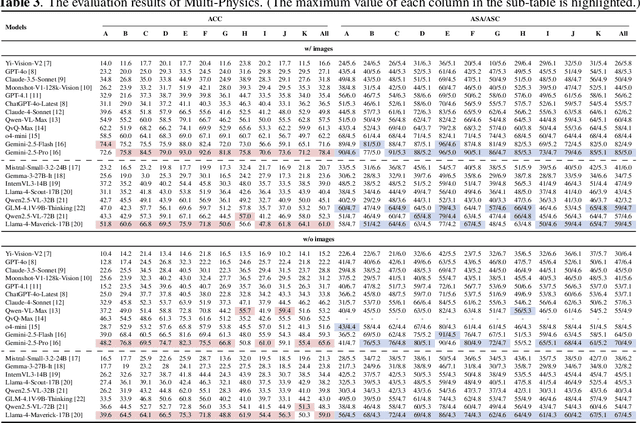
While multimodal LLMs (MLLMs) demonstrate remarkable reasoning progress, their application in specialized scientific domains like physics reveals significant gaps in current evaluation benchmarks. Specifically, existing benchmarks often lack fine-grained subject coverage, neglect the step-by-step reasoning process, and are predominantly English-centric, failing to systematically evaluate the role of visual information. Therefore, we introduce \textbf {Multi-Physics} for Chinese physics reasoning, a comprehensive benchmark that includes 5 difficulty levels, featuring 1,412 image-associated, multiple-choice questions spanning 11 high-school physics subjects. We employ a dual evaluation framework to evaluate 20 different MLLMs, analyzing both final answer accuracy and the step-by-step integrity of their chain-of-thought. Furthermore, we systematically study the impact of difficulty level and visual information by comparing the model performance before and after changing the input mode. Our work provides not only a fine-grained resource for the community but also offers a robust methodology for dissecting the multimodal reasoning process of state-of-the-art MLLMs, and our dataset and code have been open-sourced: https://github.com/luozhongze/Multi-Physics.