 Add to Chrome
 Add to Firefox
 Add to Edge
Protein Structure Prediction: From Evolutionary Constraints to Generative Modeling
Aug 17, 2026
Accurate protein structure prediction is fundamental to structural biology because protein structure underlies molecular function and provides a basis for mechanistic interpretation. Recent advances in deep learning have transformed the field from multiple sequence alignment (MSA)-driven monomer folding into broader frameworks capable of modeling protein complexes and increasingly heterogeneous molecular systems. Existing reviews have summarized this progress from the perspectives of representative models, application domains, and protein design. Building on these efforts, this review focuses on the methodological evolution of the field itself. It examines recent developments through three closely related dimensions: representations and data, architectures and learning strategies, and confidence and evaluation. Within this perspective, the field is organized into four methodological phases and three cross-cutting transitions: from explicit evolutionary coupling features and early contact prediction to learned sequence representations in AlphaFold2, RoseTTAFold, and ESMFold; from protein-only monomer folding to increasingly integrated modeling of heterogeneous molecular systems in AlphaFold-Multimer, RoseTTAFoldNA, and AlphaFold3; and, more recently, from prediction-oriented structure inference to design-oriented generative modeling in RFdiffusion and related frameworks. This framework provides a clearer understanding of how methodological shifts have shaped the capabilities, limitations, and practical roles of recent models.

Color Fundus Photography Analysis: Co-evolution of Data, Preprocessing, and Modeling toward Multimodal AI
Jul 27, 2026Color Fundus Photography (CFP) is a primary non-invasive imaging modality for large-scale screening of ophthalmic and systemic diseases. Existing surveys mainly summarize task-specific algorithms, datasets, or preprocessing techniques independently, lacking a unified perspective on their co-evolution with modern artificial intelligence. This review provides an integrated overview of CFP AI through the interplay of dataset evolution, preprocessing paradigms, and modeling frameworks. We show that CFP datasets have evolved from small single-center collections with task-specific labels to large multi-center resources featuring multimodal pairings and longitudinal clinical records. Preprocessing has progressed from conventional image enhancement to neural data-engineering pipelines, hardware-aware token optimization, and self-supervised imputation for incomplete electronic health records (EHRs). Meanwhile, modeling has advanced from convolutional neural networks (CNNs) to vision foundation models, state space models (SSMs), and multimodal expert architectures. At the multimodal frontier, CFP is increasingly integrated with EHRs and longitudinal patient information, enabling more comprehensive clinical reasoning beyond isolated image analysis. We conclude that future progress depends on the collaborative optimization of datasets, preprocessing, and multimodal modeling, providing a roadmap toward robust clinical deployment, improved cross-domain generalization, and resource-efficient edge intelligence.
Synergistic Foundation Models for Semi-Supervised Fetal Cardiac Ultrasound Analysis: SAM-Med2D Boundary Refinement and DINOv3 Semantic Enhancement
May 19, 2026We present a semi-supervised framework for joint segmentation and classification of fetal cardiac ultrasound images. Built upon the EchoCare multi-task backbone, our method integrates SAM-Med2D for boundary refinement and leverages DINOv3 to enhance pseudo-label quality. We introduce view-specific hard masking along with a two-stage optimization strategy: an EMA phase to consolidate segmentation capabilities, followed by a Classification Fine-Tuning phase that freezes segmentation parameters and resets the classification head to recover classification performance without compromising segmentation gains. Evaluated on the FETUS 2026 leaderboard, our method achieves a Dice Similarity Coefficient at 79.99%, Normalized Surface Distance at 61.62%, and F1-score at 41.20%, validating the effectiveness of our approach for prenatal congenital heart disease screening. Source code is publicly available at: https://github.com/2826056177/zcst_fetus2026.
Design and Control of a Perching Drone Inspired by the Prey-Capturing Mechanism of Venus Flytrap
Sep 16, 2025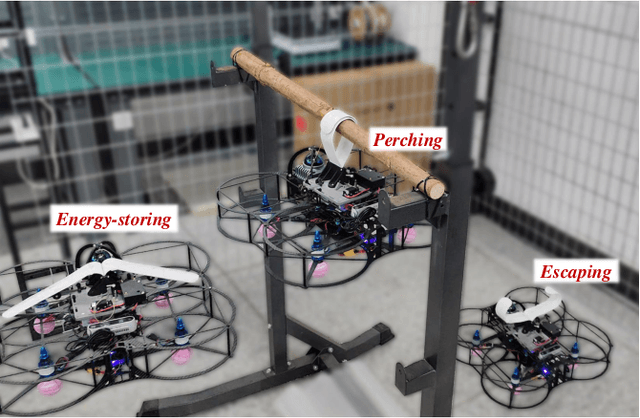
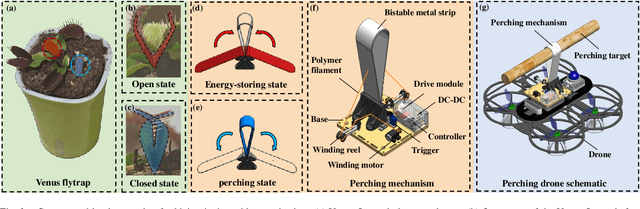
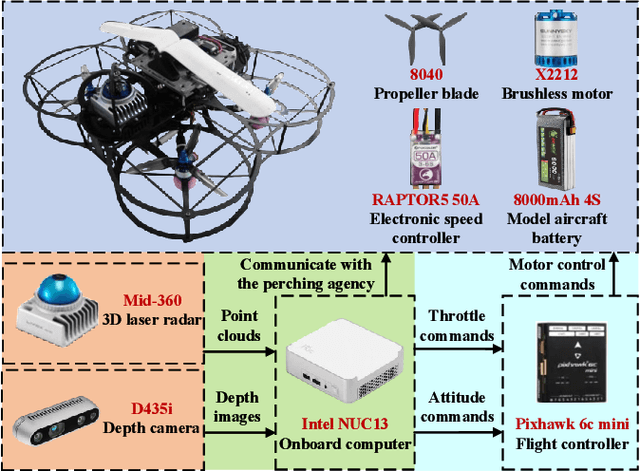
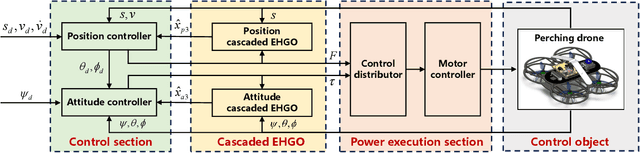
The endurance and energy efficiency of drones remain critical challenges in their design and operation. To extend mission duration, numerous studies explored perching mechanisms that enable drones to conserve energy by temporarily suspending flight. This paper presents a new perching drone that utilizes an active flexible perching mechanism inspired by the rapid predation mechanism of the Venus flytrap, achieving perching in less than 100 ms. The proposed system is designed for high-speed adaptability to the perching targets. The overall drone design is outlined, followed by the development and validation of the biomimetic perching structure. To enhance the system stability, a cascade extended high-gain observer (EHGO) based control method is developed, which can estimate and compensate for the external disturbance in real time. The experimental results demonstrate the adaptability of the perching structure and the superiority of the cascaded EHGO in resisting wind and perching disturbances.
Hierarchical Neural Architecture Search for Single Image Super-Resolution
Mar 10, 2020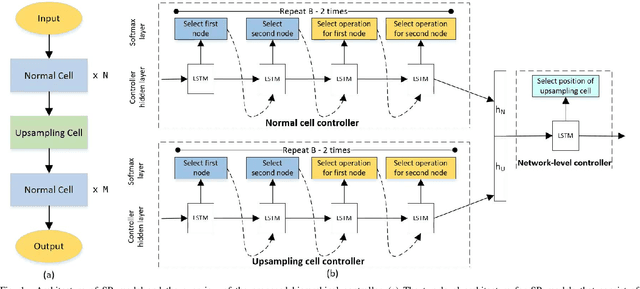
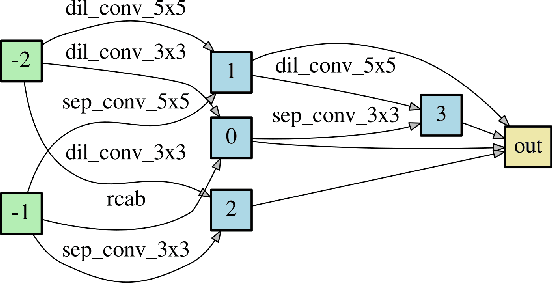
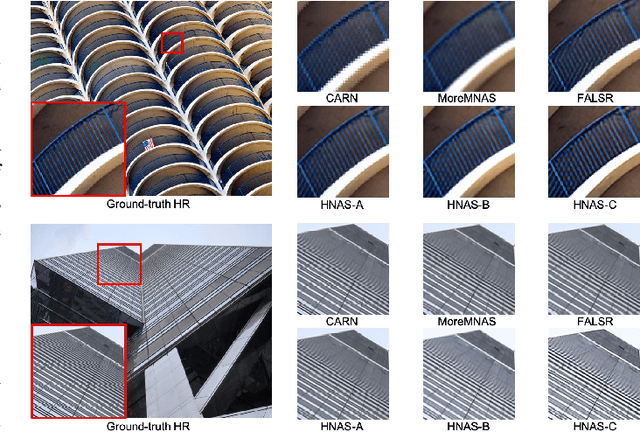
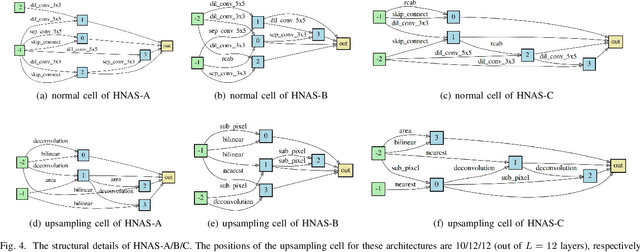
Deep neural networks have exhibited promising performance in image super-resolution (SR). Most SR models follow a hierarchical architecture that contains both the cell-level design of computational blocks and the network-level design of the positions of upsampling blocks. However, designing SR models heavily relies on human expertise and is very labor-intensive. More critically, these SR models often contain a huge number of parameters and may not meet the requirements of computation resources in real-world applications. To address the above issues, we propose a Hierarchical Neural Architecture Search (HNAS) method to automatically design promising architectures with different requirements of computation cost. To this end, we design a hierarchical SR search space and propose a hierarchical controller for architecture search. Such a hierarchical controller is able to simultaneously find promising cell-level blocks and network-level positions of upsampling layers. Moreover, to design compact architectures with promising performance, we build a joint reward by considering both the performance and computation cost to guide the search process. Extensive experiments on five benchmark datasets demonstrate the superiority of our method over existing methods.