 Add to Chrome
 Add to Firefox
 Add to Edge
Protein Structure Prediction: From Evolutionary Constraints to Generative Modeling
Aug 17, 2026
Accurate protein structure prediction is fundamental to structural biology because protein structure underlies molecular function and provides a basis for mechanistic interpretation. Recent advances in deep learning have transformed the field from multiple sequence alignment (MSA)-driven monomer folding into broader frameworks capable of modeling protein complexes and increasingly heterogeneous molecular systems. Existing reviews have summarized this progress from the perspectives of representative models, application domains, and protein design. Building on these efforts, this review focuses on the methodological evolution of the field itself. It examines recent developments through three closely related dimensions: representations and data, architectures and learning strategies, and confidence and evaluation. Within this perspective, the field is organized into four methodological phases and three cross-cutting transitions: from explicit evolutionary coupling features and early contact prediction to learned sequence representations in AlphaFold2, RoseTTAFold, and ESMFold; from protein-only monomer folding to increasingly integrated modeling of heterogeneous molecular systems in AlphaFold-Multimer, RoseTTAFoldNA, and AlphaFold3; and, more recently, from prediction-oriented structure inference to design-oriented generative modeling in RFdiffusion and related frameworks. This framework provides a clearer understanding of how methodological shifts have shaped the capabilities, limitations, and practical roles of recent models.

Color Fundus Photography Analysis: Co-evolution of Data, Preprocessing, and Modeling toward Multimodal AI
Jul 27, 2026Color Fundus Photography (CFP) is a primary non-invasive imaging modality for large-scale screening of ophthalmic and systemic diseases. Existing surveys mainly summarize task-specific algorithms, datasets, or preprocessing techniques independently, lacking a unified perspective on their co-evolution with modern artificial intelligence. This review provides an integrated overview of CFP AI through the interplay of dataset evolution, preprocessing paradigms, and modeling frameworks. We show that CFP datasets have evolved from small single-center collections with task-specific labels to large multi-center resources featuring multimodal pairings and longitudinal clinical records. Preprocessing has progressed from conventional image enhancement to neural data-engineering pipelines, hardware-aware token optimization, and self-supervised imputation for incomplete electronic health records (EHRs). Meanwhile, modeling has advanced from convolutional neural networks (CNNs) to vision foundation models, state space models (SSMs), and multimodal expert architectures. At the multimodal frontier, CFP is increasingly integrated with EHRs and longitudinal patient information, enabling more comprehensive clinical reasoning beyond isolated image analysis. We conclude that future progress depends on the collaborative optimization of datasets, preprocessing, and multimodal modeling, providing a roadmap toward robust clinical deployment, improved cross-domain generalization, and resource-efficient edge intelligence.
S1-Omni: A Unified Multimodal Reasoning Model for Scientific Understanding, Prediction, and Generation
Jul 17, 2026We present S1-Omni, a unified multimodal reasoning model for scientific understanding, prediction, and generation. AI for Science (AI4S) has advanced significantly through domain-specific models, tool-augmented LLMs, and scientific language models. However, model capabilities remain highly fragmented, limiting the joint modeling of heterogeneous data, scientific laws, and expert knowledge. S1-Omni addresses this gap by consolidating these capabilities into a single, coherent scientific reasoning model. The architecture of S1-Omni is built upon three core components: unified representation of scientific data, natural-world knowledge alignment, and decoding for domain-specific tasks. First, S1-Omni maps natural-language instructions and scientific objects, including CIF, SMILES, protein sequences, spectra, and scientific images, into a shared representation space. Second, it incorporates scientific laws and expert knowledge into data construction and training, enabling the model to reason from scientific evidence. Third, it performs task-specific decoding to support a broad range of applications, including property prediction, spectrum-to-molecular generation, protein site and structure prediction, and scientific image generation and editing. S1-Omni is trained on S1-Omni-Corpus, which covers 200 scientific tasks and contains millions of reasoning samples, and is evaluated on over 60 scientific benchmarks. It outperforms GPT-5.5 and Gemini-3.1-Pro on most benchmarks and matches or surpasses domain-specific models on several benchmarks. Overall, S1-Omni provides a practical path toward unified scientific modeling.
A high-performance reconstruction method for partially coherent ptychography
Jun 09, 2024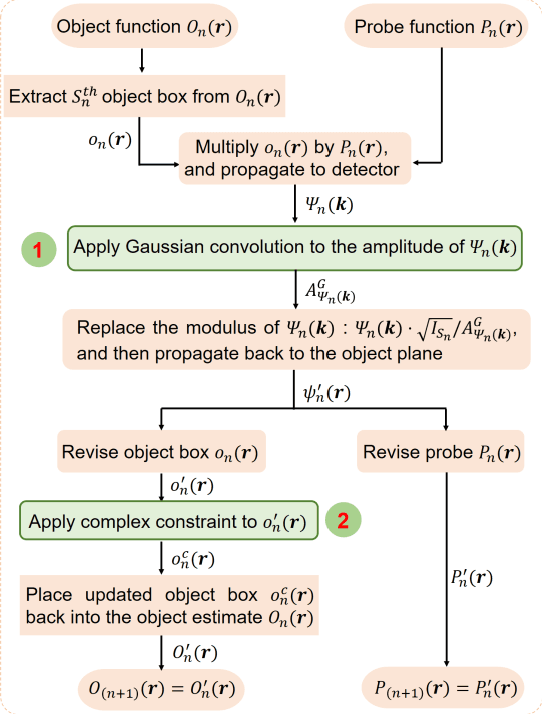
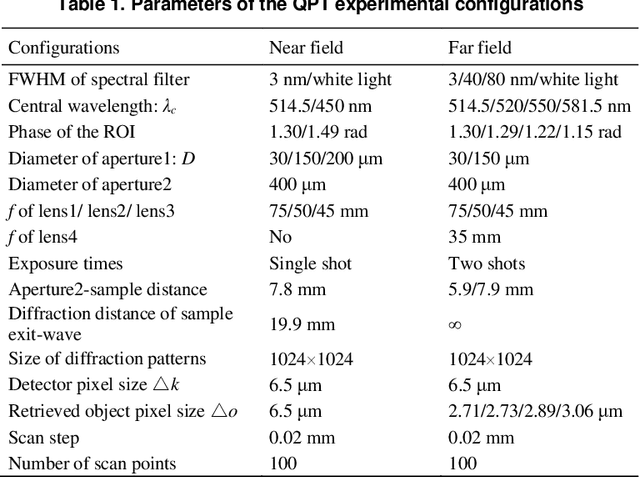
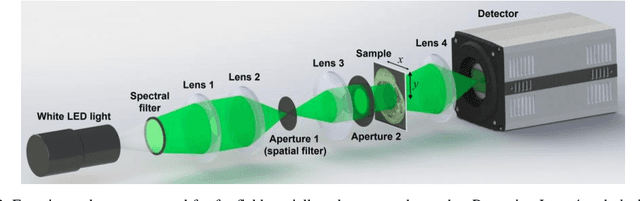
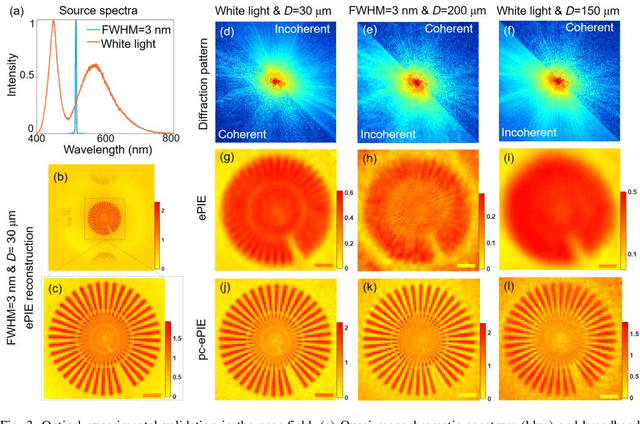
Ptychography is now integrated as a tool in mainstream microscopy allowing quantitative and high-resolution imaging capabilities over a wide field of view. However, its ultimate performance is inevitably limited by the available coherent flux when implemented using electrons or laboratory X-ray sources. We present a universal reconstruction algorithm with high tolerance to low coherence for both far-field and near-field ptychography. The approach is practical for partial temporal and spatial coherence and requires no prior knowledge of the source properties. Our initial visible-light and electron data show that the method can dramatically improve the reconstruction quality and accelerate the convergence rate of the reconstruction. The approach also integrates well into existing ptychographic engines. It can also improve mixed-state and numerical monochromatisation methods, requiring a smaller number of coherent modes or lower dimensionality of Krylov subspace while providing more stable and faster convergence. We propose that this approach could have significant impact on ptychography of weakly scattering samples.
An Integrated Constrained Gradient Descent (iCGD) Protocol to Correct Scan-Positional Errors for Electron Ptychography with High Accuracy and Precision
Nov 06, 2022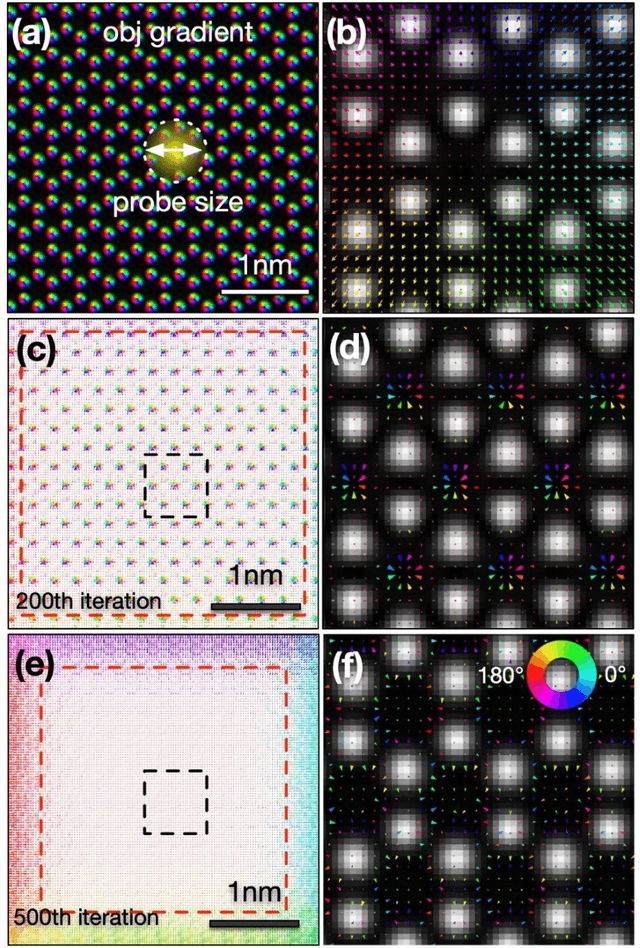
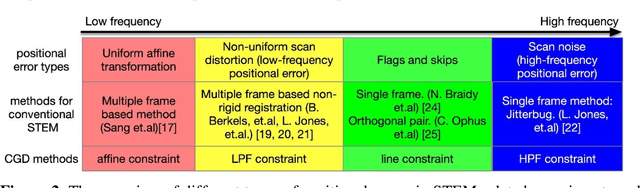
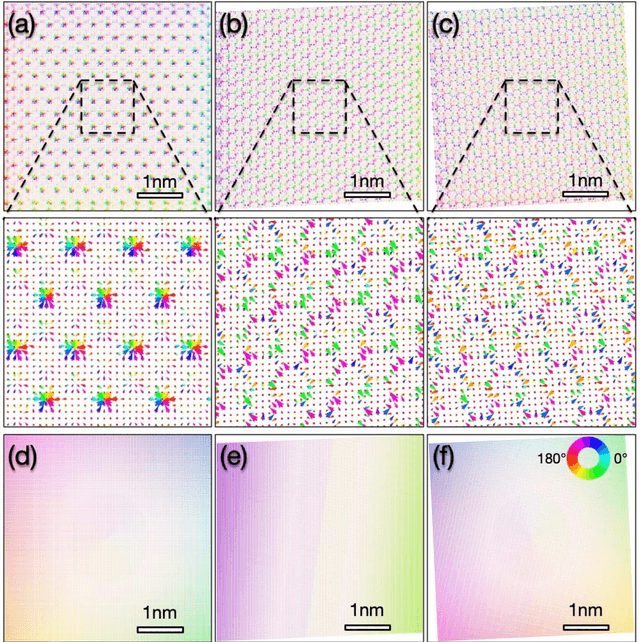
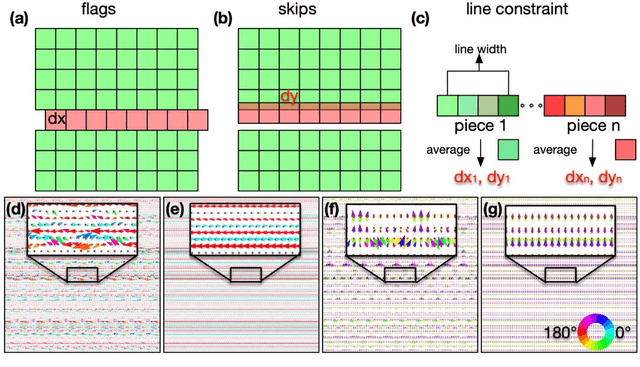
Correcting scan-positional errors is critical in achieving electron ptychography with both high resolution and high precision. This is a demanding and challenging task due to the sheer number of parameters that need to be optimized. For atomic-resolution ptychographic reconstructions, we found classical refining methods for scan positions not satisfactory due to the inherent entanglement between the object and scan positions, which can produce systematic errors in the results. Here, we propose a new protocol consisting of a series of constrained gradient descent (CGD) methods to achieve better recovery of scan positions. The central idea of these CGD methods is to utilize a priori knowledge about the nature of STEM experiments and add necessary constraints to isolate different types of scan positional errors during the iterative reconstruction process. Each constraint will be introduced with the help of simulated 4D-STEM datasets with known positional errors. Then the integrated constrained gradient decent (iCGD) protocol will be demonstrated using an experimental 4D-STEM dataset of the 1H-MoS2 monolayer. We will show that the iCGD protocol can effectively address the errors of scan positions across the spectrum and help to achieve electron ptychography with high accuracy and precision.
Effective Actor-centric Human-object Interaction Detection
Feb 24, 2022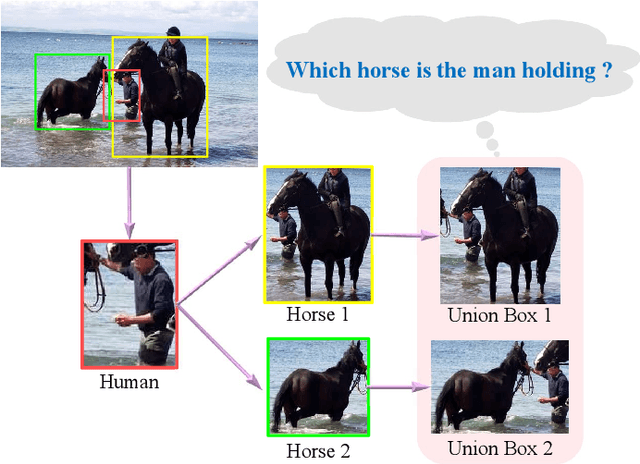
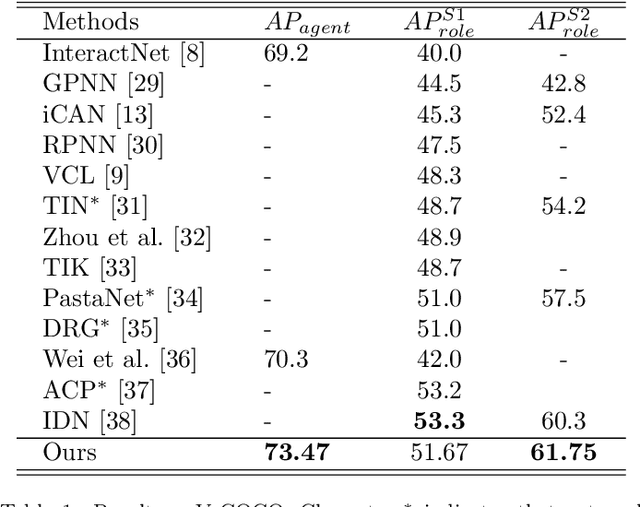
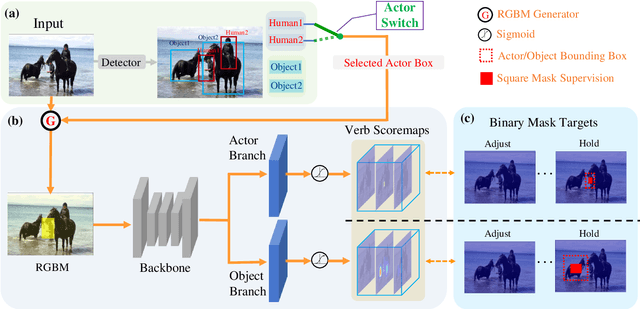
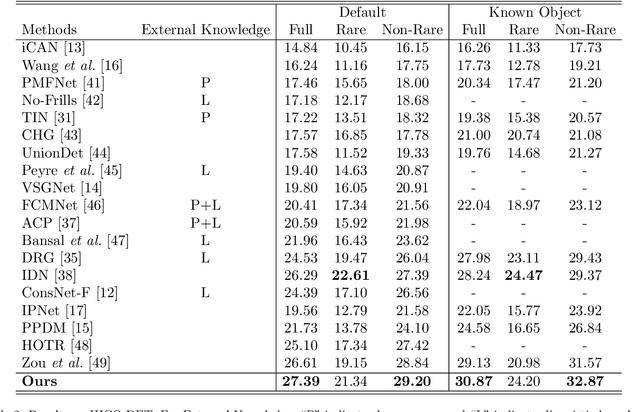
While Human-Object Interaction(HOI) Detection has achieved tremendous advances in recent, it still remains challenging due to complex interactions with multiple humans and objects occurring in images, which would inevitably lead to ambiguities. Most existing methods either generate all human-object pair candidates and infer their relationships by cropped local features successively in a two-stage manner, or directly predict interaction points in a one-stage procedure. However, the lack of spatial configurations or reasoning steps of two- or one- stage methods respectively limits their performance in such complex scenes. To avoid this ambiguity, we propose a novel actor-centric framework. The main ideas are that when inferring interactions: 1) the non-local features of the entire image guided by actor position are obtained to model the relationship between the actor and context, and then 2) we use an object branch to generate pixel-wise interaction area prediction, where the interaction area denotes the object central area. Moreover, we also use an actor branch to get interaction prediction of the actor and propose a novel composition strategy based on center-point indexing to generate the final HOI prediction. Thanks to the usage of the non-local features and the partly-coupled property of the human-objects composition strategy, our proposed framework can detect HOI more accurately especially for complex images. Extensive experimental results show that our method achieves the state-of-the-art on the challenging V-COCO and HICO-DET benchmarks and is more robust especially in multiple persons and/or objects scenes.
Learning Oriented Remote Sensing Object Detection via Naive Geometric Computing
Dec 01, 2021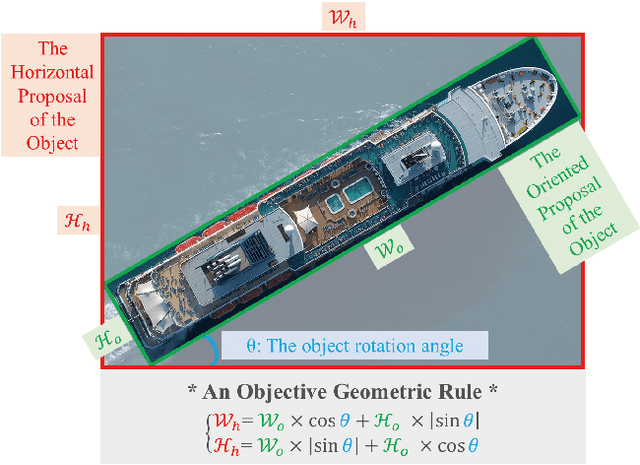
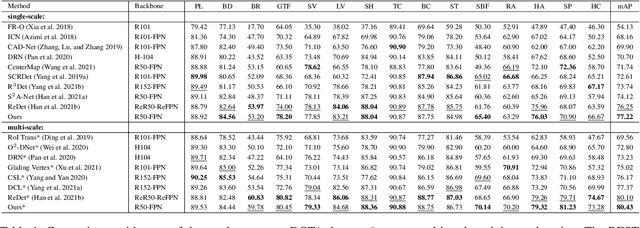
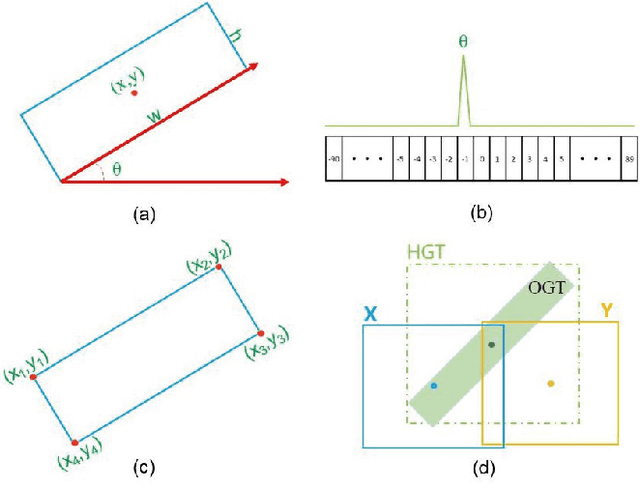
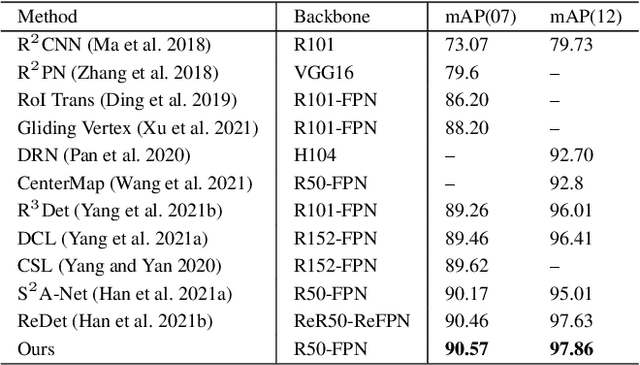
Detecting oriented objects along with estimating their rotation information is one crucial step for analyzing remote sensing images. Despite that many methods proposed recently have achieved remarkable performance, most of them directly learn to predict object directions under the supervision of only one (e.g. the rotation angle) or a few (e.g. several coordinates) groundtruth values individually. Oriented object detection would be more accurate and robust if extra constraints, with respect to proposal and rotation information regression, are adopted for joint supervision during training. To this end, we innovatively propose a mechanism that simultaneously learns the regression of horizontal proposals, oriented proposals, and rotation angles of objects in a consistent manner, via naive geometric computing, as one additional steady constraint (see Figure 1). An oriented center prior guided label assignment strategy is proposed for further enhancing the quality of proposals, yielding better performance. Extensive experiments demonstrate the model equipped with our idea significantly outperforms the baseline by a large margin to achieve a new state-of-the-art result without any extra computational burden during inference. Our proposed idea is simple and intuitive that can be readily implemented. Source codes and trained models are involved in supplementary files.