 Add to Chrome
 Add to Firefox
 Add to Edge
Machine Learning Insides OptVerse AI Solver: Design Principles and Applications
Jan 17, 2024


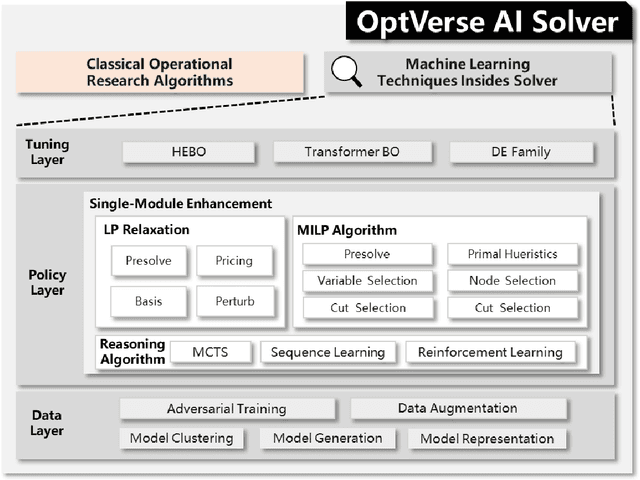
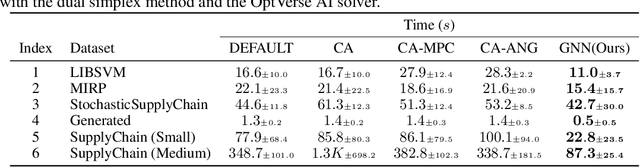
In an era of digital ubiquity, efficient resource management and decision-making are paramount across numerous industries. To this end, we present a comprehensive study on the integration of machine learning (ML) techniques into Huawei Cloud's OptVerse AI Solver, which aims to mitigate the scarcity of real-world mathematical programming instances, and to surpass the capabilities of traditional optimization techniques. We showcase our methods for generating complex SAT and MILP instances utilizing generative models that mirror multifaceted structures of real-world problem. Furthermore, we introduce a training framework leveraging augmentation policies to maintain solvers' utility in dynamic environments. Besides the data generation and augmentation, our proposed approaches also include novel ML-driven policies for personalized solver strategies, with an emphasis on applications like graph convolutional networks for initial basis selection and reinforcement learning for advanced presolving and cut selection. Additionally, we detail the incorporation of state-of-the-art parameter tuning algorithms which markedly elevate solver performance. Compared with traditional solvers such as Cplex and SCIP, our ML-augmented OptVerse AI Solver demonstrates superior speed and precision across both established benchmarks and real-world scenarios, reinforcing the practical imperative and effectiveness of machine learning techniques in mathematical programming solvers.

Artificial Intelligence for Operations Research: Revolutionizing the Operations Research Process
Jan 06, 2024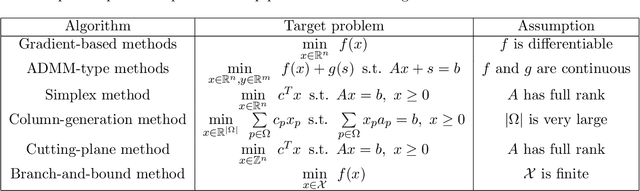
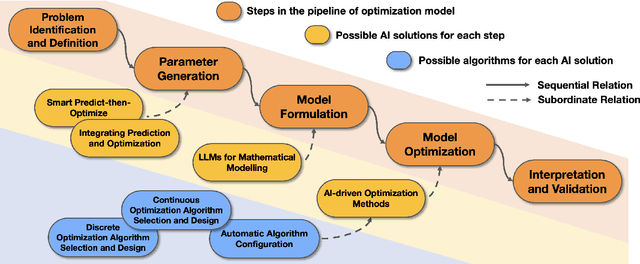
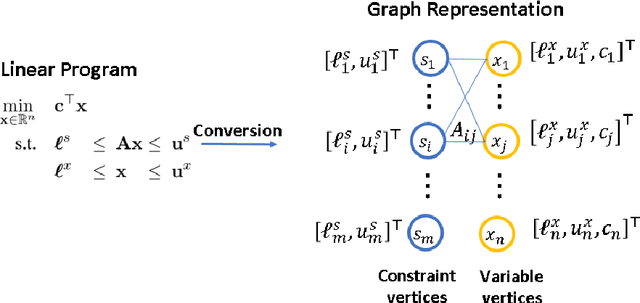
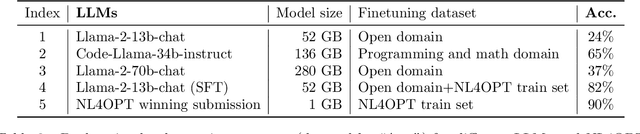
The rapid advancement of artificial intelligence (AI) techniques has opened up new opportunities to revolutionize various fields, including operations research (OR). This survey paper explores the integration of AI within the OR process (AI4OR) to enhance its effectiveness and efficiency across multiple stages, such as parameter generation, model formulation, and model optimization. By providing a comprehensive overview of the state-of-the-art and examining the potential of AI to transform OR, this paper aims to inspire further research and innovation in the development of AI-enhanced OR methods and tools. The synergy between AI and OR is poised to drive significant advancements and novel solutions in a multitude of domains, ultimately leading to more effective and efficient decision-making.
AnimateZero: Video Diffusion Models are Zero-Shot Image Animators
Dec 06, 2023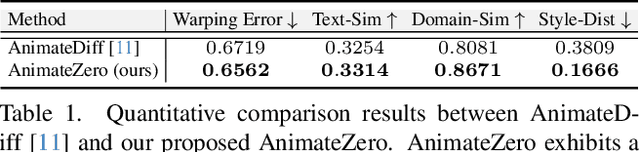


Large-scale text-to-video (T2V) diffusion models have great progress in recent years in terms of visual quality, motion and temporal consistency. However, the generation process is still a black box, where all attributes (e.g., appearance, motion) are learned and generated jointly without precise control ability other than rough text descriptions. Inspired by image animation which decouples the video as one specific appearance with the corresponding motion, we propose AnimateZero to unveil the pre-trained text-to-video diffusion model, i.e., AnimateDiff, and provide more precise appearance and motion control abilities for it. For appearance control, we borrow intermediate latents and their features from the text-to-image (T2I) generation for ensuring the generated first frame is equal to the given generated image. For temporal control, we replace the global temporal attention of the original T2V model with our proposed positional-corrected window attention to ensure other frames align with the first frame well. Empowered by the proposed methods, AnimateZero can successfully control the generating progress without further training. As a zero-shot image animator for given images, AnimateZero also enables multiple new applications, including interactive video generation and real image animation. The detailed experiments demonstrate the effectiveness of the proposed method in both T2V and related applications.
E4SRec: An Elegant Effective Efficient Extensible Solution of Large Language Models for Sequential Recommendation
Dec 05, 2023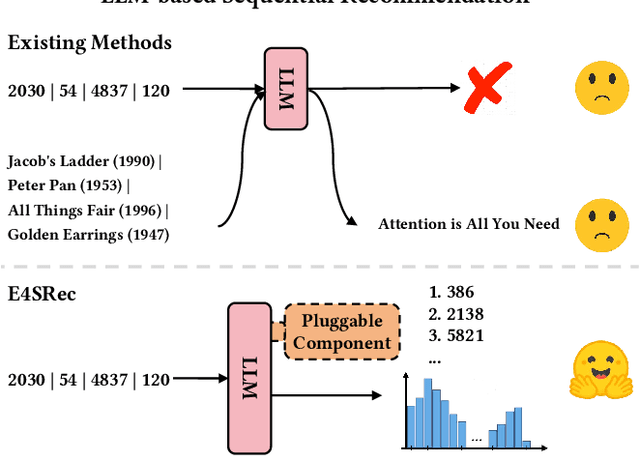
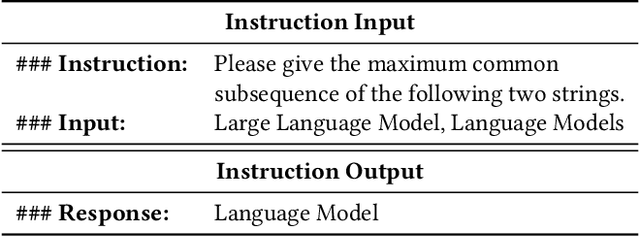
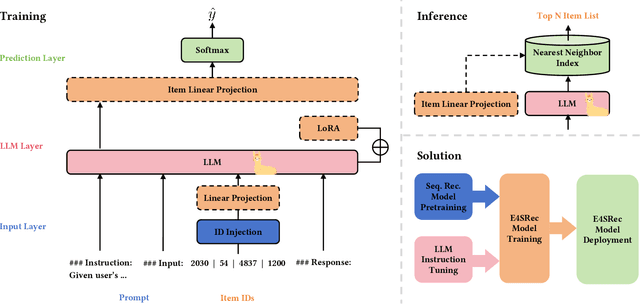
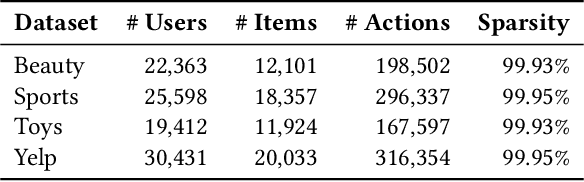
The recent advancements in Large Language Models (LLMs) have sparked interest in harnessing their potential within recommender systems. Since LLMs are designed for natural language tasks, existing recommendation approaches have predominantly transformed recommendation tasks into open-domain natural language generation tasks. However, this approach necessitates items to possess rich semantic information, often generates out-of-range results, and suffers from notably low efficiency and limited extensibility. Furthermore, practical ID-based recommendation strategies, reliant on a huge number of unique identities (IDs) to represent users and items, have gained prominence in real-world recommender systems due to their effectiveness and efficiency. Nevertheless, the incapacity of LLMs to model IDs presents a formidable challenge when seeking to leverage LLMs for personalized recommendations. In this paper, we introduce an Elegant Effective Efficient Extensible solution for large language models for Sequential Recommendation (E4SRec), which seamlessly integrates LLMs with traditional recommender systems that exclusively utilize IDs to represent items. Specifically, E4SRec takes ID sequences as inputs, ensuring that the generated outputs fall within the candidate lists. Furthermore, E4SRec possesses the capability to generate the entire ranking list in a single forward process, and demands only a minimal set of pluggable parameters, which are trained for each dataset while keeping the entire LLM frozen. We substantiate the effectiveness, efficiency, and extensibility of our proposed E4SRec through comprehensive experiments conducted on four widely-used real-world datasets. The implementation code is accessible at https://github.com/HestiaSky/E4SRec/.
StyleCrafter: Enhancing Stylized Text-to-Video Generation with Style Adapter
Dec 01, 2023


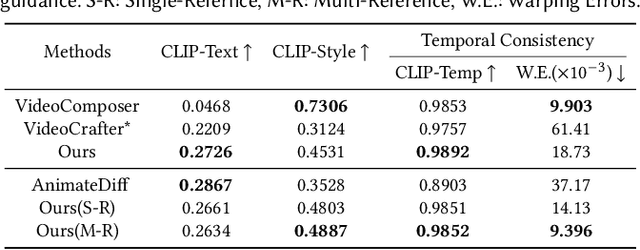
Text-to-video (T2V) models have shown remarkable capabilities in generating diverse videos. However, they struggle to produce user-desired stylized videos due to (i) text's inherent clumsiness in expressing specific styles and (ii) the generally degraded style fidelity. To address these challenges, we introduce StyleCrafter, a generic method that enhances pre-trained T2V models with a style control adapter, enabling video generation in any style by providing a reference image. Considering the scarcity of stylized video datasets, we propose to first train a style control adapter using style-rich image datasets, then transfer the learned stylization ability to video generation through a tailor-made finetuning paradigm. To promote content-style disentanglement, we remove style descriptions from the text prompt and extract style information solely from the reference image using a decoupling learning strategy. Additionally, we design a scale-adaptive fusion module to balance the influences of text-based content features and image-based style features, which helps generalization across various text and style combinations. StyleCrafter efficiently generates high-quality stylized videos that align with the content of the texts and resemble the style of the reference images. Experiments demonstrate that our approach is more flexible and efficient than existing competitors.
ChatTraffic: Text-to-Traffic Generation via Diffusion Model
Nov 29, 2023Traffic prediction is one of the most significant foundations in Intelligent Transportation Systems (ITS). Traditional traffic prediction methods rely only on historical traffic data to predict traffic trends and face two main challenges. 1) insensitivity to unusual events. 2) poor performance in long-term prediction. In this work, we explore how generative models combined with text describing the traffic system can be applied for traffic generation and name the task Text-to-Traffic Generation (TTG). The key challenge of the TTG task is how to associate text with the spatial structure of the road network and traffic data for generating traffic situations. To this end, we propose ChatTraffic, the first diffusion model for text-to-traffic generation. To guarantee the consistency between synthetic and real data, we augment a diffusion model with the Graph Convolutional Network (GCN) to extract spatial correlations of traffic data. In addition, we construct a large dataset containing text-traffic pairs for the TTG task. We benchmarked our model qualitatively and quantitatively on the released dataset. The experimental results indicate that ChatTraffic can generate realistic traffic situations from the text. Our code and dataset are available at https://github.com/ChyaZhang/ChatTraffic.
Exact Combinatorial Optimization with Temporo-Attentional Graph Neural Networks
Nov 23, 2023Combinatorial optimization finds an optimal solution within a discrete set of variables and constraints. The field has seen tremendous progress both in research and industry. With the success of deep learning in the past decade, a recent trend in combinatorial optimization has been to improve state-of-the-art combinatorial optimization solvers by replacing key heuristic components with machine learning (ML) models. In this paper, we investigate two essential aspects of machine learning algorithms for combinatorial optimization: temporal characteristics and attention. We argue that for the task of variable selection in the branch-and-bound (B&B) algorithm, incorporating the temporal information as well as the bipartite graph attention improves the solver's performance. We support our claims with intuitions and numerical results over several standard datasets used in the literature and competitions. Code is available at: https://developer.huaweicloud.com/develop/aigallery/notebook/detail?id=047c6cf2-8463-40d7-b92f-7b2ca998e935
* ECML PKDD 2023
VideoCrafter1: Open Diffusion Models for High-Quality Video Generation
Oct 30, 2023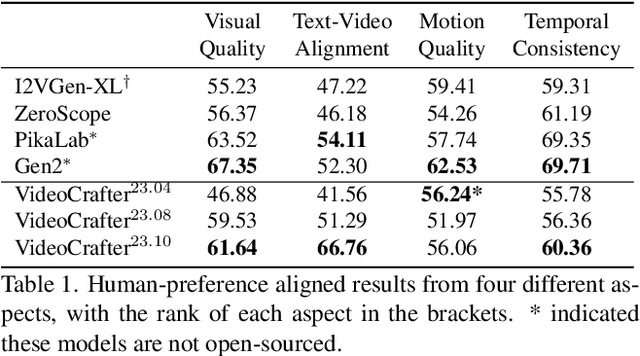
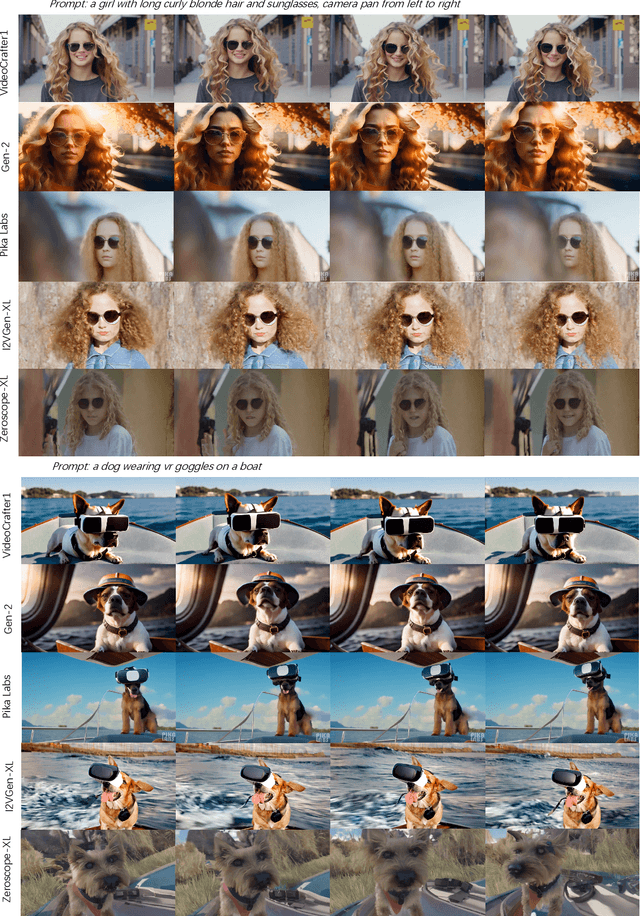
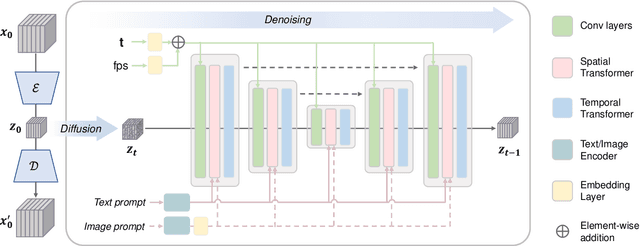
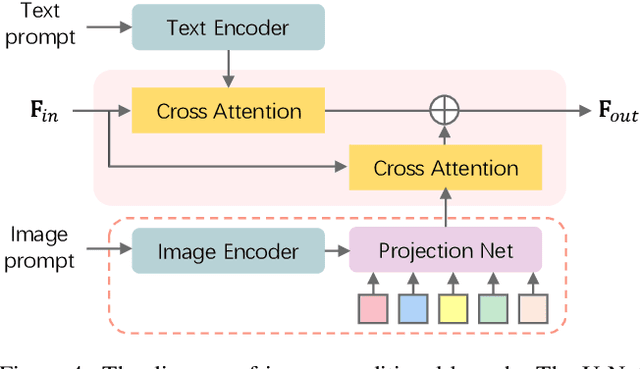
Video generation has increasingly gained interest in both academia and industry. Although commercial tools can generate plausible videos, there is a limited number of open-source models available for researchers and engineers. In this work, we introduce two diffusion models for high-quality video generation, namely text-to-video (T2V) and image-to-video (I2V) models. T2V models synthesize a video based on a given text input, while I2V models incorporate an additional image input. Our proposed T2V model can generate realistic and cinematic-quality videos with a resolution of $1024 \times 576$, outperforming other open-source T2V models in terms of quality. The I2V model is designed to produce videos that strictly adhere to the content of the provided reference image, preserving its content, structure, and style. This model is the first open-source I2V foundation model capable of transforming a given image into a video clip while maintaining content preservation constraints. We believe that these open-source video generation models will contribute significantly to the technological advancements within the community.
FreeNoise: Tuning-Free Longer Video Diffusion via Noise Rescheduling
Oct 27, 2023

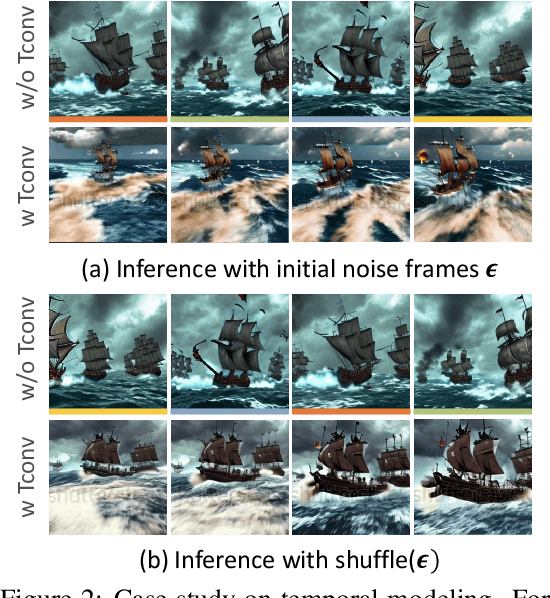

With the availability of large-scale video datasets and the advances of diffusion models, text-driven video generation has achieved substantial progress. However, existing video generation models are typically trained on a limited number of frames, resulting in the inability to generate high-fidelity long videos during inference. Furthermore, these models only support single-text conditions, whereas real-life scenarios often require multi-text conditions as the video content changes over time. To tackle these challenges, this study explores the potential of extending the text-driven capability to generate longer videos conditioned on multiple texts. 1) We first analyze the impact of initial noise in video diffusion models. Then building upon the observation of noise, we propose FreeNoise, a tuning-free and time-efficient paradigm to enhance the generative capabilities of pretrained video diffusion models while preserving content consistency. Specifically, instead of initializing noises for all frames, we reschedule a sequence of noises for long-range correlation and perform temporal attention over them by window-based function. 2) Additionally, we design a novel motion injection method to support the generation of videos conditioned on multiple text prompts. Extensive experiments validate the superiority of our paradigm in extending the generative capabilities of video diffusion models. It is noteworthy that compared with the previous best-performing method which brought about 255% extra time cost, our method incurs only negligible time cost of approximately 17%. Generated video samples are available at our website: http://haonanqiu.com/projects/FreeNoise.html.
ArchBERT: Bi-Modal Understanding of Neural Architectures and Natural Languages
Oct 26, 2023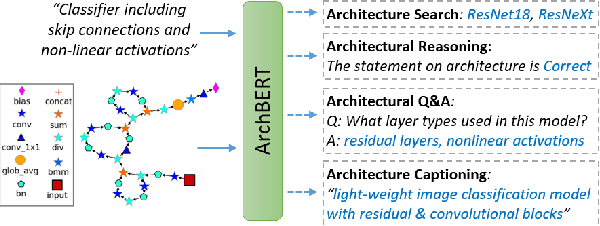
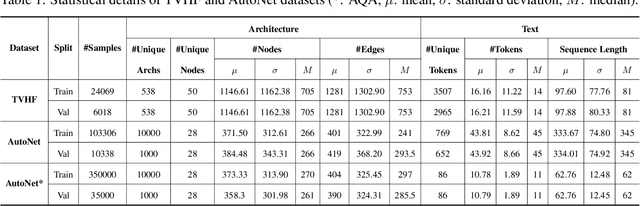
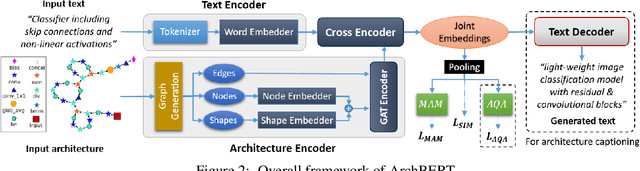
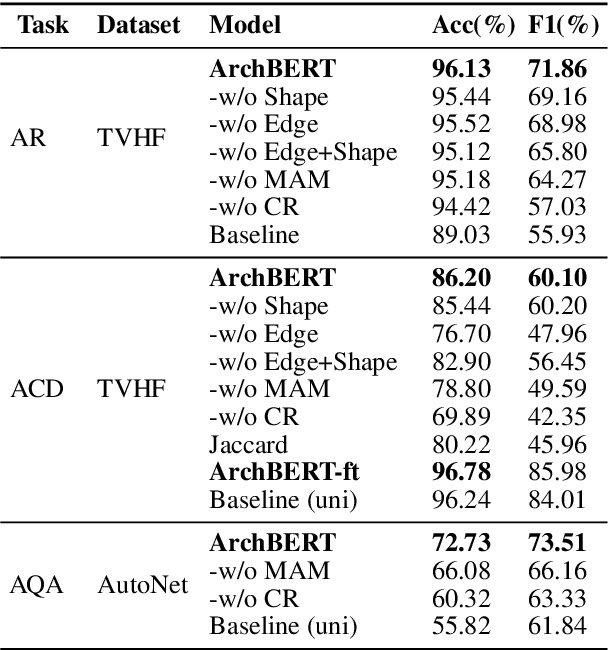
Building multi-modal language models has been a trend in the recent years, where additional modalities such as image, video, speech, etc. are jointly learned along with natural languages (i.e., textual information). Despite the success of these multi-modal language models with different modalities, there is no existing solution for neural network architectures and natural languages. Providing neural architectural information as a new modality allows us to provide fast architecture-2-text and text-2-architecture retrieval/generation services on the cloud with a single inference. Such solution is valuable in terms of helping beginner and intermediate ML users to come up with better neural architectures or AutoML approaches with a simple text query. In this paper, we propose ArchBERT, a bi-modal model for joint learning and understanding of neural architectures and natural languages, which opens up new avenues for research in this area. We also introduce a pre-training strategy named Masked Architecture Modeling (MAM) for a more generalized joint learning. Moreover, we introduce and publicly release two new bi-modal datasets for training and validating our methods. The ArchBERT's performance is verified through a set of numerical experiments on different downstream tasks such as architecture-oriented reasoning, question answering, and captioning (summarization). Datasets, codes, and demos are available supplementary materials.