 Add to Chrome
 Add to Firefox
 Add to Edge
SQA-SAM: Segmentation Quality Assessment for Medical Images Utilizing the Segment Anything Model
Dec 15, 2023
Segmentation quality assessment (SQA) plays a critical role in the deployment of a medical image based AI system. Users need to be informed/alerted whenever an AI system generates unreliable/incorrect predictions. With the introduction of the Segment Anything Model (SAM), a general foundation segmentation model, new research opportunities emerged in how one can utilize SAM for medical image segmentation. In this paper, we propose a novel SQA method, called SQA-SAM, which exploits SAM to enhance the accuracy of quality assessment for medical image segmentation. When a medical image segmentation model (MedSeg) produces predictions for a test image, we generate visual prompts based on the predictions, and SAM is utilized to generate segmentation maps corresponding to the visual prompts. How well MedSeg's segmentation aligns with SAM's segmentation indicates how well MedSeg's segmentation aligns with the general perception of objectness and image region partition. We develop a score measure for such alignment. In experiments, we find that the generated scores exhibit moderate to strong positive correlation (in Pearson correlation and Spearman correlation) with Dice coefficient scores reflecting the true segmentation quality.

KGLens: A Parameterized Knowledge Graph Solution to Assess What an LLM Does and Doesn't Know
Dec 15, 2023Current approaches to evaluating large language models (LLMs) with pre-existing Knowledge Graphs (KG) mostly ignore the structure of the KG and make arbitrary choices of which part of the graph to evaluate. In this paper, we introduce KGLens, a method to evaluate LLMs by generating natural language questions from a KG in a structure aware manner so that we can characterize its performance on a more aggregated level. KGLens uses a parameterized KG, where each edge is augmented with a beta distribution that guides how to sample edges from the KG for QA testing. As the evaluation proceeds, different edges of the parameterized KG are sampled and assessed appropriately, converging to a more global picture of the performance of the LLMs on the KG as a whole. In our experiments, we construct three domain-specific KGs for knowledge assessment, comprising over 19,000 edges, 700 relations, and 21,000 entities. The results demonstrate that KGLens can not only assess overall performance but also provide topic, temporal, and relation analyses of LLMs. This showcases the adaptability and customizability of KGLens, emphasizing its ability to focus the evaluation based on specific criteria.
Segment Anything Model-guided Collaborative Learning Network for Scribble-supervised Polyp Segmentation
Dec 01, 2023Polyp segmentation plays a vital role in accurately locating polyps at an early stage, which holds significant clinical importance for the prevention of colorectal cancer. Various polyp segmentation methods have been developed using fully-supervised deep learning techniques. However, pixel-wise annotation for polyp images by physicians during the diagnosis is both time-consuming and expensive. Moreover, visual foundation models such as the Segment Anything Model (SAM) have shown remarkable performance. Nevertheless, directly applying SAM to medical segmentation may not produce satisfactory results due to the inherent absence of medical knowledge. In this paper, we propose a novel SAM-guided Collaborative Learning Network (SAM-CLNet) for scribble-supervised polyp segmentation, enabling a collaborative learning process between our segmentation network and SAM to boost the model performance. Specifically, we first propose a Cross-level Enhancement and Aggregation Network (CEA-Net) for weakly-supervised polyp segmentation. Within CEA-Net, we propose a Cross-level Enhancement Module (CEM) that integrates the adjacent features to enhance the representation capabilities of different resolution features. Additionally, a Feature Aggregation Module (FAM) is employed to capture richer features across multiple levels. Moreover, we present a box-augmentation strategy that combines the segmentation maps generated by CEA-Net with scribble annotations to create more precise prompts. These prompts are then fed into SAM, generating segmentation SAM-guided masks, which can provide additional supervision to train CEA-Net effectively. Furthermore, we present an Image-level Filtering Mechanism to filter out unreliable SAM-guided masks. Extensive experimental results show that our SAM-CLNet outperforms state-of-the-art weakly-supervised segmentation methods.
A Survey on Deep Learning for Polyp Segmentation: Techniques, Challenges and Future Trends
Nov 30, 2023Early detection and assessment of polyps play a crucial role in the prevention and treatment of colorectal cancer (CRC). Polyp segmentation provides an effective solution to assist clinicians in accurately locating and segmenting polyp regions. In the past, people often relied on manually extracted lower-level features such as color, texture, and shape, which often had issues capturing global context and lacked robustness to complex scenarios. With the advent of deep learning, more and more outstanding medical image segmentation algorithms based on deep learning networks have emerged, making significant progress in this field. This paper provides a comprehensive review of polyp segmentation algorithms. We first review some traditional algorithms based on manually extracted features and deep segmentation algorithms, then detail benchmark datasets related to the topic. Specifically, we carry out a comprehensive evaluation of recent deep learning models and results based on polyp sizes, considering the pain points of research topics and differences in network structures. Finally, we discuss the challenges of polyp segmentation and future trends in this field. The models, benchmark datasets, and source code links we collected are all published at https://github.com/taozh2017/Awesome-Polyp-Segmentation.
Matryoshka Diffusion Models
Oct 23, 2023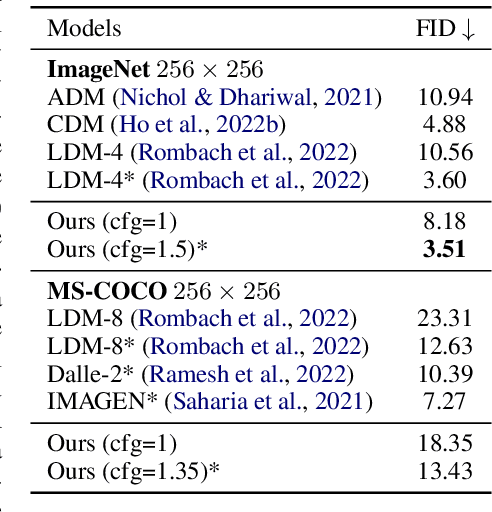
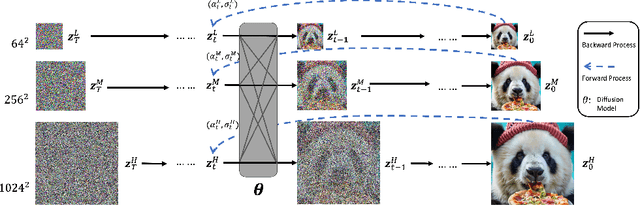
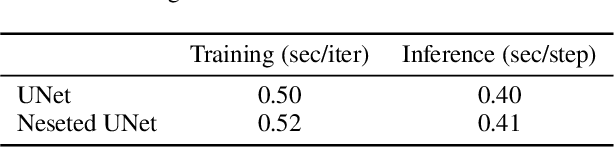

Diffusion models are the de facto approach for generating high-quality images and videos, but learning high-dimensional models remains a formidable task due to computational and optimization challenges. Existing methods often resort to training cascaded models in pixel space or using a downsampled latent space of a separately trained auto-encoder. In this paper, we introduce Matryoshka Diffusion Models(MDM), an end-to-end framework for high-resolution image and video synthesis. We propose a diffusion process that denoises inputs at multiple resolutions jointly and uses a NestedUNet architecture where features and parameters for small-scale inputs are nested within those of large scales. In addition, MDM enables a progressive training schedule from lower to higher resolutions, which leads to significant improvements in optimization for high-resolution generation. We demonstrate the effectiveness of our approach on various benchmarks, including class-conditioned image generation, high-resolution text-to-image, and text-to-video applications. Remarkably, we can train a single pixel-space model at resolutions of up to 1024x1024 pixels, demonstrating strong zero-shot generalization using the CC12M dataset, which contains only 12 million images.
Knowledge Extraction and Distillation from Large-Scale Image-Text Colonoscopy Records Leveraging Large Language and Vision Models
Oct 17, 2023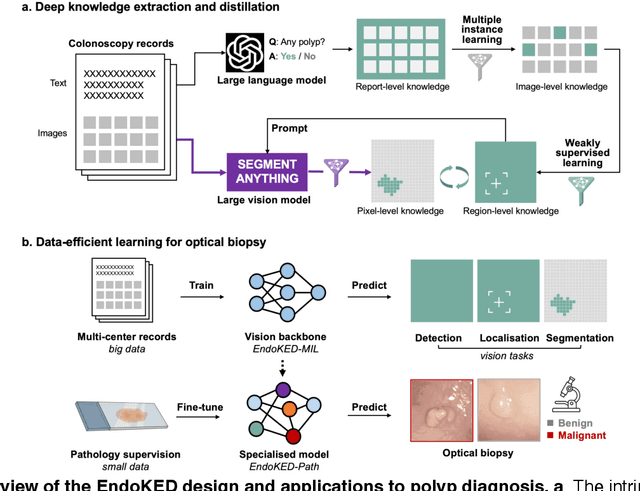
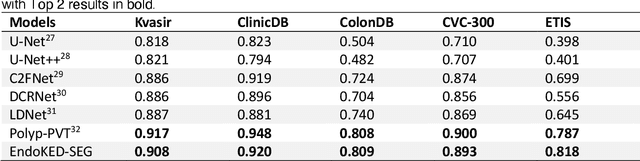
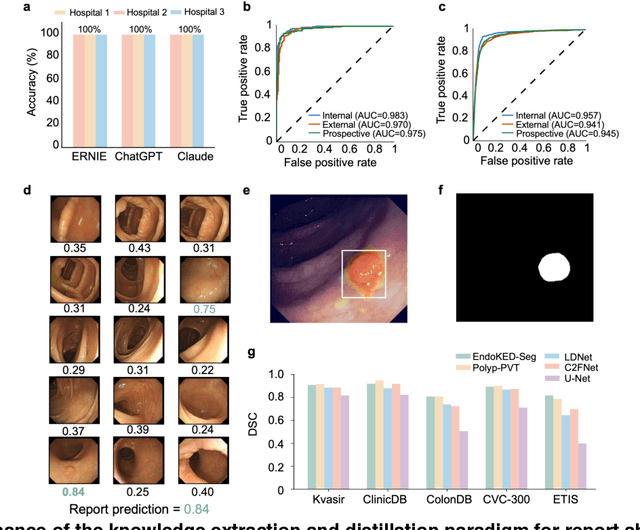
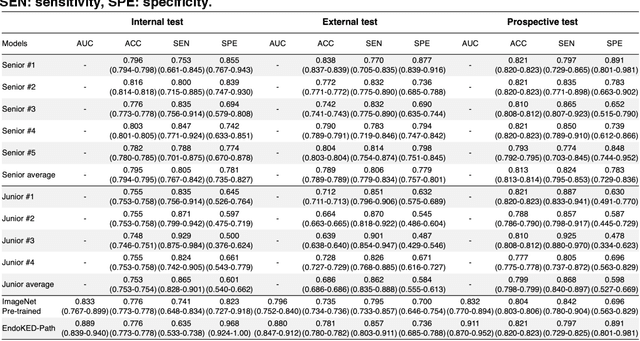
The development of artificial intelligence systems for colonoscopy analysis often necessitates expert-annotated image datasets. However, limitations in dataset size and diversity impede model performance and generalisation. Image-text colonoscopy records from routine clinical practice, comprising millions of images and text reports, serve as a valuable data source, though annotating them is labour-intensive. Here we leverage recent advancements in large language and vision models and propose EndoKED, a data mining paradigm for deep knowledge extraction and distillation. EndoKED automates the transformation of raw colonoscopy records into image datasets with pixel-level annotation. We validate EndoKED using multi-centre datasets of raw colonoscopy records (~1 million images), demonstrating its superior performance in training polyp detection and segmentation models. Furthermore, the EndoKED pre-trained vision backbone enables data-efficient and generalisable learning for optical biopsy, achieving expert-level performance in both retrospective and prospective validation.
The Entity-Deduction Arena: A playground for probing the conversational reasoning and planning capabilities of LLMs
Oct 04, 2023Large language models (LLMs) are effective at answering questions that are clearly asked. However, when faced with ambiguous queries they can act unpredictably and produce incorrect outputs. This underscores the need for the development of intelligent agents capable of asking clarification questions to resolve ambiguities effectively. This capability requires complex understanding, state tracking, reasoning and planning over multiple conversational turns. However, directly measuring this can be challenging. In this paper, we offer a surrogate problem which assesses an LLMs's capability to deduce an entity unknown to itself, but revealed to a judge, by asking the judge a series of queries. This entity-deducing game can serve as an evaluation framework to probe the conversational reasoning and planning capabilities of language models. We systematically evaluate various LLMs and discover significant differences in their performance on this task. We find that strong LLMs like GPT-4 outperform human players by a large margin. We further employ Behavior Cloning (BC) to examine whether a weaker model is capable of imitating a stronger model and generalizing to data or domains, using only the demonstrations from a stronger model. We finally propose to use Reinforcement Learning to enhance reasoning and planning capacity of Vicuna models through episodes of game playing, which lead to significant performance improvement. We hope that this problem offers insights into how autonomous agents could be trained to behave more intelligently in ambiguous circumstances.
Edge-aware Feature Aggregation Network for Polyp Segmentation
Sep 19, 2023Precise polyp segmentation is vital for the early diagnosis and prevention of colorectal cancer (CRC) in clinical practice. However, due to scale variation and blurry polyp boundaries, it is still a challenging task to achieve satisfactory segmentation performance with different scales and shapes. In this study, we present a novel Edge-aware Feature Aggregation Network (EFA-Net) for polyp segmentation, which can fully make use of cross-level and multi-scale features to enhance the performance of polyp segmentation. Specifically, we first present an Edge-aware Guidance Module (EGM) to combine the low-level features with the high-level features to learn an edge-enhanced feature, which is incorporated into each decoder unit using a layer-by-layer strategy. Besides, a Scale-aware Convolution Module (SCM) is proposed to learn scale-aware features by using dilated convolutions with different ratios, in order to effectively deal with scale variation. Further, a Cross-level Fusion Module (CFM) is proposed to effectively integrate the cross-level features, which can exploit the local and global contextual information. Finally, the outputs of CFMs are adaptively weighted by using the learned edge-aware feature, which are then used to produce multiple side-out segmentation maps. Experimental results on five widely adopted colonoscopy datasets show that our EFA-Net outperforms state-of-the-art polyp segmentation methods in terms of generalization and effectiveness.
RR-CP: Reliable-Region-Based Conformal Prediction for Trustworthy Medical Image Classification
Sep 09, 2023Conformal prediction (CP) generates a set of predictions for a given test sample such that the prediction set almost always contains the true label (e.g., 99.5\% of the time). CP provides comprehensive predictions on possible labels of a given test sample, and the size of the set indicates how certain the predictions are (e.g., a set larger than one is `uncertain'). Such distinct properties of CP enable effective collaborations between human experts and medical AI models, allowing efficient intervention and quality check in clinical decision-making. In this paper, we propose a new method called Reliable-Region-Based Conformal Prediction (RR-CP), which aims to impose a stronger statistical guarantee so that the user-specified error rate (e.g., 0.5\%) can be achieved in the test time, and under this constraint, the size of the prediction set is optimized (to be small). We consider a small prediction set size an important measure only when the user-specified error rate is achieved. Experiments on five public datasets show that our RR-CP performs well: with a reasonably small-sized prediction set, it achieves the user-specified error rate (e.g., 0.5\%) significantly more frequently than exiting CP methods.
SamDSK: Combining Segment Anything Model with Domain-Specific Knowledge for Semi-Supervised Learning in Medical Image Segmentation
Aug 26, 2023The Segment Anything Model (SAM) exhibits a capability to segment a wide array of objects in natural images, serving as a versatile perceptual tool for various downstream image segmentation tasks. In contrast, medical image segmentation tasks often rely on domain-specific knowledge (DSK). In this paper, we propose a novel method that combines the segmentation foundation model (i.e., SAM) with domain-specific knowledge for reliable utilization of unlabeled images in building a medical image segmentation model. Our new method is iterative and consists of two main stages: (1) segmentation model training; (2) expanding the labeled set by using the trained segmentation model, an unlabeled set, SAM, and domain-specific knowledge. These two stages are repeated until no more samples are added to the labeled set. A novel optimal-matching-based method is developed for combining the SAM-generated segmentation proposals and pixel-level and image-level DSK for constructing annotations of unlabeled images in the iterative stage (2). In experiments, we demonstrate the effectiveness of our proposed method for breast cancer segmentation in ultrasound images, polyp segmentation in endoscopic images, and skin lesion segmentation in dermoscopic images. Our work initiates a new direction of semi-supervised learning for medical image segmentation: the segmentation foundation model can be harnessed as a valuable tool for label-efficient segmentation learning in medical image segmentation.