 Add to Chrome
 Add to Firefox
 Add to Edge
From Generalist to Specialist: A Context-Fusion Framework for Endoscopic Polyp Reporting with a Frozen VLM
Aug 16, 2026
Reliable endoscopic polyp reporting requires integrating quantitative lesion sizing, standardized Paris classification, and clinically meaningful morphological description within a single record. General-purpose vision-language models (VLMs) offer a unified interface for image understanding and report generation. Existing specialization strategies, however, typically rely on task-specific models or model-weight adaptation, leaving unresolved how to introduce reliable specialist knowledge while preserving both this unified interface and the VLM's pretrained capabilities. We introduce a context-fusion framework that specializes a frozen general-purpose VLM through both implicit instruction context and explicit transduction context without modifying its pretrained weights. Specifically, a self-supervised polyp encoder retrieves related image-report pairs as explicit, query-specific evidence, while learned continuous specialist tokens provide implicit instruction context shared across cases. Experiments were conducted on 2,056 expert-annotated public endoscopic images. We compared the framework with general-purpose VLMs, task-specific predictors, and weight-adaptation methods to assess specialist performance, unified reporting, and adaptation efficiency. Across numerical, categorical, and report-generation metrics, the proposed framework substantially improved direct frozen-VLM inference and achieved the strongest overall performance among the evaluated methods. It added trainable parameters equal to only 0.006% of the frozen VLM's parameter count. When the top-1 retrieved case carried the correct target category, our framework corrected 70.5% of the errors made by a weight-adaptation baseline. These findings support the context-fusion framework as a lightweight and effective strategy for specialist adaptation of a frozen VLM.

A report-grounded vision-language foundation model for colonoscopy from 280000 routine reports
Jul 30, 2026Vision-language models remain underused in colonoscopy despite the rich expert descriptions recorded in routine reports. These reports document lesion appearance, size and location but summarise entire procedures rather than caption individual frames, leaving clinical findings only weakly linked to the corresponding images. Here we develop EndoCLIP, a colonoscopy vision-language foundation model trained on 125,756 lesion-level image-text pairs progressively recovered from 280,476 routine colonoscopy records. Across lesion-level image-text retrieval, structured report generation and six multi-centre clinical classification tasks, EndoCLIP outperforms general-purpose and biomedical vision-language encoders in both zero-shot and linear-probe settings. On benign-versus-malignant classification, its linear probe approaches the performance of expert readers in a blinded study involving 12 endoscopists. These results suggest that recovering finding-to-frame correspondence can transform routine documentation into scalable supervision, enabling clinical targets to be specified in language rather than separately annotated for each task.
Development and multi-center evaluation of domain-adapted speech recognition for human-AI teaming in real-world gastrointestinal endoscopy
Apr 02, 2026Automatic speech recognition (ASR) is a critical interface for human-AI interaction in gastrointestinal endoscopy, yet its reliability in real-world clinical settings is limited by domain-specific terminology and complex acoustic conditions. Here, we present EndoASR, a domain-adapted ASR system designed for real-time deployment in endoscopic workflows. We develop a two-stage adaptation strategy based on synthetic endoscopy reports, targeting domain-specific language modeling and noise robustness. In retrospective evaluation across six endoscopists, EndoASR substantially improves both transcription accuracy and clinical usability, reducing character error rate (CER) from 20.52% to 14.14% and increasing medical term accuracy (Med ACC) from 54.30% to 87.59%. In a prospective multi-center study spanning five independent endoscopy centers, EndoASR demonstrates consistent generalization under heterogeneous real-world conditions. Compared with the baseline Paraformer model, CER is reduced from 16.20% to 14.97%, while Med ACC is improved from 61.63% to 84.16%, confirming its robustness in practical deployment scenarios. Notably, EndoASR achieves a real-time factor (RTF) of 0.005, significantly faster than Whisper-large-v3 (RTF 0.055), while maintaining a compact model size of 220M parameters, enabling efficient edge deployment. Furthermore, integration with large language models demonstrates that improved ASR quality directly enhances downstream structured information extraction and clinician-AI interaction. These results demonstrate that domain-adapted ASR can serve as a reliable interface for human-AI teaming in gastrointestinal endoscopy, with consistent performance validated across multi-center real-world clinical settings.
ColoDiff: Integrating Dynamic Consistency With Content Awareness for Colonoscopy Video Generation
Feb 26, 2026Colonoscopy video generation delivers dynamic, information-rich data critical for diagnosing intestinal diseases, particularly in data-scarce scenarios. High-quality video generation demands temporal consistency and precise control over clinical attributes, but faces challenges from irregular intestinal structures, diverse disease representations, and various imaging modalities. To this end, we propose ColoDiff, a diffusion-based framework that generates dynamic-consistent and content-aware colonoscopy videos, aiming to alleviate data shortage and assist clinical analysis. At the inter-frame level, our TimeStream module decouples temporal dependency from video sequences through a cross-frame tokenization mechanism, enabling intricate dynamic modeling despite irregular intestinal structures. At the intra-frame level, our Content-Aware module incorporates noise-injected embeddings and learnable prototypes to realize precise control over clinical attributes, breaking through the coarse guidance of diffusion models. Additionally, ColoDiff employs a non-Markovian sampling strategy that cuts steps by over 90% for real-time generation. ColoDiff is evaluated across three public datasets and one hospital database, based on both generation metrics and downstream tasks including disease diagnosis, modality discrimination, bowel preparation scoring, and lesion segmentation. Extensive experiments show ColoDiff generates videos with smooth transitions and rich dynamics. ColoDiff presents an effort in controllable colonoscopy video generation, revealing the potential of synthetic videos in complementing authentic representation and mitigating data scarcity in clinical settings.
One-shot synthesis of rare gastrointestinal lesions improves diagnostic accuracy and clinical training
Dec 30, 2025Rare gastrointestinal lesions are infrequently encountered in routine endoscopy, restricting the data available for developing reliable artificial intelligence (AI) models and training novice clinicians. Here we present EndoRare, a one-shot, retraining-free generative framework that synthesizes diverse, high-fidelity lesion exemplars from a single reference image. By leveraging language-guided concept disentanglement, EndoRare separates pathognomonic lesion features from non-diagnostic attributes, encoding the former into a learnable prototype embedding while varying the latter to ensure diversity. We validated the framework across four rare pathologies (calcifying fibrous tumor, juvenile polyposis syndrome, familial adenomatous polyposis, and Peutz-Jeghers syndrome). Synthetic images were judged clinically plausible by experts and, when used for data augmentation, significantly enhanced downstream AI classifiers, improving the true positive rate at low false-positive rates. Crucially, a blinded reader study demonstrated that novice endoscopists exposed to EndoRare-generated cases achieved a 0.400 increase in recall and a 0.267 increase in precision. These results establish a practical, data-efficient pathway to bridge the rare-disease gap in both computer-aided diagnostics and clinical education.
EndoFinder: Online Lesion Retrieval for Explainable Colorectal Polyp Diagnosis Leveraging Latent Scene Representations
Jul 23, 2025Colorectal cancer (CRC) remains a leading cause of cancer-related mortality, underscoring the importance of timely polyp detection and diagnosis. While deep learning models have improved optical-assisted diagnostics, they often demand extensive labeled datasets and yield "black-box" outputs with limited interpretability. In this paper, we propose EndoFinder, an online polyp retrieval framework that leverages multi-view scene representations for explainable and scalable CRC diagnosis. First, we develop a Polyp-aware Image Encoder by combining contrastive learning and a reconstruction task, guided by polyp segmentation masks. This self-supervised approach captures robust features without relying on large-scale annotated data. Next, we treat each polyp as a three-dimensional "scene" and introduce a Scene Representation Transformer, which fuses multiple views of the polyp into a single latent representation. By discretizing this representation through a hashing layer, EndoFinder enables real-time retrieval from a compiled database of historical polyp cases, where diagnostic information serves as interpretable references for new queries. We evaluate EndoFinder on both public and newly collected polyp datasets for re-identification and pathology classification. Results show that EndoFinder outperforms existing methods in accuracy while providing transparent, retrieval-based insights for clinical decision-making. By contributing a novel dataset and a scalable, explainable framework, our work addresses key challenges in polyp diagnosis and offers a promising direction for more efficient AI-driven colonoscopy workflows. The source code is available at https://github.com/ku262/EndoFinder-Scene.
Endo-CLIP: Progressive Self-Supervised Pre-training on Raw Colonoscopy Records
May 14, 2025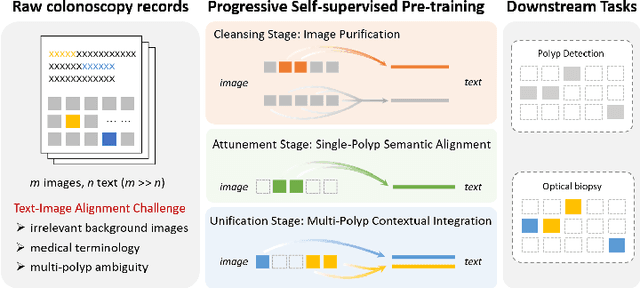
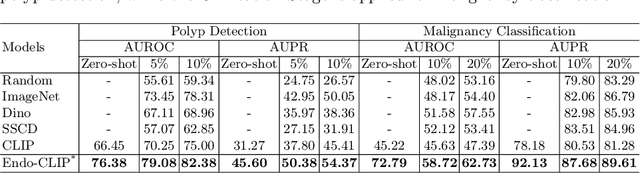
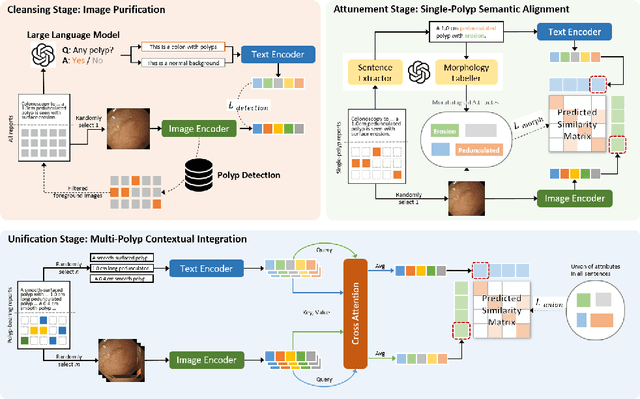
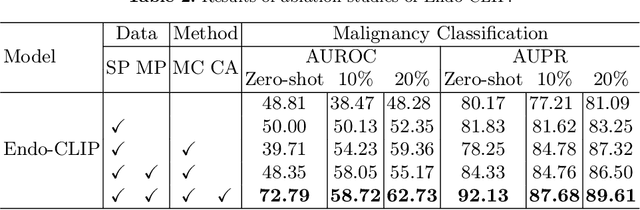
Pre-training on image-text colonoscopy records offers substantial potential for improving endoscopic image analysis, but faces challenges including non-informative background images, complex medical terminology, and ambiguous multi-lesion descriptions. We introduce Endo-CLIP, a novel self-supervised framework that enhances Contrastive Language-Image Pre-training (CLIP) for this domain. Endo-CLIP's three-stage framework--cleansing, attunement, and unification--addresses these challenges by (1) removing background frames, (2) leveraging large language models to extract clinical attributes for fine-grained contrastive learning, and (3) employing patient-level cross-attention to resolve multi-polyp ambiguities. Extensive experiments demonstrate that Endo-CLIP significantly outperforms state-of-the-art pre-training methods in zero-shot and few-shot polyp detection and classification, paving the way for more accurate and clinically relevant endoscopic analysis.
Robust Polyp Detection and Diagnosis through Compositional Prompt-Guided Diffusion Models
Feb 25, 2025Colorectal cancer (CRC) is a significant global health concern, and early detection through screening plays a critical role in reducing mortality. While deep learning models have shown promise in improving polyp detection, classification, and segmentation, their generalization across diverse clinical environments, particularly with out-of-distribution (OOD) data, remains a challenge. Multi-center datasets like PolypGen have been developed to address these issues, but their collection is costly and time-consuming. Traditional data augmentation techniques provide limited variability, failing to capture the complexity of medical images. Diffusion models have emerged as a promising solution for generating synthetic polyp images, but the image generation process in current models mainly relies on segmentation masks as the condition, limiting their ability to capture the full clinical context. To overcome these limitations, we propose a Progressive Spectrum Diffusion Model (PSDM) that integrates diverse clinical annotations-such as segmentation masks, bounding boxes, and colonoscopy reports-by transforming them into compositional prompts. These prompts are organized into coarse and fine components, allowing the model to capture both broad spatial structures and fine details, generating clinically accurate synthetic images. By augmenting training data with PSDM-generated samples, our model significantly improves polyp detection, classification, and segmentation. For instance, on the PolypGen dataset, PSDM increases the F1 score by 2.12% and the mean average precision by 3.09%, demonstrating superior performance in OOD scenarios and enhanced generalization.
EndoFinder: Online Image Retrieval for Explainable Colorectal Polyp Diagnosis
Jul 16, 2024Determining the necessity of resecting malignant polyps during colonoscopy screen is crucial for patient outcomes, yet challenging due to the time-consuming and costly nature of histopathology examination. While deep learning-based classification models have shown promise in achieving optical biopsy with endoscopic images, they often suffer from a lack of explainability. To overcome this limitation, we introduce EndoFinder, a content-based image retrieval framework to find the 'digital twin' polyp in the reference database given a newly detected polyp. The clinical semantics of the new polyp can be inferred referring to the matched ones. EndoFinder pioneers a polyp-aware image encoder that is pre-trained on a large polyp dataset in a self-supervised way, merging masked image modeling with contrastive learning. This results in a generic embedding space ready for different downstream clinical tasks based on image retrieval. We validate the framework on polyp re-identification and optical biopsy tasks, with extensive experiments demonstrating that EndoFinder not only achieves explainable diagnostics but also matches the performance of supervised classification models. EndoFinder's reliance on image retrieval has the potential to support diverse downstream decision-making tasks during real-time colonoscopy procedures.
Knowledge Extraction and Distillation from Large-Scale Image-Text Colonoscopy Records Leveraging Large Language and Vision Models
Oct 17, 2023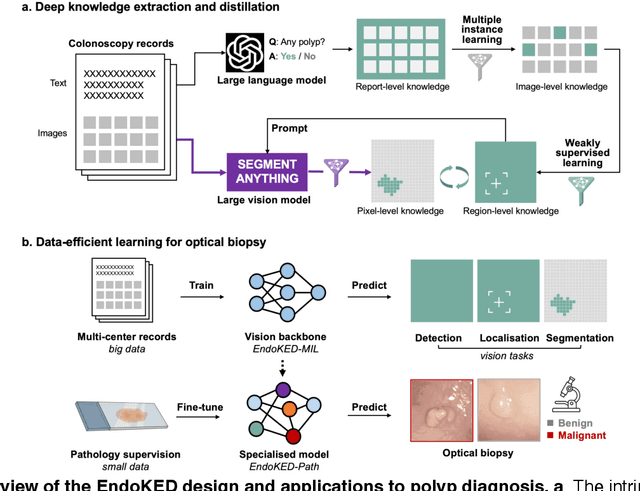
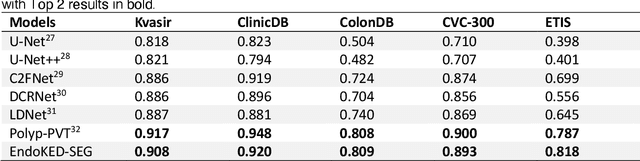
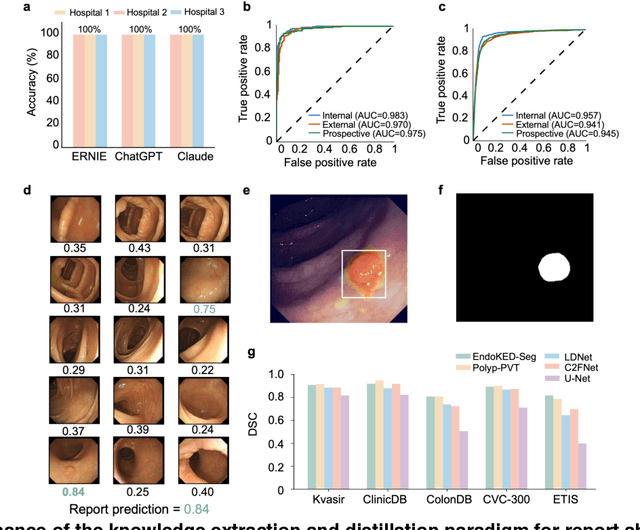
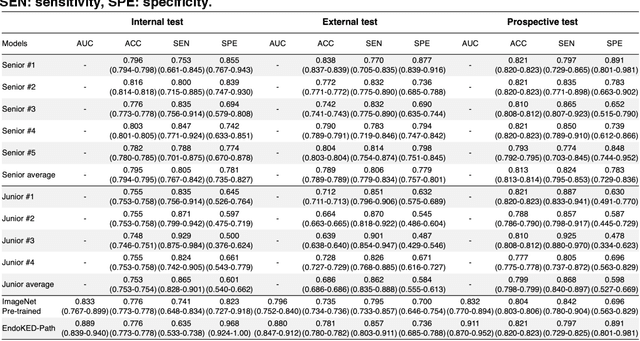
The development of artificial intelligence systems for colonoscopy analysis often necessitates expert-annotated image datasets. However, limitations in dataset size and diversity impede model performance and generalisation. Image-text colonoscopy records from routine clinical practice, comprising millions of images and text reports, serve as a valuable data source, though annotating them is labour-intensive. Here we leverage recent advancements in large language and vision models and propose EndoKED, a data mining paradigm for deep knowledge extraction and distillation. EndoKED automates the transformation of raw colonoscopy records into image datasets with pixel-level annotation. We validate EndoKED using multi-centre datasets of raw colonoscopy records (~1 million images), demonstrating its superior performance in training polyp detection and segmentation models. Furthermore, the EndoKED pre-trained vision backbone enables data-efficient and generalisable learning for optical biopsy, achieving expert-level performance in both retrospective and prospective validation.