 Add to Chrome
 Add to Firefox
 Add to Edge
Homer: Understanding Long-form Videos with Hierarchical Memory and Agentic Reasoning
Jul 01, 2026
Multimodal large language models excel on short clips but struggle on hour-long videos in an online setting, where frames are processed incrementally under limited memory. Existing online methods either retain compact visual representations that lack semantic structure, or build higher-level memory stores organized around temporal proximity rather than explicit causal links, leaving multi-hop narrative reasoning to be reconstructed by the LLM at every query. We bridge this gap with \textsc{Homer}, a Hierarchical Online Memory Exploration and Reasoning framework. \textsc{Homer}'s memory mirrors the multi-scale structure of long videos, ranging from raw perception, to recurring entities, to events connected by explicit temporal and causal relations. Its agentic reasoner then explores this memory the way humans do, locating the relevant scene, looking up details, and composing the answer through multi-round memory retrieval, with a harness that verifies and corrects each step. \textsc{Homer} outperforms the previous best agent method by $+5.5$, $+10.8$, and $+4.4$ points on M3-Bench-robot, M3-Bench-web, and Video-MME-Long, and consistently lifts three various LLM backbones, indicating a model-agnostic structural capability for grounded retrieval over long videos.

AffectVerse: Emotional World Models for Multimodal Affective Computing
May 19, 2026Humans infer emotions by integrating observed multimodal cues with expectations about how affective states may unfold. Existing multimodal large language models (MLLMs), however, often treat emotion recognition as static fusion over complete audiovisual-text inputs, leaving affective dynamics implicit. We propose AffectVerse, a Qwen2.5-Omni-based model equipped with an Emotion World Module (EWM), an action-free representation-level module for short-horizon latent affective prediction. \rev{EWM contains three modules: 1) Cross-Modal Temporal Imagination predicts future video/audio representations from past tokens with multi-step rollout. 2) MAMA(Modality-Aware Multi-step Attention) Belief Aggregation compresses imagined tokens into modality-aware belief tokens. 3) Belief Injection inserts these belief tokens into the LLM for affective reasoning.} AffectVerse uses future prediction as a past-conditioned self-supervised signal: it does not replace modeling observed history or require unseen signals at inference, but forces the current belief state to encode transition cues that are predictive of subsequent affective change. Across nine benchmarks, AffectVerse improves at least 2.57\% over other models, while controlled ablations show additive gains from temporal imagination, cross-modal rollout, and belief aggregation. These results suggest predictive belief-state modeling is a practical alternative for affective computing.
When to Trust Tools? Adaptive Tool Trust Calibration For Tool-Integrated Math Reasoning
Apr 09, 2026Large reasoning models (LRMs) have achieved strong performance enhancement through scaling test time computation, but due to the inherent limitations of the underlying language models, they still have shortcomings in tasks that require precise computation and extensive knowledge reserves. Tool-Integrated Reasoning (TIR) has emerged as a promising paradigm that incorporates tool call and execution within the reasoning trajectory. Although recent works have released some powerful open-source TIR models, our analysis reveals that these models still suffer from critical deficiencies. We find that when the reasoning of the model conflicts with the tool results, the model tends to believe in its own reasoning. And there are cases where the tool results are correct but are ignored by the model, resulting in incorrect answers, which we define as "Tool Ignored''. This indicates that the model does not know when to trust or ignore the tool. To overcome these limitations, We introduce Adaptive Tool Trust Calibration (ATTC), a novel framework that guides the model to adaptively choose to trust or ignore the tool results based on the confidence score of generated code blocks. The experimental results from various open-source TIR models of different sizes and across multiple datasets demonstrate that ATTC effectively reduces the "Tool Ignored" issue, resulting in a performance increase of 4.1% to 7.5%.
When Is Thinking Enough? Early Exit via Sufficiency Assessment for Efficient Reasoning
Apr 08, 2026Large reasoning models (LRMs) have achieved remarkable performance in complex reasoning tasks, driven by their powerful inference-time scaling capability. However, LRMs often suffer from overthinking, which results in substantial computational redundancy and significantly reduces efficiency. Early-exit methods aim to mitigate this issue by terminating reasoning once sufficient evidence has been generated, yet existing approaches mostly rely on handcrafted or empirical indicators that are unreliable and impractical. In this work, we introduce Dynamic Thought Sufficiency in Reasoning (DTSR), a novel framework for efficient reasoning that enables the model to dynamically assess the sufficiency of its chain-of-thought (CoT) and determine the optimal point for early exit. Inspired by human metacognition, DTSR operates in two stages: (1) Reflection Signal Monitoring, which identifies reflection signals as potential cues for early exit, and (2) Thought Sufficiency Check, which evaluates whether the current CoT is sufficient to derive the final answer. Experimental results on the Qwen3 models show that DTSR reduces reasoning length by 28.9%-34.9% with minimal performance loss, effectively mitigating overthinking. We further discuss overconfidence in LRMs and self-evaluation paradigms, providing valuable insights for early-exit reasoning.
GAST: Gradient-aligned Sparse Tuning of Large Language Models with Data-layer Selection
Mar 10, 2026Parameter-Efficient Fine-Tuning (PEFT) has become a key strategy for adapting large language models, with recent advances in sparse tuning reducing overhead by selectively updating key parameters or subsets of data. Existing approaches generally focus on two distinct paradigms: layer-selective methods aiming to fine-tune critical layers to minimize computational load, and data-selective methods aiming to select effective training subsets to boost training. However, current methods typically overlook the fact that different data points contribute varying degrees to distinct model layers, and they often discard potentially valuable information from data perceived as of low quality. To address these limitations, we propose Gradient-aligned Sparse Tuning (GAST), an innovative method that simultaneously performs selective fine-tuning at both data and layer dimensions as integral components of a unified optimization strategy. GAST specifically targets redundancy in information by employing a layer-sparse strategy that adaptively selects the most impactful data points for each layer, providing a more comprehensive and sophisticated solution than approaches restricted to a single dimension. Experiments demonstrate that GAST consistently outperforms baseline methods, establishing a promising direction for future research in PEFT strategies.
Taming the Titans: A Survey of Efficient LLM Inference Serving
Apr 28, 2025Large Language Models (LLMs) for Generative AI have achieved remarkable progress, evolving into sophisticated and versatile tools widely adopted across various domains and applications. However, the substantial memory overhead caused by their vast number of parameters, combined with the high computational demands of the attention mechanism, poses significant challenges in achieving low latency and high throughput for LLM inference services. Recent advancements, driven by groundbreaking research, have significantly accelerated progress in this field. This paper provides a comprehensive survey of these methods, covering fundamental instance-level approaches, in-depth cluster-level strategies, emerging scenario directions, and other miscellaneous but important areas. At the instance level, we review model placement, request scheduling, decoding length prediction, storage management, and the disaggregation paradigm. At the cluster level, we explore GPU cluster deployment, multi-instance load balancing, and cloud service solutions. For emerging scenarios, we organize the discussion around specific tasks, modules, and auxiliary methods. To ensure a holistic overview, we also highlight several niche yet critical areas. Finally, we outline potential research directions to further advance the field of LLM inference serving.
Test-time Computing: from System-1 Thinking to System-2 Thinking
Jan 05, 2025

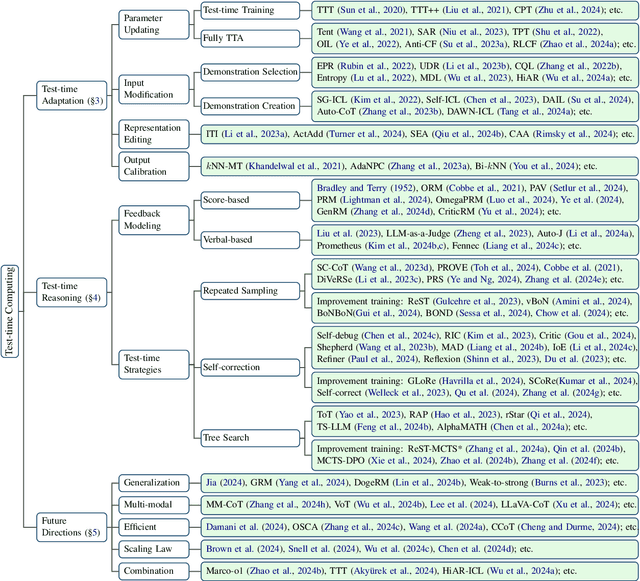

The remarkable performance of the o1 model in complex reasoning demonstrates that test-time computing scaling can further unlock the model's potential, enabling powerful System-2 thinking. However, there is still a lack of comprehensive surveys for test-time computing scaling. We trace the concept of test-time computing back to System-1 models. In System-1 models, test-time computing addresses distribution shifts and improves robustness and generalization through parameter updating, input modification, representation editing, and output calibration. In System-2 models, it enhances the model's reasoning ability to solve complex problems through repeated sampling, self-correction, and tree search. We organize this survey according to the trend of System-1 to System-2 thinking, highlighting the key role of test-time computing in the transition from System-1 models to weak System-2 models, and then to strong System-2 models. We also point out a few possible future directions.
Boosting LLM-based Relevance Modeling with Distribution-Aware Robust Learning
Dec 17, 2024With the rapid advancement of pre-trained large language models (LLMs), recent endeavors have leveraged the capabilities of LLMs in relevance modeling, resulting in enhanced performance. This is usually done through the process of fine-tuning LLMs on specifically annotated datasets to determine the relevance between queries and items. However, there are two limitations when LLMs are naively employed for relevance modeling through fine-tuning and inference. First, it is not inherently efficient for performing nuanced tasks beyond simple yes or no answers, such as assessing search relevance. It may therefore tend to be overconfident and struggle to distinguish fine-grained degrees of relevance (e.g., strong relevance, weak relevance, irrelevance) used in search engines. Second, it exhibits significant performance degradation when confronted with data distribution shift in real-world scenarios. In this paper, we propose a novel Distribution-Aware Robust Learning framework (DaRL) for relevance modeling in Alipay Search. Specifically, we design an effective loss function to enhance the discriminability of LLM-based relevance modeling across various fine-grained degrees of query-item relevance. To improve the generalizability of LLM-based relevance modeling, we first propose the Distribution-Aware Sample Augmentation (DASA) module. This module utilizes out-of-distribution (OOD) detection techniques to actively select appropriate samples that are not well covered by the original training set for model fine-tuning. Furthermore, we adopt a multi-stage fine-tuning strategy to simultaneously improve in-distribution (ID) and OOD performance, bridging the performance gap between them. DaRL has been deployed online to serve the Alipay's insurance product search...
* 8 pages
CPRM: A LLM-based Continual Pre-training Framework for Relevance Modeling in Commercial Search
Dec 03, 2024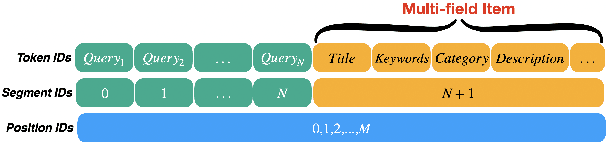


Relevance modeling between queries and items stands as a pivotal component in commercial search engines, directly affecting the user experience. Given the remarkable achievements of large language models (LLMs) in various natural language processing (NLP) tasks, LLM-based relevance modeling is gradually being adopted within industrial search systems. Nevertheless, foundational LLMs lack domain-specific knowledge and do not fully exploit the potential of in-context learning. Furthermore, structured item text remains underutilized, and there is a shortage in the supply of corresponding queries and background knowledge. We thereby propose CPRM (Continual Pre-training for Relevance Modeling), a framework designed for the continual pre-training of LLMs to address these issues. Our CPRM framework includes three modules: 1) employing both queries and multi-field item to jointly pre-train for enhancing domain knowledge, 2) applying in-context pre-training, a novel approach where LLMs are pre-trained on a sequence of related queries or items, and 3) conducting reading comprehension on items to produce associated domain knowledge and background information (e.g., generating summaries and corresponding queries) to further strengthen LLMs. Results on offline experiments and online A/B testing demonstrate that our model achieves convincing performance compared to strong baselines.
Beware of Calibration Data for Pruning Large Language Models
Oct 23, 2024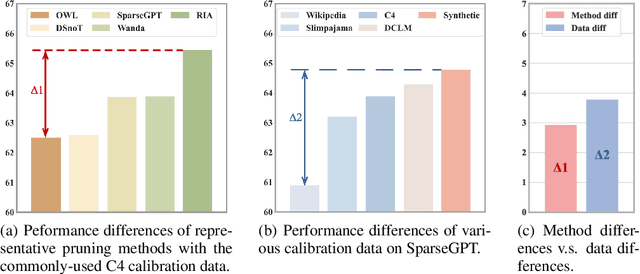
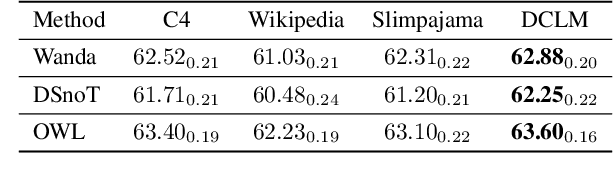
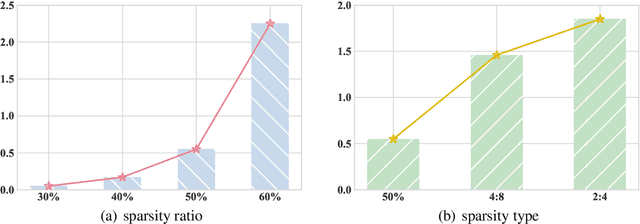
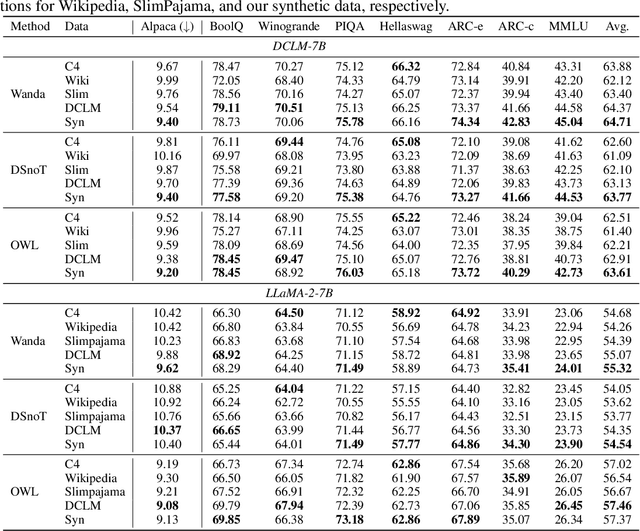
As large language models (LLMs) are widely applied across various fields, model compression has become increasingly crucial for reducing costs and improving inference efficiency. Post-training pruning is a promising method that does not require resource-intensive iterative training and only needs a small amount of calibration data to assess the importance of parameters. Previous research has primarily focused on designing advanced pruning methods, while different calibration data's impact on pruning performance still lacks systematical exploration. We fill this blank and surprisingly observe that the effects of calibration data even value more than designing advanced pruning strategies, especially for high sparsity. Our preliminary exploration also discloses that using calibration data similar to the training data can yield better performance. As pre-training data is usually inaccessible for advanced LLMs, we further provide a self-generating calibration data synthesis strategy to construct feasible calibration data. We conduct experiments on the recent strong open-source LLMs (e.g., DCLM, and LLaMA-3), and the results show that the proposed method outperforms commonly used calibration data and can effectively enhance strong pruning methods (e.g., Wanda, OWL).