 Add to Chrome
 Add to Firefox
 Add to Edge
Towards Physically Consistent 4D Scene Reconstruction for Closed-loop Autonomous Driving Simulation
May 20, 2026
High-fidelity street scene reconstruction is pivotal for end-to-end autonomous driving simulation, where novel-view synthesis (NVS) and time-varying information modeling are two fundamental capabilities to facilitate closed-loop training. However, existing 3DGS methods and their 4D extensions fail to simultaneously achieve both. To bridge this gap, we establish an information-geometric diagnostic framework, revealing that this limitation stems from a credit assignment dilemma between spatial and temporal parameters. Specifically, the deterministic coupling between viewpoint and time in single-source observation creates a low-rank structure that induces massive null-space ambiguity between static view-dependent and dynamic time-varying components. Temporal information overshadows spatial cues, causing the estimation variance of spatial parameters to diverge. To address this issue, we propose Orthogonal Projected Gradient (OPG), a hierarchical training method designed to restore spatial identifiability. OPG prioritizes the integrity of spatial representations by securing them in an initial stage, then restricts temporal updates to the spatial null space, enabling proactive credit assignment. While OPG isolates temporal updates algebraically, Temporal Regularization Strategy is proposed to further refine the temporal solution space by imposing a smoothness constraint based on the physical prior of consistent appearance evolution, ensuring that the reconstructed scene remains physically consistent in closed-loop simulation. Extensive experiments demonstrate that our method not only maintains stable NVS capabilities but also demonstrates superior performance in traditional observation-reproducing metrics, which indirectly reflect the capability of modeling temporal dynamics.

DynMoLE: Boosting Mixture of LoRA Experts Fine-Tuning with a Hybrid Routing Mechanism
Apr 01, 2025Instruction-based fine-tuning of large language models (LLMs) has achieved remarkable success in various natural language processing (NLP) tasks. Parameter-efficient fine-tuning (PEFT) methods, such as Mixture of LoRA Experts (MoLE), combine the efficiency of Low-Rank Adaptation (LoRA) with the versatility of Mixture of Experts (MoE) models, demonstrating significant potential for handling multiple downstream tasks. However, the existing routing mechanisms for MoLE often involve a trade-off between computational efficiency and predictive accuracy, and they fail to fully address the diverse expert selection demands across different transformer layers. In this work, we propose DynMoLE, a hybrid routing strategy that dynamically adjusts expert selection based on the Tsallis entropy of the router's probability distribution. This approach mitigates router uncertainty, enhances stability, and promotes more equitable expert participation, leading to faster convergence and improved model performance. Additionally, we introduce an auxiliary loss based on Tsallis entropy to further guide the model toward convergence with reduced uncertainty, thereby improving training stability and performance. Our extensive experiments on commonsense reasoning benchmarks demonstrate that DynMoLE achieves substantial performance improvements, outperforming LoRA by 9.6% and surpassing the state-of-the-art MoLE method, MoLA, by 2.3%. We also conduct a comprehensive ablation study to evaluate the contributions of DynMoLE's key components.
MixLoRA: Enhancing Large Language Models Fine-Tuning with LoRA based Mixture of Experts
Apr 22, 2024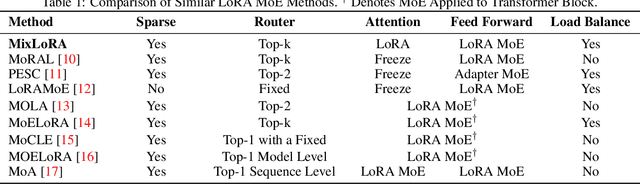
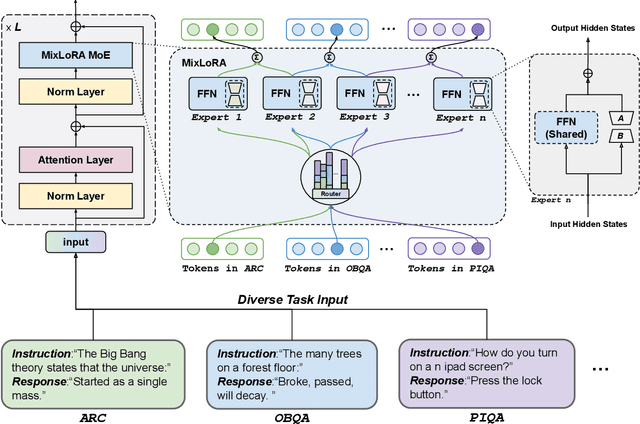
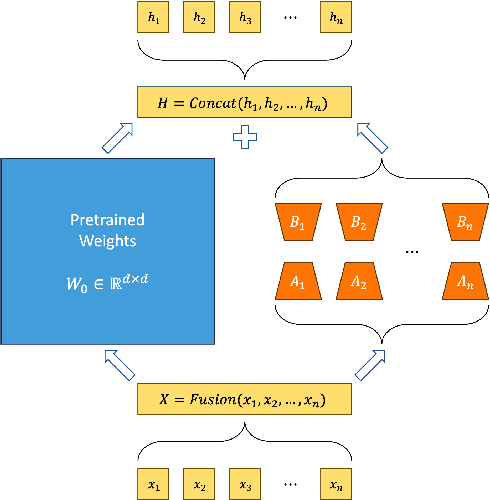

Large Language Models (LLMs) have showcased exceptional performance across a wide array of Natural Language Processing (NLP) tasks. Fine-tuning techniques are commonly utilized to tailor pre-trained models to specific applications. While methods like LoRA have effectively tackled GPU memory constraints during fine-tuning, their applicability is often restricted to limited performance, especially on multi-task. On the other hand, Mix-of-Expert (MoE) models, such as Mixtral 8x7B, demonstrate remarkable performance across multiple NLP tasks while maintaining a reduced parameter count. However, the resource requirements of these MoEs still challenging, particularly for consumer-grade GPUs only have limited VRAM. To address these challenge, we propose MixLoRA, an innovative approach aimed at constructing a resource-efficient sparse MoE model based on LoRA. MixLoRA inserts multiple LoRA-based experts within the feed-forward network block of a frozen pre-trained dense model through fine-tuning, employing a commonly used top-k router. Unlike other LoRA based MoE methods, MixLoRA enhances model performance by utilizing independently configurable attention-layer LoRA adapters, supporting the use of LoRA and its variants for the construction of experts, and applying auxiliary load balance loss to address the imbalance problem of the router. In experiments, MixLoRA achieves commendable performance across all evaluation metrics in both single-task and multi-task learning scenarios. Implemented within the m-LoRA framework, MixLoRA enables parallel fine-tuning of multiple mixture-of-experts models on a single 24GB consumer-grade GPU without quantization, thereby reducing GPU memory consumption by 41\% and latency during the training process by 17\%.