 Add to Chrome
 Add to Firefox
 Add to Edge
Reconstruction-Shift Discrimination via Mask-Guided Latent Diffusion for Medical Anomaly Detection
Aug 01, 2026
Unsupervised medical anomaly detection learns normal anatomical patterns from healthy training images and identifies deviations at test time. Reconstruction-based and diffusion-based methods commonly use the difference between an input image and its reconstruction as anomaly evidence. However, this residual can be ambiguous. Expressive models may preserve pathological structures, while benign anatomical variation, imaging noise, and acquisition differences may also produce large reconstruction errors. We propose discriminative mask-guided diffusion (DMD), a medical anomaly detection framework that complements residual-based localization with reconstruction-shift discrimination. DMD first learns a compact quantized latent representation of normal images. Localized masks then perturb selected latent regions, and a latent diffusion model reconstructs the perturbed representations. The resulting reconstructions are paired with their original normal images to define a self-supervised classification task. At inference, the classifier provides a learned image-level anomaly score, while the residual between the input and its diffusion-based reconstruction yields a pixel-level anomaly map. Experiments on five datasets spanning brain MRI, breast ultrasound, and chest radiography show that DMD achieves the best overall performance among the state-of-the-art baseline methods.

Beyond Static Anchors: Bounded Prototype Conditioning for Language-Free Medical Anomaly Detection
Aug 01, 2026Medical anomaly detection identifies abnormal images and localizes lesions under scarce supervision while generalizing across organs and modalities. Existing CLIP-based methods reduce annotation requirements through vision--language alignment, but their normal and abnormal references, whether text prompts or learned visual tokens, remain fixed across test images. Such static references may not transfer reliably to unseen targets in a cross-domain medical imaging scenario. To address this, we propose ReCAP, a language-free framework that replaces static anchors with input-conditioned visual prototypes. ReCAP re-centers separated normal and abnormal prototypes for each image through a bounded gated modulation, enabling query-adaptive anomaly scoring while constraining context-induced prototype drift. For the few-shot setting, we introduce a non-parametric normal-reference memory to preserve instance-level target-domain variation and complement the conditional prototype branch. Across six medical benchmarks, ReCAP achieves the best image-level AUROC on all zero-shot and 23 of 24 few-shot settings, and the best zero-shot pixel-level AUROC on all three segmentation datasets. Particularly, it reduces inference latency by over 70% compared to the fastest baseline, without text prompts or test-time gradient updates.
GLOW: Graph-Language Co-Reasoning for Agentic Workflow Performance Prediction
Dec 11, 2025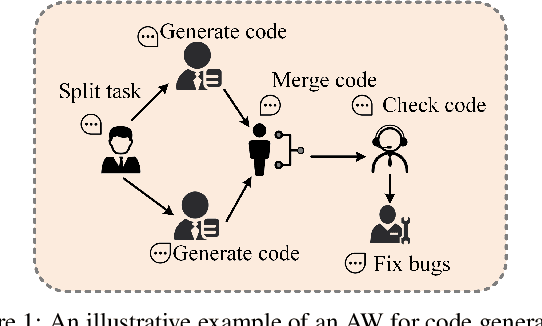
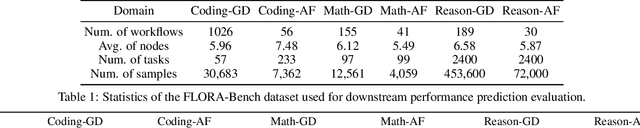
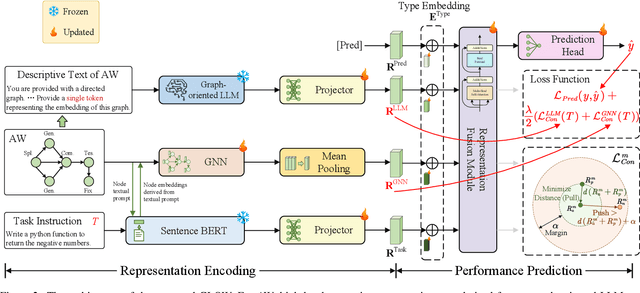
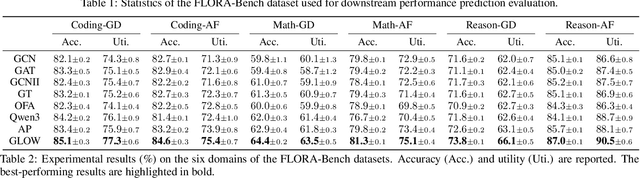
Agentic Workflows (AWs) have emerged as a promising paradigm for solving complex tasks. However, the scalability of automating their generation is severely constrained by the high cost and latency of execution-based evaluation. Existing AW performance prediction methods act as surrogates but fail to simultaneously capture the intricate topological dependencies and the deep semantic logic embedded in AWs. To address this limitation, we propose GLOW, a unified framework for AW performance prediction that combines the graph-structure modeling capabilities of GNNs with the reasoning power of LLMs. Specifically, we introduce a graph-oriented LLM, instruction-tuned on graph tasks, to extract topologically aware semantic features, which are fused with GNN-encoded structural representations. A contrastive alignment strategy further refines the latent space to distinguish high-quality AWs. Extensive experiments on FLORA-Bench show that GLOW outperforms state-of-the-art baselines in prediction accuracy and ranking utility.
More Than One Teacher: Adaptive Multi-Guidance Policy Optimization for Diverse Exploration
Oct 02, 2025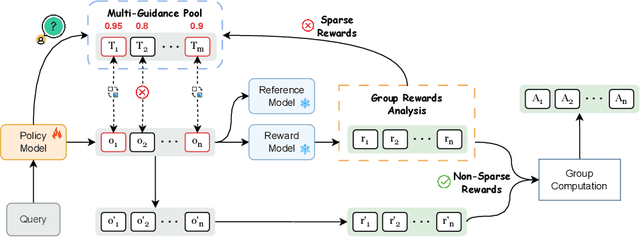
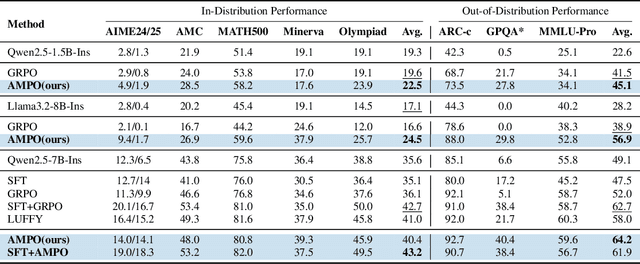
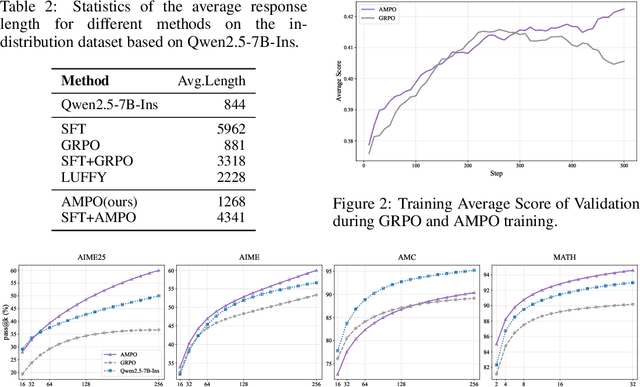
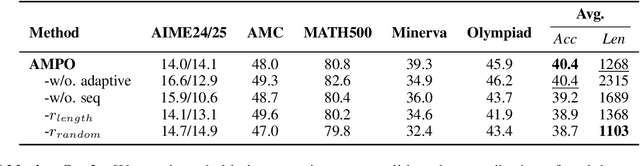
Reinforcement Learning with Verifiable Rewards (RLVR) is a promising paradigm for enhancing the reasoning ability in Large Language Models (LLMs). However, prevailing methods primarily rely on self-exploration or a single off-policy teacher to elicit long chain-of-thought (LongCoT) reasoning, which may introduce intrinsic model biases and restrict exploration, ultimately limiting reasoning diversity and performance. Drawing inspiration from multi-teacher strategies in knowledge distillation, we introduce Adaptive Multi-Guidance Policy Optimization (AMPO), a novel framework that adaptively leverages guidance from multiple proficient teacher models, but only when the on-policy model fails to generate correct solutions. This "guidance-on-demand" approach expands exploration while preserving the value of self-discovery. Moreover, AMPO incorporates a comprehension-based selection mechanism, prompting the student to learn from the reasoning paths that it is most likely to comprehend, thus balancing broad exploration with effective exploitation. Extensive experiments show AMPO substantially outperforms a strong baseline (GRPO), with a 4.3% improvement on mathematical reasoning tasks and 12.2% on out-of-distribution tasks, while significantly boosting Pass@k performance and enabling more diverse exploration. Notably, using four peer-sized teachers, our method achieves comparable results to approaches that leverage a single, more powerful teacher (e.g., DeepSeek-R1) with more data. These results demonstrate a more efficient and scalable path to superior reasoning and generalizability. Our code is available at https://github.com/SII-Enigma/AMPO.
WereWolf-Plus: An Update of Werewolf Game setting Based on DSGBench
Jun 15, 2025With the rapid development of LLM-based agents, increasing attention has been given to their social interaction and strategic reasoning capabilities. However, existing Werewolf-based benchmarking platforms suffer from overly simplified game settings, incomplete evaluation metrics, and poor scalability. To address these limitations, we propose WereWolf-Plus, a multi-model, multi-dimensional, and multi-method benchmarking platform for evaluating multi-agent strategic reasoning in the Werewolf game. The platform offers strong extensibility, supporting customizable configurations for roles such as Seer, Witch, Hunter, Guard, and Sheriff, along with flexible model assignment and reasoning enhancement strategies for different roles. In addition, we introduce a comprehensive set of quantitative evaluation metrics for all special roles, werewolves, and the sheriff, and enrich the assessment dimensions for agent reasoning ability, cooperation capacity, and social influence. WereWolf-Plus provides a more flexible and reliable environment for advancing research on inference and strategic interaction within multi-agent communities. Our code is open sourced at https://github.com/MinstrelsyXia/WereWolfPlus.
Simulation of Language Evolution under Regulated Social Media Platforms: A Synergistic Approach of Large Language Models and Genetic Algorithms
Feb 26, 2025Social media platforms frequently impose restrictive policies to moderate user content, prompting the emergence of creative evasion language strategies. This paper presents a multi-agent framework based on Large Language Models (LLMs) to simulate the iterative evolution of language strategies under regulatory constraints. In this framework, participant agents, as social media users, continuously evolve their language expression, while supervisory agents emulate platform-level regulation by assessing policy violations. To achieve a more faithful simulation, we employ a dual design of language strategies (constraint and expression) to differentiate conflicting goals and utilize an LLM-driven GA (Genetic Algorithm) for the selection, mutation, and crossover of language strategies. The framework is evaluated using two distinct scenarios: an abstract password game and a realistic simulated illegal pet trade scenario. Experimental results demonstrate that as the number of dialogue rounds increases, both the number of uninterrupted dialogue turns and the accuracy of information transmission improve significantly. Furthermore, a user study with 40 participants validates the real-world relevance of the generated dialogues and strategies. Moreover, ablation studies validate the importance of the GA, emphasizing its contribution to long-term adaptability and improved overall results.
Automatic Adaptation Rule Optimization via Large Language Models
Jul 02, 2024Rule-based adaptation is a foundational approach to self-adaptation, characterized by its human readability and rapid response. However, building high-performance and robust adaptation rules is often a challenge because it essentially involves searching the optimal design in a complex (variables) space. In response, this paper attempt to employ large language models (LLMs) as a optimizer to construct and optimize adaptation rules, leveraging the common sense and reasoning capabilities inherent in LLMs. Preliminary experiments conducted in SWIM have validated the effectiveness and limitation of our method.
Exploring the Improvement of Evolutionary Computation via Large Language Models
May 05, 2024Evolutionary computation (EC), as a powerful optimization algorithm, has been applied across various domains. However, as the complexity of problems increases, the limitations of EC have become more apparent. The advent of large language models (LLMs) has not only transformed natural language processing but also extended their capabilities to diverse fields. By harnessing LLMs' vast knowledge and adaptive capabilities, we provide a forward-looking overview of potential improvements LLMs can bring to EC, focusing on the algorithms themselves, population design, and additional enhancements. This presents a promising direction for future research at the intersection of LLMs and EC.
Language Evolution for Evading Social Media Regulation via LLM-based Multi-agent Simulation
May 05, 2024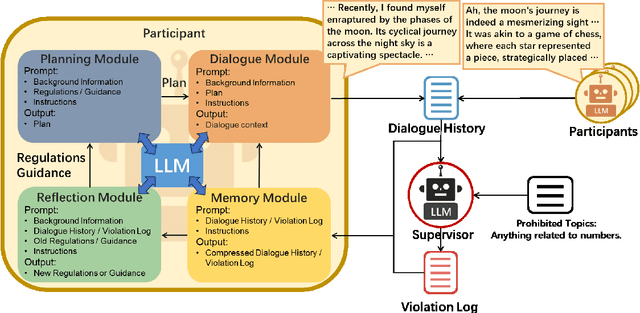
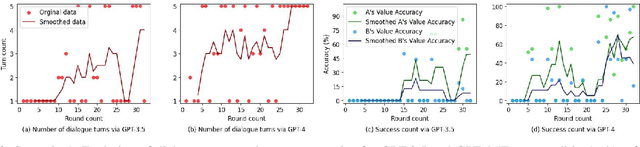
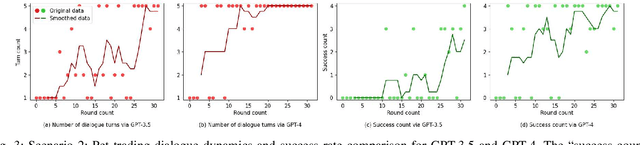
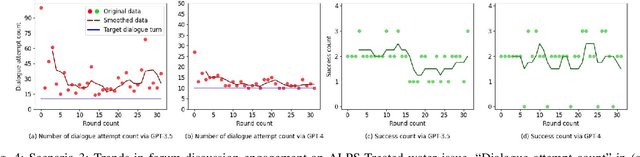
Social media platforms such as Twitter, Reddit, and Sina Weibo play a crucial role in global communication but often encounter strict regulations in geopolitically sensitive regions. This situation has prompted users to ingeniously modify their way of communicating, frequently resorting to coded language in these regulated social media environments. This shift in communication is not merely a strategy to counteract regulation, but a vivid manifestation of language evolution, demonstrating how language naturally evolves under societal and technological pressures. Studying the evolution of language in regulated social media contexts is of significant importance for ensuring freedom of speech, optimizing content moderation, and advancing linguistic research. This paper proposes a multi-agent simulation framework using Large Language Models (LLMs) to explore the evolution of user language in regulated social media environments. The framework employs LLM-driven agents: supervisory agent who enforce dialogue supervision and participant agents who evolve their language strategies while engaging in conversation, simulating the evolution of communication styles under strict regulations aimed at evading social media regulation. The study evaluates the framework's effectiveness through a range of scenarios from abstract scenarios to real-world situations. Key findings indicate that LLMs are capable of simulating nuanced language dynamics and interactions in constrained settings, showing improvement in both evading supervision and information accuracy as evolution progresses. Furthermore, it was found that LLM agents adopt different strategies for different scenarios.
FGAD: Self-boosted Knowledge Distillation for An Effective Federated Graph Anomaly Detection Framework
Feb 20, 2024Graph anomaly detection (GAD) aims to identify anomalous graphs that significantly deviate from other ones, which has raised growing attention due to the broad existence and complexity of graph-structured data in many real-world scenarios. However, existing GAD methods usually execute with centralized training, which may lead to privacy leakage risk in some sensitive cases, thereby impeding collaboration among organizations seeking to collectively develop robust GAD models. Although federated learning offers a promising solution, the prevalent non-IID problems and high communication costs present significant challenges, particularly pronounced in collaborations with graph data distributed among different participants. To tackle these challenges, we propose an effective federated graph anomaly detection framework (FGAD). We first introduce an anomaly generator to perturb the normal graphs to be anomalous, and train a powerful anomaly detector by distinguishing generated anomalous graphs from normal ones. Then, we leverage a student model to distill knowledge from the trained anomaly detector (teacher model), which aims to maintain the personality of local models and alleviate the adverse impact of non-IID problems. Moreover, we design an effective collaborative learning mechanism that facilitates the personalization preservation of local models and significantly reduces communication costs among clients. Empirical results of the GAD tasks on non-IID graphs compared with state-of-the-art baselines demonstrate the superiority and efficiency of the proposed FGAD method.