 Add to Chrome
 Add to Firefox
 Add to Edge
LMPAN: A Lightweight Multi-Path Alignment Network for Joint Full-Duplex Acoustic Echo Cancellation and Noise Suppression
Jul 02, 2026
We propose a lightweight multi-path alignment network (LMPAN) for on-device joint acoustic echo cancellation (AEC) and noise suppression (NS) in full-duplex spoken dialogue systems. To address hardware-induced distortions and dynamic acoustic conditions, we introduce three core innovations: (1) a multi-path alignment stage correcting temporal and energy mismatches across reference, linear AEC (LAEC) output, and microphone signals; (2) an attention-based mechanism that dynamically integrates enhanced LAEC and microphone features under varying acoustic scenarios; (3) a post-filtering module with a dynamic target generation strategy for downstream tasks (ASR, VAD). Furthermore, we adopt a two-stage training framework leveraging self-supervised learning representations to enhance perceptual quality. Experiments show that LMPAN, with only 480K parameters and 126 MACs, achieves performance comparable to the state-of-the-art lightweight model DeepVQE-S, while ensuring real-time inference capability.

A Hybrid Discriminative and Generative System for Universal Speech Enhancement
Jan 27, 2026Universal speech enhancement aims at handling inputs with various speech distortions and recording conditions. In this work, we propose a novel hybrid architecture that synergizes the signal fidelity of discriminative modeling with the reconstruction capabilities of generative modeling. Our system utilizes the discriminative TF-GridNet model with the Sampling-Frequency-Independent strategy to handle variable sampling rates universally. In parallel, an autoregressive model combined with spectral mapping modeling generates detail-rich speech while effectively suppressing generative artifacts. Finally, a fusion network learns adaptive weights of the two outputs under the optimization of signal-level losses and the comprehensive Speech Quality Assessment (SQA) loss. Our proposed system is evaluated in the ICASSP 2026 URGENT Challenge (Track 1) and ranks the third place.
QuarkAudio Technical Report
Dec 23, 2025Many existing audio processing and generation models rely on task-specific architectures, resulting in fragmented development efforts and limited extensibility. It is therefore promising to design a unified framework capable of handling multiple tasks, while providing robust instruction and audio understanding and high-quality audio generation. This requires a compatible paradigm design, a powerful backbone, and a high-fidelity audio reconstruction module. To meet these requirements, this technical report introduces QuarkAudio, a decoder-only autoregressive (AR) LM-based generative framework that unifies multiple tasks. The framework includes a unified discrete audio tokenizer, H-Codec, which incorporates self-supervised learning (SSL) representations into the tokenization and reconstruction process. We further propose several improvements to H-Codec, such as a dynamic frame-rate mechanism and extending the audio sampling rate to 48 kHz. QuarkAudio unifies tasks by using task-specific conditional information as the conditioning sequence of the decoder-only LM, and predicting discrete target audio tokens in an AR manner. The framework supports a wide range of audio processing and generation tasks, including speech restoration (SR), target speaker extraction (TSE), speech separation (SS), voice conversion (VC), and language-queried audio source separation (LASS). In addition, we extend downstream tasks to universal free-form audio editing guided by natural language instructions (including speech semantic editing and audio event editing). Experimental results show that H-Codec achieves high-quality audio reconstruction with a low frame rate, improving both the efficiency and performance of downstream audio generation, and that QuarkAudio delivers competitive or comparable performance to state-of-the-art task-specific or multi-task systems across multiple tasks.
UniSE: A Unified Framework for Decoder-only Autoregressive LM-based Speech Enhancement
Oct 23, 2025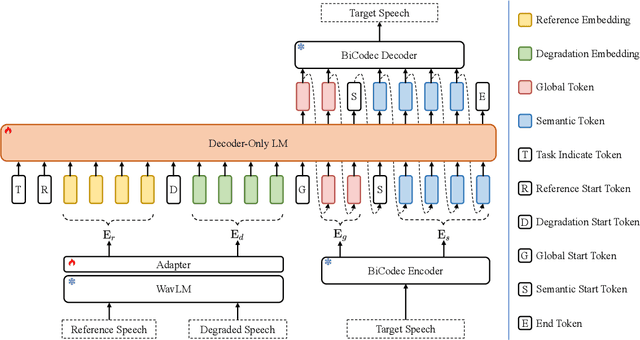
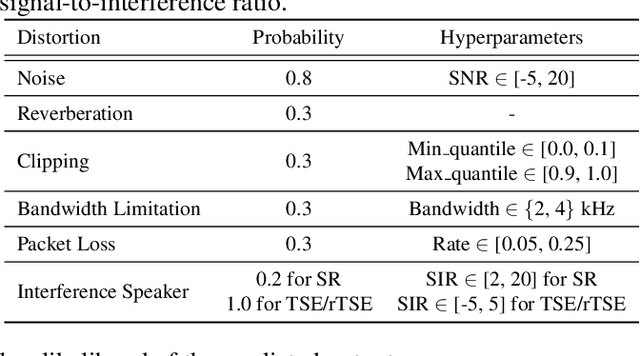

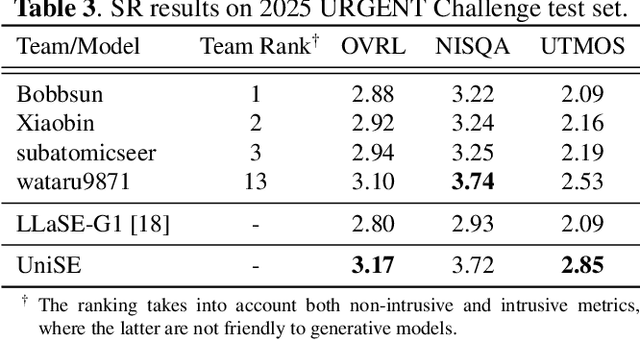
The development of neural audio codecs (NACs) has largely promoted applications of language models (LMs) to speech processing and understanding. However, there lacks the verification on the effectiveness of autoregressive (AR) LMbased models in unifying different sub-tasks of speech enhancement (SE). In this work, we propose UniSE, a unified decoder-only LM-based framework to handle different SE tasks including speech restoration, target speaker extraction and speech separation. It takes input speech features as conditions and generates discrete tokens of the target speech using AR modeling, which facilitates a compatibility between distinct learning patterns of multiple tasks. Experiments on several benchmarks indicate the proposed UniSE can achieve competitive performance compared to discriminative and generative baselines, showing the capacity of LMs in unifying SE tasks. The demo page is available here: https://github.com/hyyan2k/UniSE.