 Add to Chrome
 Add to Firefox
 Add to Edge
Struct-GStream: Towards Efficient Free-Viewpoint Video Streaming at Low-Bitrates with Structured 3D Gaussians
Aug 02, 2026
Constructing photorealistic Free-Viewpoint Videos (FVVs) of dynamic scenes from a set of posed 2D images has been an intriguing yet challenging task in computer vision. Methods based on neural rendering achieve high-fidelity image quality in FVV construction. However, most of these methods are unable to achieve real-time rendering and often require complete video sequences to train. Despite the existence of some online training methods capable of rendering FVVs in real time, they struggle to meet the requirements for storage and training time for downstream applications. To overcome this problem, we propose Struct-GStream, which can achieve efficient FVV streaming using structured 3D Gaussians (3DGs). Specifically, we introduce dynamic anchor points to generate structured 3DGs to construct basic scenes and model approximate scene movements based on the assumption of local rigidity in object motion. Besides, we introduce a global free 3DGs patching strategy involving free 3DGs' generation, pruning, and optimization to patch and model deficient areas and emerging objects. Our method achieves fast training at low bitrates while maintaining high rendering quality. Extensive experiments demonstrate that Struct-GStream significantly outperforms existing online training methods for FVV construction in terms of training time, storage, and rendering quality while maintaining competitive rendering speed.

RoadVGGT: Road-Structure-Aware Feed-Forward Road Surface Reconstruction
Jul 26, 2026Large-scale road surface reconstruction supports high-definition mapping, autonomous-driving perception, annotation, and simulation. Existing road-specialized optimization methods can produce high-quality road representations, but they typically require per-scene training and scene-dependent coverage design around the driving trajectory, limiting scalable reconstruction over newly collected roads. To address these limitations, we introduce RoadVGGT, a road-structure-aware feed-forward framework that reconstructs compact Gaussian road surfaces without test-time per-scene optimization. RoadVGGT uses a geometric foundation model to exploit multi-view images together with provided pose and depth observations, and predicts dense pixel-aligned Gaussian attributes through a learned Gaussian head. To make these dense predictions usable for large road surfaces, we align them into a consistent metric world coordinate system and fuse redundant Gaussians on the road-aligned XY plane through confidence-weighted grid fusion. Category-aware grouping and road--sidewalk junction protection further control fusion around vulnerable road structures. The resulting representation supports RGB and semantic bird's-eye-view maps, elevation estimation, and novel view synthesis. RoadVGGT eliminates the need for per-scene optimization in prior methods, reconstructs complete road surfaces with a compact Gaussian representation, and improves image quality, semantic mapping, and elevation accuracy. Extensive experiments demonstrate the potential of geometric foundation models for scalable feed-forward road surface reconstruction.
Fast and Robust Deformable 3D Gaussian Splatting
Mar 21, 20263D Gaussian Splatting has demonstrated remarkable real-time rendering capabilities and superior visual quality in novel view synthesis for static scenes. Building upon these advantages, researchers have progressively extended 3D Gaussians to dynamic scene reconstruction. Deformation field-based methods have emerged as a promising approach among various techniques. These methods maintain 3D Gaussian attributes in a canonical field and employ the deformation field to transform this field across temporal sequences. Nevertheless, these approaches frequently encounter challenges such as suboptimal rendering speeds, significant dependence on initial point clouds, and vulnerability to local optima in dim scenes. To overcome these limitations, we present FRoG, an efficient and robust framework for high-quality dynamic scene reconstruction. FRoG integrates per-Gaussian embedding with a coarse-to-fine temporal embedding strategy, accelerating rendering through the early fusion of temporal embeddings. Moreover, to enhance robustness against sparse initializations, we introduce a novel depth- and error-guided sampling strategy. This strategy populates the canonical field with new 3D Gaussians at low-deviation initial positions, significantly reducing the optimization burden on the deformation field and improving detail reconstruction in both static and dynamic regions. Furthermore, by modulating opacity variations, we mitigate the local optima problem in dim scenes, improving color fidelity. Comprehensive experimental results validate that our method achieves accelerated rendering speeds while maintaining state-of-the-art visual quality.
MAPo : Motion-Aware Partitioning of Deformable 3D Gaussian Splatting for High-Fidelity Dynamic Scene Reconstruction
Aug 27, 2025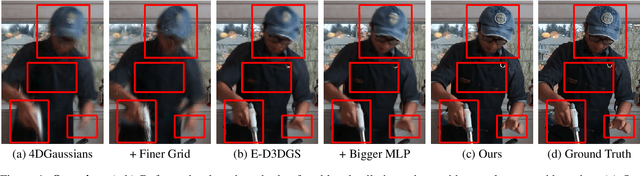
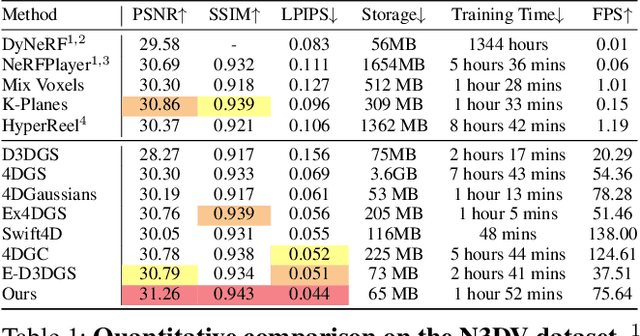
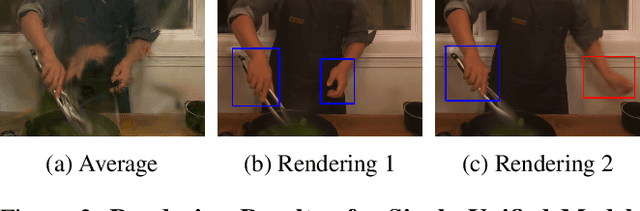
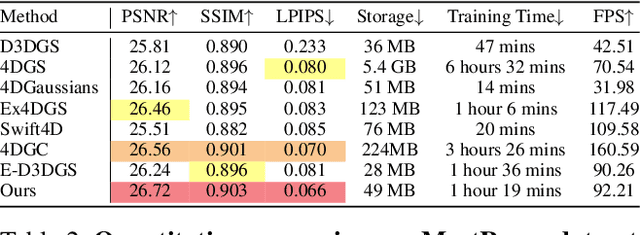
3D Gaussian Splatting, known for enabling high-quality static scene reconstruction with fast rendering, is increasingly being applied to dynamic scene reconstruction. A common strategy involves learning a deformation field to model the temporal changes of a canonical set of 3D Gaussians. However, these deformation-based methods often produce blurred renderings and lose fine motion details in highly dynamic regions due to the inherent limitations of a single, unified model in representing diverse motion patterns. To address these challenges, we introduce Motion-Aware Partitioning of Deformable 3D Gaussian Splatting (MAPo), a novel framework for high-fidelity dynamic scene reconstruction. Its core is a dynamic score-based partitioning strategy that distinguishes between high- and low-dynamic 3D Gaussians. For high-dynamic 3D Gaussians, we recursively partition them temporally and duplicate their deformation networks for each new temporal segment, enabling specialized modeling to capture intricate motion details. Concurrently, low-dynamic 3DGs are treated as static to reduce computational costs. However, this temporal partitioning strategy for high-dynamic 3DGs can introduce visual discontinuities across frames at the partition boundaries. To address this, we introduce a cross-frame consistency loss, which not only ensures visual continuity but also further enhances rendering quality. Extensive experiments demonstrate that MAPo achieves superior rendering quality compared to baselines while maintaining comparable computational costs, particularly in regions with complex or rapid motions.
Rethinking Video Deblurring with Wavelet-Aware Dynamic Transformer and Diffusion Model
Aug 24, 2024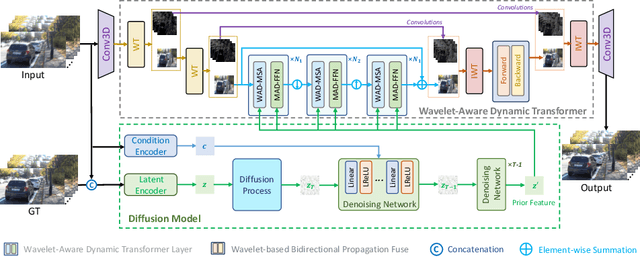
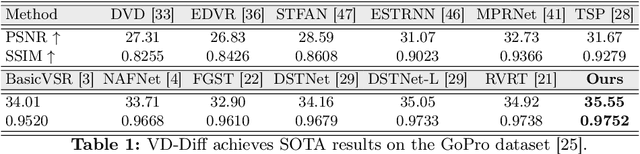
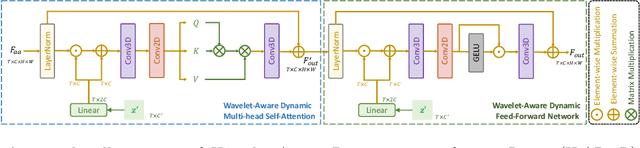
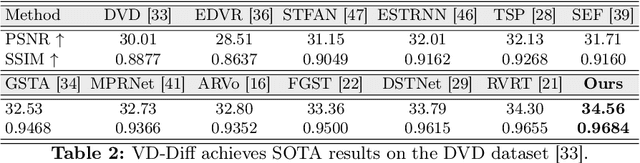
Current video deblurring methods have limitations in recovering high-frequency information since the regression losses are conservative with high-frequency details. Since Diffusion Models (DMs) have strong capabilities in generating high-frequency details, we consider introducing DMs into the video deblurring task. However, we found that directly applying DMs to the video deblurring task has the following problems: (1) DMs require many iteration steps to generate videos from Gaussian noise, which consumes many computational resources. (2) DMs are easily misled by the blurry artifacts in the video, resulting in irrational content and distortion of the deblurred video. To address the above issues, we propose a novel video deblurring framework VD-Diff that integrates the diffusion model into the Wavelet-Aware Dynamic Transformer (WADT). Specifically, we perform the diffusion model in a highly compact latent space to generate prior features containing high-frequency information that conforms to the ground truth distribution. We design the WADT to preserve and recover the low-frequency information in the video while utilizing the high-frequency information generated by the diffusion model. Extensive experiments show that our proposed VD-Diff outperforms SOTA methods on GoPro, DVD, BSD, and Real-World Video datasets.
Rethink Arbitrary Style Transfer with Transformer and Contrastive Learning
Apr 21, 2024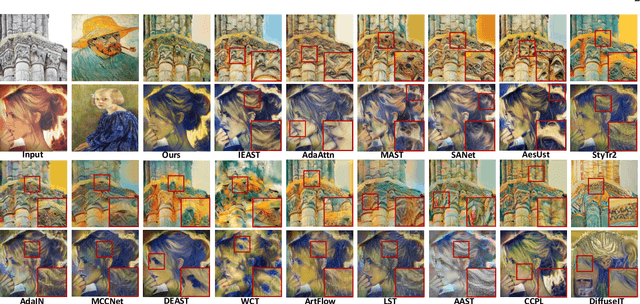
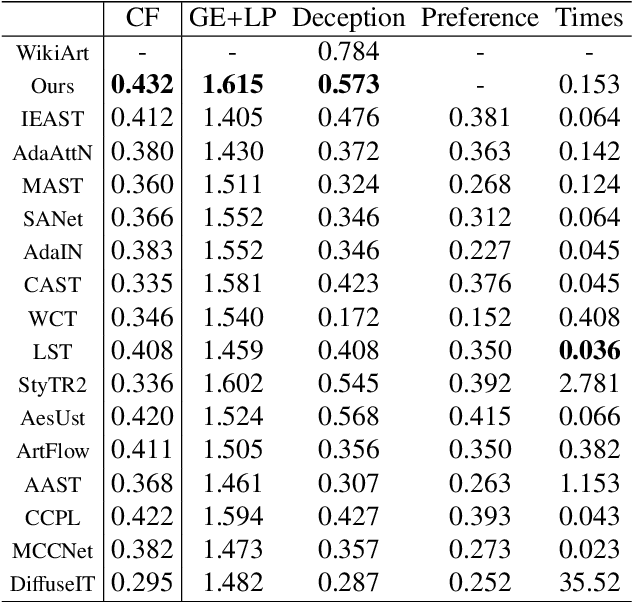
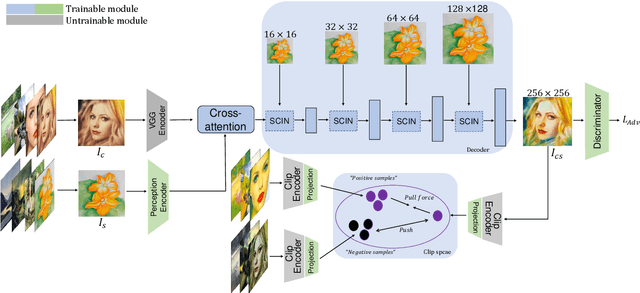
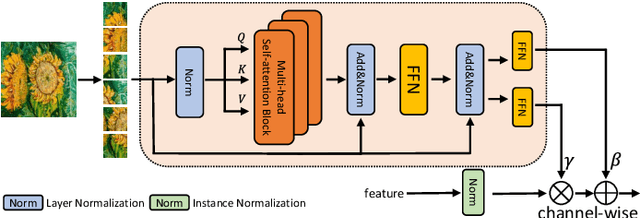
Arbitrary style transfer holds widespread attention in research and boasts numerous practical applications. The existing methods, which either employ cross-attention to incorporate deep style attributes into content attributes or use adaptive normalization to adjust content features, fail to generate high-quality stylized images. In this paper, we introduce an innovative technique to improve the quality of stylized images. Firstly, we propose Style Consistency Instance Normalization (SCIN), a method to refine the alignment between content and style features. In addition, we have developed an Instance-based Contrastive Learning (ICL) approach designed to understand the relationships among various styles, thereby enhancing the quality of the resulting stylized images. Recognizing that VGG networks are more adept at extracting classification features and need to be better suited for capturing style features, we have also introduced the Perception Encoder (PE) to capture style features. Extensive experiments demonstrate that our proposed method generates high-quality stylized images and effectively prevents artifacts compared with the existing state-of-the-art methods.
PNeSM: Arbitrary 3D Scene Stylization via Prompt-Based Neural Style Mapping
Mar 13, 20243D scene stylization refers to transform the appearance of a 3D scene to match a given style image, ensuring that images rendered from different viewpoints exhibit the same style as the given style image, while maintaining the 3D consistency of the stylized scene. Several existing methods have obtained impressive results in stylizing 3D scenes. However, the models proposed by these methods need to be re-trained when applied to a new scene. In other words, their models are coupled with a specific scene and cannot adapt to arbitrary other scenes. To address this issue, we propose a novel 3D scene stylization framework to transfer an arbitrary style to an arbitrary scene, without any style-related or scene-related re-training. Concretely, we first map the appearance of the 3D scene into a 2D style pattern space, which realizes complete disentanglement of the geometry and appearance of the 3D scene and makes our model be generalized to arbitrary 3D scenes. Then we stylize the appearance of the 3D scene in the 2D style pattern space via a prompt-based 2D stylization algorithm. Experimental results demonstrate that our proposed framework is superior to SOTA methods in both visual quality and generalization.
Attack Deterministic Conditional Image Generative Models for Diverse and Controllable Generation
Mar 13, 2024Existing generative adversarial network (GAN) based conditional image generative models typically produce fixed output for the same conditional input, which is unreasonable for highly subjective tasks, such as large-mask image inpainting or style transfer. On the other hand, GAN-based diverse image generative methods require retraining/fine-tuning the network or designing complex noise injection functions, which is computationally expensive, task-specific, or struggle to generate high-quality results. Given that many deterministic conditional image generative models have been able to produce high-quality yet fixed results, we raise an intriguing question: is it possible for pre-trained deterministic conditional image generative models to generate diverse results without changing network structures or parameters? To answer this question, we re-examine the conditional image generation tasks from the perspective of adversarial attack and propose a simple and efficient plug-in projected gradient descent (PGD) like method for diverse and controllable image generation. The key idea is attacking the pre-trained deterministic generative models by adding a micro perturbation to the input condition. In this way, diverse results can be generated without any adjustment of network structures or fine-tuning of the pre-trained models. In addition, we can also control the diverse results to be generated by specifying the attack direction according to a reference text or image. Our work opens the door to applying adversarial attack to low-level vision tasks, and experiments on various conditional image generation tasks demonstrate the effectiveness and superiority of the proposed method.
3DGStream: On-the-Fly Training of 3D Gaussians for Efficient Streaming of Photo-Realistic Free-Viewpoint Videos
Mar 05, 2024Constructing photo-realistic Free-Viewpoint Videos (FVVs) of dynamic scenes from multi-view videos remains a challenging endeavor. Despite the remarkable advancements achieved by current neural rendering techniques, these methods generally require complete video sequences for offline training and are not capable of real-time rendering. To address these constraints, we introduce 3DGStream, a method designed for efficient FVV streaming of real-world dynamic scenes. Our method achieves fast on-the-fly per-frame reconstruction within 12 seconds and real-time rendering at 200 FPS. Specifically, we utilize 3D Gaussians (3DGs) to represent the scene. Instead of the na\"ive approach of directly optimizing 3DGs per-frame, we employ a compact Neural Transformation Cache (NTC) to model the translations and rotations of 3DGs, markedly reducing the training time and storage required for each FVV frame. Furthermore, we propose an adaptive 3DG addition strategy to handle emerging objects in dynamic scenes. Experiments demonstrate that 3DGStream achieves competitive performance in terms of rendering speed, image quality, training time, and model storage when compared with state-of-the-art methods.
ArtBank: Artistic Style Transfer with Pre-trained Diffusion Model and Implicit Style Prompt Bank
Dec 11, 2023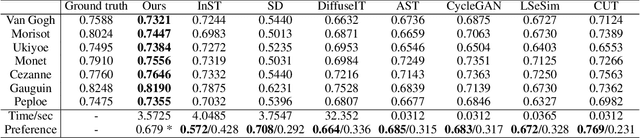
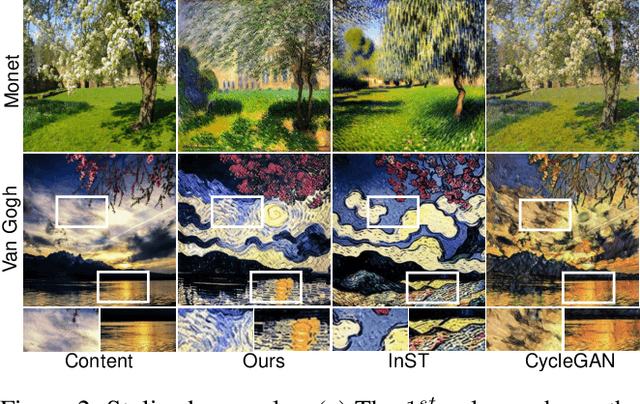


Artistic style transfer aims to repaint the content image with the learned artistic style. Existing artistic style transfer methods can be divided into two categories: small model-based approaches and pre-trained large-scale model-based approaches. Small model-based approaches can preserve the content strucuture, but fail to produce highly realistic stylized images and introduce artifacts and disharmonious patterns; Pre-trained large-scale model-based approaches can generate highly realistic stylized images but struggle with preserving the content structure. To address the above issues, we propose ArtBank, a novel artistic style transfer framework, to generate highly realistic stylized images while preserving the content structure of the content images. Specifically, to sufficiently dig out the knowledge embedded in pre-trained large-scale models, an Implicit Style Prompt Bank (ISPB), a set of trainable parameter matrices, is designed to learn and store knowledge from the collection of artworks and behave as a visual prompt to guide pre-trained large-scale models to generate highly realistic stylized images while preserving content structure. Besides, to accelerate training the above ISPB, we propose a novel Spatial-Statistical-based self-Attention Module (SSAM). The qualitative and quantitative experiments demonstrate the superiority of our proposed method over state-of-the-art artistic style transfer methods.