 Add to Chrome
 Add to Firefox
 Add to Edge
PRBench: End-to-end Paper Reproduction in Physics Research
Mar 29, 2026
AI agents powered by large language models exhibit strong reasoning and problem-solving capabilities, enabling them to assist scientific research tasks such as formula derivation and code generation. However, whether these agents can reliably perform end-to-end reproduction from real scientific papers remains an open question. We introduce PRBench, a benchmark of 30 expert-curated tasks spanning 11 subfields of physics. Each task requires an agent to comprehend the methodology of a published paper, implement the corresponding algorithms from scratch, and produce quantitative results matching the original publication. Agents are provided only with the task instruction and paper content, and operate in a sandboxed execution environment. All tasks are contributed by domain experts from over 20 research groups at the School of Physics, Peking University, each grounded in a real published paper and validated through end-to-end reproduction with verified ground-truth results and detailed scoring rubrics. Using an agentified assessment pipeline, we evaluate a set of coding agents on PRBench and analyze their capabilities across key dimensions of scientific reasoning and execution. The best-performing agent, OpenAI Codex powered by GPT-5.3-Codex, achieves a mean overall score of 34%. All agents exhibit a zero end-to-end callback success rate, with particularly poor performance in data accuracy and code correctness. We further identify systematic failure modes, including errors in formula implementation, inability to debug numerical simulations, and fabrication of output data. Overall, PRBench provides a rigorous benchmark for evaluating progress toward autonomous scientific research.

An Energy-concentrated Wavelet Transform for Time Frequency Analysis of Transient Signals
Feb 22, 2022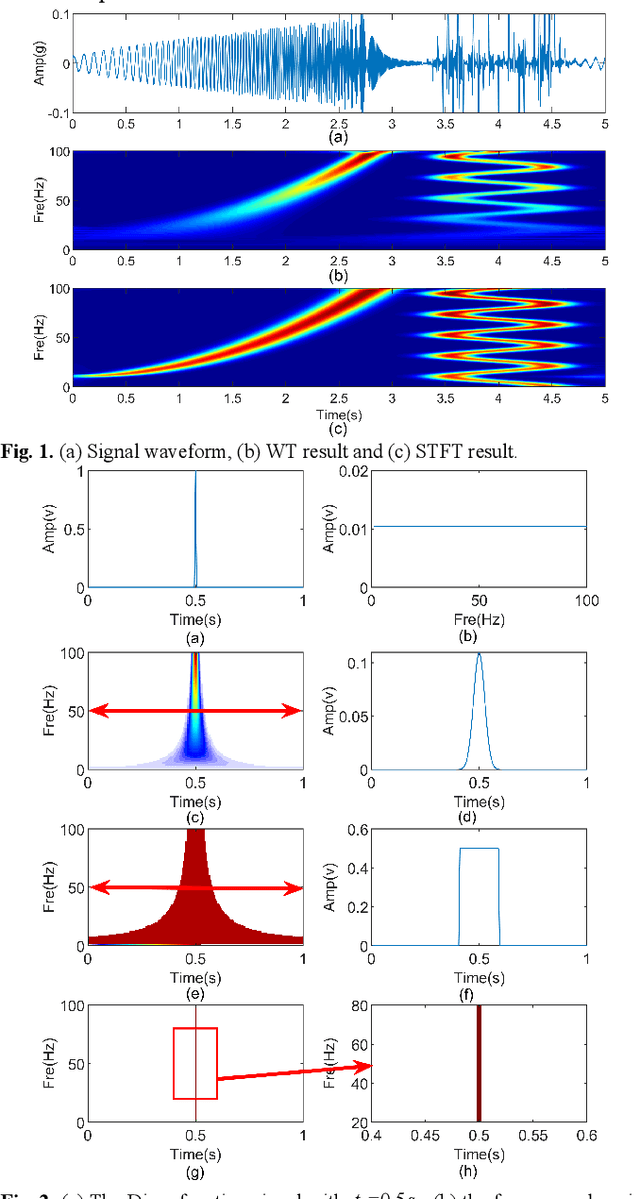
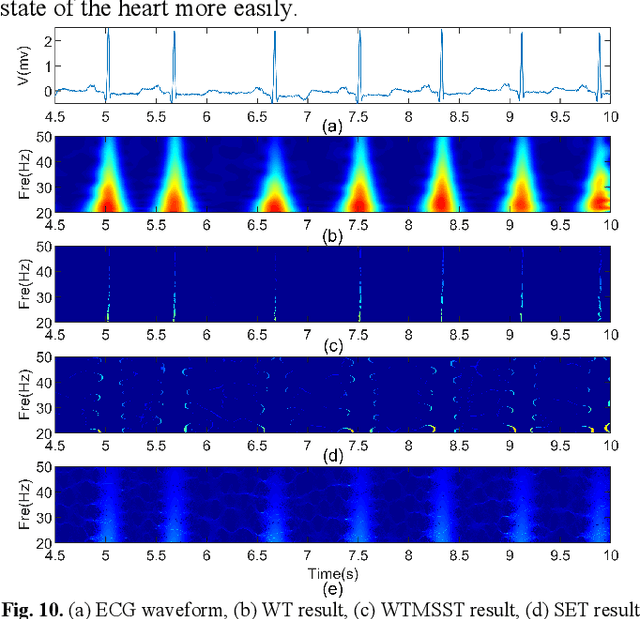
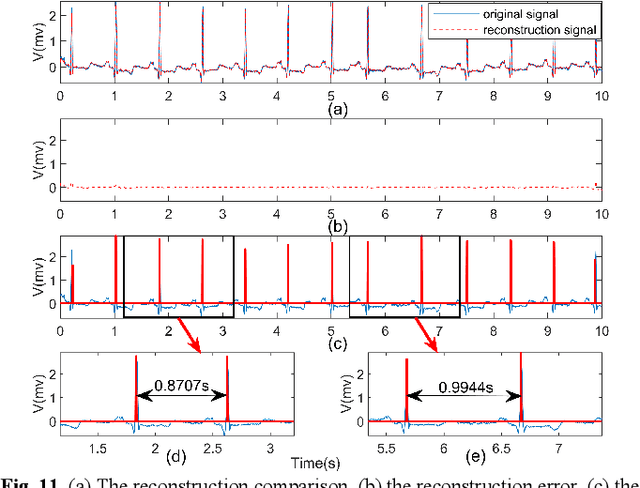
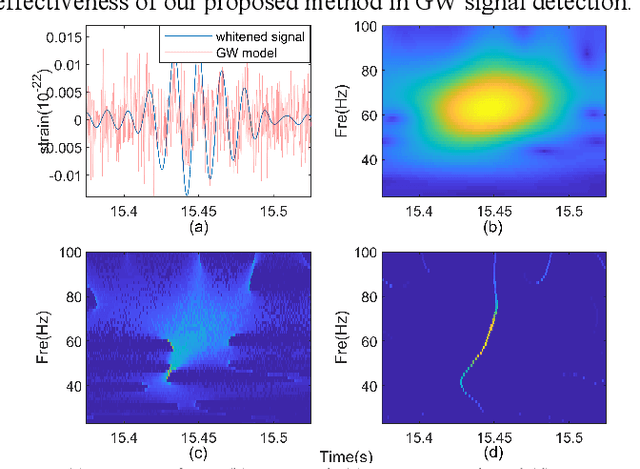
Transient signals are often composed of a series of modes that have multivalued time-dependent instantaneous frequency (IF), which brings challenges to the development of signal processing technology. Fortunately, the group delay (GD) of such signal can be well expressed as a single valued function of frequency. By considering the frequency-domain signal model, we present a postprocessing method called wavelet transform (WT)-based time-reassigned synchrosqueezing transform (WTSST). Our proposed method embeds a two-dimensional GD operator into a synchrosqueezing framework to generate a time-frequency representation (TFR) of transient signal with high energy concentration and allows to retrieve the whole or part of the signal. The theoretical analyses of the WTSST are provided, including the analysis of GD candidate accuracy and signal reconstruction accuracy. Moreover, based on WTSST, the WT-based time-reassigned multisynchrosqueezing transform (WTMSST) is proposed by introducing a stepwise refinement scheme, which further improves the drawback that the WTSST method is unable to deal with strong frequency-varying signal. Simulation and real signal analysis illustrate that the proposed methods have the capacity to appropriately describe the features of transient signals.