 Add to Chrome
 Add to Firefox
 Add to Edge
ASTELD: A Six-Axis Classification Framework for Autonomous AI Agents - Design, Evaluation, and an OpenClaw Case Study
Aug 05, 2026
Autonomous AI agent platforms differ substantially in architecture, security, tool integration, execution, autonomy, and deployment, yet the field lacks a common classification scheme for comparing these design choices. We propose ASTELD, an operational six-axis classification framework for autonomous AI agents: Architecture pattern, Security posture, Tool integration model, Execution paradigm, Level of autonomy and human control, and Deployment topology. ASTELD is constructed by synthesizing prior agent taxonomies with observable platform properties and explicit category-assignment rules. We evaluate its discriminative and explanatory utility by mapping eight representative frameworks and by using OpenClaw as an in-depth case study. The resulting profiles separate all eight platforms under their dominant configurations and reveal three cross-platform patterns: a security-accessibility diagonal, strong execution-architecture coupling, and capability convergence with persistent architectural differentiation. We further classify 50+ OpenClaw derivatives and find that innovation concentrates on the Security, Execution, and Deployment axes, indicating that ASTELD can explain where ecosystem fragmentation occurs. The OpenClaw case study also supplies a six-category vulnerability taxonomy, evidence from five institutional assessments, and adoption and governance analyses that connect platform coordinates to observed risks. These results position ASTELD as a reproducible method for comparing agent platforms, identifying unoccupied design regions, guiding framework selection, and organizing future empirical research. The analysis also exposes a consequential empty region: none of the evaluated systems combines local-first deployment with enterprise-grade security.

AutoSCORE: Enhancing Automated Scoring with Multi-Agent Large Language Models via Structured Component Recognition
Sep 26, 2025
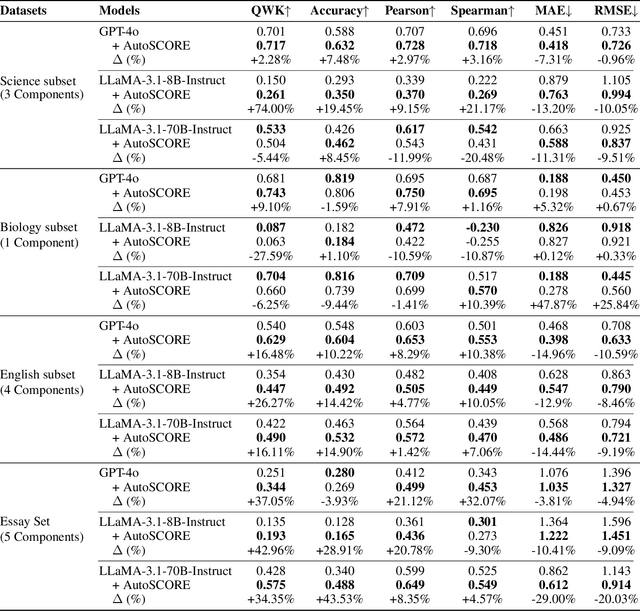
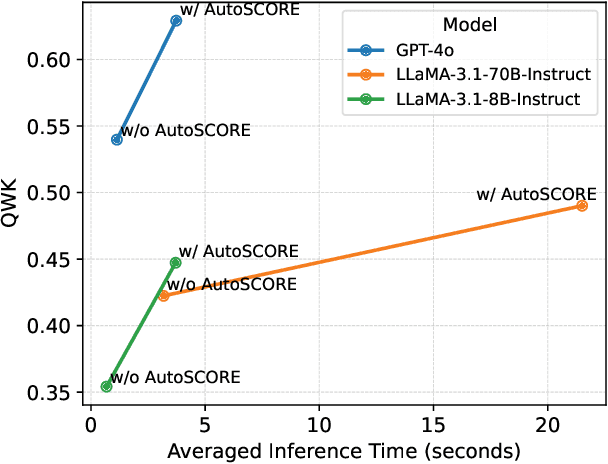
Automated scoring plays a crucial role in education by reducing the reliance on human raters, offering scalable and immediate evaluation of student work. While large language models (LLMs) have shown strong potential in this task, their use as end-to-end raters faces challenges such as low accuracy, prompt sensitivity, limited interpretability, and rubric misalignment. These issues hinder the implementation of LLM-based automated scoring in assessment practice. To address the limitations, we propose AutoSCORE, a multi-agent LLM framework enhancing automated scoring via rubric-aligned Structured COmponent REcognition. With two agents, AutoSCORE first extracts rubric-relevant components from student responses and encodes them into a structured representation (i.e., Scoring Rubric Component Extraction Agent), which is then used to assign final scores (i.e., Scoring Agent). This design ensures that model reasoning follows a human-like grading process, enhancing interpretability and robustness. We evaluate AutoSCORE on four benchmark datasets from the ASAP benchmark, using both proprietary and open-source LLMs (GPT-4o, LLaMA-3.1-8B, and LLaMA-3.1-70B). Across diverse tasks and rubrics, AutoSCORE consistently improves scoring accuracy, human-machine agreement (QWK, correlations), and error metrics (MAE, RMSE) compared to single-agent baselines, with particularly strong benefits on complex, multi-dimensional rubrics, and especially large relative gains on smaller LLMs. These results demonstrate that structured component recognition combined with multi-agent design offers a scalable, reliable, and interpretable solution for automated scoring.
RadFabric: Agentic AI System with Reasoning Capability for Radiology
Jun 17, 2025Chest X ray (CXR) imaging remains a critical diagnostic tool for thoracic conditions, but current automated systems face limitations in pathology coverage, diagnostic accuracy, and integration of visual and textual reasoning. To address these gaps, we propose RadFabric, a multi agent, multimodal reasoning framework that unifies visual and textual analysis for comprehensive CXR interpretation. RadFabric is built on the Model Context Protocol (MCP), enabling modularity, interoperability, and scalability for seamless integration of new diagnostic agents. The system employs specialized CXR agents for pathology detection, an Anatomical Interpretation Agent to map visual findings to precise anatomical structures, and a Reasoning Agent powered by large multimodal reasoning models to synthesize visual, anatomical, and clinical data into transparent and evidence based diagnoses. RadFabric achieves significant performance improvements, with near-perfect detection of challenging pathologies like fractures (1.000 accuracy) and superior overall diagnostic accuracy (0.799) compared to traditional systems (0.229 to 0.527). By integrating cross modal feature alignment and preference-driven reasoning, RadFabric advances AI-driven radiology toward transparent, anatomically precise, and clinically actionable CXR analysis.
Foundation Models for Low-Resource Language Education (Vision Paper)
Dec 06, 2024Recent studies show that large language models (LLMs) are powerful tools for working with natural language, bringing advances in many areas of computational linguistics. However, these models face challenges when applied to low-resource languages due to limited training data and difficulty in understanding cultural nuances. Research is now focusing on multilingual models to improve LLM performance for these languages. Education in these languages also struggles with a lack of resources and qualified teachers, particularly in underdeveloped regions. Here, LLMs can be transformative, supporting innovative methods like community-driven learning and digital platforms. This paper discusses how LLMs could enhance education for low-resource languages, emphasizing practical applications and benefits.