 Add to Chrome
 Add to Firefox
 Add to Edge
SegRap2025: A Benchmark of Gross Tumor Volume and Lymph Node Clinical Target Volume Segmentation for Radiotherapy Planning of Nasopharyngeal Carcinoma
Jan 28, 2026
Accurate delineation of Gross Tumor Volume (GTV), Lymph Node Clinical Target Volume (LN CTV), and Organ-at-Risk (OAR) from Computed Tomography (CT) scans is essential for precise radiotherapy planning in Nasopharyngeal Carcinoma (NPC). Building upon SegRap2023, which focused on OAR and GTV segmentation using single-center paired non-contrast CT (ncCT) and contrast-enhanced CT (ceCT) scans, the SegRap2025 challenge aims to enhance the generalizability and robustness of segmentation models across imaging centers and modalities. SegRap2025 comprises two tasks: Task01 addresses GTV segmentation using paired CT from the SegRap2023 dataset, with an additional external testing set to evaluate cross-center generalization, and Task02 focuses on LN CTV segmentation using multi-center training data and an unseen external testing set, where each case contains paired CT scans or a single modality, emphasizing both cross-center and cross-modality robustness. This paper presents the challenge setup and provides a comprehensive analysis of the solutions submitted by ten participating teams. For GTV segmentation task, the top-performing models achieved average Dice Similarity Coefficient (DSC) of 74.61% and 56.79% on the internal and external testing cohorts, respectively. For LN CTV segmentation task, the highest average DSC values reached 60.24%, 60.50%, and 57.23% on paired CT, ceCT-only, and ncCT-only subsets, respectively. SegRap2025 establishes a large-scale multi-center, multi-modality benchmark for evaluating the generalization and robustness in radiotherapy target segmentation, providing valuable insights toward clinically applicable automated radiotherapy planning systems. The benchmark is available at: https://hilab-git.github.io/SegRap2025_Challenge.

InvCoSS: Inversion-driven Continual Self-supervised Learning in Medical Multi-modal Image Pre-training
Dec 22, 2025Continual self-supervised learning (CSSL) in medical imaging trains a foundation model sequentially, alleviating the need for collecting multi-modal images for joint training and offering promising improvements in downstream performance while preserving data privacy. However, most existing methods still rely on replaying data from previous stages to prevent catastrophic forgetting, which compromises privacy and limits their applicability in real-world scenarios where data transfer across sites is often restricted. In this work, we propose InvCoSS, an inversion-driven continual self-supervised learning framework for medical multi-modal image pre-training. Specifically, after training on a previous task, InvCoSS inverts the pre-trained self-supervised model to generate synthetic images that approximate the original training distribution. These synthetic images are then combined with data from the new task for joint optimization, which effectively mitigates catastrophic forgetting while strictly adhering to the constraint of no access to previous real data. Furthermore, to improve the fidelity of synthetic images, we introduce a novel InvUNet with a multi-scale fusion architecture to restore both high- and low-frequency components of the inverted images. To enhance diversity and prevent mode collapse, we design a repulsive representation-learning mechanism that encourages a diverse feature space for synthetic images without class guidance. Extensive experiments across nine downstream tasks validate the effectiveness of InvCoSS, achieving performance comparable to or even superior to prior data-replay methods while significantly reducing storage requirements and eliminating data privacy constraints.
An Uncertainty-guided Tiered Self-training Framework for Active Source-free Domain Adaptation in Prostate Segmentation
Jul 03, 2024


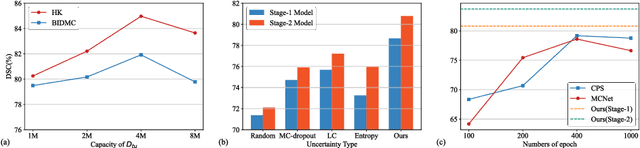
Deep learning models have exhibited remarkable efficacy in accurately delineating the prostate for diagnosis and treatment of prostate diseases, but challenges persist in achieving robust generalization across different medical centers. Source-free Domain Adaptation (SFDA) is a promising technique to adapt deep segmentation models to address privacy and security concerns while reducing domain shifts between source and target domains. However, recent literature indicates that the performance of SFDA remains far from satisfactory due to unpredictable domain gaps. Annotating a few target domain samples is acceptable, as it can lead to significant performance improvement with a low annotation cost. Nevertheless, due to extremely limited annotation budgets, careful consideration is needed in selecting samples for annotation. Inspired by this, our goal is to develop Active Source-free Domain Adaptation (ASFDA) for medical image segmentation. Specifically, we propose a novel Uncertainty-guided Tiered Self-training (UGTST) framework, consisting of efficient active sample selection via entropy-based primary local peak filtering to aggregate global uncertainty and diversity-aware redundancy filter, coupled with a tiered self-learning strategy, achieves stable domain adaptation. Experimental results on cross-center prostate MRI segmentation datasets revealed that our method yielded marked advancements, with a mere 5% annotation, exhibiting an average Dice score enhancement of 9.78% and 7.58% in two target domains compared with state-of-the-art methods, on par with fully supervised learning. Code is available at:https://github.com/HiLab-git/UGTST
Privacy-Preserving Low-Rank Adaptation for Latent Diffusion Models
Feb 19, 2024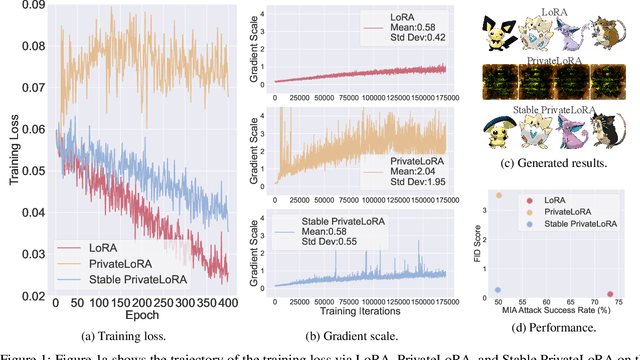

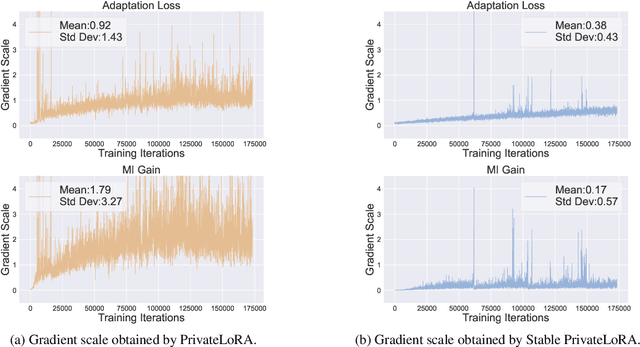
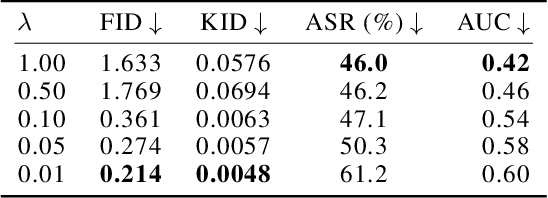
Low-rank adaptation (LoRA) is an efficient strategy for adapting latent diffusion models (LDMs) on a training dataset to generate specific objects by minimizing the adaptation loss. However, adapted LDMs via LoRA are vulnerable to membership inference (MI) attacks that can judge whether a particular data point belongs to private training datasets, thus facing severe risks of privacy leakage. To defend against MI attacks, we make the first effort to propose a straightforward solution: privacy-preserving LoRA (PrivateLoRA). PrivateLoRA is formulated as a min-max optimization problem where a proxy attack model is trained by maximizing its MI gain while the LDM is adapted by minimizing the sum of the adaptation loss and the proxy attack model's MI gain. However, we empirically disclose that PrivateLoRA has the issue of unstable optimization due to the large fluctuation of the gradient scale which impedes adaptation. To mitigate this issue, we propose Stable PrivateLoRA that adapts the LDM by minimizing the ratio of the adaptation loss to the MI gain, which implicitly rescales the gradient and thus stabilizes the optimization. Our comprehensive empirical results corroborate that adapted LDMs via Stable PrivateLoRA can effectively defend against MI attacks while generating high-quality images. Our code is available at https://github.com/WilliamLUO0/StablePrivateLoRA.