 Add to Chrome
 Add to Firefox
 Add to Edge
MathFlow: Enhancing the Perceptual Flow of MLLMs for Visual Mathematical Problems
Mar 19, 2025
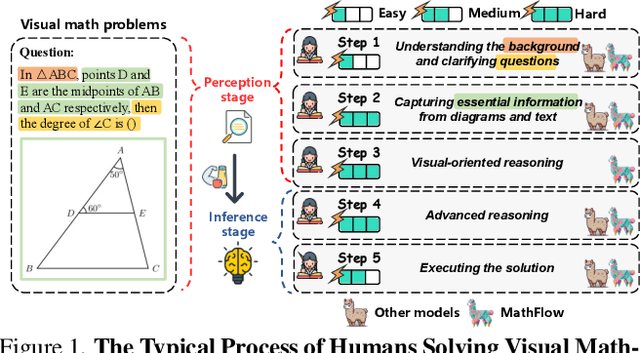
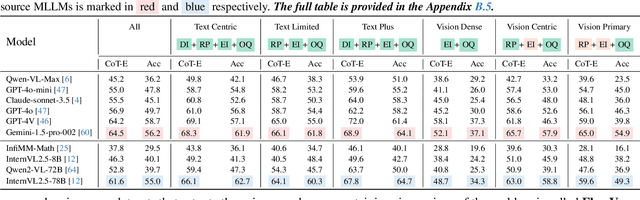
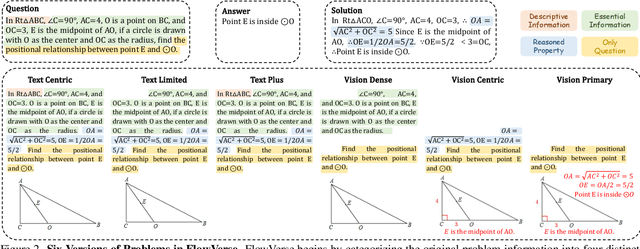

Despite impressive performance across diverse tasks, Multimodal Large Language Models (MLLMs) have yet to fully demonstrate their potential in visual mathematical problem-solving, particularly in accurately perceiving and interpreting diagrams. Inspired by typical processes of humans, we hypothesize that the perception capabilities to extract meaningful information from diagrams is crucial, as it directly impacts subsequent inference processes. To validate this hypothesis, we developed FlowVerse, a comprehensive benchmark that categorizes all information used during problem-solving into four components, which are then combined into six problem versions for evaluation. Our preliminary results on FlowVerse reveal that existing MLLMs exhibit substantial limitations when extracting essential information and reasoned property from diagrams and performing complex reasoning based on these visual inputs. In response, we introduce MathFlow, a modular problem-solving pipeline that decouples perception and inference into distinct stages, thereby optimizing each independently. Given the perceptual limitations observed in current MLLMs, we trained MathFlow-P-7B as a dedicated perception model. Experimental results indicate that MathFlow-P-7B yields substantial performance gains when integrated with various closed-source and open-source inference models. This demonstrates the effectiveness of the MathFlow pipeline and its compatibility to diverse inference frameworks. The FlowVerse benchmark and code are available at https://github.com/MathFlow-zju/MathFlow.

Advances in 4D Generation: A Survey
Mar 19, 2025Generative artificial intelligence (AI) has made significant progress across various domains in recent years. Building on the rapid advancements in 2D, video, and 3D content generation fields, 4D generation has emerged as a novel and rapidly evolving research area, attracting growing attention. 4D generation focuses on creating dynamic 3D assets with spatiotemporal consistency based on user input, offering greater creative freedom and richer immersive experiences. This paper presents a comprehensive survey of the 4D generation field, systematically summarizing its core technologies, developmental trajectory, key challenges, and practical applications, while also exploring potential future research directions. The survey begins by introducing various fundamental 4D representation models, followed by a review of 4D generation frameworks built upon these representations and the key technologies that incorporate motion and geometry priors into 4D assets. We summarize five major challenges of 4D generation: consistency, controllability, diversity, efficiency, and fidelity, accompanied by an outline of existing solutions to address these issues. We systematically analyze applications of 4D generation, spanning dynamic object generation, scene generation, digital human synthesis, 4D editing, and autonomous driving. Finally, we provide an in-depth discussion of the obstacles currently hindering the development of the 4D generation. This survey offers a clear and comprehensive overview of 4D generation, aiming to stimulate further exploration and innovation in this rapidly evolving field. Our code is publicly available at: https://github.com/MiaoQiaowei/Awesome-4D.
TarPro: Targeted Protection against Malicious Image Editing
Mar 18, 2025The rapid advancement of image editing techniques has raised concerns about their misuse for generating Not-Safe-for-Work (NSFW) content. This necessitates a targeted protection mechanism that blocks malicious edits while preserving normal editability. However, existing protection methods fail to achieve this balance, as they indiscriminately disrupt all edits while still allowing some harmful content to be generated. To address this, we propose TarPro, a targeted protection framework that prevents malicious edits while maintaining benign modifications. TarPro achieves this through a semantic-aware constraint that only disrupts malicious content and a lightweight perturbation generator that produces a more stable, imperceptible, and robust perturbation for image protection. Extensive experiments demonstrate that TarPro surpasses existing methods, achieving a high protection efficacy while ensuring minimal impact on normal edits. Our results highlight TarPro as a practical solution for secure and controlled image editing.
DIFFVSGG: Diffusion-Driven Online Video Scene Graph Generation
Mar 18, 2025Top-leading solutions for Video Scene Graph Generation (VSGG) typically adopt an offline pipeline. Though demonstrating promising performance, they remain unable to handle real-time video streams and consume large GPU memory. Moreover, these approaches fall short in temporal reasoning, merely aggregating frame-level predictions over a temporal context. In response, we introduce DIFFVSGG, an online VSGG solution that frames this task as an iterative scene graph update problem. Drawing inspiration from Latent Diffusion Models (LDMs) which generate images via denoising a latent feature embedding, we unify the decoding of object classification, bounding box regression, and graph generation three tasks using one shared feature embedding. Then, given an embedding containing unified features of object pairs, we conduct a step-wise Denoising on it within LDMs, so as to deliver a clean embedding which clearly indicates the relationships between objects. This embedding then serves as the input to task-specific heads for object classification, scene graph generation, etc. DIFFVSGG further facilitates continuous temporal reasoning, where predictions for subsequent frames leverage results of past frames as the conditional inputs of LDMs, to guide the reverse diffusion process for current frames. Extensive experiments on three setups of Action Genome demonstrate the superiority of DIFFVSGG.
Evaluating Global Geo-alignment for Precision Learned Autonomous Vehicle Localization using Aerial Data
Mar 18, 2025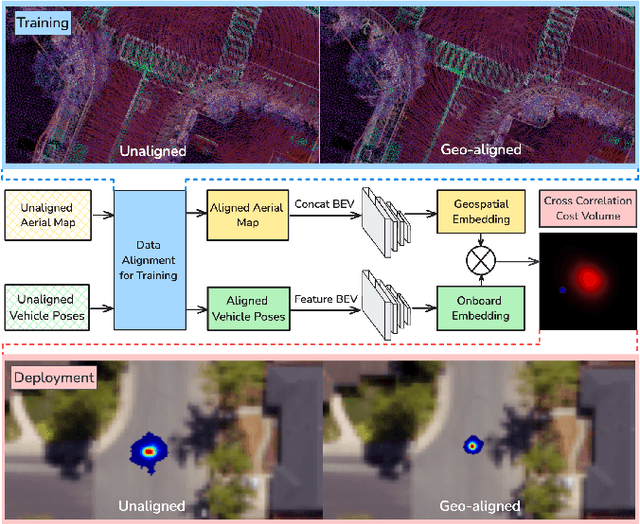
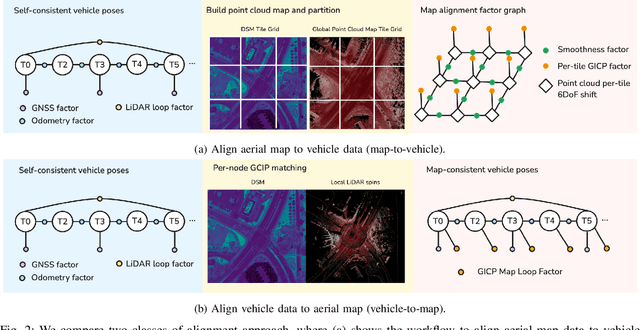

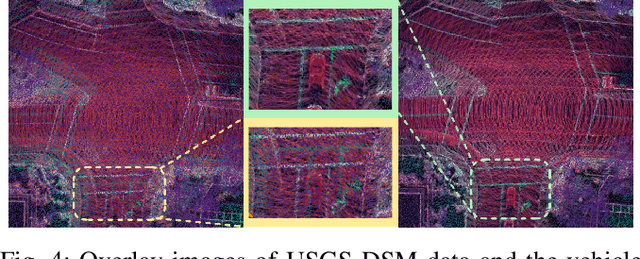
Recently there has been growing interest in the use of aerial and satellite map data for autonomous vehicles, primarily due to its potential for significant cost reduction and enhanced scalability. Despite the advantages, aerial data also comes with challenges such as a sensor-modality gap and a viewpoint difference gap. Learned localization methods have shown promise for overcoming these challenges to provide precise metric localization for autonomous vehicles. Most learned localization methods rely on coarsely aligned ground truth, or implicit consistency-based methods to learn the localization task -- however, in this paper we find that improving the alignment between aerial data and autonomous vehicle sensor data at training time is critical to the performance of a learning-based localization system. We compare two data alignment methods using a factor graph framework and, using these methods, we then evaluate the effects of closely aligned ground truth on learned localization accuracy through ablation studies. Finally, we evaluate a learned localization system using the data alignment methods on a comprehensive (1600km) autonomous vehicle dataset and demonstrate localization error below 0.3m and 0.5$^{\circ}$ sufficient for autonomous vehicle applications.
DreamRenderer: Taming Multi-Instance Attribute Control in Large-Scale Text-to-Image Models
Mar 17, 2025Image-conditioned generation methods, such as depth- and canny-conditioned approaches, have demonstrated remarkable abilities for precise image synthesis. However, existing models still struggle to accurately control the content of multiple instances (or regions). Even state-of-the-art models like FLUX and 3DIS face challenges, such as attribute leakage between instances, which limits user control. To address these issues, we introduce DreamRenderer, a training-free approach built upon the FLUX model. DreamRenderer enables users to control the content of each instance via bounding boxes or masks, while ensuring overall visual harmony. We propose two key innovations: 1) Bridge Image Tokens for Hard Text Attribute Binding, which uses replicated image tokens as bridge tokens to ensure that T5 text embeddings, pre-trained solely on text data, bind the correct visual attributes for each instance during Joint Attention; 2) Hard Image Attribute Binding applied only to vital layers. Through our analysis of FLUX, we identify the critical layers responsible for instance attribute rendering and apply Hard Image Attribute Binding only in these layers, using soft binding in the others. This approach ensures precise control while preserving image quality. Evaluations on the COCO-POS and COCO-MIG benchmarks demonstrate that DreamRenderer improves the Image Success Ratio by 17.7% over FLUX and enhances the performance of layout-to-image models like GLIGEN and 3DIS by up to 26.8%. Project Page: https://limuloo.github.io/DreamRenderer/.
Bridging the LLM Accessibility Divide? Performance, Fairness, and Cost of Closed versus Open LLMs for Automated Essay Scoring
Mar 14, 2025Closed large language models (LLMs) such as GPT-4 have set state-of-the-art results across a number of NLP tasks and have become central to NLP and machine learning (ML)-driven solutions. Closed LLMs' performance and wide adoption has sparked considerable debate about their accessibility in terms of availability, cost, and transparency. In this study, we perform a rigorous comparative analysis of nine leading LLMs, spanning closed, open, and open-source LLM ecosystems, across text assessment and generation tasks related to automated essay scoring. Our findings reveal that for few-shot learning-based assessment of human generated essays, open LLMs such as Llama 3 and Qwen2.5 perform comparably to GPT-4 in terms of predictive performance, with no significant differences in disparate impact scores when considering age- or race-related fairness. Moreover, Llama 3 offers a substantial cost advantage, being up to 37 times more cost-efficient than GPT-4. For generative tasks, we find that essays generated by top open LLMs are comparable to closed LLMs in terms of their semantic composition/embeddings and ML assessed scores. Our findings challenge the dominance of closed LLMs and highlight the democratizing potential of open LLMs, suggesting they can effectively bridge accessibility divides while maintaining competitive performance and fairness.
R1-Onevision: Advancing Generalized Multimodal Reasoning through Cross-Modal Formalization
Mar 13, 2025Large Language Models have demonstrated remarkable reasoning capability in complex textual tasks. However, multimodal reasoning, which requires integrating visual and textual information, remains a significant challenge. Existing visual-language models often struggle to effectively analyze and reason visual content, resulting in suboptimal performance on complex reasoning tasks. Moreover, the absence of comprehensive benchmarks hinders the accurate assessment of multimodal reasoning capabilities. In this paper, we introduce R1-Onevision, a multimodal reasoning model designed to bridge the gap between visual perception and deep reasoning. To achieve this, we propose a cross-modal reasoning pipeline that transforms images into formal textural representations, enabling precise language-based reasoning. Leveraging this pipeline, we construct the R1-Onevision dataset which provides detailed, step-by-step multimodal reasoning annotations across diverse domains. We further develop the R1-Onevision model through supervised fine-tuning and reinforcement learning to cultivate advanced reasoning and robust generalization abilities. To comprehensively evaluate multimodal reasoning performance across different grades, we introduce R1-Onevision-Bench, a benchmark aligned with human educational stages, covering exams from junior high school to university and beyond. Experimental results show that R1-Onevision achieves state-of-the-art performance, outperforming models such as GPT-4o and Qwen2.5-VL on multiple challenging multimodal reasoning benchmarks.
Evaluating and Aligning Human Economic Risk Preferences in LLMs
Mar 09, 2025Large Language Models (LLMs) are increasingly used in decision-making scenarios that involve risk assessment, yet their alignment with human economic rationality remains unclear. In this study, we investigate whether LLMs exhibit risk preferences consistent with human expectations across different personas. Specifically, we assess whether LLM-generated responses reflect appropriate levels of risk aversion or risk-seeking behavior based on individual's persona. Our results reveal that while LLMs make reasonable decisions in simplified, personalized risk contexts, their performance declines in more complex economic decision-making tasks. To address this, we propose an alignment method designed to enhance LLM adherence to persona-specific risk preferences. Our approach improves the economic rationality of LLMs in risk-related applications, offering a step toward more human-aligned AI decision-making.
Chart-HQA: A Benchmark for Hypothetical Question Answering in Charts
Mar 07, 2025Multimodal Large Language Models (MLLMs) have garnered significant attention for their strong visual-semantic understanding. Most existing chart benchmarks evaluate MLLMs' ability to parse information from charts to answer questions. However, they overlook the inherent output biases of MLLMs, where models rely on their parametric memory to answer questions rather than genuinely understanding the chart content. To address this limitation, we introduce a novel Chart Hypothetical Question Answering (HQA) task, which imposes assumptions on the same question to compel models to engage in counterfactual reasoning based on the chart content. Furthermore, we introduce HAI, a human-AI interactive data synthesis approach that leverages the efficient text-editing capabilities of LLMs alongside human expert knowledge to generate diverse and high-quality HQA data at a low cost. Using HAI, we construct Chart-HQA, a challenging benchmark synthesized from publicly available data sources. Evaluation results on 18 MLLMs of varying model sizes reveal that current models face significant generalization challenges and exhibit imbalanced reasoning performance on the HQA task.