 Add to Chrome
 Add to Firefox
 Add to Edge
Autonomous LLM-Enhanced Adversarial Attack for Text-to-Motion
Aug 01, 2024
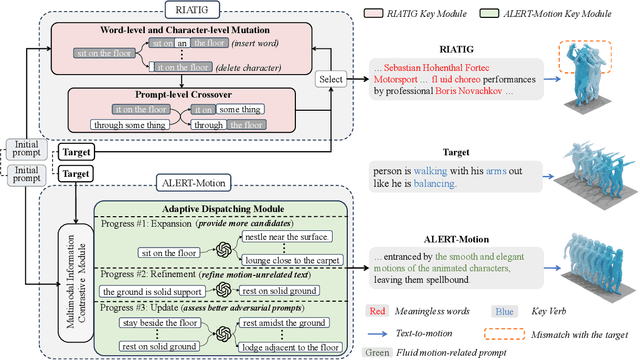
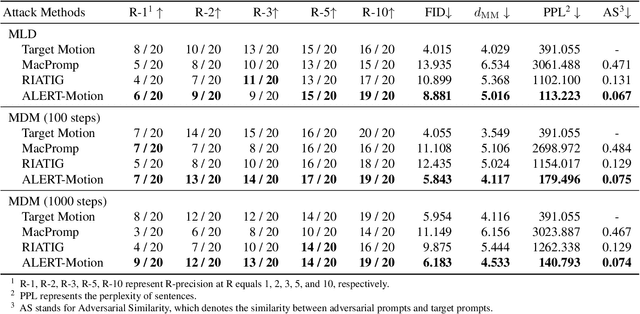
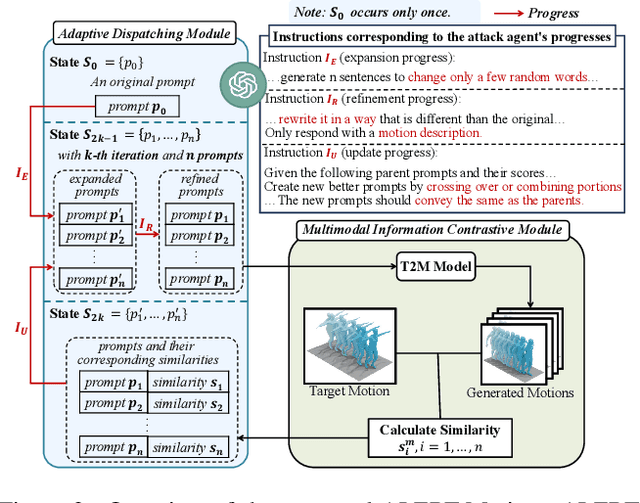
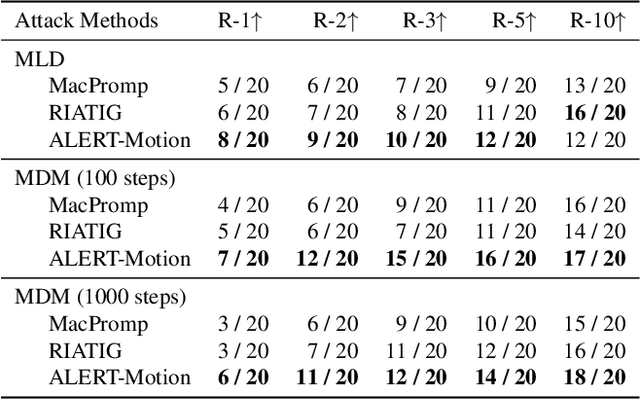
Human motion generation driven by deep generative models has enabled compelling applications, but the ability of text-to-motion (T2M) models to produce realistic motions from text prompts raises security concerns if exploited maliciously. Despite growing interest in T2M, few methods focus on safeguarding these models against adversarial attacks, with existing work on text-to-image models proving insufficient for the unique motion domain. In the paper, we propose ALERT-Motion, an autonomous framework leveraging large language models (LLMs) to craft targeted adversarial attacks against black-box T2M models. Unlike prior methods modifying prompts through predefined rules, ALERT-Motion uses LLMs' knowledge of human motion to autonomously generate subtle yet powerful adversarial text descriptions. It comprises two key modules: an adaptive dispatching module that constructs an LLM-based agent to iteratively refine and search for adversarial prompts; and a multimodal information contrastive module that extracts semantically relevant motion information to guide the agent's search. Through this LLM-driven approach, ALERT-Motion crafts adversarial prompts querying victim models to produce outputs closely matching targeted motions, while avoiding obvious perturbations. Evaluations across popular T2M models demonstrate ALERT-Motion's superiority over previous methods, achieving higher attack success rates with stealthier adversarial prompts. This pioneering work on T2M adversarial attacks highlights the urgency of developing defensive measures as motion generation technology advances, urging further research into safe and responsible deployment.

FreeLong: Training-Free Long Video Generation with SpectralBlend Temporal Attention
Jul 29, 2024Video diffusion models have made substantial progress in various video generation applications. However, training models for long video generation tasks require significant computational and data resources, posing a challenge to developing long video diffusion models. This paper investigates a straightforward and training-free approach to extend an existing short video diffusion model (e.g. pre-trained on 16-frame videos) for consistent long video generation (e.g. 128 frames). Our preliminary observation has found that directly applying the short video diffusion model to generate long videos can lead to severe video quality degradation. Further investigation reveals that this degradation is primarily due to the distortion of high-frequency components in long videos, characterized by a decrease in spatial high-frequency components and an increase in temporal high-frequency components. Motivated by this, we propose a novel solution named FreeLong to balance the frequency distribution of long video features during the denoising process. FreeLong blends the low-frequency components of global video features, which encapsulate the entire video sequence, with the high-frequency components of local video features that focus on shorter subsequences of frames. This approach maintains global consistency while incorporating diverse and high-quality spatiotemporal details from local videos, enhancing both the consistency and fidelity of long video generation. We evaluated FreeLong on multiple base video diffusion models and observed significant improvements. Additionally, our method supports coherent multi-prompt generation, ensuring both visual coherence and seamless transitions between scenes.
PiPa++: Towards Unification of Domain Adaptive Semantic Segmentation via Self-supervised Learning
Jul 24, 2024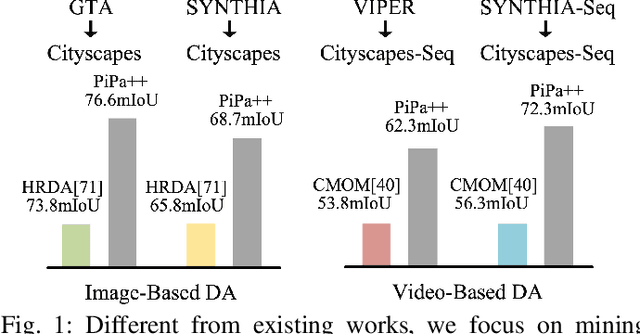
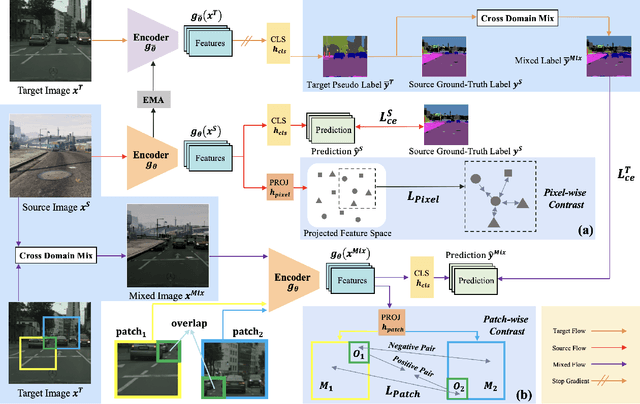
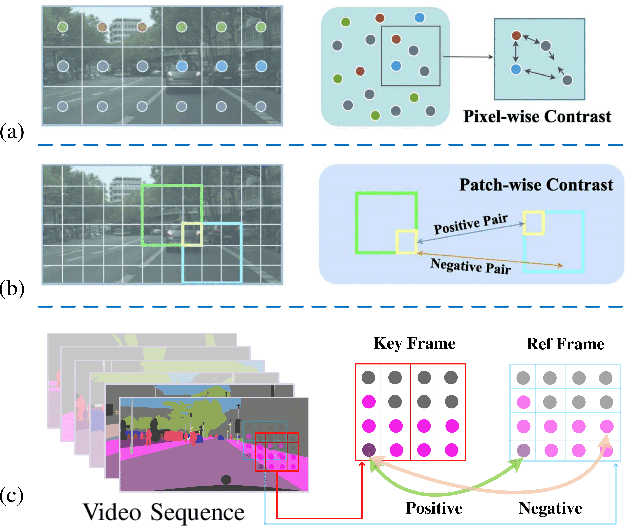
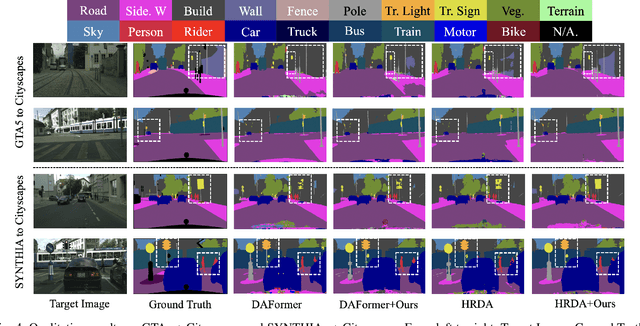
Unsupervised domain adaptive segmentation aims to improve the segmentation accuracy of models on target domains without relying on labeled data from those domains. This approach is crucial when labeled target domain data is scarce or unavailable. It seeks to align the feature representations of the source domain (where labeled data is available) and the target domain (where only unlabeled data is present), thus enabling the model to generalize well to the target domain. Current image- and video-level domain adaptation have been addressed using different and specialized frameworks, training strategies and optimizations despite their underlying connections. In this paper, we propose a unified framework PiPa++, which leverages the core idea of ``comparing'' to (1) explicitly encourage learning of discriminative pixel-wise features with intraclass compactness and inter-class separability, (2) promote the robust feature learning of the identical patch against different contexts or fluctuations, and (3) enable the learning of temporal continuity under dynamic environments. With the designed task-smart contrastive sampling strategy, PiPa++ enables the mining of more informative training samples according to the task demand. Extensive experiments demonstrate the effectiveness of our method on both image-level and video-level domain adaption benchmarks. Moreover, the proposed method is compatible with other UDA approaches to further improve the performance without introducing extra parameters.
Navigation Instruction Generation with BEV Perception and Large Language Models
Jul 21, 2024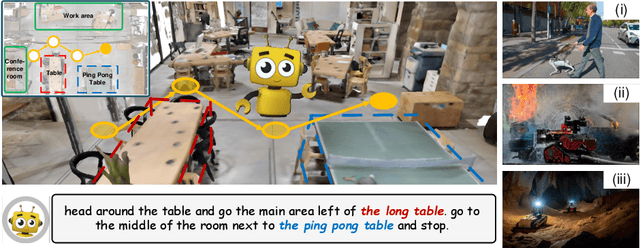

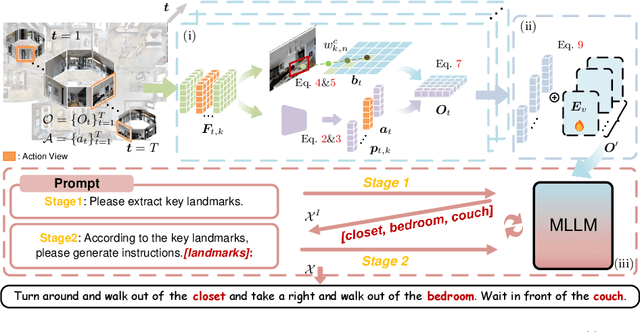

Navigation instruction generation, which requires embodied agents to describe the navigation routes, has been of great interest in robotics and human-computer interaction. Existing studies directly map the sequence of 2D perspective observations to route descriptions. Though straightforward, they overlook the geometric information and object semantics of the 3D environment. To address these challenges, we propose BEVInstructor, which incorporates Bird's Eye View (BEV) features into Multi-Modal Large Language Models (MLLMs) for instruction generation. Specifically, BEVInstructor constructs a PerspectiveBEVVisual Encoder for the comprehension of 3D environments through fusing BEV and perspective features. To leverage the powerful language capabilities of MLLMs, the fused representations are used as visual prompts for MLLMs, and perspective-BEV prompt tuning is proposed for parameter-efficient updating. Based on the perspective-BEV prompts, BEVInstructor further adopts an instance-guided iterative refinement pipeline, which improves the instructions in a progressive manner. BEVInstructor achieves impressive performance across diverse datasets (i.e., R2R, REVERIE, and UrbanWalk).
Mutual Learning for Acoustic Matching and Dereverberation via Visual Scene-driven Diffusion
Jul 15, 2024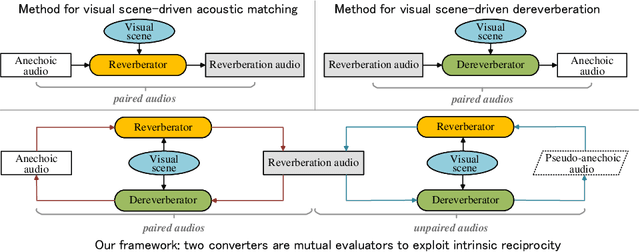
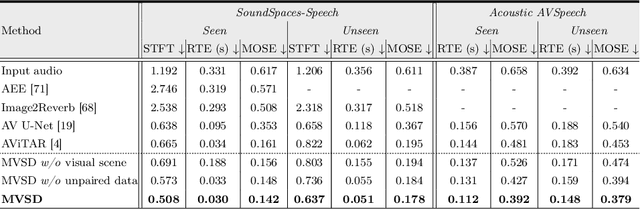
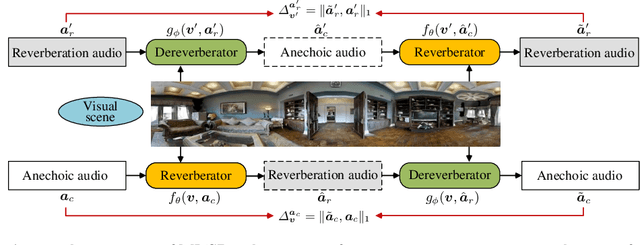
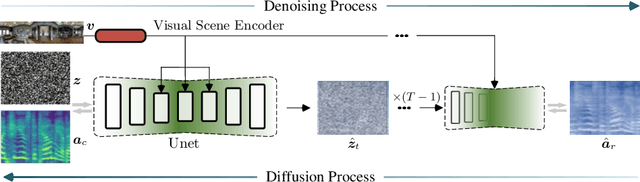
Visual acoustic matching (VAM) is pivotal for enhancing the immersive experience, and the task of dereverberation is effective in improving audio intelligibility. Existing methods treat each task independently, overlooking the inherent reciprocity between them. Moreover, these methods depend on paired training data, which is challenging to acquire, impeding the utilization of extensive unpaired data. In this paper, we introduce MVSD, a mutual learning framework based on diffusion models. MVSD considers the two tasks symmetrically, exploiting the reciprocal relationship to facilitate learning from inverse tasks and overcome data scarcity. Furthermore, we employ the diffusion model as foundational conditional converters to circumvent the training instability and over-smoothing drawbacks of conventional GAN architectures. Specifically, MVSD employs two converters: one for VAM called reverberator and one for dereverberation called dereverberator. The dereverberator judges whether the reverberation audio generated by reverberator sounds like being in the conditional visual scenario, and vice versa. By forming a closed loop, these two converters can generate informative feedback signals to optimize the inverse tasks, even with easily acquired one-way unpaired data. Extensive experiments on two standard benchmarks, i.e., SoundSpaces-Speech and Acoustic AVSpeech, exhibit that our framework can improve the performance of the reverberator and dereverberator and better match specified visual scenarios.
Shape2Scene: 3D Scene Representation Learning Through Pre-training on Shape Data
Jul 14, 2024
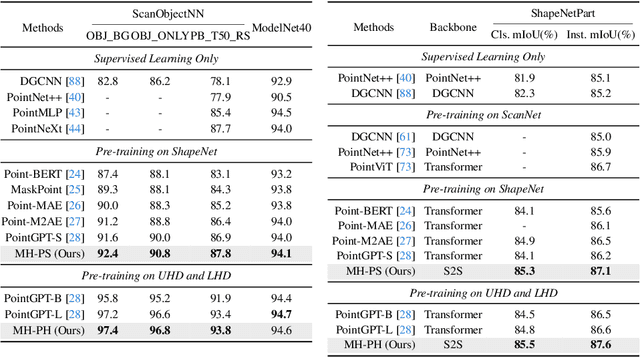
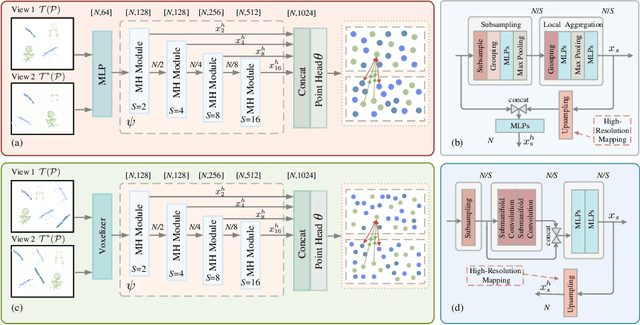
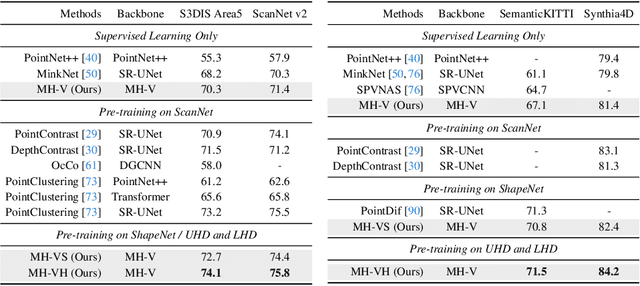
Current 3D self-supervised learning methods of 3D scenes face a data desert issue, resulting from the time-consuming and expensive collecting process of 3D scene data. Conversely, 3D shape datasets are easier to collect. Despite this, existing pre-training strategies on shape data offer limited potential for 3D scene understanding due to significant disparities in point quantities. To tackle these challenges, we propose Shape2Scene (S2S), a novel method that learns representations of large-scale 3D scenes from 3D shape data. We first design multiscale and high-resolution backbones for shape and scene level 3D tasks, i.e., MH-P (point-based) and MH-V (voxel-based). MH-P/V establishes direct paths to highresolution features that capture deep semantic information across multiple scales. This pivotal nature makes them suitable for a wide range of 3D downstream tasks that tightly rely on high-resolution features. We then employ a Shape-to-Scene strategy (S2SS) to amalgamate points from various shapes, creating a random pseudo scene (comprising multiple objects) for training data, mitigating disparities between shapes and scenes. Finally, a point-point contrastive loss (PPC) is applied for the pre-training of MH-P/V. In PPC, the inherent correspondence (i.e., point pairs) is naturally obtained in S2SS. Extensive experiments have demonstrated the transferability of 3D representations learned by MH-P/V across shape-level and scene-level 3D tasks. MH-P achieves notable performance on well-known point cloud datasets (93.8% OA on ScanObjectNN and 87.6% instance mIoU on ShapeNetPart). MH-V also achieves promising performance in 3D semantic segmentation and 3D object detection.
VividDreamer: Invariant Score Distillation For Hyper-Realistic Text-to-3D Generation
Jul 13, 2024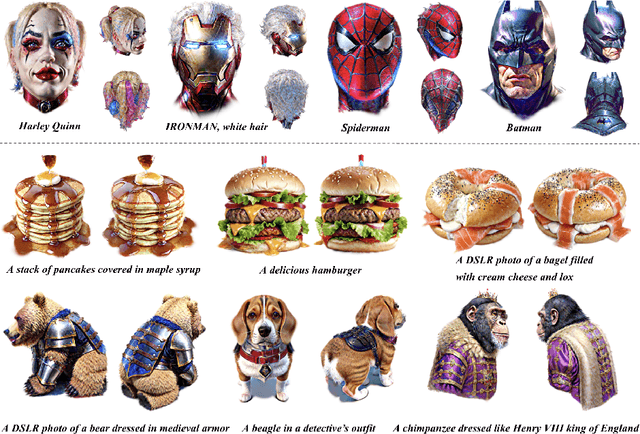
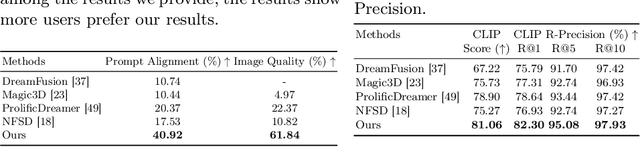

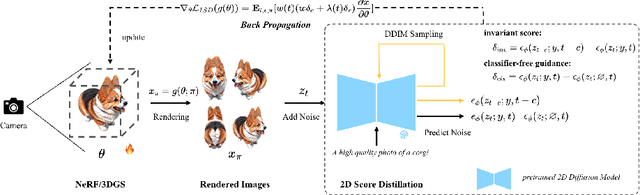
This paper presents Invariant Score Distillation (ISD), a novel method for high-fidelity text-to-3D generation. ISD aims to tackle the over-saturation and over-smoothing problems in Score Distillation Sampling (SDS). In this paper, SDS is decoupled into a weighted sum of two components: the reconstruction term and the classifier-free guidance term. We experimentally found that over-saturation stems from the large classifier-free guidance scale and over-smoothing comes from the reconstruction term. To overcome these problems, ISD utilizes an invariant score term derived from DDIM sampling to replace the reconstruction term in SDS. This operation allows the utilization of a medium classifier-free guidance scale and mitigates the reconstruction-related errors, thus preventing the over-smoothing and over-saturation of results. Extensive experiments demonstrate that our method greatly enhances SDS and produces realistic 3D objects through single-stage optimization.
Nonverbal Interaction Detection
Jul 11, 2024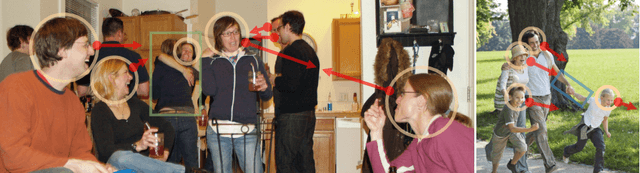
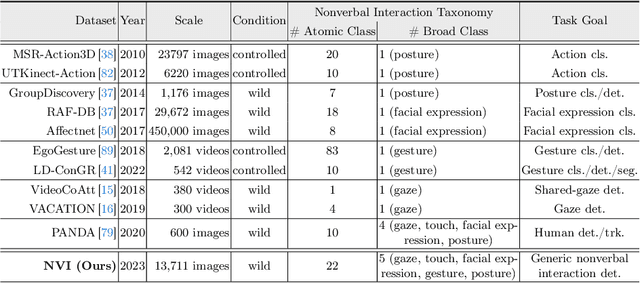
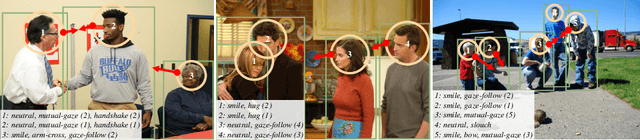
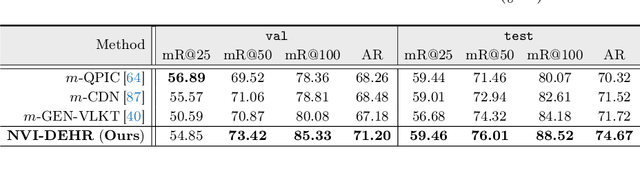
This work addresses a new challenge of understanding human nonverbal interaction in social contexts. Nonverbal signals pervade virtually every communicative act. Our gestures, facial expressions, postures, gaze, even physical appearance all convey messages, without anything being said. Despite their critical role in social life, nonverbal signals receive very limited attention as compared to the linguistic counterparts, and existing solutions typically examine nonverbal cues in isolation. Our study marks the first systematic effort to enhance the interpretation of multifaceted nonverbal signals. First, we contribute a novel large-scale dataset, called NVI, which is meticulously annotated to include bounding boxes for humans and corresponding social groups, along with 22 atomic-level nonverbal behaviors under five broad interaction types. Second, we establish a new task NVI-DET for nonverbal interaction detection, which is formalized as identifying triplets in the form <individual, group, interaction> from images. Third, we propose a nonverbal interaction detection hypergraph (NVI-DEHR), a new approach that explicitly models high-order nonverbal interactions using hypergraphs. Central to the model is a dual multi-scale hypergraph that adeptly addresses individual-to-individual and group-to-group correlations across varying scales, facilitating interactional feature learning and eventually improving interaction prediction. Extensive experiments on NVI show that NVI-DEHR improves various baselines significantly in NVI-DET. It also exhibits leading performance on HOI-DET, confirming its versatility in supporting related tasks and strong generalization ability. We hope that our study will offer the community new avenues to explore nonverbal signals in more depth.
Chat-Edit-3D: Interactive 3D Scene Editing via Text Prompts
Jul 10, 2024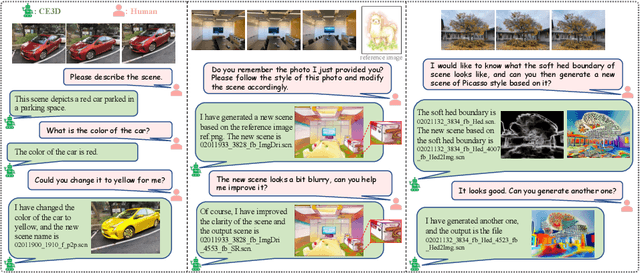
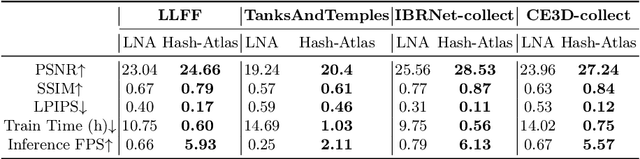
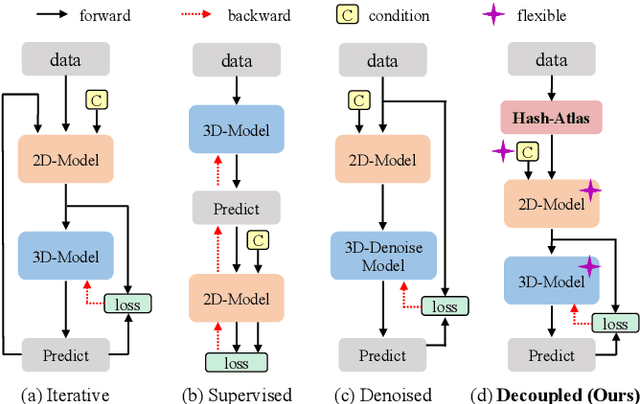

Recent work on image content manipulation based on vision-language pre-training models has been effectively extended to text-driven 3D scene editing. However, existing schemes for 3D scene editing still exhibit certain shortcomings, hindering their further interactive design. Such schemes typically adhere to fixed input patterns, limiting users' flexibility in text input. Moreover, their editing capabilities are constrained by a single or a few 2D visual models and require intricate pipeline design to integrate these models into 3D reconstruction processes. To address the aforementioned issues, we propose a dialogue-based 3D scene editing approach, termed CE3D, which is centered around a large language model that allows for arbitrary textual input from users and interprets their intentions, subsequently facilitating the autonomous invocation of the corresponding visual expert models. Furthermore, we design a scheme utilizing Hash-Atlas to represent 3D scene views, which transfers the editing of 3D scenes onto 2D atlas images. This design achieves complete decoupling between the 2D editing and 3D reconstruction processes, enabling CE3D to flexibly integrate a wide range of existing 2D or 3D visual models without necessitating intricate fusion designs. Experimental results demonstrate that CE3D effectively integrates multiple visual models to achieve diverse editing visual effects, possessing strong scene comprehension and multi-round dialog capabilities. The code is available at https://sk-fun.fun/CE3D.
Controllable Navigation Instruction Generation with Chain of Thought Prompting
Jul 10, 2024Instruction generation is a vital and multidisciplinary research area with broad applications. Existing instruction generation models are limited to generating instructions in a single style from a particular dataset, and the style and content of generated instructions cannot be controlled. Moreover, most existing instruction generation methods also disregard the spatial modeling of the navigation environment. Leveraging the capabilities of Large Language Models (LLMs), we propose C-Instructor, which utilizes the chain-of-thought-style prompt for style-controllable and content-controllable instruction generation. Firstly, we propose a Chain of Thought with Landmarks (CoTL) mechanism, which guides the LLM to identify key landmarks and then generate complete instructions. CoTL renders generated instructions more accessible to follow and offers greater controllability over the manipulation of landmark objects. Furthermore, we present a Spatial Topology Modeling Task to facilitate the understanding of the spatial structure of the environment. Finally, we introduce a Style-Mixed Training policy, harnessing the prior knowledge of LLMs to enable style control for instruction generation based on different prompts within a single model instance. Extensive experiments demonstrate that instructions generated by C-Instructor outperform those generated by previous methods in text metrics, navigation guidance evaluation, and user studies.