 Add to Chrome
 Add to Firefox
 Add to Edge
Hide to Guide: Learning via Semantic Masking
May 24, 2026
Reinforcement learning with verifiable rewards (RLVR) has become a powerful paradigm for improving language models on reasoning-intensive tasks, but its effectiveness is often limited by exploration. For example, models often fail on hard problems, leaving little useful reward signal. External expert traces offer a natural source of guidance, yet they may also expose reward-relevant content along the critical path to the verifier target, such as final answers, intermediate values, executable implementations, or answer-related entities. This content can create an unintended reward hacking channel, allowing the policy to obtain reward by copying the trace rather than learning the underlying reasoning or agentic behavior. Existing guided-RL methods reduce this risk by using partial trajectories, but they mainly control how much expert information is shown heuristically rather than which parts should be hidden. To this end, we propose Semantic Masked Expert Policy Optimization (SMEPO), a fine-grained semantic masking strategy for expert-guided RLVR. Instead of truncating traces coarsely or revealing them unchanged, SMEPO masks reward-relevant semantic spans along the critical path while preserving the expert's decomposition, plan, and procedural structure. This turns hard problems from reasoning from scratch into a fill-in-the-blank process: the policy can follow the expert's problem-solving route, but must still reconstruct the missing values, code, or entities by itself. SMEPO is simple to apply and requires no changes to the reward function or RL objective. Across diverse domains, including math, code, and agentic search, SMEPO improves accuracy by up to 3.2 points over GRPO and reduces training time by up to 4.2x. The code is available at https://github.com/mit-han-lab/SMEPO.

Atoms of Thought: Universal EEG Representation Learning with Microstates
May 19, 2026Learning universal representations from electroencephalogram (EEG) signals is a cutting-edge approach in the field of neuroinformatics and brain-computer interfaces (BCIs). Conventionally, EEG is treated as a multivariate temporal signal, where time- or frequency-domain features are extracted for representation learning. This paper investigates a simple yet effective EEG representation, i.e., microstates. Microstates represent the building blocks of brain activity patterns at a microscopic time scale. We build a universal microstate tokenizer from a large medical EEG dataset by clustering continuous EEG signals into sequences of discrete microstates. The microstate tokenizer is then adopted universally across a series of downstream tasks, including sleep staging, emotion recognition, and motor imagery classification. Experimental results show that EEG representation learning with microstates outperforms traditional time-domain and frequency-domain features under different models and across different tasks. Further analysis shows that microstates offer greater interpretability and scalability, thereby opening up applications in both cognitive neuroscience and clinical research.
A Readiness-Driven Runtime for Pipeline-Parallel Training under Runtime Variability
May 18, 2026Pipeline parallelism is a key technique for scaling large-model training, but modern workloads exhibit runtime variability in computation and communication. Existing pipeline systems typically consume static, profiled, or adaptively generated schedules as pre-committed execution orders. When realized task readiness diverges from the pre-committed order, stages may wait for not-yet-ready work even though other executable work is available, creating stage misalignment, idle bubbles, and reduced utilization. We present Runtime-Readiness-First Pipeline (RRFP), a readiness-driven runtime for pipeline-parallel training. RRFP changes how schedules are consumed at runtime: instead of treating a schedule as a sequence that stages must wait to follow, it treats the schedule as a non-binding hint order for ranking currently ready work. To support this model, RRFP combines message-driven asynchronous communication, lightweight tensor-parallel coordination for collective consistency, and ready-set arbitration for low-overhead dispatch. We implement RRFP in a Megatron-based training framework and evaluate it on language-only and multimodal workloads at up to 128 GPUs. RRFP improves over fixed-order pipeline baselines across all settings. Using the BFW hint, RRFP achieves up to 1.77$\times$ speedup on language-only workloads and up to 2.77$\times$ on multimodal workloads. In cross-framework comparisons, RRFP with the default BF hint outperforms the faster available external system by up to 1.84$\times$ while preserving training correctness.
SyncDiff: Synchronized Motion Diffusion for Multi-Body Human-Object Interaction Synthesis
Dec 28, 2024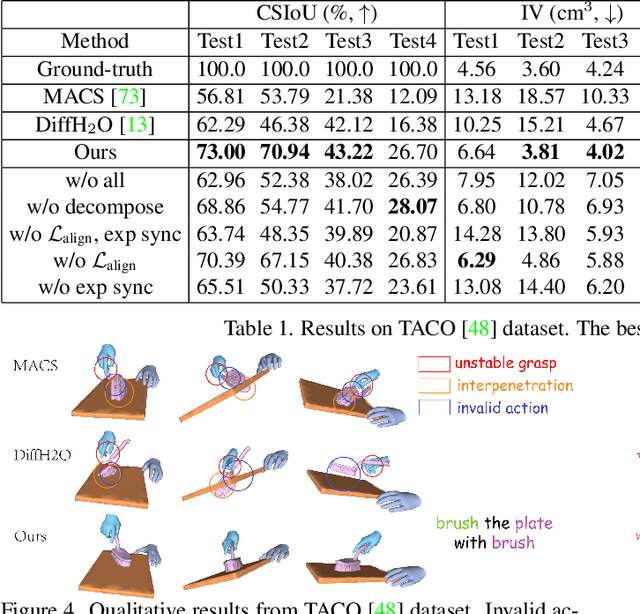

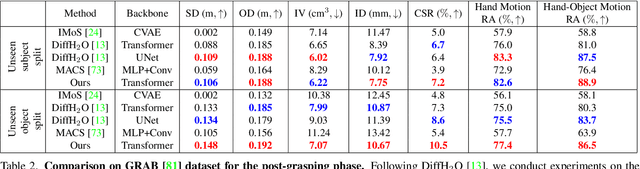
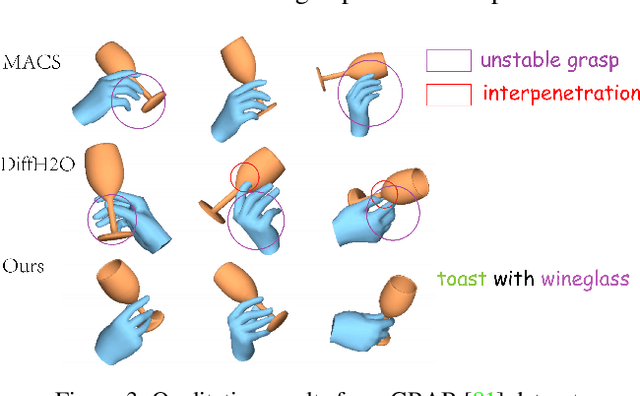
Synthesizing realistic human-object interaction motions is a critical problem in VR/AR and human animation. Unlike the commonly studied scenarios involving a single human or hand interacting with one object, we address a more generic multi-body setting with arbitrary numbers of humans, hands, and objects. This complexity introduces significant challenges in synchronizing motions due to the high correlations and mutual influences among bodies. To address these challenges, we introduce SyncDiff, a novel method for multi-body interaction synthesis using a synchronized motion diffusion strategy. SyncDiff employs a single diffusion model to capture the joint distribution of multi-body motions. To enhance motion fidelity, we propose a frequency-domain motion decomposition scheme. Additionally, we introduce a new set of alignment scores to emphasize the synchronization of different body motions. SyncDiff jointly optimizes both data sample likelihood and alignment likelihood through an explicit synchronization strategy. Extensive experiments across four datasets with various multi-body configurations demonstrate the superiority of SyncDiff over existing state-of-the-art motion synthesis methods.