 Add to Chrome
 Add to Firefox
 Add to Edge
Inside the Latent Flow: Causal Deciphering of Attention Dynamics in Audio Separation Foundation Models
Jun 08, 2026
Flow-matching transformers achieve strong audio separation, yet their attention dynamics are opaque. We adapt established causal-intervention principles into a deterministic, inference-time probing protocol for SAM Audio. Orthogonal probing uncovers a dual-pathway text-conditioning mechanism: additive injections control semantic identity, while cross-attention refines acoustic structure. We observe an asynchronous layerwise convergence: stable layers build temporal scaffolds early, whereas fast layers continue resolving artifacts during sampling. The model also attenuates temporal segmentation cues to maintain continuous-flow stability. Using these insights, we propose Layer-Selective Attention Caching (LSAC), a training-free acceleration method that caches attention in stable layers. Across acoustic complexities, LSAC cuts self-attention computation by about ~25% with negligible quality loss and yields up to 6.7x higher quality retention than naive step reduction.

DRFusion: Drift-Resilient Temporally Consistent Infrared-Visible Video Fusion
May 25, 2026Infrared and visible video fusion is essential for achieving comprehensive perception in dynamic scenes. However, maintaining temporal consistency remains a formidable challenge. Conventional methods relying on optical flow often suffer from geometric rigidity and ghosting artifacts. Moreover, standard diffusion-based fusion models typically operate in a frame-by-frame manner; when extended to autoregressive settings, they lack intrinsic temporal constraints and are prone to severe error accumulation and drifting, where minor artifacts amplify over time. To address these limitations, we propose a drift-resilient video fusion method that reformulates the task as history-conditioned motion generation. We introduce Stabilized History Guidance and Soft Temporal Anchoring to reframe temporal consistency as spectral filtering, implicitly aggregating motion dynamics without rigid alignment. Furthermore, our Decoupled Structure-Motion Adaptation strategy bridges pre-trained priors and structural constraints via two-stage training and latent refinement. Extensive experiments demonstrate that our method achieves state-of-the-art performance in both fusion quality and temporal stability.
Uncertainty-aware Spatial-Frequency Registration and Fusion for Infrared and Visible Images
May 13, 2026Infrared and Visible Image Fusion (IVIF) has shown promise in visual tasks under challenging environments, but fusion under unregistered conditions faces inherent misalignments. Current studies to solve them either predict the deformation parameters coarse-to-fine (i.e., coarse registration and fine registration) or estimate the deformation fields in multi-scales for registration. Though straightforward, they overlook the cumulative errors in registration, which contaminate the fusion stage and severely deteriorate the resulting images. We introduce the Spatial-Frequency Registration and Fusion (SFRF) framework, which incorporates uncertainty estimation and infrared thermal radiation distribution consistency into a unified pipeline to handle the error accumulation for robust registration and fusion across both spatial and frequency domains. Specifically, SFRF constructs a Multi-scale Iterative Registration (MIR) framework that iteratively refines the deformation field across scales, leveraging uncertainty estimation at each stage to mitigate error accumulation and enhance alignment accuracy dynamically. To ensure the accurate alignment of infrared thermal distributions during registration, thermal radiation distribution consistency is employed as a frequency-domain supervisory signal, promoting global consistency in the frequency domain. Based on the spatial-frequency alignment, SFRF further adopts a Dual-branch Spatial-Frequency Fusion (DSFF) module, which incorporates spatial geometric features and frequency distribution information to reconstruct visually appealing images. SFRF achieves impressive performance across diverse datasets.
The Evolution of Tool Use in LLM Agents: From Single-Tool Call to Multi-Tool Orchestration
Mar 24, 2026Tool use enables large language models (LLMs) to access external information, invoke software systems, and act in digital environments beyond what can be solved from model parameters alone. Early research mainly studied whether a model could select and execute a correct single tool call. As agent systems evolve, however, the central problem has shifted from isolated invocation to multi-tool orchestration over long trajectories with intermediate state, execution feedback, changing environments, and practical constraints such as safety, cost, and verifiability. We comprehensively review recent progress in multi-tool LLM agents and analyzes the state of the art in this rapidly developing area. First, we unify task formulations and distinguish single-call tool use from long-horizon orchestration. Then, we organize the literature around six core dimensions: inference-time planning and execution, training and trajectory construction, safety and control, efficiency under resource constraints, capability completeness in open environments, and benchmark design and evaluation. We further summarize representative applications in software engineering, enterprise workflows, graphical user interfaces, and mobile systems. Finally, we discuss major challenges and outline future directions for building reliable, scalable, and verifiable multi-tool agents.
Bridging Human Evaluation to Infrared and Visible Image Fusion
Mar 04, 2026Infrared and visible image fusion (IVIF) integrates complementary modalities to enhance scene perception. Current methods predominantly focus on optimizing handcrafted losses and objective metrics, often resulting in fusion outcomes that do not align with human visual preferences. This challenge is further exacerbated by the ill-posed nature of IVIF, which severely limits its effectiveness in human perceptual environments such as security surveillance and driver assistance systems. To address these limitations, we propose a feedback reinforcement framework that bridges human evaluation to infrared and visible image fusion. To address the lack of human-centric evaluation metrics and data, we introduce the first large-scale human feedback dataset for IVIF, containing multidimensional subjective scores and artifact annotations, and enriched by a fine-tuned large language model with expert review. Based on this dataset, we design a domain-specific reward function and train a reward model to quantify perceptual quality. Guided by this reward, we fine-tune the fusion network through Group Relative Policy Optimization, achieving state-of-the-art performance that better aligns fused images with human aesthetics. Code is available at https://github.com/ALKA-Wind/EVAFusion.
UniWhisper: Efficient Continual Multi-task Training for Robust Universal Audio Representation
Feb 25, 2026A universal audio representation should capture fine-grained speech cues and high-level semantics for environmental sounds and music in a single encoder. Existing encoders often excel in one domain but degrade in others. We propose UniWhisper, an efficient continual multi-task training framework that casts heterogeneous audio tasks into a unified instruction and answer format. This enables standard next-token training without task-specific heads and losses. We train it on 38k hours of public audio and assess the encoder using shallow MLP probes and k-nearest neighbors (kNN) on 20 tasks spanning speech, environmental sound, and music. UniWhisper reaches normalized weighted averages of 0.81 with MLP probes and 0.61 with kNN, compared to 0.64 and 0.46 for Whisper, while retaining strong speech performance.
Xray-Visual Models: Scaling Vision models on Industry Scale Data
Feb 18, 2026We present Xray-Visual, a unified vision model architecture for large-scale image and video understanding trained on industry-scale social media data. Our model leverages over 15 billion curated image-text pairs and 10 billion video-hashtag pairs from Facebook and Instagram, employing robust data curation pipelines that incorporate balancing and noise suppression strategies to maximize semantic diversity while minimizing label noise. We introduce a three-stage training pipeline that combines self-supervised MAE, semi-supervised hashtag classification, and CLIP-style contrastive learning to jointly optimize image and video modalities. Our architecture builds on a Vision Transformer backbone enhanced with efficient token reorganization (EViT) for improved computational efficiency. Extensive experiments demonstrate that Xray-Visual achieves state-of-the-art performance across diverse benchmarks, including ImageNet for image classification, Kinetics and HMDB51 for video understanding, and MSCOCO for cross-modal retrieval. The model exhibits strong robustness to domain shift and adversarial perturbations. We further demonstrate that integrating large language models as text encoders (LLM2CLIP) significantly enhances retrieval performance and generalization capabilities, particularly in real-world environments. Xray-Visual establishes new benchmarks for scalable, multimodal vision models, while maintaining superior accuracy and computational efficiency.
Integrated Drill Boom Hole-Seeking Control via Reinforcement Learning
Dec 04, 2023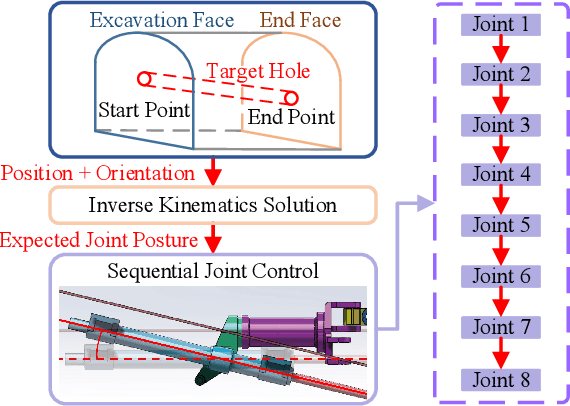
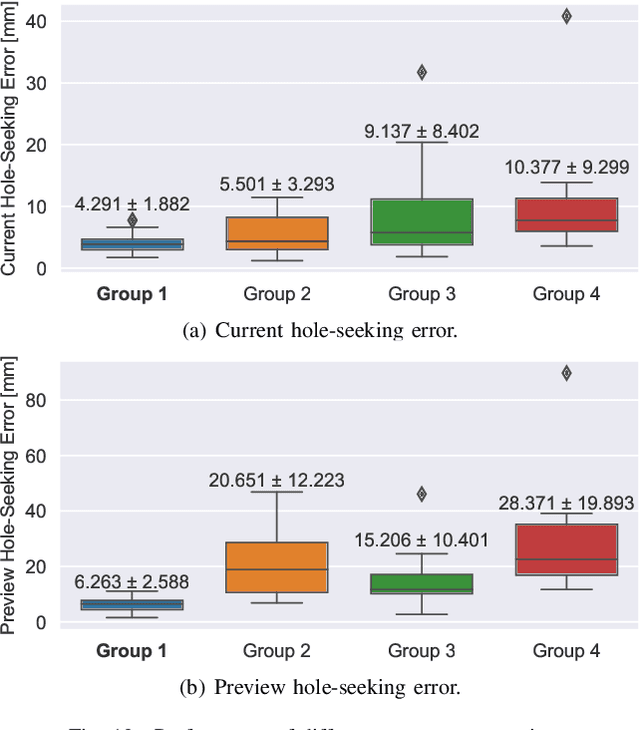
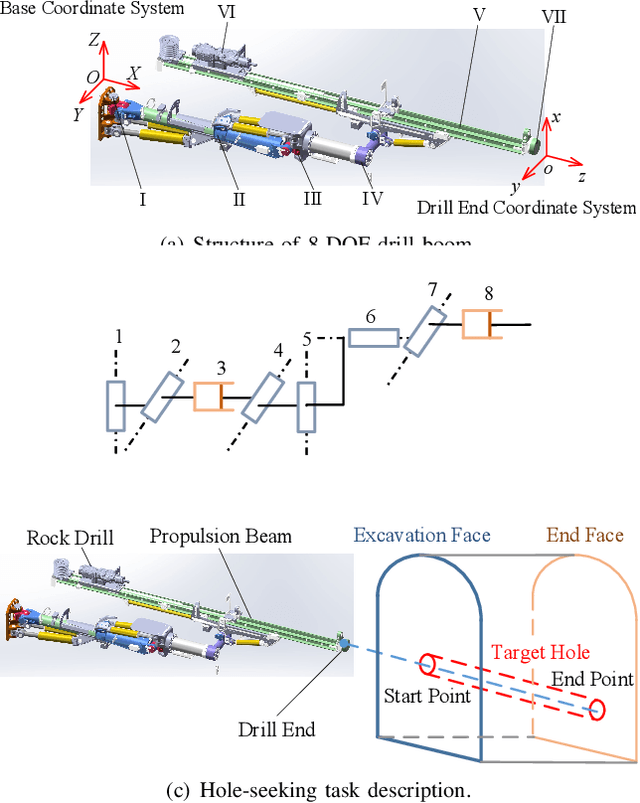
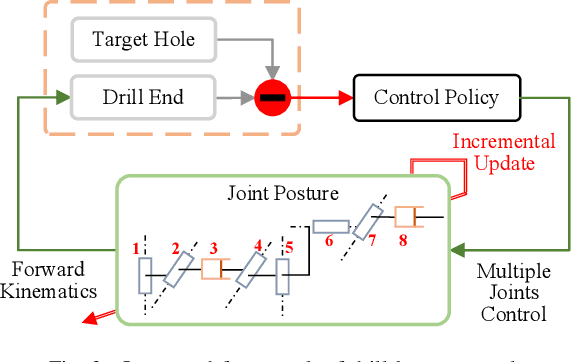
Intelligent drill boom hole-seeking is a promising technology for enhancing drilling efficiency, mitigating potential safety hazards, and relieving human operators. Most existing intelligent drill boom control methods rely on a hierarchical control framework based on inverse kinematics. However, these methods are generally time-consuming due to the computational complexity of inverse kinematics and the inefficiency of the sequential execution of multiple joints. To tackle these challenges, this study proposes an integrated drill boom control method based on Reinforcement Learning (RL). We develop an integrated drill boom control framework that utilizes a parameterized policy to directly generate control inputs for all joints at each time step, taking advantage of joint posture and target hole information. By formulating the hole-seeking task as a Markov decision process, contemporary mainstream RL algorithms can be directly employed to learn a hole-seeking policy, thus eliminating the need for inverse kinematics solutions and promoting cooperative multi-joint control. To enhance the drilling accuracy throughout the entire drilling process, we devise a state representation that combines Denavit-Hartenberg joint information and preview hole-seeking discrepancy data. Simulation results show that the proposed method significantly outperforms traditional methods in terms of hole-seeking accuracy and time efficiency.