 Add to Chrome
 Add to Firefox
 Add to Edge
MM-ReCoder: Advancing Chart-to-Code Generation with Reinforcement Learning and Self-Correction
Apr 02, 2026
Multimodal Large Language Models (MLLMs) have recently demonstrated promising capabilities in multimodal coding tasks such as chart-to-code generation. However, existing methods primarily rely on supervised fine-tuning (SFT), which requires the model to learn code patterns through chart-code pairs but does not expose the model to a code execution environment. Moreover, while self-correction through execution feedback offers a potential route to improve coding quality, even state-of-the-art MLLMs have been shown to struggle with effective self-correction. In this work, we introduce MM-ReCoder, a chart-to-code generation model trained with reinforcement learning (RL) and equipped with self-correction ability. We propose a two-stage multi-turn self-correction RL strategy based on Group Relative Policy Optimization (GRPO). The first stage enhances the model's self-correction ability via rolling out a shared first turn, while the second stage improves the coding capability with full-trajectory optimization. MM-ReCoder learns to produce more accurate and executable code through the interaction with the environment and by iteratively correcting its own outputs. Our results on three chart-to-code benchmarks demonstrate the state-of-the-art performance of MM-ReCoder.

NAVERO: Unlocking Fine-Grained Semantics for Video-Language Compositionality
Aug 18, 2024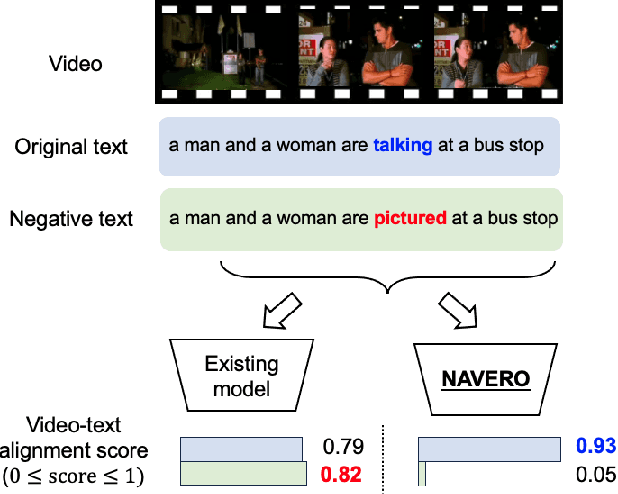


We study the capability of Video-Language (VidL) models in understanding compositions between objects, attributes, actions and their relations. Composition understanding becomes particularly challenging for video data since the compositional relations rapidly change over time in videos. We first build a benchmark named AARO to evaluate composition understanding related to actions on top of spatial concepts. The benchmark is constructed by generating negative texts with incorrect action descriptions for a given video and the model is expected to pair a positive text with its corresponding video. Furthermore, we propose a training method called NAVERO which utilizes video-text data augmented with negative texts to enhance composition understanding. We also develop a negative-augmented visual-language matching loss which is used explicitly to benefit from the generated negative text. We compare NAVERO with other state-of-the-art methods in terms of compositional understanding as well as video-text retrieval performance. NAVERO achieves significant improvement over other methods for both video-language and image-language composition understanding, while maintaining strong performance on traditional text-video retrieval tasks.