 Add to Chrome
 Add to Firefox
 Add to Edge
ESN-DAGMM: A Lightweight Framework for Unsupervised Time-Series Data Monitoring in 5G O-RAN Networks
Apr 14, 2026
Open Radio Access Network (O-RAN) is an important 5G network architecture enabling flexible communication with adaptive strategies for different verticals. However, testing for O-RAN deployments involve massive volumes of time-series data (e.g., key performance indicators), creating critical challenges for scalable, unsupervised monitoring without labels or high computational overhead. To address this, we present ESN-DAGMM, a lightweight adaptation of the Deep Autoencoding Gaussian Mixture Model (DAGMM) framework for time series analysis. Our model utilizes an Echo State Network (ESN) to efficiently model temporal dependencies, proving effective in O-RAN networks where training samples are highly limited. Combined with DAGMM's integratation of dimensionality reduction and density estimation, we present a scalable framework for unsupervised monitoring of high volume network telemetry. When trained on only 10% of an O-RAN video-streaming dataset, ESN-DAGMM achieved on average 269.59% higher quality clustering than baselines under identical conditions, all while maintaining competitive reconstruction error. By extending DAGMM to capture temporal dynamics, ESN-DAGMM offers a practical solution for time-series analysis using very limited training samples, outperforming baselines and enabling operator's control over the clustering-reconstruction trade-off.

Learning Low-Dimensional Representation for O-RAN Testing via Transformer-ESN
Apr 14, 2026Open Radio Access Network (O-RAN) architectures enhance flexibility for 6G and NextG networks. However, it also brings significant challenges in O-RAN testing with evaluating abundant, high-dimensional key performance indicators (KPIs). In this paper, we introduce a novel two-stage framework to learn temporally-aware low-dimensional representations of O-RAN testing KPIs. To be specific, stage one employs an information-theoretic H-score to train a hybrid self-attentive transformer and echo state network (ESN) reservoir, called Transformer-ESN, capturing temporal dynamics and producing task-aligned $8$-dimensional embeddings. Stage two evaluates these embeddings by training a lightweight multilayer perceptron (MLP) predictor exclusively on them for key target KPIs such as reference signal received quality (RSRQ) and spectral efficiency. Using real-world O-RAN testbed data (video streaming with interference), our approach demonstrates a significant advantage specifically when training samples are very limited. In this scenario, the low-dimensional representations learned from the Transformer-ESN yield mean square error (MSE) reductions of up to 41.9\% for RSRQ and 29.9\% for spectral efficiency compared to predictions from the original high-dimensional data. The framework exhibits high efficiency for O-RAN testing, significantly reducing testing complexities for O-RAN systems.
CGFormer: A Cross-Attention Based Grid-Free Transformer for Radio Map Estimation
Mar 22, 2026Radio map estimation (RME), which predicts wireless signal metrics at unmeasured locations from sparse measurements, has attracted growing attention as a key enabler of intelligent wireless networks. The majority of existing RME techniques employ grid-based strategies to process sparse measurements, where the pursuit of accuracy results in significant computational inefficiency and inflexibility for off-grid prediction. In contrast, grid-free approaches directly exploit coordinate features to capture location-specific spatial dependencies, enabling signal prediction at arbitrary locations without relying on predefined grids. However, current grid-free approaches demand substantial preprocessing overhead for constructing the spatial representation, leading to high complexity and constrained adaptability. To address these limitations, this paper proposes a novel cross-attention grid-free based transformer model for RME. We introduce a lightweight spatial embedding module that incorporates environmental knowledge into high-dimensional feature construction. A cross-attention transformer then models the spatial correlation between target and measurement points. The simulation results demonstrate that our proposed method reduces RMSE by up to 6%, outperforming grid-based and gridfree baselines.
When Learning Hurts: Fixed-Pole RNN for Real-Time Online Training
Feb 25, 2026Recurrent neural networks (RNNs) can be interpreted as discrete-time state-space models, where the state evolution corresponds to an infinite-impulse-response (IIR) filtering operation governed by both feedforward weights and recurrent poles. While, in principle, all parameters including pole locations can be optimized via backpropagation through time (BPTT), such joint learning incurs substantial computational overhead and is often impractical for applications with limited training data. Echo state networks (ESNs) mitigate this limitation by fixing the recurrent dynamics and training only a linear readout, enabling efficient and stable online adaptation. In this work, we analytically and empirically examine why learning recurrent poles does not provide tangible benefits in data-constrained, real-time learning scenarios. Our analysis shows that pole learning renders the weight optimization problem highly non-convex, requiring significantly more training samples and iterations for gradient-based methods to converge to meaningful solutions. Empirically, we observe that for complex-valued data, gradient descent frequently exhibits prolonged plateaus, and advanced optimizers offer limited improvement. In contrast, fixed-pole architectures induce stable and well-conditioned state representations even with limited training data. Numerical results demonstrate that fixed-pole networks achieve superior performance with lower training complexity, making them more suitable for online real-time tasks.
A Universal Neural Receiver that Learns at the Speed of Wireless
Feb 17, 2026Today we design wireless networks using mathematical models that govern communication in different propagation environments. We rely on measurement campaigns to deliver parametrized propagation models, and on the 3GPP standards process to optimize model-based performance, but as wireless networks become more complex this model-based approach is losing ground. Mobile Network Operators (MNOs) are counting on Artificial Intelligence (AI) to transform wireless by increasing spectral efficiency, reducing signaling overhead, and enabling continuous network innovation through software upgrades. They may also be interested in new use cases like integrated sensing and communications (ISAC). All we need is an AI-native physical layer, so why not simply tailor the offline AI algorithms that have revolutionized image and natural language processing to the wireless domain? We argue that these algorithms rely on off-line training that is precluded by the sub-millisecond speeds at which the wireless interference environment changes. We present an alternative architecture, a universal neural receiver based on convolution, which governs transmit and receive signal processing of any signal in any part of the wireless spectrum. Our neural receiver is designed to invert convolution, and we separate the question of which convolution to invert from the actual deconvolution. The neural network that performs deconvolution is very simple, and we configure this network by setting weights based on domain knowledge. By telling our neural network what we know, we avoid extensive offline training. By developing a universal receiver, we hope to simplify discussions about the proper choice of waveform for different use cases in the international standards. Since the receiver architecture is largely independent of technologies introduced at the base station, we hope to increase the rate of innovation in wireless.
LiQSS: Post-Transformer Linear Quantum-Inspired State-Space Tensor Networks for Real-Time 6G
Jan 18, 2026Proactive and agentic control in Sixth-Generation (6G) Open Radio Access Networks (O-RAN) requires control-grade prediction under stringent Near-Real-Time (Near-RT) latency and computational constraints. While Transformer-based models are effective for sequence modeling, their quadratic complexity limits scalability in Near-RT RAN Intelligent Controller (RIC) analytics. This paper investigates a post-Transformer design paradigm for efficient radio telemetry forecasting. We propose a quantum-inspired many-body state-space tensor network that replaces self-attention with stable structured state-space dynamics kernels, enabling linear-time sequence modeling. Tensor-network factorizations in the form of Tensor Train (TT) / Matrix Product State (MPS) representations are employed to reduce parameterization and data movement in both input projections and prediction heads, while lightweight channel gating and mixing layers capture non-stationary cross-Key Performance Indicator (KPI) dependencies. The proposed model is instantiated as an agentic perceive-predict xApp and evaluated on a bespoke O-RAN KPI time-series dataset comprising 59,441 sliding windows across 13 KPIs, using Reference Signal Received Power (RSRP) forecasting as a representative use case. Our proposed Linear Quantum-Inspired State-Space (LiQSS) model is 10.8x-15.8x smaller and approximately 1.4x faster than prior structured state-space baselines. Relative to Transformer-based models, LiQSS achieves up to a 155x reduction in parameter count and up to 2.74x faster inference, without sacrificing forecasting accuracy.
Spreading over OFDM for Integrated Sensing and Communications (ISAC) Ranging: Multi-user Interference Mitigation
May 04, 2025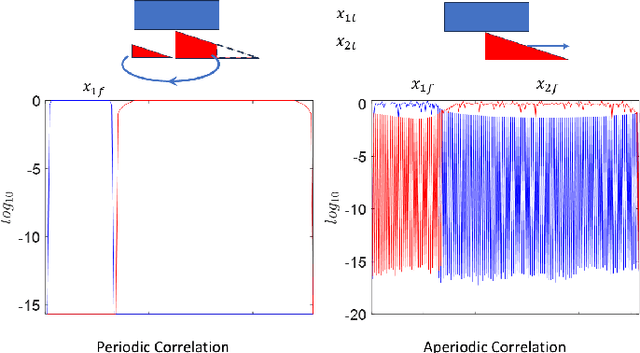
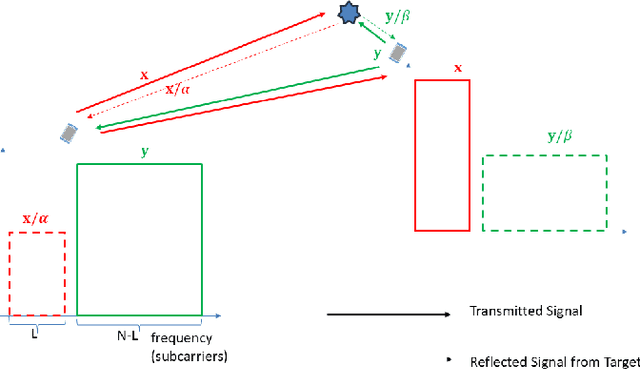

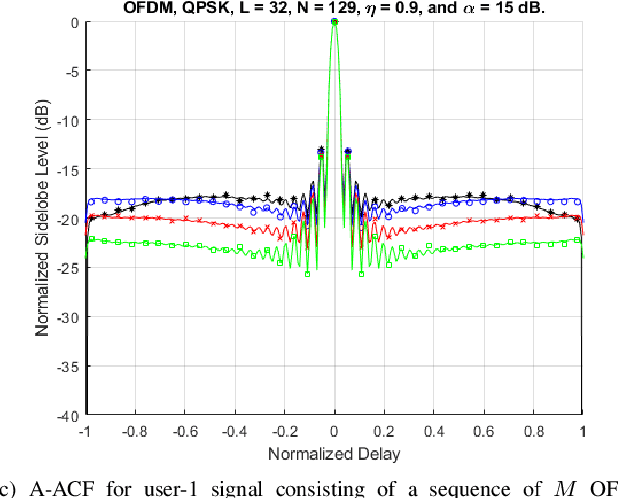
In the context of communication-centric integrated sensing and communication (ISAC), the orthogonal frequency division multiplexing (OFDM) waveform was proven to be optimal in minimizing ranging sidelobes when random signaling is used. A typical assumption in OFDM-based ranging is that the max target delay is less than the cyclic prefix (CP) length, which is equivalent to performing a \textit{periodic} correlation between the signal reflected from the target and the transmitted signal. In the multi-user case, such as in Orthogonal Frequency Division Multiple Access (OFDMA), users are assigned disjoint subsets of subcarriers which eliminates mutual interference between the communication channels of the different users. However, ranging involves an aperiodic correlation operation for target ranges with delays greater than the CP length. Aperiodic correlation between signals from disjoint frequency bands will not be zero, resulting in mutual interference between different user bands. We refer to this as \textit{inter-band} (IB) cross-correlation interference. In this work, we analytically characterize IB interference and quantify its impact on the integrated sidelobe levels (ISL). We introduce an orthogonal spreading layer on top of OFDM that can reduce IB interference resulting in ISL levels significantly lower than for OFDM without spreading in the multi-user setup. We validate our claims through simulations, and using an upper bound on IB energy which we show that it can be minimized using our proposed spreading. However, for orthogonal spreading to be effective, a price must be paid in terms of spectral utilization, which is yet another manifestation of the trade-off between sensing accuracy and data communication capacity
Mobile Distributed MIMO (MD-MIMO) for NextG: Mobility Meets Cooperation in Distributed Arrays
Apr 16, 2025Distributed multiple-input multiple-output (D\mbox{-}MIMO) is a promising technology to realize the promise of massive MIMO gains by fiber-connecting the distributed antenna arrays, thereby overcoming the form factor limitations of co-located MIMO. In this paper, we introduce the concept of mobile D-MIMO (MD-MIMO) network, a further extension of the D-MIMO technology where distributed antenna arrays are connected to the base station with a wireless link allowing all radio network nodes to be mobile. This approach significantly improves deployment flexibility and reduces operating costs, enabling the network to adapt to the highly dynamic nature of next-generation (NextG) networks. We discuss use cases, system design, network architecture, and the key enabling technologies for MD-MIMO. Furthermore, we investigate a case study of MD-MIMO for vehicular networks, presenting detailed performance evaluations for both downlink and uplink. The results show that an MD-MIMO network can provide substantial improvements in network throughput and reliability.
Distributed Uplink Joint Transmission for 6G Communication
Apr 11, 2025
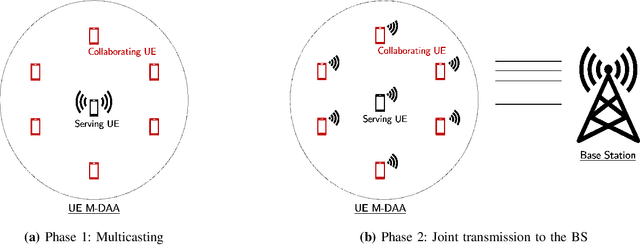
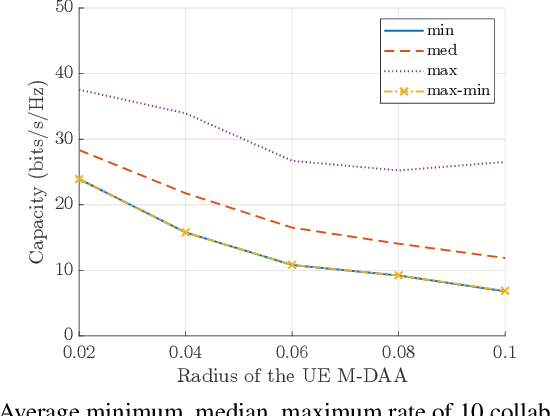
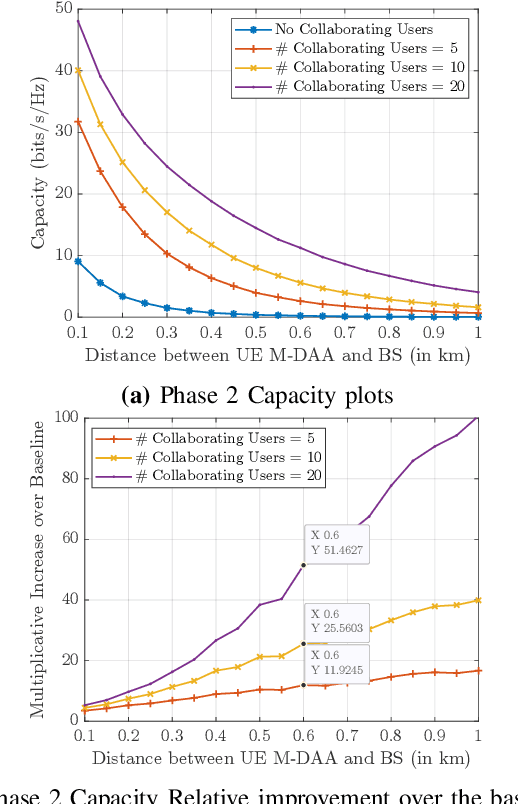
This paper investigates the spectral efficiency achieved through uplink joint transmission, where a serving user and the network users (UEs) collaborate by jointly transmitting to the base station (BS). The analysis incorporates the resource requirements for information sharing among UEs as a critical factor in the capacity evaluation. Furthermore, coherent and non-coherent joint transmission schemes are compared under various transmission power scenarios, providing insights into spectral and energy efficiency. A selection algorithm identifying the optimal UEs for joint transmission, achieving maximum capacity, is discussed. The results indicate that uplink joint transmission is one of the promising techniques for enabling 6G, achieving greater spectral efficiency even when accounting for the resource requirements for information sharing.
Digital Twin Enabled Site Specific Channel Precoding: Over the Air CIR Inference
Jan 27, 2025This paper investigates the significance of designing a reliable, intelligent, and true physical environment-aware precoding scheme by leveraging an accurately designed channel twin model to obtain realistic channel state information (CSI) for cellular communication systems. Specifically, we propose a fine-tuned multi-step channel twin design process that can render CSI very close to the CSI of the actual environment. After generating a precise CSI, we execute precoding using the obtained CSI at the transmitter end. We demonstrate a two-step parameters' tuning approach to design channel twin by ray tracing (RT) emulation, then further fine-tuning of CSI by employing an artificial intelligence (AI) based algorithm can significantly reduce the gap between actual CSI and the fine-tuned digital twin (DT) rendered CSI. The simulation results show the effectiveness of the proposed novel approach in designing a true physical environment-aware channel twin model.