 Add to Chrome
 Add to Firefox
 Add to Edge
Robust Dataset Distillation by Matching Adversarial Trajectories
Mar 15, 2025
Dataset distillation synthesizes compact datasets that enable models to achieve performance comparable to training on the original large-scale datasets. However, existing distillation methods overlook the robustness of the model, resulting in models that are vulnerable to adversarial attacks when trained on distilled data. To address this limitation, we introduce the task of ``robust dataset distillation", a novel paradigm that embeds adversarial robustness into the synthetic datasets during the distillation process. We propose Matching Adversarial Trajectories (MAT), a method that integrates adversarial training into trajectory-based dataset distillation. MAT incorporates adversarial samples during trajectory generation to obtain robust training trajectories, which are then used to guide the distillation process. As experimentally demonstrated, even through natural training on our distilled dataset, models can achieve enhanced adversarial robustness while maintaining competitive accuracy compared to existing distillation methods. Our work highlights robust dataset distillation as a new and important research direction and provides a strong baseline for future research to bridge the gap between efficient training and adversarial robustness.

FP3: A 3D Foundation Policy for Robotic Manipulation
Mar 11, 2025Following its success in natural language processing and computer vision, foundation models that are pre-trained on large-scale multi-task datasets have also shown great potential in robotics. However, most existing robot foundation models rely solely on 2D image observations, ignoring 3D geometric information, which is essential for robots to perceive and reason about the 3D world. In this paper, we introduce FP3, a first large-scale 3D foundation policy model for robotic manipulation. FP3 builds on a scalable diffusion transformer architecture and is pre-trained on 60k trajectories with point cloud observations. With the model design and diverse pre-training data, FP3 can be efficiently fine-tuned for downstream tasks while exhibiting strong generalization capabilities. Experiments on real robots demonstrate that with only 80 demonstrations, FP3 is able to learn a new task with over 90% success rates in novel environments with unseen objects, significantly surpassing existing robot foundation models.
Unified Human Localization and Trajectory Prediction with Monocular Vision
Mar 05, 2025Conventional human trajectory prediction models rely on clean curated data, requiring specialized equipment or manual labeling, which is often impractical for robotic applications. The existing predictors tend to overfit to clean observation affecting their robustness when used with noisy inputs. In this work, we propose MonoTransmotion (MT), a Transformer-based framework that uses only a monocular camera to jointly solve localization and prediction tasks. Our framework has two main modules: Bird's Eye View (BEV) localization and trajectory prediction. The BEV localization module estimates the position of a person using 2D human poses, enhanced by a novel directional loss for smoother sequential localizations. The trajectory prediction module predicts future motion from these estimates. We show that by jointly training both tasks with our unified framework, our method is more robust in real-world scenarios made of noisy inputs. We validate our MT network on both curated and non-curated datasets. On the curated dataset, MT achieves around 12% improvement over baseline models on BEV localization and trajectory prediction. On real-world non-curated dataset, experimental results indicate that MT maintains similar performance levels, highlighting its robustness and generalization capability. The code is available at https://github.com/vita-epfl/MonoTransmotion.
Extrapolation Merging: Keep Improving With Extrapolation and Merging
Mar 05, 2025Large Language Models (LLMs) require instruction fine-tuning to perform different downstream tasks. However, the instruction fine-tuning phase still demands significant computational resources and labeled data, lacking a paradigm that can improve model performance without additional computational power and data. Model merging aims to enhance performance by combining the parameters of different models, but the lack of a clear optimization direction during the merging process does not always guarantee improved performance. In this paper, we attempt to provide a clear optimization direction for model merging. We first validate the effectiveness of the model extrapolation method during the instruction fine-tuning phase. Then, we propose Extrapolation Merging, a paradigm that can continue improving model performance without requiring extra computational resources or data. Using the extrapolation method, we provide a clear direction for model merging, achieving local optimization search, and consequently enhancing the merged model's performance. We conduct experiments on seven different tasks, and the results show that our method can consistently improve the model's performance after fine-tuning.
SuperGPQA: Scaling LLM Evaluation across 285 Graduate Disciplines
Feb 20, 2025Large language models (LLMs) have demonstrated remarkable proficiency in mainstream academic disciplines such as mathematics, physics, and computer science. However, human knowledge encompasses over 200 specialized disciplines, far exceeding the scope of existing benchmarks. The capabilities of LLMs in many of these specialized fields-particularly in light industry, agriculture, and service-oriented disciplines-remain inadequately evaluated. To address this gap, we present SuperGPQA, a comprehensive benchmark that evaluates graduate-level knowledge and reasoning capabilities across 285 disciplines. Our benchmark employs a novel Human-LLM collaborative filtering mechanism to eliminate trivial or ambiguous questions through iterative refinement based on both LLM responses and expert feedback. Our experimental results reveal significant room for improvement in the performance of current state-of-the-art LLMs across diverse knowledge domains (e.g., the reasoning-focused model DeepSeek-R1 achieved the highest accuracy of 61.82% on SuperGPQA), highlighting the considerable gap between current model capabilities and artificial general intelligence. Additionally, we present comprehensive insights from our management of a large-scale annotation process, involving over 80 expert annotators and an interactive Human-LLM collaborative system, offering valuable methodological guidance for future research initiatives of comparable scope.
SKIL: Semantic Keypoint Imitation Learning for Generalizable Data-efficient Manipulation
Jan 24, 2025Real-world tasks such as garment manipulation and table rearrangement demand robots to perform generalizable, highly precise, and long-horizon actions. Although imitation learning has proven to be an effective approach for teaching robots new skills, large amounts of expert demonstration data are still indispensible for these complex tasks, resulting in high sample complexity and costly data collection. To address this, we propose Semantic Keypoint Imitation Learning (SKIL), a framework which automatically obtain semantic keypoints with help of vision foundation models, and forms the descriptor of semantic keypoints that enables effecient imitation learning of complex robotic tasks with significantly lower sample complexity. In real world experiments, SKIL doubles the performance of baseline methods in tasks such as picking a cup or mouse, while demonstrating exceptional robustness to variations in objects, environmental changes, and distractors. For long-horizon tasks like hanging a towel on a rack where previous methods fail completely, SKIL achieves a mean success rate of 70\% with as few as 30 demonstrations. Furthermore, SKIL naturally supports cross-embodiment learning due to its semantic keypoints abstraction, our experiments demonstrate that even human videos bring considerable improvement to the learning performance. All these results demonstrate the great success of SKIL in achieving data-efficint generalizable robotic learning. Visualizations and code are available at: https://skil-robotics.github.io/SKIL-robotics/.
RoboHorizon: An LLM-Assisted Multi-View World Model for Long-Horizon Robotic Manipulation
Jan 15, 2025


Efficient control in long-horizon robotic manipulation is challenging due to complex representation and policy learning requirements. Model-based visual reinforcement learning (RL) has shown great potential in addressing these challenges but still faces notable limitations, particularly in handling sparse rewards and complex visual features in long-horizon environments. To address these limitations, we propose the Recognize-Sense-Plan-Act (RSPA) pipeline for long-horizon tasks and further introduce RoboHorizon, an LLM-assisted multi-view world model tailored for long-horizon robotic manipulation. In RoboHorizon, pre-trained LLMs generate dense reward structures for multi-stage sub-tasks based on task language instructions, enabling robots to better recognize long-horizon tasks. Keyframe discovery is then integrated into the multi-view masked autoencoder (MAE) architecture to enhance the robot's ability to sense critical task sequences, strengthening its multi-stage perception of long-horizon processes. Leveraging these dense rewards and multi-view representations, a robotic world model is constructed to efficiently plan long-horizon tasks, enabling the robot to reliably act through RL algorithms. Experiments on two representative benchmarks, RLBench and FurnitureBench, show that RoboHorizon outperforms state-of-the-art visual model-based RL methods, achieving a 23.35% improvement in task success rates on RLBench's 4 short-horizon tasks and a 29.23% improvement on 6 long-horizon tasks from RLBench and 3 furniture assembly tasks from FurnitureBench.
SOLAMI: Social Vision-Language-Action Modeling for Immersive Interaction with 3D Autonomous Characters
Nov 29, 2024Human beings are social animals. How to equip 3D autonomous characters with similar social intelligence that can perceive, understand and interact with humans remains an open yet foundamental problem. In this paper, we introduce SOLAMI, the first end-to-end Social vision-Language-Action (VLA) Modeling framework for Immersive interaction with 3D autonomous characters. Specifically, SOLAMI builds 3D autonomous characters from three aspects: (1) Social VLA Architecture: We propose a unified social VLA framework to generate multimodal response (speech and motion) based on the user's multimodal input to drive the character for social interaction. (2) Interactive Multimodal Data: We present SynMSI, a synthetic multimodal social interaction dataset generated by an automatic pipeline using only existing motion datasets to address the issue of data scarcity. (3) Immersive VR Interface: We develop a VR interface that enables users to immersively interact with these characters driven by various architectures. Extensive quantitative experiments and user studies demonstrate that our framework leads to more precise and natural character responses (in both speech and motion) that align with user expectations with lower latency.
Distractor-free Generalizable 3D Gaussian Splatting
Nov 26, 2024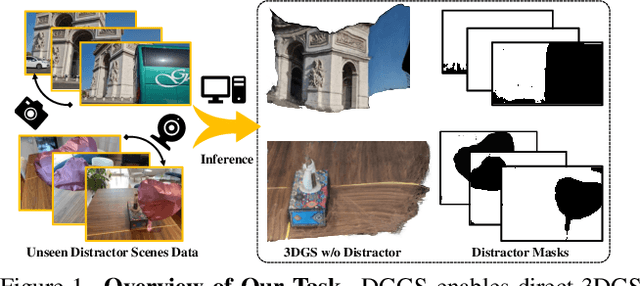

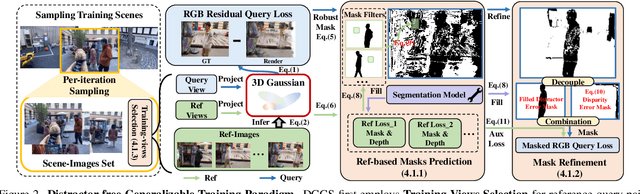

We present DGGS, a novel framework addressing the previously unexplored challenge of Distractor-free Generalizable 3D Gaussian Splatting (3DGS). It accomplishes two key objectives: fortifying generalizable 3DGS against distractor-laden data during both training and inference phases, while successfully extending cross-scene adaptation capabilities to conventional distractor-free approaches. To achieve these objectives, DGGS introduces a scene-agnostic reference-based mask prediction and refinement methodology during training phase, coupled with a training view selection strategy, effectively improving distractor prediction accuracy and training stability. Moreover, to address distractor-induced voids and artifacts during inference stage, we propose a two-stage inference framework for better reference selection based on the predicted distractor masks, complemented by a distractor pruning module to eliminate residual distractor effects. Extensive generalization experiments demonstrate DGGS's advantages under distractor-laden conditions. Additionally, experimental results show that our scene-agnostic mask inference achieves accuracy comparable to scene-specific trained methods. Homepage is \url{https://github.com/bbbbby-99/DGGS}.
SRA-MCTS: Self-driven Reasoning Augmentation with Monte Carlo Tree Search for Code Generation
Nov 21, 2024Large language models demonstrate exceptional performance in simple code generation tasks but still face challenges in tackling complex problems. These challenges may stem from insufficient reasoning and problem decomposition capabilities. To address this issue, we propose a reasoning-augmented data generation process, SRA-MCTS, which guides the model to autonomously generate high-quality intermediate reasoning paths. This creates a positive feedback loop, enabling continuous improvement. Our method operates entirely through the model itself without requiring additional supervision. By synthesizing natural language reasoning paths and translating them into executable code, the approach ensures analytical accuracy and enhances the success rate in solving complex tasks. Experimental results show that, even without additional supervisory signals, our method achieves performance improvements across different model scales, demonstrating the significant potential of self-improvement in small models. Furthermore, the method remains robust when traditional Chain-of-Thought (CoT) approaches exhibit performance degradation, with notable improvements observed in diversity metrics such as pass@10. We encourage further exploration of reasoning processes within training data to enhance the ability of language models to address complex problems.