 Add to Chrome
 Add to Firefox
 Add to Edge
A Triple-Modal Contrastive Learning Framework with Sequence, Graph, and 3D Features for Drug-Target Interaction Prediction
May 28, 2026
Accurate prediction of drug-target interactions (DTI) is critical for drug discovery. Existing methods often rely on single-modal representations (e.g., sequences or graphs) or combine only two modalities, overlooking 3D structural features. To address this challenge, we propose TriMod-DTI, a triple-modal contrastive learning framework that incorporates 1D sequences, 2D graphs, and 3D structures of drugs and proteins, obtaining the universal and complementary feature representations for DTI prediction. We design a Feature Extractor to capture drug and target features across the three modalities, thereby enriching their representations. We further propose a triple-modal contrastive learning strategy to align different modal representations of the same drug or protein in the latent space. By constructing cross-modal positive and negative sample pairs, this approach enhances the model's discriminative ability. Experiments on three benchmark datasets demonstrate that TriMod-DTI outperforms state-of-the-art methods. The ablation studies validate the contributions of each modality. Moreover, case studies highlight its practical potential for DTI prediction and drug discovery.

Deep-layer limit and stability analysis of the basic forward-backward-splitting induced network (II): learning problems
May 26, 2026Deep unfolding neural networks derived from iterative optimization schemes and numerical ordinary/partial differential equations (ODEs/PDEs) have attracted much attention in data science over the last decade. Therein, numerous important network architectures were constructed from the basic forward-backward-splitting (FBS) algorithm. In this paper, we continue our research on the most basic FBS-induced network, an architecture unrolled from the original FBS algorithm by incorporating direct parameter relaxations. Following the difference/differential inclusion formulations in our previous forward system analyses, we here consider some theoretical aspects of corresponding learning problems. Under some mild assumptions, we establish a general convergence property of the training problem of the basic FBS-induced network to the learning problem of the deep-layer limit system, implying a $Γ$-convergence argument showing that any cluster point of the optimal learning parameters for the network is a solution to the learning problem of the deep-layer limit system. A qualitative analysis of perturbation stabilities of these learning problems is also presented. A simple numerical experiment is conducted to validate our main general convergence result.
RubricEval: A Rubric-Level Meta-Evaluation Benchmark for LLM Judges in Instruction Following
Mar 26, 2026Rubric-based evaluation has become a prevailing paradigm for evaluating instruction following in large language models (LLMs). Despite its widespread use, the reliability of these rubric-level evaluations remains unclear, calling for meta-evaluation. However, prior meta-evaluation efforts largely focus on the response level, failing to assess the fine-grained judgment accuracy that rubric-based evaluation relies on. To bridge this gap, we introduce RubricEval. Our benchmark features: (1) the first rubric-level meta-evaluation benchmark for instruction following, (2) diverse instructions and responses spanning multiple categories and model sources, and (3) a substantial set of 3,486 quality-controlled instances, along with Easy/Hard subsets that better differentiates judge performance. Our experiments reveal that rubric-level judging remains far from solved: even GPT-4o, a widely adopted judge in instruction-following benchmarks, achieves only 55.97% on Hard subset. Considering evaluation paradigm, rubric-level evaluation outperforms checklist-level, explicit reasoning improves accuracy, and both together reduce inter-judge variance. Through our established rubric taxonomy, we further identify common failure modes and offer actionable insights for reliable instruction-following evaluation.
An Industrial-Scale Insurance LLM Achieving Verifiable Domain Mastery and Hallucination Control without Competence Trade-offs
Mar 15, 2026Adapting Large Language Models (LLMs) to high-stakes vertical domains like insurance presents a significant challenge: scenarios demand strict adherence to complex regulations and business logic with zero tolerance for hallucinations. Existing approaches often suffer from a Competency Trade-off - sacrificing general intelligence for domain expertise - or rely heavily on RAG without intrinsic reasoning. To bridge this gap, we present INS-S1, an insurance-specific LLM family trained via a novel end-to-end alignment paradigm. Our approach features two methodological innovations: (1) A Verifiable Data Synthesis System that constructs hierarchical datasets for actuarial reasoning and compliance; and (2) A Progressive SFT-RL Curriculum Framework that integrates dynamic data annealing with a synergistic mix of Verified Reasoning (RLVR) and AI Feedback (RLAIF). By optimizing data ratios and reward signals, this framework enforces domain constraints while preventing catastrophic forgetting. Additionally, we release INSEva, the most comprehensive insurance benchmark to date (39k+ samples). Extensive experiments show that INS-S1 achieves SOTA performance on domain tasks, significantly outperforming DeepSeek-R1 and Gemini-2.5-Pro. Crucially, it maintains top-tier general capabilities and achieves a record-low 0.6% hallucination rate (HHEM). Our results demonstrate that rigorous domain specialization can be achieved without compromising general intelligence.
Softmax Linear Attention: Reclaiming Global Competition
Feb 02, 2026While linear attention reduces the quadratic complexity of standard Transformers to linear time, it often lags behind in expressivity due to the removal of softmax normalization. This omission eliminates \emph{global competition}, a critical mechanism that enables models to sharply focus on relevant information amidst long-context noise. In this work, we propose \textbf{Softmax Linear Attention (SLA)}, a framework designed to restore this competitive selection without sacrificing efficiency. By lifting the softmax operation from the token level to the head level, SLA leverages attention heads as coarse semantic slots, applying a competitive gating mechanism to dynamically select the most relevant subspaces. This reintroduces the ``winner-take-all'' dynamics essential for precise retrieval and robust long-context understanding. Distinct from prior methods that focus on refining local kernel functions, SLA adopts a broader perspective by exploiting the higher-level multi-head aggregation structure. Extensive experiments demonstrate that SLA consistently enhances state-of-the-art linear baselines (RetNet, GLA, GDN) across language modeling and long-context benchmarks, particularly in challenging retrieval scenarios where it significantly boosts robustness against noise, validating its capability to restore precise focus while maintaining linear complexity.
MolBridge: Atom-Level Joint Graph Refinement for Robust Drug-Drug Interaction Event Prediction
Oct 23, 2025Drug combinations offer therapeutic benefits but also carry the risk of adverse drug-drug interactions (DDIs), especially under complex molecular structures. Accurate DDI event prediction requires capturing fine-grained inter-drug relationships, which are critical for modeling metabolic mechanisms such as enzyme-mediated competition. However, existing approaches typically rely on isolated drug representations and fail to explicitly model atom-level cross-molecular interactions, limiting their effectiveness across diverse molecular complexities and DDI type distributions. To address these limitations, we propose MolBridge, a novel atom-level joint graph refinement framework for robust DDI event prediction. MolBridge constructs a joint graph that integrates atomic structures of drug pairs, enabling direct modeling of inter-drug associations. A central challenge in such joint graph settings is the potential loss of information caused by over-smoothing when modeling long-range atomic dependencies. To overcome this, we introduce a structure consistency module that iteratively refines node features while preserving the global structural context. This joint design allows MolBridge to effectively learn both local and global interaction outperforms state-of-the-art baselines, achieving superior performance across long-tail and inductive scenarios. patterns, yielding robust representations across both frequent and rare DDI types. Extensive experiments on two benchmark datasets show that MolBridge consistently. These results demonstrate the advantages of fine-grained graph refinement in improving the accuracy, robustness, and mechanistic interpretability of DDI event prediction.This work contributes to Web Mining and Content Analysis by developing graph-based methods for mining and analyzing drug-drug interaction networks.
DynamicDTA: Drug-Target Binding Affinity Prediction Using Dynamic Descriptors and Graph Representation
May 13, 2025Predicting drug-target binding affinity (DTA) is essential for identifying potential therapeutic candidates in drug discovery. However, most existing models rely heavily on static protein structures, often overlooking the dynamic nature of proteins, which is crucial for capturing conformational flexibility that will be beneficial for protein binding interactions. We introduce DynamicDTA, an innovative deep learning framework that incorporates static and dynamic protein features to enhance DTA prediction. The proposed DynamicDTA takes three types of inputs, including drug sequence, protein sequence, and dynamic descriptors. A molecular graph representation of the drug sequence is generated and subsequently processed through graph convolutional network, while the protein sequence is encoded using dilated convolutions. Dynamic descriptors, such as root mean square fluctuation, are processed through a multi-layer perceptron. These embedding features are fused with static protein features using cross-attention, and a tensor fusion network integrates all three modalities for DTA prediction. Extensive experiments on three datasets demonstrate that DynamicDTA achieves by at least 3.4% improvement in RMSE score with comparison to seven state-of-the-art baseline methods. Additionally, predicting novel drugs for Human Immunodeficiency Virus Type 1 and visualizing the docking complexes further demonstrates the reliability and biological relevance of DynamicDTA.
Enhancing Chemical Reaction and Retrosynthesis Prediction with Large Language Model and Dual-task Learning
May 05, 2025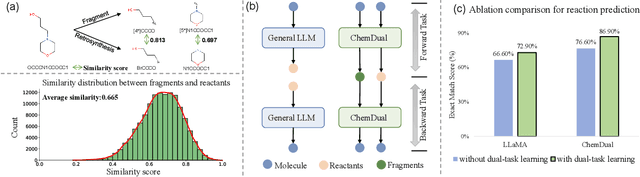
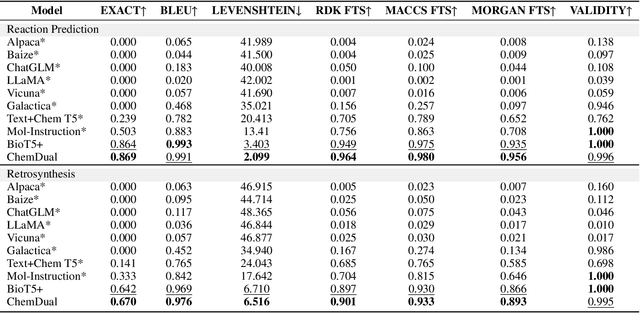
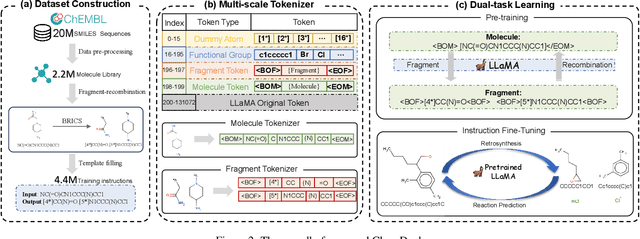
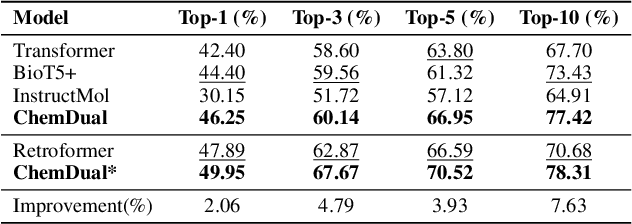
Chemical reaction and retrosynthesis prediction are fundamental tasks in drug discovery. Recently, large language models (LLMs) have shown potential in many domains. However, directly applying LLMs to these tasks faces two major challenges: (i) lacking a large-scale chemical synthesis-related instruction dataset; (ii) ignoring the close correlation between reaction and retrosynthesis prediction for the existing fine-tuning strategies. To address these challenges, we propose ChemDual, a novel LLM framework for accurate chemical synthesis. Specifically, considering the high cost of data acquisition for reaction and retrosynthesis, ChemDual regards the reaction-and-retrosynthesis of molecules as a related recombination-and-fragmentation process and constructs a large-scale of 4.4 million instruction dataset. Furthermore, ChemDual introduces an enhanced LLaMA, equipped with a multi-scale tokenizer and dual-task learning strategy, to jointly optimize the process of recombination and fragmentation as well as the tasks between reaction and retrosynthesis prediction. Extensive experiments on Mol-Instruction and USPTO-50K datasets demonstrate that ChemDual achieves state-of-the-art performance in both predictions of reaction and retrosynthesis, outperforming the existing conventional single-task approaches and the general open-source LLMs. Through molecular docking analysis, ChemDual generates compounds with diverse and strong protein binding affinity, further highlighting its strong potential in drug design.
Property Enhanced Instruction Tuning for Multi-task Molecule Generation with Large Language Models
Dec 24, 2024Large language models (LLMs) are widely applied in various natural language processing tasks such as question answering and machine translation. However, due to the lack of labeled data and the difficulty of manual annotation for biochemical properties, the performance for molecule generation tasks is still limited, especially for tasks involving multi-properties constraints. In this work, we present a two-step framework PEIT (Property Enhanced Instruction Tuning) to improve LLMs for molecular-related tasks. In the first step, we use textual descriptions, SMILES, and biochemical properties as multimodal inputs to pre-train a model called PEIT-GEN, by aligning multi-modal representations to synthesize instruction data. In the second step, we fine-tune existing open-source LLMs with the synthesized data, the resulting PEIT-LLM can handle molecule captioning, text-based molecule generation, molecular property prediction, and our newly proposed multi-constraint molecule generation tasks. Experimental results show that our pre-trained PEIT-GEN outperforms MolT5 and BioT5 in molecule captioning, demonstrating modalities align well between textual descriptions, structures, and biochemical properties. Furthermore, PEIT-LLM shows promising improvements in multi-task molecule generation, proving the scalability of the PEIT framework for various molecular tasks. We release the code, constructed instruction data, and model checkpoints in https://github.com/chenlong164/PEIT.
S$^2$DN: Learning to Denoise Unconvincing Knowledge for Inductive Knowledge Graph Completion
Dec 20, 2024Inductive Knowledge Graph Completion (KGC) aims to infer missing facts between newly emerged entities within knowledge graphs (KGs), posing a significant challenge. While recent studies have shown promising results in inferring such entities through knowledge subgraph reasoning, they suffer from (i) the semantic inconsistencies of similar relations, and (ii) noisy interactions inherent in KGs due to the presence of unconvincing knowledge for emerging entities. To address these challenges, we propose a Semantic Structure-aware Denoising Network (S$^2$DN) for inductive KGC. Our goal is to learn adaptable general semantics and reliable structures to distill consistent semantic knowledge while preserving reliable interactions within KGs. Specifically, we introduce a semantic smoothing module over the enclosing subgraphs to retain the universal semantic knowledge of relations. We incorporate a structure refining module to filter out unreliable interactions and offer additional knowledge, retaining robust structure surrounding target links. Extensive experiments conducted on three benchmark KGs demonstrate that S$^2$DN surpasses the performance of state-of-the-art models. These results demonstrate the effectiveness of S$^2$DN in preserving semantic consistency and enhancing the robustness of filtering out unreliable interactions in contaminated KGs.