 Add to Chrome
 Add to Firefox
 Add to Edge
Bridging Local Observation and Global Simulation in Closed-Loop Traffic Modeling
Jun 30, 2026
A local-to-global context mismatch arises when autoregressive traffic simulators trained on ego-centric driving logs are deployed in globally observable closed-loop environments. In such logs, the ego vehicle has rich local observations, while surrounding agents are only partially observed due to perception limits and occlusions. As a result, simulators may learn incomplete context--action mappings that remain hidden in log-based training but emerge during closed-loop rollouts, leading to unrealistic behaviors such as abnormal stops, unsafe interactions, and rule violations. We propose CRAFT, a Contextual pReference Alignment Framework for Traffic Simulation, to mitigate this mismatch via self-supervised failure discovery and preference-guided test-time alignment. CRAFT treats the base simulator as a globally observable sandbox, generating diverse what-if rollouts from logged initial states to expose context-induced failures. These failures are grounded with human-aligned driving priors and converted into preference supervision for training a Contextual Preference Evaluator (CPE). At inference time, CPE acts as a plug-in alignment module that scores candidate actions under complete scene context and reweights autoregressive decoding toward globally coherent behaviors. CRAFT mitigates this local-to-global contextual bias, reducing collisions by 31.2\% and traffic violations by 33.2\% without retraining the base simulator.

Long-term Traffic Simulation via Structured Autoregressive Modeling
Jun 30, 2026Interactive traffic simulation is a vital world model for autonomous driving. A central challenge in long-horizon simulation is modeling sustained multi-agent interactions, which is further exacerbated by dynamic token cardinality as agents continuously enter and exit the scene. In this work, we propose that the solution lies in the synergy between the architectural inductive biases and statistical priors of large-scale sequence models, e.g., Large Language Models (LLMs). Our probing experiments reveal that the transferability of attention mechanisms and the distributional consistency between motion tokens and natural language enable small-scale, heavily frozen LLMs to rapidly adapt to traffic modeling. Building on this insight, we introduce RosettaSim, a unified framework that projects scene topology, agent states, and spawning intents into a structured autoregressive stream with variable length, achieving both strong short-term accuracy and stable long-horizon simulation fidelity. Furthermore, evaluating extended rollouts presents yet another hurdle, as one-to-one agent correspondence inevitably fades over time. To address this, we introduce Retrieval-based Traffic Evaluation (RTE), which retrieves semantically similar real-world scenarios as context-aware reference anchors. Experiments on the Waymo Open Sim Agent Challenge (WOSAC) demonstrate that RosettaSim achieves state-of-the-art performance in both short- and long-term simulation. Furthermore, RTE exhibits a stronger correlation with standard metrics ($r=0.83$) than existing approaches ($r=0.74$), indicating improved alignment with long-horizon simulation fidelity.
Horizon Adaptive Offline Policy Learning via Value Stitching
Jun 19, 2026Learning accurate value functions plays a decisive role for reinforcement learning (RL) agents to solve long-horizon, complex tasks. Conventional temporal-difference (TD) learning objectives suffer from value-estimation bias that accumulates over the horizon, while extended-horizon modeling methods, such as n-step TD backups and Q-chunking, adopt a rigid, fixed-horizon value-modeling recipe that is often not flexible enough to capture complex value structures in long-horizon, multi-stage tasks. In this paper, we show that enabling value updates with dynamic horizon composition can yield a strong offline policy learning scheme. Our method, Horizon Adaptive Offline Policy Learning via VAlue STitching (VAST), replaces fixed-horizon backups with recursive, horizon-adaptive value composition. Its key ingredient is to couple value optimization with a future state- and horizon-length-conditioned auxiliary value function that is learned through direct data supervision, and a stitching policy that optimally selects the reward-maximizing horizon length and future sub-goal to achieve horizon-adaptive value stitching. This design enables direct estimation and compositional "stitching" of variable-length returns grounded in actionable sub-goal states, providing an accurate and greedily exploitable value-supervision signal for offline policy optimization. Across 50 tasks on OGBench, VAST outperforms fixed-step, extended-horizon methods, and generative-value offline RL baselines, achieving strong performance particularly in high-complexity, long-horizon decision-making tasks.
Learning Responsibility-Attributed Adversarial Scenarios for Testing Autonomous Vehicles
May 13, 2026Establishing trustworthy safety assurance for autonomous driving systems (ADSs) requires evidence that failures arise from avoidable system deficiencies rather than unavoidable traffic conflicts. Current adversarial simulation methods can efficiently expose collisions, but generally lack mechanisms to distinguish these fundamentally different failure modes. Here we present CARS (Context-Aware, Responsibility-attributed Scenario generation), a framework that integrates responsibility attribution directly into adversarial scenario generation. CARS combines context-aware adversary selection with a generative adversarial policy optimized in closed-loop simulation to construct collision scenarios that are both physically feasible and diagnostically attributable. Across benchmark datasets spanning heterogeneous national traffic environments, CARS consistently discovers feasible collision scenarios with high attribution rates under multiple regulation-prescribed careful and competent driver models. By coupling adversarial generation with normative responsibility assessment, CARS moves simulation testing beyond collision discovery toward the construction of interpretable, regulation-aligned safety evidence for scalable ADS validation.
TeraSim-World: Worldwide Safety-Critical Data Synthesis for End-to-End Autonomous Driving
Sep 16, 2025Safe and scalable deployment of end-to-end (E2E) autonomous driving requires extensive and diverse data, particularly safety-critical events. Existing data are mostly generated from simulators with a significant sim-to-real gap or collected from on-road testing that is costly and unsafe. This paper presents TeraSim-World, an automated pipeline that synthesizes realistic and geographically diverse safety-critical data for E2E autonomous driving at anywhere in the world. Starting from an arbitrary location, TeraSim-World retrieves real-world maps and traffic demand from geospatial data sources. Then, it simulates agent behaviors from naturalistic driving datasets, and orchestrates diverse adversities to create corner cases. Informed by street views of the same location, it achieves photorealistic, geographically grounded sensor rendering via the frontier video generation model Cosmos-Drive. By bridging agent and sensor simulations, TeraSim-World provides a scalable and critical~data synthesis framework for training and evaluation of E2E autonomous driving systems.
Improving Traffic Signal Data Quality for the Waymo Open Motion Dataset
Jun 08, 2025Datasets pertaining to autonomous vehicles (AVs) hold significant promise for a range of research fields, including artificial intelligence (AI), autonomous driving, and transportation engineering. Nonetheless, these datasets often encounter challenges related to the states of traffic signals, such as missing or inaccurate data. Such issues can compromise the reliability of the datasets and adversely affect the performance of models developed using them. This research introduces a fully automated approach designed to tackle these issues by utilizing available vehicle trajectory data alongside knowledge from the transportation domain to effectively impute and rectify traffic signal information within the Waymo Open Motion Dataset (WOMD). The proposed method is robust and flexible, capable of handling diverse intersection geometries and traffic signal configurations in real-world scenarios. Comprehensive validations have been conducted on the entire WOMD, focusing on over 360,000 relevant scenarios involving traffic signals, out of a total of 530,000 real-world driving scenarios. In the original dataset, 71.7% of traffic signal states are either missing or unknown, all of which were successfully imputed by our proposed method. Furthermore, in the absence of ground-truth signal states, the accuracy of our approach is evaluated based on the rate of red-light violations among vehicle trajectories. Results show that our method reduces the estimated red-light running rate from 15.7% in the original data to 2.9%, thereby demonstrating its efficacy in rectifying data inaccuracies. This paper significantly enhances the quality of AV datasets, contributing to the wider AI and AV research communities and benefiting various downstream applications. The code and improved traffic signal data are open-sourced at https://github.com/michigan-traffic-lab/WOMD-Traffic-Signal-Data-Improvement
Behavioral Safety Assessment towards Large-scale Deployment of Autonomous Vehicles
May 22, 2025Autonomous vehicles (AVs) have significantly advanced in real-world deployment in recent years, yet safety continues to be a critical barrier to widespread adoption. Traditional functional safety approaches, which primarily verify the reliability, robustness, and adequacy of AV hardware and software systems from a vehicle-centric perspective, do not sufficiently address the AV's broader interactions and behavioral impact on the surrounding traffic environment. To overcome this limitation, we propose a paradigm shift toward behavioral safety, a comprehensive approach focused on evaluating AV responses and interactions within the traffic environment. To systematically assess behavioral safety, we introduce a third-party AV safety assessment framework comprising two complementary evaluation components: the Driver Licensing Test and the Driving Intelligence Test. The Driver Licensing Test evaluates the AV's reactive behaviors under controlled scenarios, ensuring basic behavioral competency. In contrast, the Driving Intelligence Test assesses the AV's interactive behaviors within naturalistic traffic conditions, quantifying the frequency of safety-critical events to deliver statistically meaningful safety metrics before large-scale deployment. We validated our proposed framework using Autoware.Universe, an open-source Level 4 AV, tested both in simulated environments and on the physical test track at the University of Michigan's Mcity Testing Facility. The results indicate that Autoware.Universe passed 6 out of 14 scenarios and exhibited a crash rate of 3.01e-3 crashes per mile, approximately 1,000 times higher than the average human driver crash rate. During the tests, we also uncovered several unknown unsafe scenarios for Autoware.Universe. These findings underscore the necessity of behavioral safety evaluations for improving AV safety performance prior to widespread public deployment.
RADE: Learning Risk-Adjustable Driving Environment via Multi-Agent Conditional Diffusion
May 06, 2025Generating safety-critical scenarios in high-fidelity simulations offers a promising and cost-effective approach for efficient testing of autonomous vehicles. Existing methods typically rely on manipulating a single vehicle's trajectory through sophisticated designed objectives to induce adversarial interactions, often at the cost of realism and scalability. In this work, we propose the Risk-Adjustable Driving Environment (RADE), a simulation framework that generates statistically realistic and risk-adjustable traffic scenes. Built upon a multi-agent diffusion architecture, RADE jointly models the behavior of all agents in the environment and conditions their trajectories on a surrogate risk measure. Unlike traditional adversarial methods, RADE learns risk-conditioned behaviors directly from data, preserving naturalistic multi-agent interactions with controllable risk levels. To ensure physical plausibility, we incorporate a tokenized dynamics check module that efficiently filters generated trajectories using a motion vocabulary. We validate RADE on the real-world rounD dataset, demonstrating that it preserves statistical realism across varying risk levels and naturally increases the likelihood of safety-critical events as the desired risk level grows up. Our results highlight RADE's potential as a scalable and realistic tool for AV safety evaluation.
TeraSim: Uncovering Unknown Unsafe Events for Autonomous Vehicles through Generative Simulation
Mar 06, 2025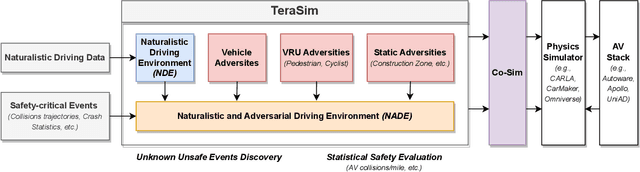
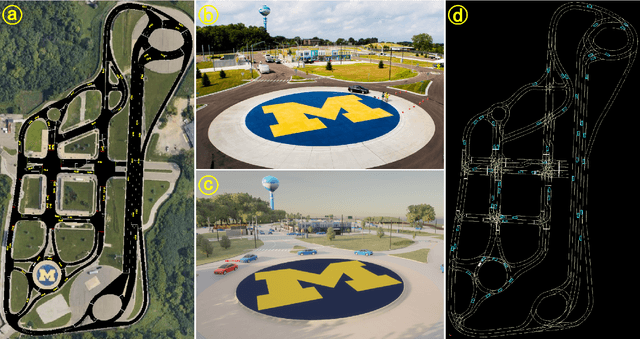
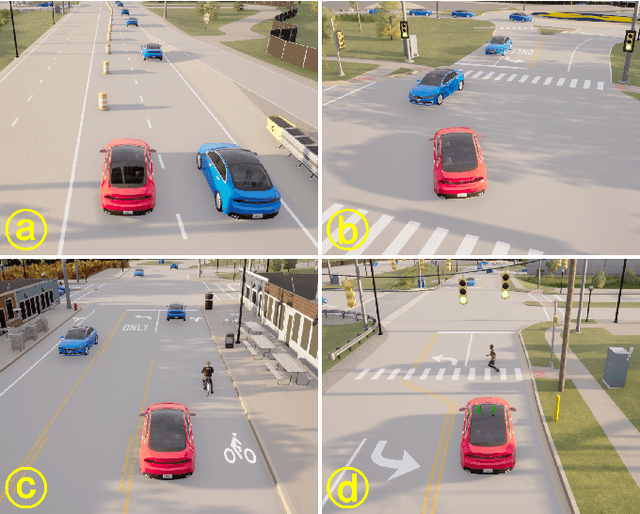
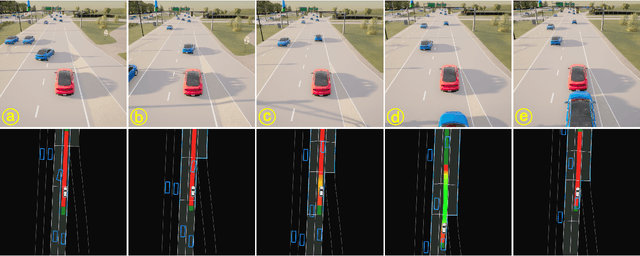
Traffic simulation is essential for autonomous vehicle (AV) development, enabling comprehensive safety evaluation across diverse driving conditions. However, traditional rule-based simulators struggle to capture complex human interactions, while data-driven approaches often fail to maintain long-term behavioral realism or generate diverse safety-critical events. To address these challenges, we propose TeraSim, an open-source, high-fidelity traffic simulation platform designed to uncover unknown unsafe events and efficiently estimate AV statistical performance metrics, such as crash rates. TeraSim is designed for seamless integration with third-party physics simulators and standalone AV stacks, to construct a complete AV simulation system. Experimental results demonstrate its effectiveness in generating diverse safety-critical events involving both static and dynamic agents, identifying hidden deficiencies in AV systems, and enabling statistical performance evaluation. These findings highlight TeraSim's potential as a practical tool for AV safety assessment, benefiting researchers, developers, and policymakers. The code is available at https://github.com/mcity/TeraSim.
CSDO: Enhancing Efficiency and Success in Large-Scale Multi-Vehicle Trajectory Planning
May 31, 2024This paper presents an efficient algorithm, naming Centralized Searching and Decentralized Optimization (CSDO), to find feasible solution for large-scale Multi-Vehicle Trajectory Planning (MVTP) problem. Due to the intractable growth of non-convex constraints with the number of agents, exploring various homotopy classes that imply different convex domains, is crucial for finding a feasible solution. However, existing methods struggle to explore various homotopy classes efficiently due to combining it with time-consuming precise trajectory solution finding. CSDO, addresses this limitation by separating them into different levels and integrating an efficient Multi-Agent Path Finding (MAPF) algorithm to search homotopy classes. It first searches for a coarse initial guess using a large search step, identifying a specific homotopy class. Subsequent decentralized Quadratic Programming (QP) refinement processes this guess, resolving minor collisions efficiently. Experimental results demonstrate that CSDO outperforms existing MVTP algorithms in large-scale, high-density scenarios, achieving up to 95% success rate in 50m $\times$ 50m random scenarios around one second. Source codes are released in https://github.com/YangSVM/CSDOTrajectoryPlanning.