 Add to Chrome
 Add to Firefox
 Add to Edge
Learning Responsibility-Attributed Adversarial Scenarios for Testing Autonomous Vehicles
May 13, 2026
Establishing trustworthy safety assurance for autonomous driving systems (ADSs) requires evidence that failures arise from avoidable system deficiencies rather than unavoidable traffic conflicts. Current adversarial simulation methods can efficiently expose collisions, but generally lack mechanisms to distinguish these fundamentally different failure modes. Here we present CARS (Context-Aware, Responsibility-attributed Scenario generation), a framework that integrates responsibility attribution directly into adversarial scenario generation. CARS combines context-aware adversary selection with a generative adversarial policy optimized in closed-loop simulation to construct collision scenarios that are both physically feasible and diagnostically attributable. Across benchmark datasets spanning heterogeneous national traffic environments, CARS consistently discovers feasible collision scenarios with high attribution rates under multiple regulation-prescribed careful and competent driver models. By coupling adversarial generation with normative responsibility assessment, CARS moves simulation testing beyond collision discovery toward the construction of interpretable, regulation-aligned safety evidence for scalable ADS validation.

ROSClaw: A Hierarchical Semantic-Physical Framework for Heterogeneous Multi-Agent Collaboration
Apr 06, 2026The integration of large language models (LLMs) with embodied agents has improved high-level reasoning capabilities; however, a critical gap remains between semantic understanding and physical execution. While vision-language-action (VLA) and vision-language-navigation (VLN) systems enable robots to perform manipulation and navigation tasks from natural language instructions, they still struggle with long-horizon sequential and temporally structured tasks. Existing frameworks typically adopt modular pipelines for data collection, skill training, and policy deployment, resulting in high costs in experimental validation and policy optimization. To address these limitations, we propose ROSClaw, an agent framework for heterogeneous robots that integrates policy learning and task execution within a unified vision-language model (VLM) controller. The framework leverages e-URDF representations of heterogeneous robots as physical constraints to construct a sim-to-real topological mapping, enabling real-time access to the physical states of both simulated and real-world agents. We further incorporate a data collection and state accumulation mechanism that stores robot states, multimodal observations, and execution trajectories during real-world execution, enabling subsequent iterative policy optimization. During deployment, a unified agent maintains semantic continuity between reasoning and execution, and dynamically assigns task-specific control to different agents, thereby improving robustness in multi-policy execution. By establishing an autonomous closed-loop framework, ROSClaw minimizes the reliance on robot-specific development workflows. The framework supports hardware-level validation, automated generation of SDK-level control programs, and tool-based execution, enabling rapid cross-platform transfer and continual improvement of robotic skills. Ours project page: https://www.rosclaw.io/.
VTD: Visual and Tactile Database for Driver State and Behavior Perception
Dec 06, 2024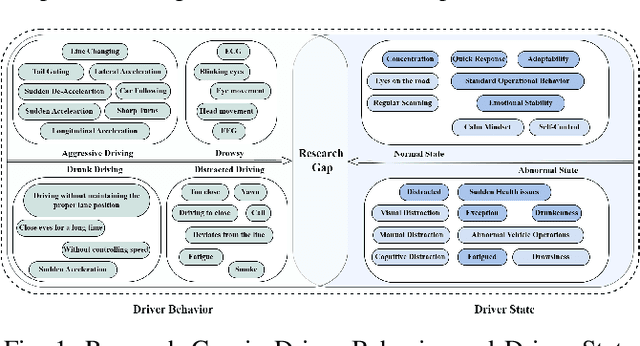
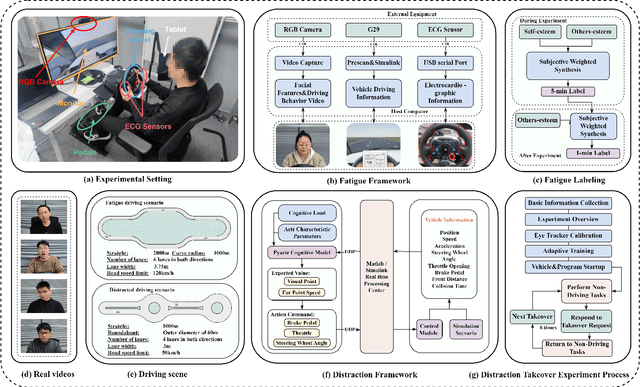
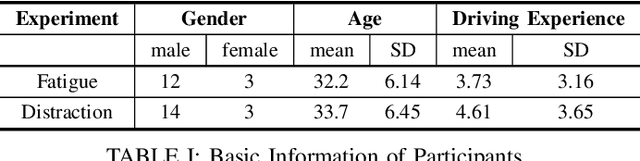
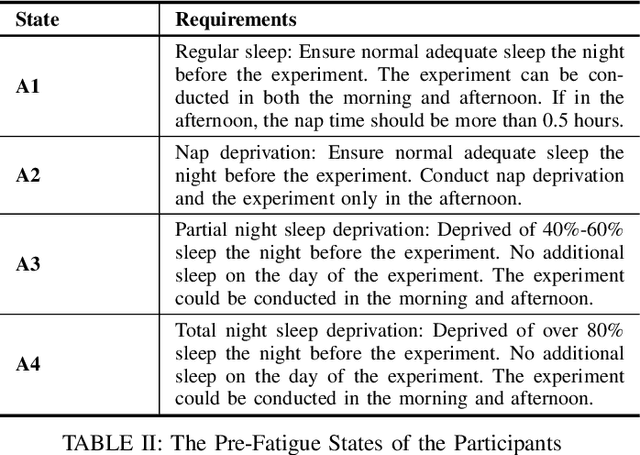
In the domain of autonomous vehicles, the human-vehicle co-pilot system has garnered significant research attention. To address the subjective uncertainties in driver state and interaction behaviors, which are pivotal to the safety of Human-in-the-loop co-driving systems, we introduce a novel visual-tactile perception method. Utilizing a driving simulation platform, a comprehensive dataset has been developed that encompasses multi-modal data under fatigue and distraction conditions. The experimental setup integrates driving simulation with signal acquisition, yielding 600 minutes of fatigue detection data from 15 subjects and 102 takeover experiments with 17 drivers. The dataset, synchronized across modalities, serves as a robust resource for advancing cross-modal driver behavior perception algorithms.