 Add to Chrome
 Add to Firefox
 Add to Edge
AcademiClaw: When Students Set Challenges for AI Agents
May 04, 2026
Benchmarks within the OpenClaw ecosystem have thus far evaluated exclusively assistant-level tasks, leaving the academic-level capabilities of OpenClaw largely unexamined. We introduce AcademiClaw, a bilingual benchmark of 80 complex, long-horizon tasks sourced directly from university students' real academic workflows -- homework, research projects, competitions, and personal projects -- that they found current AI agents unable to solve effectively. Curated from 230 student-submitted candidates through rigorous expert review, the final task set spans 25+ professional domains, ranging from olympiad-level mathematics and linguistics problems to GPU-intensive reinforcement learning and full-stack system debugging, with 16 tasks requiring CUDA GPU execution. Each task executes in an isolated Docker sandbox and is scored on task completion by multi-dimensional rubrics combining six complementary techniques, with an independent five-category safety audit providing additional behavioral analysis. Experiments on six frontier models show that even the best achieves only a 55\% pass rate. Further analysis uncovers sharp capability boundaries across task domains, divergent behavioral strategies among models, and a disconnect between token consumption and output quality, providing fine-grained diagnostic signals beyond what aggregate metrics reveal. We hope that AcademiClaw and its open-sourced data and code can serve as a useful resource for the OpenClaw community, driving progress toward agents that are more capable and versatile across the full breadth of real-world academic demands. All data and code are available at https://github.com/GAIR-NLP/AcademiClaw.

Adversarial Imitation Learning with General Function Approximation: Theoretical Analysis and Practical Algorithms
May 03, 2026Adversarial imitation learning (AIL), a prominent approach in imitation learning, has achieved significant practical success powered by neural network approximation. However, existing theoretical analyses of AIL are primarily confined to simplified settings, such as tabular and linear function approximation, and involve complex algorithmic designs that impede practical implementation. This creates a substantial gap between theory and practice. This paper bridges this gap by exploring the theoretical underpinnings of online AIL with general function approximation. We introduce a novel framework called optimization-based AIL (OPT-AIL), which performs online optimization for reward learning coupled with optimism-regularized optimization for policy learning. Within this framework, we develop two concrete methods: model-free OPT-AIL and model-based OPT-AIL. Our theoretical analysis demonstrates that both variants achieve polynomial expert sample complexity and interaction complexity for learning near-expert policies. To the best of our knowledge, they represent the first provably efficient AIL methods under general function approximation. From a practical standpoint, OPT-AIL requires only the approximate optimization of two objectives, thereby facilitating practical implementation. Empirical studies demonstrate that OPT-AIL outperforms previous state-of-the-art deep AIL methods across several challenging tasks.
Speedup Patch: Learning a Plug-and-Play Policy to Accelerate Embodied Manipulation
Mar 21, 2026While current embodied policies exhibit remarkable manipulation skills, their execution remains unsatisfactorily slow as they inherit the tardy pacing of human demonstrations. Existing acceleration methods typically require policy retraining or costly online interactions, limiting their scalability for large-scale foundation models. In this paper, we propose Speedup Patch (SuP), a lightweight, policy-agnostic framework that enables plug-and-play acceleration using solely offline data. SuP introduces an external scheduler that adaptively downsamples action chunks provided by embodied policies to eliminate redundancies. Specifically, we formalize the optimization of our scheduler as a Constrained Markov Decision Process (CMDP) aimed at maximizing efficiency without compromising task performance. Since direct success evaluation is infeasible in offline settings, SuP introduces World Model based state deviation as a surrogate metric to enforce safety constraints. By leveraging a learned world model as a virtual evaluator to predict counterfactual trajectories, the scheduler can be optimized via offline reinforcement learning. Empirical results on simulation benchmarks (Libero, Bigym) and real-world tasks validate that SuP achieves an overall 1.8x execution speedup for diverse policies while maintaining their original success rates.
Towards Practical World Model-based Reinforcement Learning for Vision-Language-Action Models
Mar 21, 2026Vision-Language-Action (VLA) models show strong generalization for robotic control, but finetuning them with reinforcement learning (RL) is constrained by the high cost and safety risks of real-world interaction. Training VLA models in interactive world models avoids these issues but introduces several challenges, including pixel-level world modeling, multi-view consistency, and compounding errors under sparse rewards. Building on recent advances across large multimodal models and model-based RL, we propose VLA-MBPO, a practical framework to tackle these problems in VLA finetuning. Our approach has three key design choices: (i) adapting unified multimodal models (UMMs) for data-efficient world modeling; (ii) an interleaved view decoding mechanism to enforce multi-view consistency; and (iii) chunk-level branched rollout to mitigate error compounding. Theoretical analysis and experiments across simulation and real-world tasks demonstrate that VLA-MBPO significantly improves policy performance and sample efficiency, underscoring its robustness and scalability for real-world robotic deployment.
The Three Regimes of Offline-to-Online Reinforcement Learning
Oct 01, 2025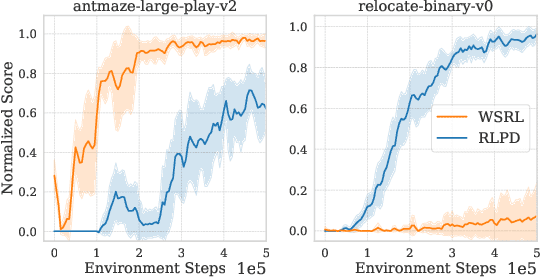
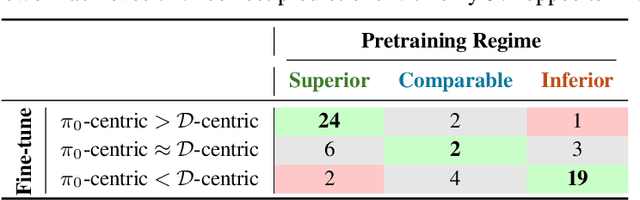
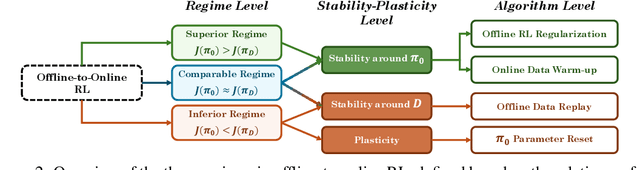
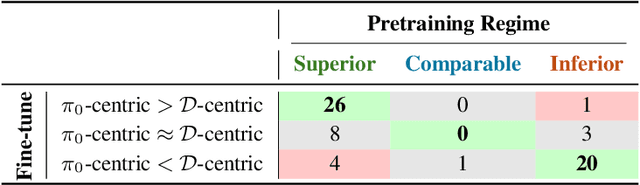
Offline-to-online reinforcement learning (RL) has emerged as a practical paradigm that leverages offline datasets for pretraining and online interactions for fine-tuning. However, its empirical behavior is highly inconsistent: design choices of online-fine tuning that work well in one setting can fail completely in another. We propose a stability--plasticity principle that can explain this inconsistency: we should preserve the knowledge of pretrained policy or offline dataset during online fine-tuning, whichever is better, while maintaining sufficient plasticity. This perspective identifies three regimes of online fine-tuning, each requiring distinct stability properties. We validate this framework through a large-scale empirical study, finding that the results strongly align with its predictions in 45 of 63 cases. This work provides a principled framework for guiding design choices in offline-to-online RL based on the relative performance of the offline dataset and the pretrained policy.
TeraSim: Uncovering Unknown Unsafe Events for Autonomous Vehicles through Generative Simulation
Mar 06, 2025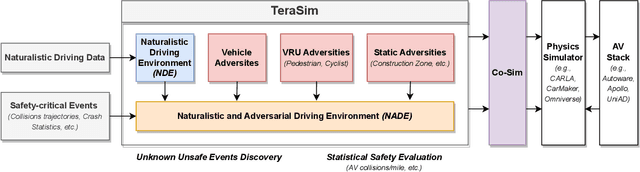
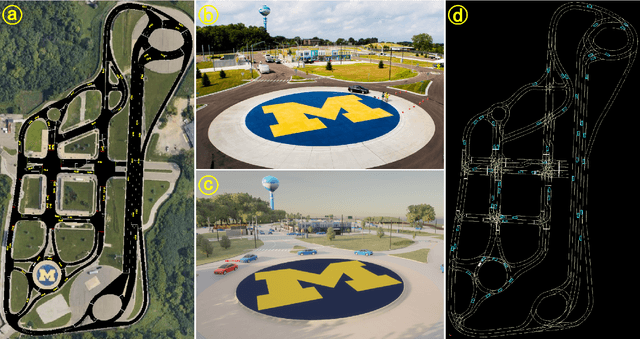
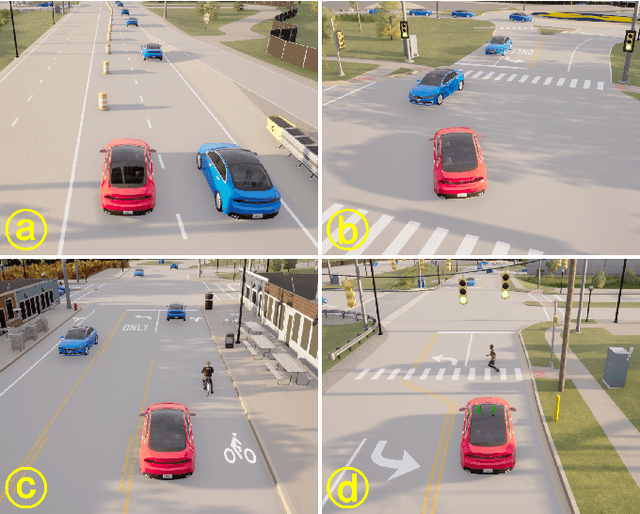
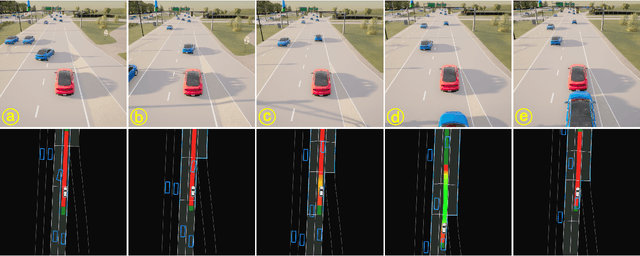
Traffic simulation is essential for autonomous vehicle (AV) development, enabling comprehensive safety evaluation across diverse driving conditions. However, traditional rule-based simulators struggle to capture complex human interactions, while data-driven approaches often fail to maintain long-term behavioral realism or generate diverse safety-critical events. To address these challenges, we propose TeraSim, an open-source, high-fidelity traffic simulation platform designed to uncover unknown unsafe events and efficiently estimate AV statistical performance metrics, such as crash rates. TeraSim is designed for seamless integration with third-party physics simulators and standalone AV stacks, to construct a complete AV simulation system. Experimental results demonstrate its effectiveness in generating diverse safety-critical events involving both static and dynamic agents, identifying hidden deficiencies in AV systems, and enabling statistical performance evaluation. These findings highlight TeraSim's potential as a practical tool for AV safety assessment, benefiting researchers, developers, and policymakers. The code is available at https://github.com/mcity/TeraSim.
WHALE: Towards Generalizable and Scalable World Models for Embodied Decision-making
Nov 08, 2024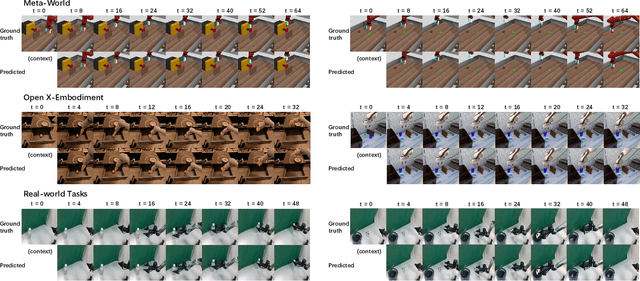
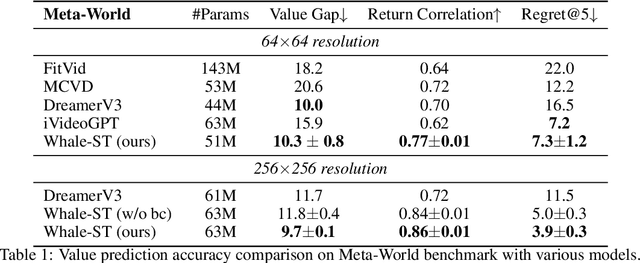
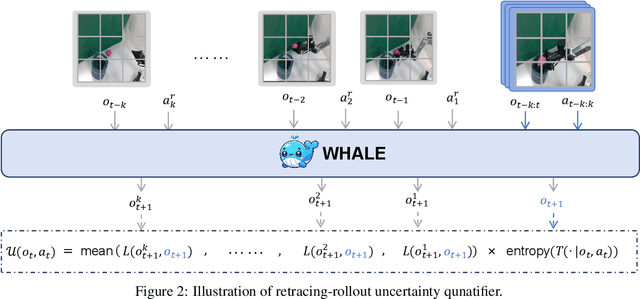
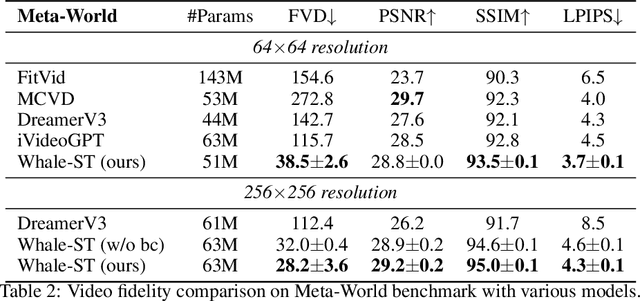
World models play a crucial role in decision-making within embodied environments, enabling cost-free explorations that would otherwise be expensive in the real world. To facilitate effective decision-making, world models must be equipped with strong generalizability to support faithful imagination in out-of-distribution (OOD) regions and provide reliable uncertainty estimation to assess the credibility of the simulated experiences, both of which present significant challenges for prior scalable approaches. This paper introduces WHALE, a framework for learning generalizable world models, consisting of two key techniques: behavior-conditioning and retracing-rollout. Behavior-conditioning addresses the policy distribution shift, one of the primary sources of the world model generalization error, while retracing-rollout enables efficient uncertainty estimation without the necessity of model ensembles. These techniques are universal and can be combined with any neural network architecture for world model learning. Incorporating these two techniques, we present Whale-ST, a scalable spatial-temporal transformer-based world model with enhanced generalizability. We demonstrate the superiority of Whale-ST in simulation tasks by evaluating both value estimation accuracy and video generation fidelity. Additionally, we examine the effectiveness of our uncertainty estimation technique, which enhances model-based policy optimization in fully offline scenarios. Furthermore, we propose Whale-X, a 414M parameter world model trained on 970K trajectories from Open X-Embodiment datasets. We show that Whale-X exhibits promising scalability and strong generalizability in real-world manipulation scenarios using minimal demonstrations.
Provably and Practically Efficient Adversarial Imitation Learning with General Function Approximation
Nov 01, 2024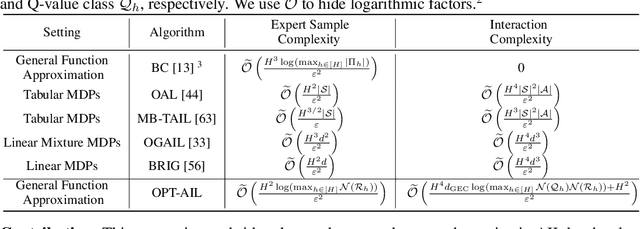
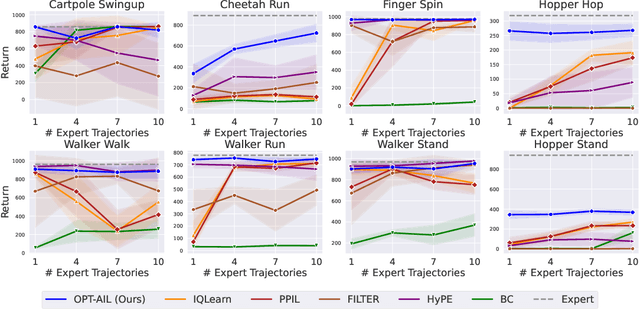
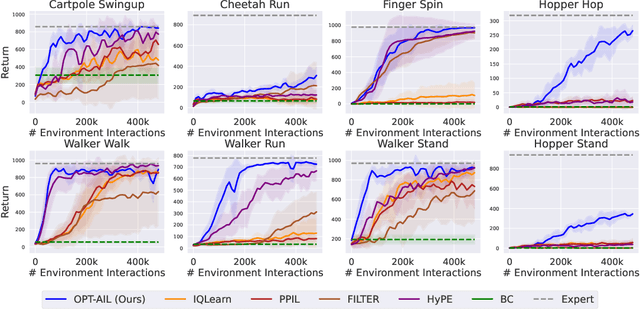
As a prominent category of imitation learning methods, adversarial imitation learning (AIL) has garnered significant practical success powered by neural network approximation. However, existing theoretical studies on AIL are primarily limited to simplified scenarios such as tabular and linear function approximation and involve complex algorithmic designs that hinder practical implementation, highlighting a gap between theory and practice. In this paper, we explore the theoretical underpinnings of online AIL with general function approximation. We introduce a new method called optimization-based AIL (OPT-AIL), which centers on performing online optimization for reward functions and optimism-regularized Bellman error minimization for Q-value functions. Theoretically, we prove that OPT-AIL achieves polynomial expert sample complexity and interaction complexity for learning near-expert policies. To our best knowledge, OPT-AIL is the first provably efficient AIL method with general function approximation. Practically, OPT-AIL only requires the approximate optimization of two objectives, thereby facilitating practical implementation. Empirical studies demonstrate that OPT-AIL outperforms previous state-of-the-art deep AIL methods in several challenging tasks.
Any-step Dynamics Model Improves Future Predictions for Online and Offline Reinforcement Learning
May 27, 2024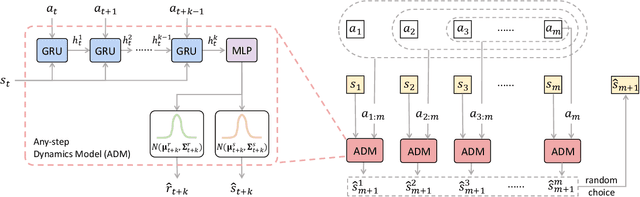
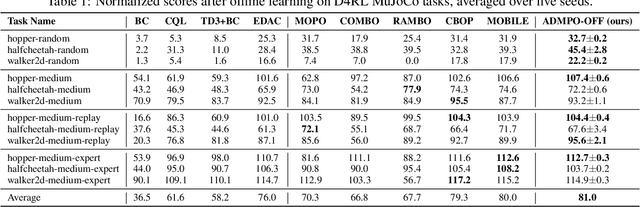
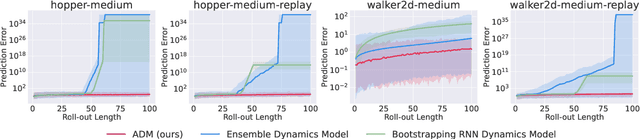
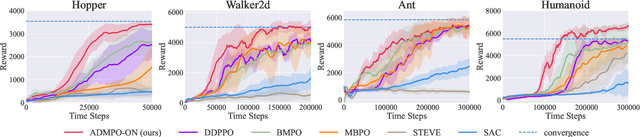
Model-based methods in reinforcement learning offer a promising approach to enhance data efficiency by facilitating policy exploration within a dynamics model. However, accurately predicting sequential steps in the dynamics model remains a challenge due to the bootstrapping prediction, which attributes the next state to the prediction of the current state. This leads to accumulated errors during model roll-out. In this paper, we propose the Any-step Dynamics Model (ADM) to mitigate the compounding error by reducing bootstrapping prediction to direct prediction. ADM allows for the use of variable-length plans as inputs for predicting future states without frequent bootstrapping. We design two algorithms, ADMPO-ON and ADMPO-OFF, which apply ADM in online and offline model-based frameworks, respectively. In the online setting, ADMPO-ON demonstrates improved sample efficiency compared to previous state-of-the-art methods. In the offline setting, ADMPO-OFF not only demonstrates superior performance compared to recent state-of-the-art offline approaches but also offers better quantification of model uncertainty using only a single ADM.
Assemblage: Automatic Binary Dataset Construction for Machine Learning
May 07, 2024
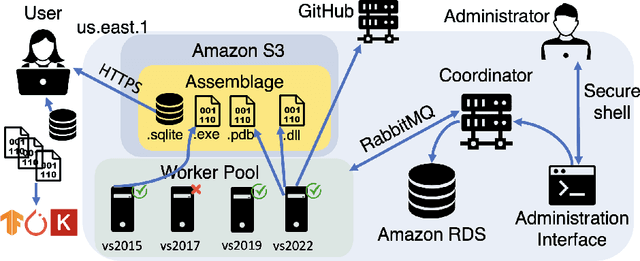


Binary code is pervasive, and binary analysis is a key task in reverse engineering, malware classification, and vulnerability discovery. Unfortunately, while there exist large corpuses of malicious binaries, obtaining high-quality corpuses of benign binaries for modern systems has proven challenging (e.g., due to licensing issues). Consequently, machine learning based pipelines for binary analysis utilize either costly commercial corpuses (e.g., VirusTotal) or open-source binaries (e.g., coreutils) available in limited quantities. To address these issues, we present Assemblage: an extensible cloud-based distributed system that crawls, configures, and builds Windows PE binaries to obtain high-quality binary corpuses suitable for training state-of-the-art models in binary analysis. We have run Assemblage on AWS over the past year, producing 890k Windows PE and 428k Linux ELF binaries across 29 configurations. Assemblage is designed to be both reproducible and extensible, enabling users to publish "recipes" for their datasets, and facilitating the extraction of a wide array of features. We evaluated Assemblage by using its data to train modern learning-based pipelines for compiler provenance and binary function similarity. Our results illustrate the practical need for robust corpuses of high-quality Windows PE binaries in training modern learning-based binary analyses. Assemblage can be downloaded from https://assemblage-dataset.net