 Add to Chrome
 Add to Firefox
 Add to Edge
A knowledge-augmented dataset of high-risk driving scenarios with LLM annotations for autonomous driving
Jul 08, 2026
Safe autonomous driving requires both rapid responses to common high-risk events and deeper reasoning over rare, extreme long-tail scenarios in traffic safety. These scenarios are severely under-represented in naturalistic driving data, and existing trajectory and language-augmented datasets seldom provide high-risk event labels, semantic annotations, and verifiable safety signals. Here we present K-Risk, a knowledge-augmented dataset that combines structured driving trajectories with large language model generated semantic annotations for safety-critical driving scenarios. K-Risk integrates 20 human-driven and autonomous-vehicle trajectory datasets from Europe, China, and the United States, covering highways, urban freeways, intersections, and roundabouts. Using a unified risk-centric extraction pipeline, K-Risk curates 31,398 high-risk events, together with a 1,036-event extreme subset of near-collision cases. Each event is released as a synchronized trajectory, metadata, and language triplet containing structured scenario descriptions, abnormal-behavior notifications, and, for a representative subset, causal risk analyses and action recommendations validated through a closed-loop simulator with iterative reflection. By combining multi-dimensional risk annotations, interpretable language supervision, and verifiable decisions, K-Risk bridges structured traffic trajectories, semantic reasoning, and decision supervision, providing a standardized foundation for developing and evaluating next-generation risk-aware autonomous driving agents.

From Scene to Object: Text-Guided Dual-Gaze Prediction
Apr 22, 2026Interpretable driver attention prediction is crucial for human-like autonomous driving. However, existing datasets provide only scene-level global gaze rather than fine-grained object-level annotations, inherently failing to support text-grounded cognitive modeling. Consequently, while Vision-Language Models (VLMs) hold great potential for semantic reasoning, this critical data limitations leads to severe text-vision decoupling and visual-bias hallucinations. To break this bottleneck and achieve precise object-level attention prediction, this paper proposes a novel dual-branch gaze prediction framework, establishing a complete paradigm from data construction to model architecture. First, we construct G-W3DA, a object-level driver attention dataset. By integrating a multimodal large language model with the Segment Anything Model 3 (SAM3), we decouple macroscopic heatmaps into object-level masks under rigorous cross-validation, fundamentally eliminating annotation hallucinations. Building upon this high-quality data foundation, we propose the DualGaze-VLM architecture. This architecture extracts the hidden states of semantic queries and dynamically modulates visual features via a Condition-Aware SE-Gate, achieving intent-driven precise spatial anchoring. Extensive experiments on the W3DA benchmark demonstrate that DualGaze-VLM consistently surpasses existing state-of-the-art (SOTA) models in spatial alignment metrics, notably achieving up to a 17.8% improvement in Similarity (SIM) under safety-critical scenarios. Furthermore, a visual Turing test reveals that the attention heatmaps generated by DualGaze-VLM are perceived as authentic by 88.22% of human evaluators, proving its capability to generate rational cognitive priors.
Driving risk emerges from the required two-dimensional joint evasive acceleration
Apr 20, 2026Most autonomous driving safety benchmarks use time-to-collision (TTC) to assess risk and guide safe behaviour. However, TTC-based methods treat risk as a one-dimensional closing problem, despite the inherently two-dimensional nature of collision avoidance, and therefore cannot faithfully capture risk or its evolution over time. Here, we report evasive acceleration (EA), a hyperparameter-free and physically interpretable two-dimensional paradigm for risk quantification. By evaluating all possible directions of collision avoidance, EA defines risk as the minimum magnitude of a constant relative acceleration vector required to alter the relative motion and make the interaction collision-free. Using interaction data from five open datasets and more than 600 real crashes, we derive percentile-based warning thresholds and show that EA provides the earliest statistically significant warning across all thresholds. Moreover, EA provides the best discrimination of eventual collision outcomes and improves information retention by 54.2-241.4% over all compared baselines. Adding EA to existing methods yields 17.5-95.5 times more information gain than adding existing methods to EA, indicating that EA captures much of the outcome-relevant information in existing methods while contributing substantial additional nonredundant information. Overall, EA better captures the structure of collision risk and provides a foundation for next-generation autonomous driving systems.
Risk-Controllable Multi-View Diffusion for Driving Scenario Generation
Mar 12, 2026Generating safety-critical driving scenarios is crucial for evaluating and improving autonomous driving systems, but long-tail risky situations are rarely observed in real-world data and difficult to specify through manual scenario design. Existing generative approaches typically treat risk as an after-the-fact label and struggle to maintain geometric consistency in multi-view driving scenes. We present RiskMV-DPO, a general and systematic pipeline for physically-informed, risk-controllable multi-view scenario generation. By integrating target risk levels with physically-grounded risk modeling, we autonomously synthesize diverse and high-stakes dynamic trajectories that serve as explicit geometric anchors for a diffusion-based video generator. To ensure spatial-temporal coherence and geometric fidelity, we introduce a geometry-appearance alignment module and a region-aware direct preference optimization (RA-DPO) strategy with motion-aware masking to focus learning on localized dynamic regions.Experiments on the nuScenes dataset show that RiskMV-DPO can freely generate a wide spectrum of diverse long-tail scenarios while maintaining state-of-the-art visual quality, improving 3D detection mAP from 18.17 to 30.50 and reducing FID to 15.70. Our work shifts the role of world models from passive environment prediction to proactive, risk-controllable synthesis, providing a scalable toolchain for the safety-oriented development of embodied intelligence.
SMART: Scalable Multi-Agent Reasoning and Trajectory Planning in Dense Environments
Sep 19, 2025Multi-vehicle trajectory planning is a non-convex problem that becomes increasingly difficult in dense environments due to the rapid growth of collision constraints. Efficient exploration of feasible behaviors and resolution of tight interactions are essential for real-time, large-scale coordination. This paper introduces SMART, Scalable Multi-Agent Reasoning and Trajectory Planning, a hierarchical framework that combines priority-based search with distributed optimization to achieve efficient and feasible multi-vehicle planning. The upper layer explores diverse interaction modes using reinforcement learning-based priority estimation and large-step hybrid A* search, while the lower layer refines solutions via parallelizable convex optimization. By partitioning space among neighboring vehicles and constructing robust feasible corridors, the method decouples the joint non-convex problem into convex subproblems solved efficiently in parallel. This design alleviates the step-size trade-off while ensuring kinematic feasibility and collision avoidance. Experiments show that SMART consistently outperforms baselines. On 50 m x 50 m maps, it sustains over 90% success within 1 s up to 25 vehicles, while baselines often drop below 50%. On 100 m x 100 m maps, SMART achieves above 95% success up to 50 vehicles and remains feasible up to 90 vehicles, with runtimes more than an order of magnitude faster than optimization-only approaches. Built on vehicle-to-everything communication, SMART incorporates vehicle-infrastructure cooperation through roadside sensing and agent coordination, improving scalability and safety. Real-world experiments further validate this design, achieving planning times as low as 0.014 s while preserving cooperative behaviors.
REACT: Runtime-Enabled Active Collision-avoidance Technique for Autonomous Driving
May 16, 2025Achieving rapid and effective active collision avoidance in dynamic interactive traffic remains a core challenge for autonomous driving. This paper proposes REACT (Runtime-Enabled Active Collision-avoidance Technique), a closed-loop framework that integrates risk assessment with active avoidance control. By leveraging energy transfer principles and human-vehicle-road interaction modeling, REACT dynamically quantifies runtime risk and constructs a continuous spatial risk field. The system incorporates physically grounded safety constraints such as directional risk and traffic rules to identify high-risk zones and generate feasible, interpretable avoidance behaviors. A hierarchical warning trigger strategy and lightweight system design enhance runtime efficiency while ensuring real-time responsiveness. Evaluations across four representative high-risk scenarios including car-following braking, cut-in, rear-approaching, and intersection conflict demonstrate REACT's capability to accurately identify critical risks and execute proactive avoidance. Its risk estimation aligns closely with human driver cognition (i.e., warning lead time < 0.4 s), achieving 100% safe avoidance with zero false alarms or missed detections. Furthermore, it exhibits superior real-time performance (< 50 ms latency), strong foresight, and generalization. The lightweight architecture achieves state-of-the-art accuracy, highlighting its potential for real-time deployment in safety-critical autonomous systems.
RiskNet: Interaction-Aware Risk Forecasting for Autonomous Driving in Long-Tail Scenarios
Apr 22, 2025Ensuring the safety of autonomous vehicles (AVs) in long-tail scenarios remains a critical challenge, particularly under high uncertainty and complex multi-agent interactions. To address this, we propose RiskNet, an interaction-aware risk forecasting framework, which integrates deterministic risk modeling with probabilistic behavior prediction for comprehensive risk assessment. At its core, RiskNet employs a field-theoretic model that captures interactions among ego vehicle, surrounding agents, and infrastructure via interaction fields and force. This model supports multidimensional risk evaluation across diverse scenarios (highways, intersections, and roundabouts), and shows robustness under high-risk and long-tail settings. To capture the behavioral uncertainty, we incorporate a graph neural network (GNN)-based trajectory prediction module, which learns multi-modal future motion distributions. Coupled with the deterministic risk field, it enables dynamic, probabilistic risk inference across time, enabling proactive safety assessment under uncertainty. Evaluations on the highD, inD, and rounD datasets, spanning lane changes, turns, and complex merges, demonstrate that our method significantly outperforms traditional approaches (e.g., TTC, THW, RSS, NC Field) in terms of accuracy, responsiveness, and directional sensitivity, while maintaining strong generalization across scenarios. This framework supports real-time, scenario-adaptive risk forecasting and demonstrates strong generalization across uncertain driving environments. It offers a unified foundation for safety-critical decision-making in long-tail scenarios.
SACA: A Scenario-Aware Collision Avoidance Framework for Autonomous Vehicles Integrating LLMs-Driven Reasoning
Mar 31, 2025Reliable collision avoidance under extreme situations remains a critical challenge for autonomous vehicles. While large language models (LLMs) offer promising reasoning capabilities, their application in safety-critical evasive maneuvers is limited by latency and robustness issues. Even so, LLMs stand out for their ability to weigh emotional, legal, and ethical factors, enabling socially responsible and context-aware collision avoidance. This paper proposes a scenario-aware collision avoidance (SACA) framework for extreme situations by integrating predictive scenario evaluation, data-driven reasoning, and scenario-preview-based deployment to improve collision avoidance decision-making. SACA consists of three key components. First, a predictive scenario analysis module utilizes obstacle reachability analysis and motion intention prediction to construct a comprehensive situational prompt. Second, an online reasoning module refines decision-making by leveraging prior collision avoidance knowledge and fine-tuning with scenario data. Third, an offline evaluation module assesses performance and stores scenarios in a memory bank. Additionally, A precomputed policy method improves deployability by previewing scenarios and retrieving or reasoning policies based on similarity and confidence levels. Real-vehicle tests show that, compared with baseline methods, SACA effectively reduces collision losses in extreme high-risk scenarios and lowers false triggering under complex conditions. Project page: https://sean-shiyuez.github.io/SACA/.
Understanding Driver Cognition and Decision-Making Behaviors in High-Risk Scenarios: A Drift Diffusion Perspective
Mar 16, 2025
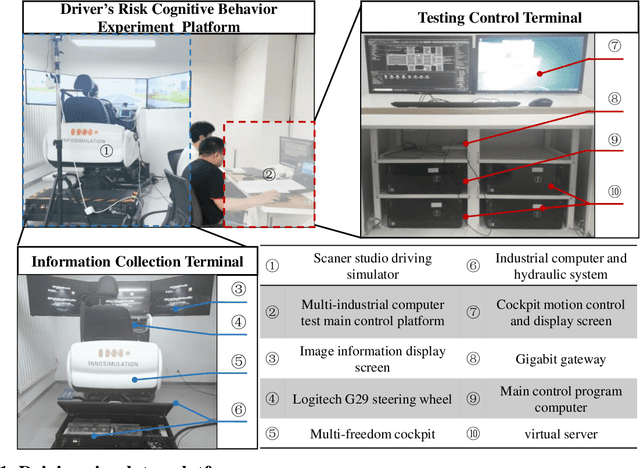
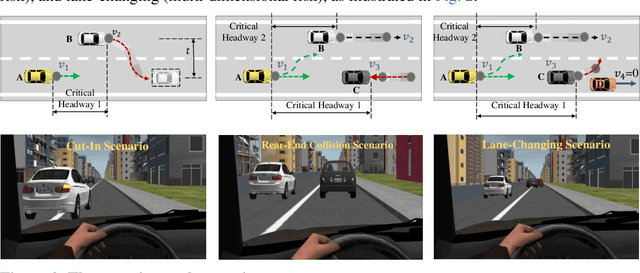
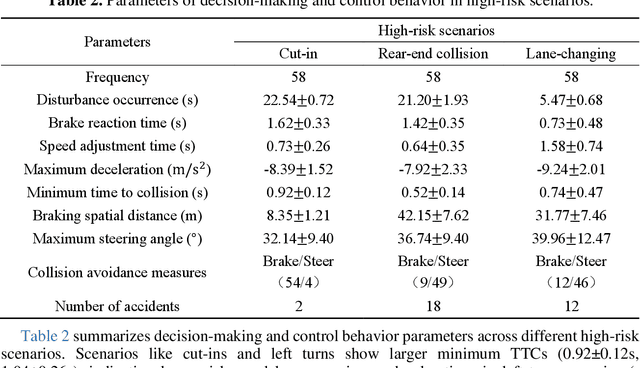
Ensuring safe interactions between autonomous vehicles (AVs) and human drivers in mixed traffic systems remains a major challenge, particularly in complex, high-risk scenarios. This paper presents a cognition-decision framework that integrates individual variability and commonalities in driver behavior to quantify risk cognition and model dynamic decision-making. First, a risk sensitivity model based on a multivariate Gaussian distribution is developed to characterize individual differences in risk cognition. Then, a cognitive decision-making model based on the drift diffusion model (DDM) is introduced to capture common decision-making mechanisms in high-risk environments. The DDM dynamically adjusts decision thresholds by integrating initial bias, drift rate, and boundary parameters, adapting to variations in speed, relative distance, and risk sensitivity to reflect diverse driving styles and risk preferences. By simulating high-risk scenarios with lateral, longitudinal, and multidimensional risk sources in a driving simulator, the proposed model accurately predicts cognitive responses and decision behaviors during emergency maneuvers. Specifically, by incorporating driver-specific risk sensitivity, the model enables dynamic adjustments of key DDM parameters, allowing for personalized decision-making representations in diverse scenarios. Comparative analysis with IDM, Gipps, and MOBIL demonstrates that DDM more precisely captures human cognitive processes and adaptive decision-making in high-risk scenarios. These findings provide a theoretical basis for modeling human driving behavior and offer critical insights for enhancing AV-human interaction in real-world traffic environments.
InVDriver: Intra-Instance Aware Vectorized Query-Based Autonomous Driving Transformer
Feb 25, 2025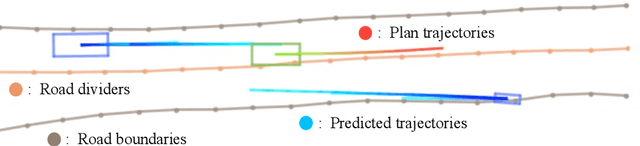
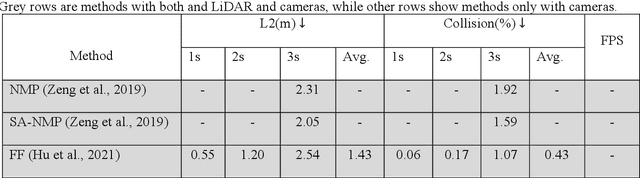
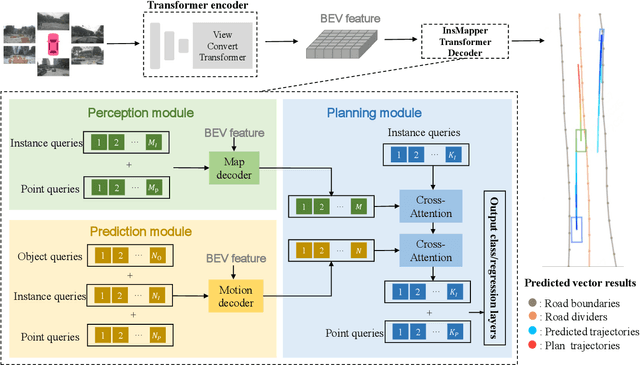
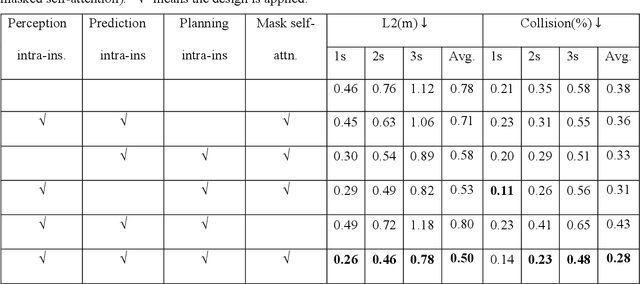
End-to-end autonomous driving with its holistic optimization capabilities, has gained increasing traction in academia and industry. Vectorized representations, which preserve instance-level topological information while reducing computational overhead, have emerged as a promising paradigm. While existing vectorized query-based frameworks often overlook the inherent spatial correlations among intra-instance points, resulting in geometrically inconsistent outputs (e.g., fragmented HD map elements or oscillatory trajectories). To address these limitations, we propose InVDriver, a novel vectorized query-based system that systematically models intra-instance spatial dependencies through masked self-attention layers, thereby enhancing planning accuracy and trajectory smoothness. Across all core modules, i.e., perception, prediction, and planning, InVDriver incorporates masked self-attention mechanisms that restrict attention to intra-instance point interactions, enabling coordinated refinement of structural elements while suppressing irrelevant inter-instance noise. Experimental results on the nuScenes benchmark demonstrate that InVDriver achieves state-of-the-art performance, surpassing prior methods in both accuracy and safety, while maintaining high computational efficiency. Our work validates that explicit modeling of intra-instance geometric coherence is critical for advancing vectorized autonomous driving systems, bridging the gap between theoretical advantages of end-to-end frameworks and practical deployment requirements.