 Add to Chrome
 Add to Firefox
 Add to Edge
AstraNav-Memory: Contexts Compression for Long Memory
Dec 25, 2025
Lifelong embodied navigation requires agents to accumulate, retain, and exploit spatial-semantic experience across tasks, enabling efficient exploration in novel environments and rapid goal reaching in familiar ones. While object-centric memory is interpretable, it depends on detection and reconstruction pipelines that limit robustness and scalability. We propose an image-centric memory framework that achieves long-term implicit memory via an efficient visual context compression module end-to-end coupled with a Qwen2.5-VL-based navigation policy. Built atop a ViT backbone with frozen DINOv3 features and lightweight PixelUnshuffle+Conv blocks, our visual tokenizer supports configurable compression rates; for example, under a representative 16$\times$ compression setting, each image is encoded with about 30 tokens, expanding the effective context capacity from tens to hundreds of images. Experimental results on GOAT-Bench and HM3D-OVON show that our method achieves state-of-the-art navigation performance, improving exploration in unfamiliar environments and shortening paths in familiar ones. Ablation studies further reveal that moderate compression provides the best balance between efficiency and accuracy. These findings position compressed image-centric memory as a practical and scalable interface for lifelong embodied agents, enabling them to reason over long visual histories and navigate with human-like efficiency.

Mitigating Behavioral Hallucination in Multimodal Large Language Models for Sequential Images
Jun 08, 2025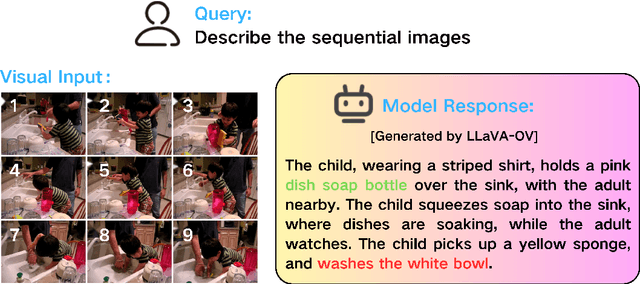
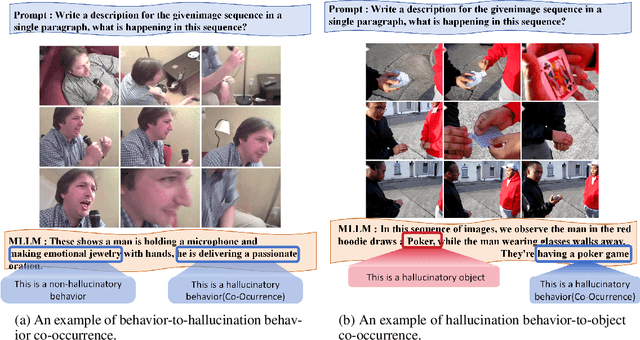
While multimodal large language models excel at various tasks, they still suffer from hallucinations, which limit their reliability and scalability for broader domain applications. To address this issue, recent research mainly focuses on objective hallucination. However, for sequential images, besides objective hallucination, there is also behavioral hallucination, which is less studied. This work aims to fill in the gap. We first reveal that behavioral hallucinations mainly arise from two key factors: prior-driven bias and the snowball effect. Based on these observations, we introduce SHE (Sequence Hallucination Eradication), a lightweight, two-stage framework that (1) detects hallucinations via visual-textual alignment check using our proposed adaptive temporal window and (2) mitigates them via orthogonal projection onto the joint embedding space. We also propose a new metric (BEACH) to quantify behavioral hallucination severity. Empirical results on standard benchmarks demonstrate that SHE reduces behavioral hallucination by over 10% on BEACH while maintaining descriptive accuracy.