 Add to Chrome
 Add to Firefox
 Add to Edge
Long-Context Inference with Retrieval-Augmented Speculative Decoding
Feb 27, 2025
The emergence of long-context large language models (LLMs) offers a promising alternative to traditional retrieval-augmented generation (RAG) for processing extensive documents. However, the computational overhead of long-context inference, particularly in managing key-value (KV) caches, presents significant efficiency challenges. While Speculative Decoding (SD) traditionally accelerates inference using smaller draft models, its effectiveness diminishes substantially in long-context scenarios due to memory-bound KV cache operations. We present Retrieval-Augmented Speculative Decoding (RAPID), which leverages RAG for both accelerating and enhancing generation quality in long-context inference. RAPID introduces the RAG drafter-a draft LLM operating on shortened retrieval contexts-to speculate on the generation of long-context target LLMs. Our approach enables a new paradigm where same-scale or even larger LLMs can serve as RAG drafters while maintaining computational efficiency. To fully leverage the potentially superior capabilities from stronger RAG drafters, we develop an inference-time knowledge transfer dynamic that enriches the target distribution by RAG. Extensive experiments on the LLaMA-3.1 and Qwen2.5 backbones demonstrate that RAPID effectively integrates the strengths of both approaches, achieving significant performance improvements (e.g., from 39.33 to 42.83 on InfiniteBench for LLaMA-3.1-8B) with more than 2x speedups. Our analyses reveal that RAPID achieves robust acceleration beyond 32K context length and demonstrates superior generation quality in real-world applications.

InternVQA: Advancing Compressed Video Quality Assessment with Distilling Large Foundation Model
Feb 26, 2025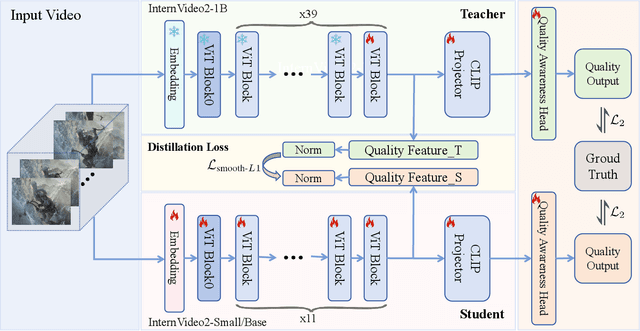
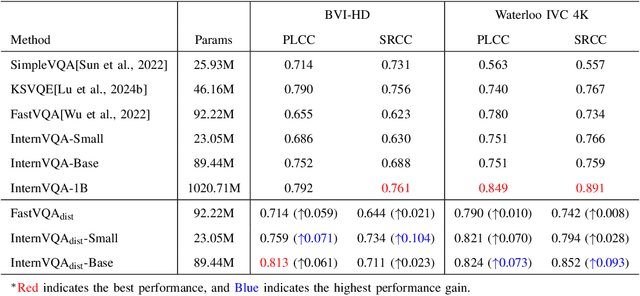
Video quality assessment tasks rely heavily on the rich features required for video understanding, such as semantic information, texture, and temporal motion. The existing video foundational model, InternVideo2, has demonstrated strong potential in video understanding tasks due to its large parameter size and large-scale multimodal data pertaining. Building on this, we explored the transferability of InternVideo2 to video quality assessment under compression scenarios. To design a lightweight model suitable for this task, we proposed a distillation method to equip the smaller model with rich compression quality priors. Additionally, we examined the performance of different backbones during the distillation process. The results showed that, compared to other methods, our lightweight model distilled from InternVideo2 achieved excellent performance in compression video quality assessment.
Citrus: Leveraging Expert Cognitive Pathways in a Medical Language Model for Advanced Medical Decision Support
Feb 26, 2025Large language models (LLMs), particularly those with reasoning capabilities, have rapidly advanced in recent years, demonstrating significant potential across a wide range of applications. However, their deployment in healthcare, especially in disease reasoning tasks, is hindered by the challenge of acquiring expert-level cognitive data. In this paper, we introduce Citrus, a medical language model that bridges the gap between clinical expertise and AI reasoning by emulating the cognitive processes of medical experts. The model is trained on a large corpus of simulated expert disease reasoning data, synthesized using a novel approach that accurately captures the decision-making pathways of clinicians. This approach enables Citrus to better simulate the complex reasoning processes involved in diagnosing and treating medical conditions. To further address the lack of publicly available datasets for medical reasoning tasks, we release the last-stage training data, including a custom-built medical diagnostic dialogue dataset. This open-source contribution aims to support further research and development in the field. Evaluations using authoritative benchmarks such as MedQA, covering tasks in medical reasoning and language understanding, show that Citrus achieves superior performance compared to other models of similar size. These results highlight Citrus potential to significantly enhance medical decision support systems, providing a more accurate and efficient tool for clinical decision-making.
Easy-Poly: A Easy Polyhedral Framework For 3D Multi-Object Tracking
Feb 26, 2025Recent advancements in 3D multi-object tracking (3D MOT) have predominantly relied on tracking-by-detection pipelines. However, these approaches often neglect potential enhancements in 3D detection processes, leading to high false positives (FP), missed detections (FN), and identity switches (IDS), particularly in challenging scenarios such as crowded scenes, small-object configurations, and adverse weather conditions. Furthermore, limitations in data preprocessing, association mechanisms, motion modeling, and life-cycle management hinder overall tracking robustness. To address these issues, we present Easy-Poly, a real-time, filter-based 3D MOT framework for multiple object categories. Our contributions include: (1) An Augmented Proposal Generator utilizing multi-modal data augmentation and refined SpConv operations, significantly improving mAP and NDS on nuScenes; (2) A Dynamic Track-Oriented (DTO) data association algorithm that effectively manages uncertainties and occlusions through optimal assignment and multiple hypothesis handling; (3) A Dynamic Motion Modeling (DMM) incorporating a confidence-weighted Kalman filter and adaptive noise covariances, enhancing MOTA and AMOTA in challenging conditions; and (4) An extended life-cycle management system with adjustive thresholds to reduce ID switches and false terminations. Experimental results show that Easy-Poly outperforms state-of-the-art methods such as Poly-MOT and Fast-Poly, achieving notable gains in mAP (e.g., from 63.30% to 64.96% with LargeKernel3D) and AMOTA (e.g., from 73.1% to 74.5%), while also running in real-time. These findings highlight Easy-Poly's adaptability and robustness in diverse scenarios, making it a compelling choice for autonomous driving and related 3D MOT applications. The source code of this paper will be published upon acceptance.
EyeBench: A Call for More Rigorous Evaluation of Retinal Image Enhancement
Feb 20, 2025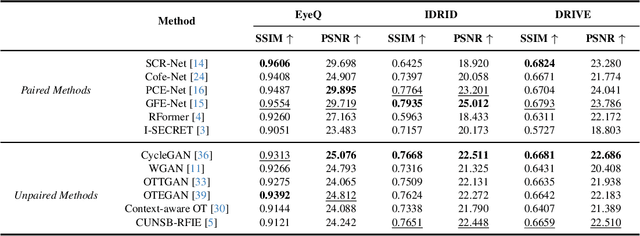
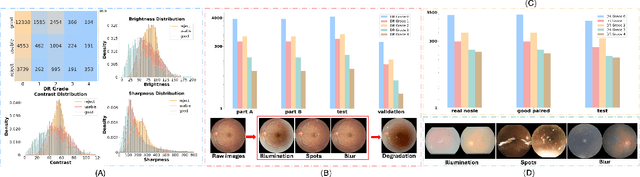
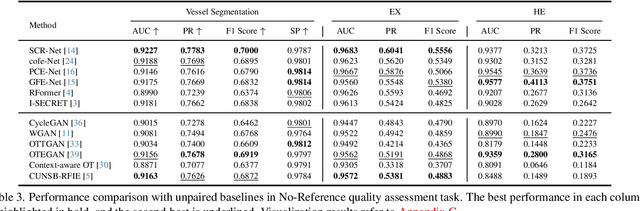

Over the past decade, generative models have achieved significant success in enhancement fundus images.However, the evaluation of these models still presents a considerable challenge. A comprehensive evaluation benchmark for fundus image enhancement is indispensable for three main reasons: 1) The existing denoising metrics (e.g., PSNR, SSIM) are hardly to extend to downstream real-world clinical research (e.g., Vessel morphology consistency). 2) There is a lack of comprehensive evaluation for both paired and unpaired enhancement methods, along with the need for expert protocols to accurately assess clinical value. 3) An ideal evaluation system should provide insights to inform future developments of fundus image enhancement. To this end, we propose a novel comprehensive benchmark, EyeBench, to provide insights that align enhancement models with clinical needs, offering a foundation for future work to improve the clinical relevance and applicability of generative models for fundus image enhancement. EyeBench has three appealing properties: 1) multi-dimensional clinical alignment downstream evaluation: In addition to evaluating the enhancement task, we provide several clinically significant downstream tasks for fundus images, including vessel segmentation, DR grading, denoising generalization, and lesion segmentation. 2) Medical expert-guided evaluation design: We introduce a novel dataset that promote comprehensive and fair comparisons between paired and unpaired methods and includes a manual evaluation protocol by medical experts. 3) Valuable insights: Our benchmark study provides a comprehensive and rigorous evaluation of existing methods across different downstream tasks, assisting medical experts in making informed choices. Additionally, we offer further analysis of the challenges faced by existing methods. The code is available at \url{https://github.com/Retinal-Research/EyeBench}
LongPO: Long Context Self-Evolution of Large Language Models through Short-to-Long Preference Optimization
Feb 20, 2025Large Language Models (LLMs) have demonstrated remarkable capabilities through pretraining and alignment. However, superior short-context LLMs may underperform in long-context scenarios due to insufficient long-context alignment. This alignment process remains challenging due to the impracticality of human annotation for extended contexts and the difficulty in balancing short- and long-context performance. To address these challenges, we introduce LongPO, that enables short-context LLMs to self-evolve to excel on long-context tasks by internally transferring short-context capabilities. LongPO harnesses LLMs to learn from self-generated short-to-long preference data, comprising paired responses generated for identical instructions with long-context inputs and their compressed short-context counterparts, respectively. This preference reveals capabilities and potentials of LLMs cultivated during short-context alignment that may be diminished in under-aligned long-context scenarios. Additionally, LongPO incorporates a short-to-long KL constraint to mitigate short-context performance decline during long-context alignment. When applied to Mistral-7B-Instruct-v0.2 from 128K to 512K context lengths, LongPO fully retains short-context performance and largely outperforms naive SFT and DPO in both long- and short-context tasks. Specifically, LongPO-trained models can achieve results on long-context benchmarks comparable to, or even surpassing, those of superior LLMs (e.g., GPT-4-128K) that involve extensive long-context annotation and larger parameter scales. Our code is available at https://github.com/DAMO-NLP-SG/LongPO.
LSR-Adapt: Ultra-Efficient Parameter Tuning with Matrix Low Separation Rank Kernel Adaptation
Feb 19, 2025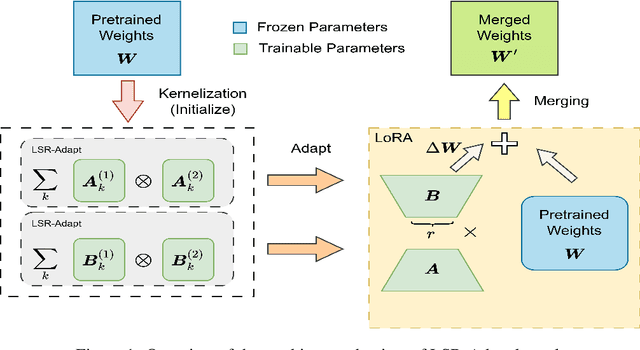
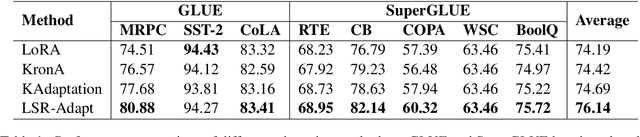
Imposing an effective structural assumption on neural network weight matrices has been the major paradigm for designing Parameter-Efficient Fine-Tuning (PEFT) systems for adapting modern large pre-trained models to various downstream tasks. However, low rank based adaptation has become increasingly challenging due to the sheer scale of modern large language models. In this paper, we propose an effective kernelization to further reduce the number of parameters required for adaptation tasks. Specifically, from the classical idea in numerical analysis regarding matrix Low-Separation-Rank (LSR) representations, we develop a kernel using this representation for the low rank adapter matrices of the linear layers from large networks, named the Low Separation Rank Adaptation (LSR-Adapt) kernel. With the ultra-efficient kernel representation of the low rank adapter matrices, we manage to achieve state-of-the-art performance with even higher accuracy with almost half the number of parameters as compared to conventional low rank based methods. This structural assumption also opens the door to further GPU-side optimizations due to the highly parallelizable nature of Kronecker computations.
Unraveling the Localized Latents: Learning Stratified Manifold Structures in LLM Embedding Space with Sparse Mixture-of-Experts
Feb 19, 2025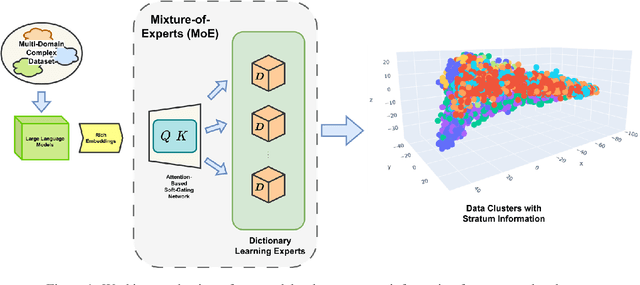
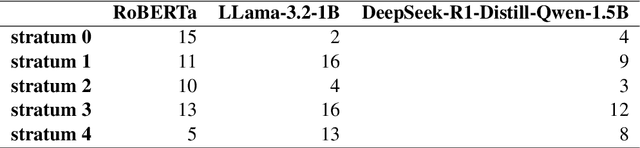
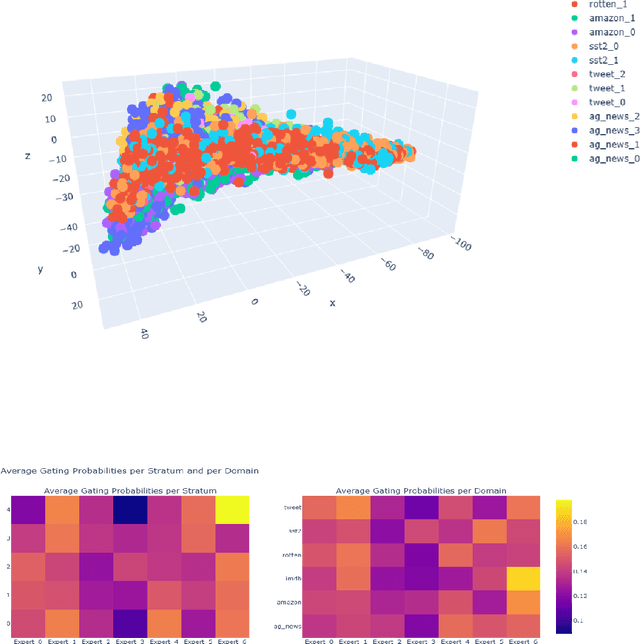
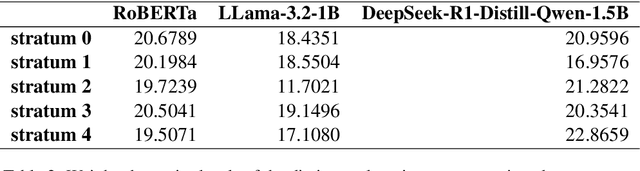
However, real-world data often exhibit complex local structures that can be challenging for single-model approaches with a smooth global manifold in the embedding space to unravel. In this work, we conjecture that in the latent space of these large language models, the embeddings live in a local manifold structure with different dimensions depending on the perplexities and domains of the input data, commonly referred to as a Stratified Manifold structure, which in combination form a structured space known as a Stratified Space. To investigate the validity of this structural claim, we propose an analysis framework based on a Mixture-of-Experts (MoE) model where each expert is implemented with a simple dictionary learning algorithm at varying sparsity levels. By incorporating an attention-based soft-gating network, we verify that our model learns specialized sub-manifolds for an ensemble of input data sources, reflecting the semantic stratification in LLM embedding space. We further analyze the intrinsic dimensions of these stratified sub-manifolds and present extensive statistics on expert assignments, gating entropy, and inter-expert distances. Our experimental results demonstrate that our method not only validates the claim of a stratified manifold structure in the LLM embedding space, but also provides interpretable clusters that align with the intrinsic semantic variations of the input data.
Cross-Domain Continual Learning for Edge Intelligence in Wireless ISAC Networks
Feb 18, 2025In wireless networks with integrated sensing and communications (ISAC), edge intelligence (EI) is expected to be developed at edge devices (ED) for sensing user activities based on channel state information (CSI). However, due to the CSI being highly specific to users' characteristics, the CSI-activity relationship is notoriously domain dependent, essentially demanding EI to learn sufficient datasets from various domains in order to gain cross-domain sensing capability. This poses a crucial challenge owing to the EDs' limited resources, for which storing datasets across all domains will be a significant burden. In this paper, we propose the EdgeCL framework, enabling the EI to continually learn-then-discard each incoming dataset, while remaining resilient to catastrophic forgetting. We design a transformer-based discriminator for handling sequences of noisy and nonequispaced CSI samples. Besides, we propose a distilled core-set based knowledge retention method with robustness-enhanced optimization to train the discriminator, preserving its performance for previous domains while preventing future forgetting. Experimental evaluations show that EdgeCL achieves 89% of performance compared to cumulative training while consuming only 3% of its memory, mitigating forgetting by 79%.
Complex Physics-Informed Neural Network
Feb 07, 2025We propose compleX-PINN, a novel physics-informed neural network (PINN) architecture that incorporates a learnable activation function inspired by Cauchy integral theorem. By learning the parameters of the activation function, compleX-PINN achieves high accuracy with just a single hidden layer. Empirical results show that compleX-PINN effectively solves problems where traditional PINNs struggle and consistently delivers significantly higher precision, often by an order of magnitude.