 Add to Chrome
 Add to Firefox
 Add to Edge
Unleashing the Power of Task-Specific Directions in Parameter Efficient Fine-tuning
Sep 02, 2024
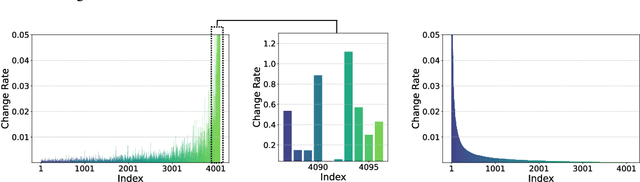
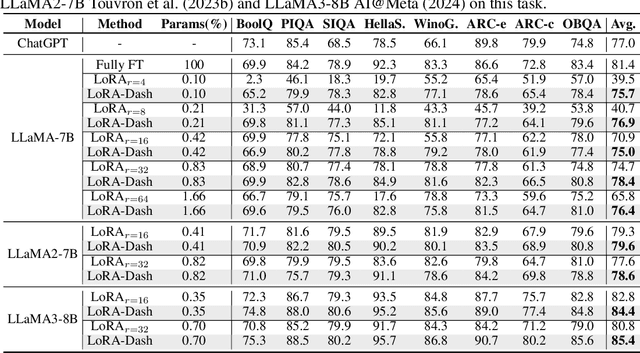
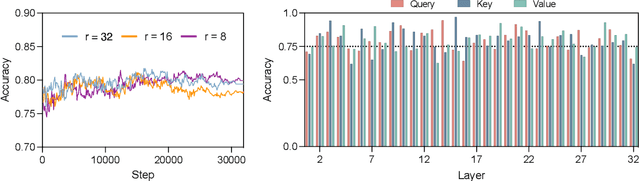

Large language models demonstrate impressive performance on downstream tasks, yet requiring extensive resource consumption when fully fine-tuning all parameters. To mitigate this, Parameter Efficient Fine-Tuning (PEFT) strategies, such as LoRA, have been developed. In this paper, we delve into the concept of task-specific directions--critical for transitioning large models from pre-trained states to task-specific enhancements in PEFT. We propose a framework to clearly define these directions and explore their properties, and practical utilization challenges. We then introduce a novel approach, LoRA-Dash, which aims to maximize the impact of task-specific directions during the fine-tuning process, thereby enhancing model performance on targeted tasks. Extensive experiments have conclusively demonstrated the effectiveness of LoRA-Dash, and in-depth analyses further reveal the underlying mechanisms of LoRA-Dash. The code is available at https://github.com/Chongjie-Si/Subspace-Tuning.

Dynamic Scene Understanding through Object-Centric Voxelization and Neural Rendering
Jul 30, 2024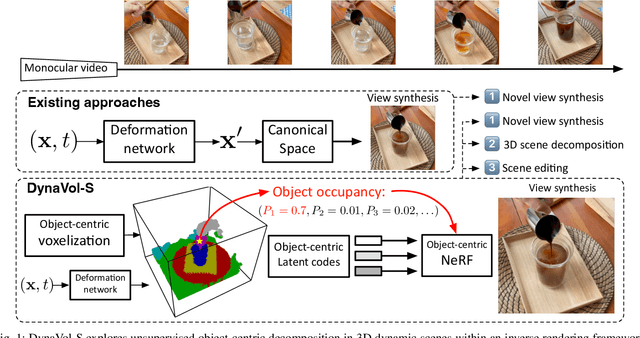


Learning object-centric representations from unsupervised videos is challenging. Unlike most previous approaches that focus on decomposing 2D images, we present a 3D generative model named DynaVol-S for dynamic scenes that enables object-centric learning within a differentiable volume rendering framework. The key idea is to perform object-centric voxelization to capture the 3D nature of the scene, which infers per-object occupancy probabilities at individual spatial locations. These voxel features evolve through a canonical-space deformation function and are optimized in an inverse rendering pipeline with a compositional NeRF. Additionally, our approach integrates 2D semantic features to create 3D semantic grids, representing the scene through multiple disentangled voxel grids. DynaVol-S significantly outperforms existing models in both novel view synthesis and unsupervised decomposition tasks for dynamic scenes. By jointly considering geometric structures and semantic features, it effectively addresses challenging real-world scenarios involving complex object interactions. Furthermore, once trained, the explicitly meaningful voxel features enable additional capabilities that 2D scene decomposition methods cannot achieve, such as novel scene generation through editing geometric shapes or manipulating the motion trajectories of objects.
SaccadeDet: A Novel Dual-Stage Architecture for Rapid and Accurate Detection in Gigapixel Images
Jul 25, 2024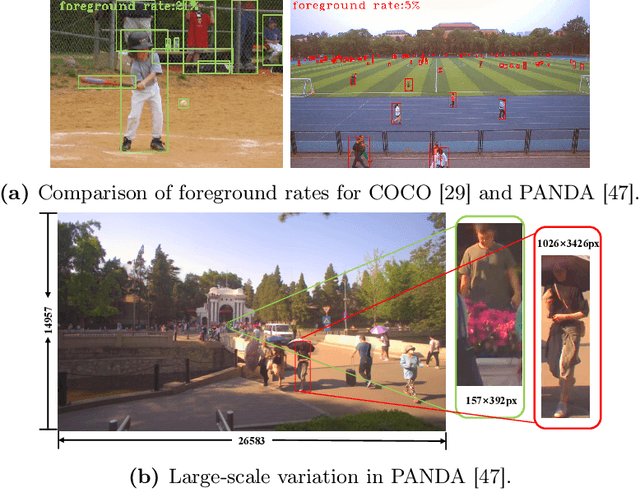
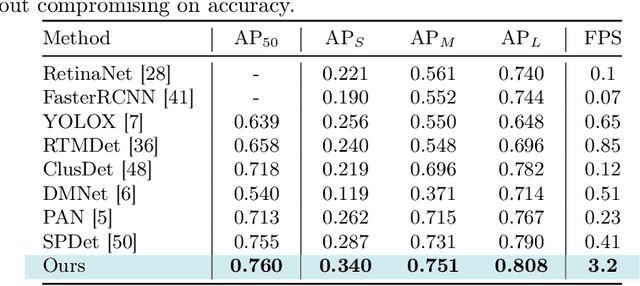
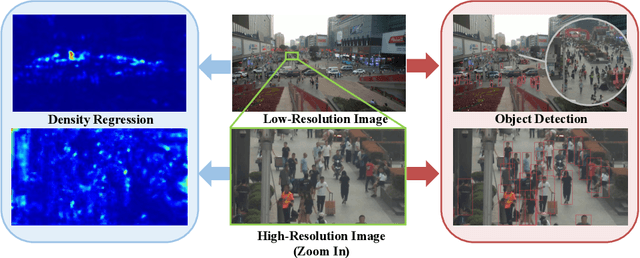
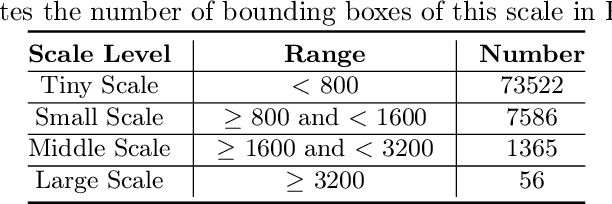
The advancement of deep learning in object detection has predominantly focused on megapixel images, leaving a critical gap in the efficient processing of gigapixel images. These super high-resolution images present unique challenges due to their immense size and computational demands. To address this, we introduce 'SaccadeDet', an innovative architecture for gigapixel-level object detection, inspired by the human eye saccadic movement. The cornerstone of SaccadeDet is its ability to strategically select and process image regions, dramatically reducing computational load. This is achieved through a two-stage process: the 'saccade' stage, which identifies regions of probable interest, and the 'gaze' stage, which refines detection in these targeted areas. Our approach, evaluated on the PANDA dataset, not only achieves an 8x speed increase over the state-of-the-art methods but also demonstrates significant potential in gigapixel-level pathology analysis through its application to Whole Slide Imaging.
* This paper is accepted to ECML-PKDD 2024
Text-Augmented Multimodal LLMs for Chemical Reaction Condition Recommendation
Jul 21, 2024High-throughput reaction condition (RC) screening is fundamental to chemical synthesis. However, current RC screening suffers from laborious and costly trial-and-error workflows. Traditional computer-aided synthesis planning (CASP) tools fail to find suitable RCs due to data sparsity and inadequate reaction representations. Nowadays, large language models (LLMs) are capable of tackling chemistry-related problems, such as molecule design, and chemical logic Q\&A tasks. However, LLMs have not yet achieved accurate predictions of chemical reaction conditions. Here, we present MM-RCR, a text-augmented multimodal LLM that learns a unified reaction representation from SMILES, reaction graphs, and textual corpus for chemical reaction recommendation (RCR). To train MM-RCR, we construct 1.2 million pair-wised Q\&A instruction datasets. Our experimental results demonstrate that MM-RCR achieves state-of-the-art performance on two open benchmark datasets and exhibits strong generalization capabilities on out-of-domain (OOD) and High-Throughput Experimentation (HTE) datasets. MM-RCR has the potential to accelerate high-throughput condition screening in chemical synthesis.
LinSATNet: The Positive Linear Satisfiability Neural Networks
Jul 18, 2024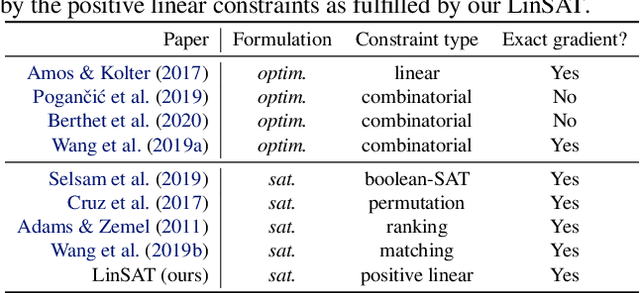
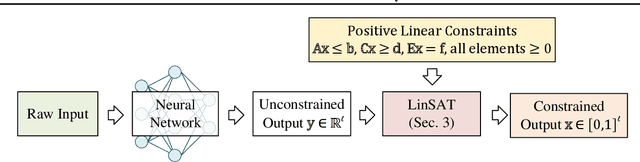
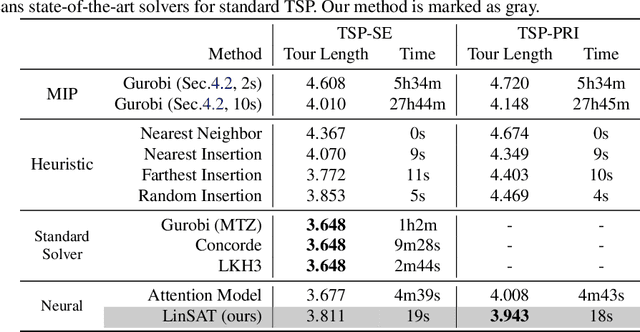
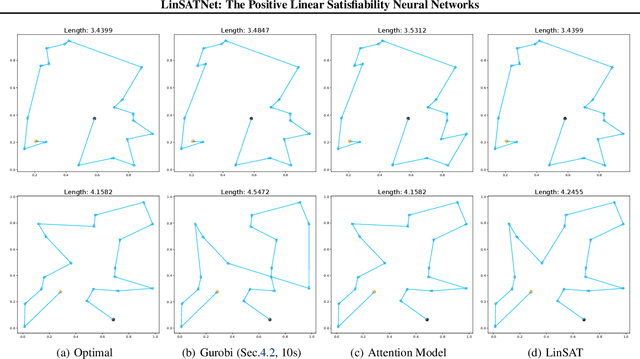
Encoding constraints into neural networks is attractive. This paper studies how to introduce the popular positive linear satisfiability to neural networks. We propose the first differentiable satisfiability layer based on an extension of the classic Sinkhorn algorithm for jointly encoding multiple sets of marginal distributions. We further theoretically characterize the convergence property of the Sinkhorn algorithm for multiple marginals. In contrast to the sequential decision e.g.\ reinforcement learning-based solvers, we showcase our technique in solving constrained (specifically satisfiability) problems by one-shot neural networks, including i) a neural routing solver learned without supervision of optimal solutions; ii) a partial graph matching network handling graphs with unmatchable outliers on both sides; iii) a predictive network for financial portfolios with continuous constraints. To our knowledge, there exists no one-shot neural solver for these scenarios when they are formulated as satisfiability problems. Source code is available at https://github.com/Thinklab-SJTU/LinSATNet
HIMO: A New Benchmark for Full-Body Human Interacting with Multiple Objects
Jul 17, 2024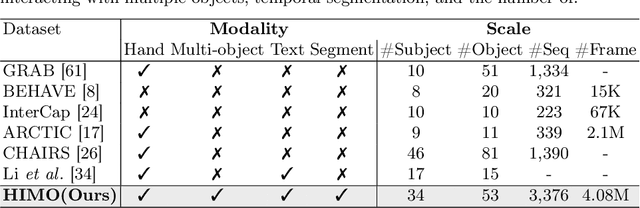

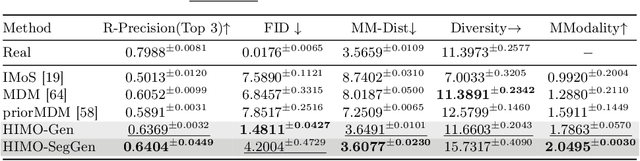

Generating human-object interactions (HOIs) is critical with the tremendous advances of digital avatars. Existing datasets are typically limited to humans interacting with a single object while neglecting the ubiquitous manipulation of multiple objects. Thus, we propose HIMO, a large-scale MoCap dataset of full-body human interacting with multiple objects, containing 3.3K 4D HOI sequences and 4.08M 3D HOI frames. We also annotate HIMO with detailed textual descriptions and temporal segments, benchmarking two novel tasks of HOI synthesis conditioned on either the whole text prompt or the segmented text prompts as fine-grained timeline control. To address these novel tasks, we propose a dual-branch conditional diffusion model with a mutual interaction module for HOI synthesis. Besides, an auto-regressive generation pipeline is also designed to obtain smooth transitions between HOI segments. Experimental results demonstrate the generalization ability to unseen object geometries and temporal compositions.
PosFormer: Recognizing Complex Handwritten Mathematical Expression with Position Forest Transformer
Jul 10, 2024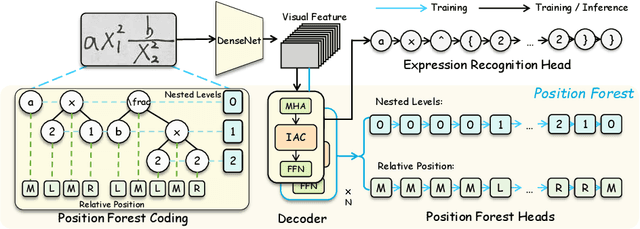
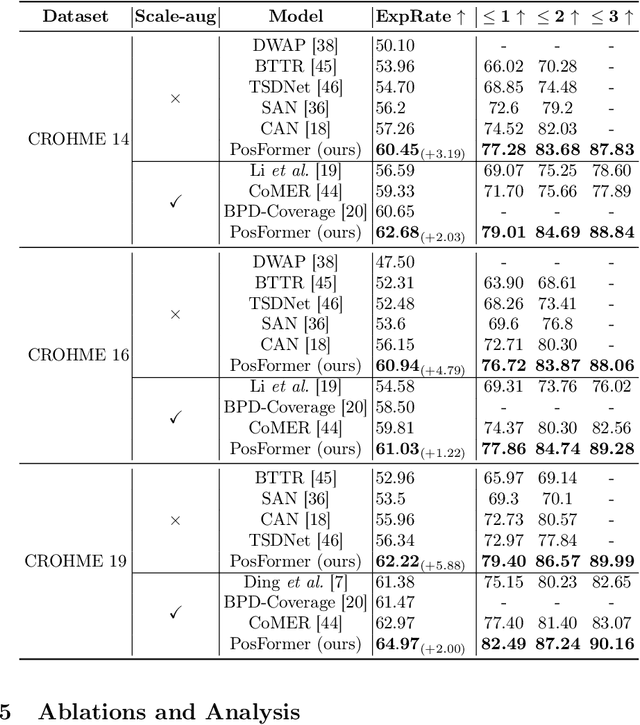
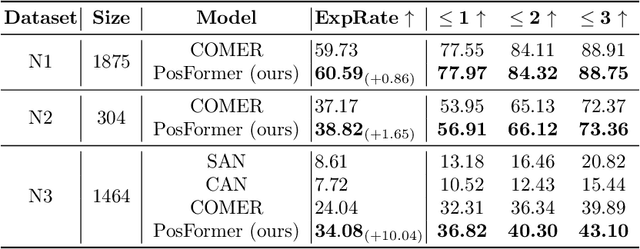

Handwritten Mathematical Expression Recognition (HMER) has wide applications in human-machine interaction scenarios, such as digitized education and automated offices. Recently, sequence-based models with encoder-decoder architectures have been commonly adopted to address this task by directly predicting LaTeX sequences of expression images. However, these methods only implicitly learn the syntax rules provided by LaTeX, which may fail to describe the position and hierarchical relationship between symbols due to complex structural relations and diverse handwriting styles. To overcome this challenge, we propose a position forest transformer (PosFormer) for HMER, which jointly optimizes two tasks: expression recognition and position recognition, to explicitly enable position-aware symbol feature representation learning. Specifically, we first design a position forest that models the mathematical expression as a forest structure and parses the relative position relationships between symbols. Without requiring extra annotations, each symbol is assigned a position identifier in the forest to denote its relative spatial position. Second, we propose an implicit attention correction module to accurately capture attention for HMER in the sequence-based decoder architecture. Extensive experiments validate the superiority of PosFormer, which consistently outperforms the state-of-the-art methods 2.03%/1.22%/2.00%, 1.83%, and 4.62% gains on the single-line CROHME 2014/2016/2019, multi-line M2E, and complex MNE datasets, respectively, with no additional latency or computational cost. Code is available at https://github.com/SJTU-DeepVisionLab/PosFormer.
Multi-times Monte Carlo Rendering for Inter-reflection Reconstruction
Jul 08, 2024Inverse rendering methods have achieved remarkable performance in reconstructing high-fidelity 3D objects with disentangled geometries, materials, and environmental light. However, they still face huge challenges in reflective surface reconstruction. Although recent methods model the light trace to learn specularity, the ignorance of indirect illumination makes it hard to handle inter-reflections among multiple smooth objects. In this work, we propose Ref-MC2 that introduces the multi-time Monte Carlo sampling which comprehensively computes the environmental illumination and meanwhile considers the reflective light from object surfaces. To address the computation challenge as the times of Monte Carlo sampling grow, we propose a specularity-adaptive sampling strategy, significantly reducing the computational complexity. Besides the computational resource, higher geometry accuracy is also required because geometric errors accumulate multiple times. Therefore, we further introduce a reflection-aware surface model to initialize the geometry and refine it during inverse rendering. We construct a challenging dataset containing scenes with multiple objects and inter-reflections. Experiments show that our method outperforms other inverse rendering methods on various object groups. We also show downstream applications, e.g., relighting and material editing, to illustrate the disentanglement ability of our method.
See Further for Parameter Efficient Fine-tuning by Standing on the Shoulders of Decomposition
Jul 07, 2024The rapid expansion of large foundation models within the pre-training and fine-tuning framework has underscored that larger models often yield better results. However, the scaling up of large foundation models has led to soaring costs in fine-tuning and parameter storage, rendering extensive adaptations impractical. This challenge has sparked the development of parameter-efficient fine-tuning (PEFT), which focuses on optimizing a select subset of parameters while keeping the rest fixed, significantly lowering computational and storage overheads. While recent years have witnessed a significant success in PEFT, a deep understanding of the fundamental principles behind these methods remains unexplored. To this end, here we take the first step to unify all approaches by dissecting them from a decomposition perspective. We initiate a comprehensive mathematical analysis of these methods, allowing us to delve deeply into their underlying mechanisms, and we explore the reasons behind the variations in performance among different techniques. Furthermore, inspired by our theoretical analysis, we introduce two novel PEFT methods alongside a simple yet effective framework designed to enhance the performance of PEFT techniques across various applications. Our empirical validations, conducted across multiple datasets, demonstrate the efficacy of these methods, showcasing both theoretical validity and practical performance improvements under the guidance of our analytical findings. We believe our work will deepen researchers' understanding of PEFT and other techniques, prompting further contemplation and advancing the research across the whole community.
Latent Intuitive Physics: Learning to Transfer Hidden Physics from A 3D Video
Jun 18, 2024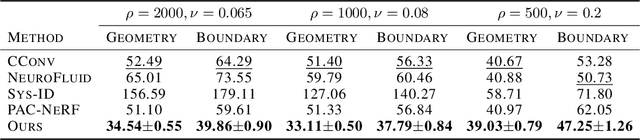
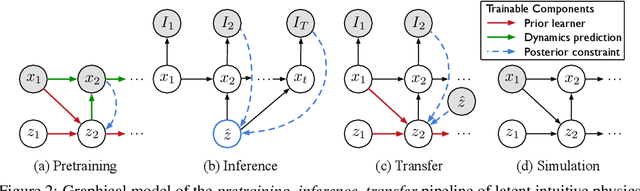
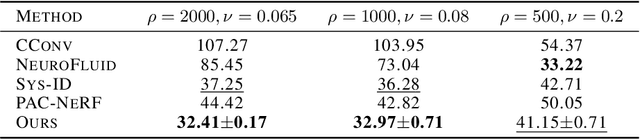
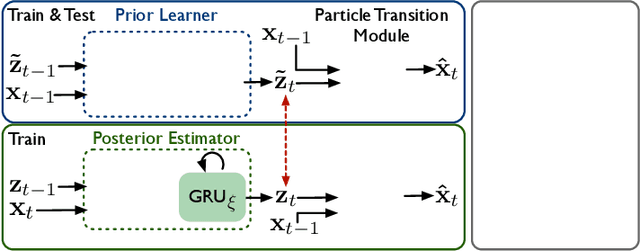
We introduce latent intuitive physics, a transfer learning framework for physics simulation that can infer hidden properties of fluids from a single 3D video and simulate the observed fluid in novel scenes. Our key insight is to use latent features drawn from a learnable prior distribution conditioned on the underlying particle states to capture the invisible and complex physical properties. To achieve this, we train a parametrized prior learner given visual observations to approximate the visual posterior of inverse graphics, and both the particle states and the visual posterior are obtained from a learned neural renderer. The converged prior learner is embedded in our probabilistic physics engine, allowing us to perform novel simulations on unseen geometries, boundaries, and dynamics without knowledge of the true physical parameters. We validate our model in three ways: (i) novel scene simulation with the learned visual-world physics, (ii) future prediction of the observed fluid dynamics, and (iii) supervised particle simulation. Our model demonstrates strong performance in all three tasks.
* Published as a conference paper at ICLR 2024