 Add to Chrome
 Add to Firefox
 Add to Edge
Inter-X++: A Comprehensive Benchmark for Multimodal Human-Human Interaction Analysis
Aug 20, 2026
The capability to perceive and synthesize human-human interactions is fundamental to developing intelligent digital human systems. However, existing datasets and modeling approaches are fundamentally constrained by low-fidelity kinematics, the omission of dexterous hand gestures and a severe lack of rich multimodal annotations. Furthermore, fragmented interaction representations and inconsistent evaluation protocols also impede fair and rigorous benchmarking. To systematically address these bottlenecks, we present Inter-X++, a comprehensive and large-scale benchmark designed to empower versatile HHI analysis. Captured via a novel hybrid motion capture system, Inter-X++ provides 11,388 high-fidelity interaction sequences and over 8.1M frames, featuring precise whole-body movements and detailed finger articulations. Meanwhile, we enrich the data foundation with multifaceted annotations, including hierarchical fine-grained textual descriptions, interaction categories, causal interaction orders, the relationship and personality of the subjects, as well as vertex-level contact maps and physically regularized constraints. Leveraging these elaborate annotations, we formulate a unified testing ground comprising four categories of downstream tasks that symmetrically span both generative and perceptive paradigms. To eliminate benchmarking ambiguities, we systematically standardize the interaction representations and evaluation protocols. Finally, we go beyond dataset construction to propose OpenHHI, a single and unified HHI representation and modeling framework that jointly optimizes interaction reconstruction and semantic understanding. Extensive experiments reveal that OpenHHI achieves state-of-the-art performance on both generation and perception tasks. This definitively proves that our unified representation successfully bridges interaction understanding and generation simultaneously.

HIMO: A New Benchmark for Full-Body Human Interacting with Multiple Objects
Jul 17, 2024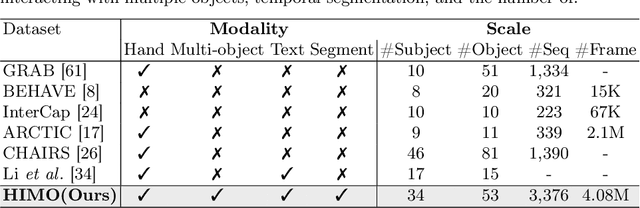

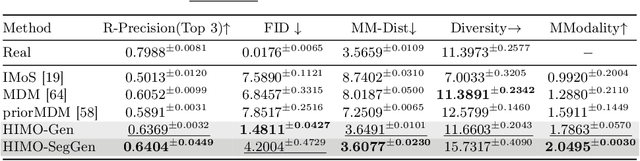

Generating human-object interactions (HOIs) is critical with the tremendous advances of digital avatars. Existing datasets are typically limited to humans interacting with a single object while neglecting the ubiquitous manipulation of multiple objects. Thus, we propose HIMO, a large-scale MoCap dataset of full-body human interacting with multiple objects, containing 3.3K 4D HOI sequences and 4.08M 3D HOI frames. We also annotate HIMO with detailed textual descriptions and temporal segments, benchmarking two novel tasks of HOI synthesis conditioned on either the whole text prompt or the segmented text prompts as fine-grained timeline control. To address these novel tasks, we propose a dual-branch conditional diffusion model with a mutual interaction module for HOI synthesis. Besides, an auto-regressive generation pipeline is also designed to obtain smooth transitions between HOI segments. Experimental results demonstrate the generalization ability to unseen object geometries and temporal compositions.
Inter-X: Towards Versatile Human-Human Interaction Analysis
Dec 26, 2023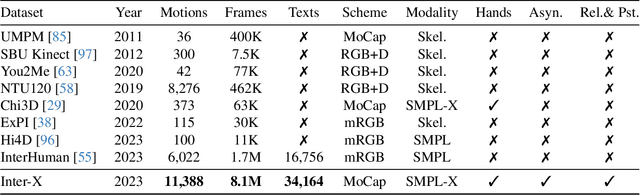
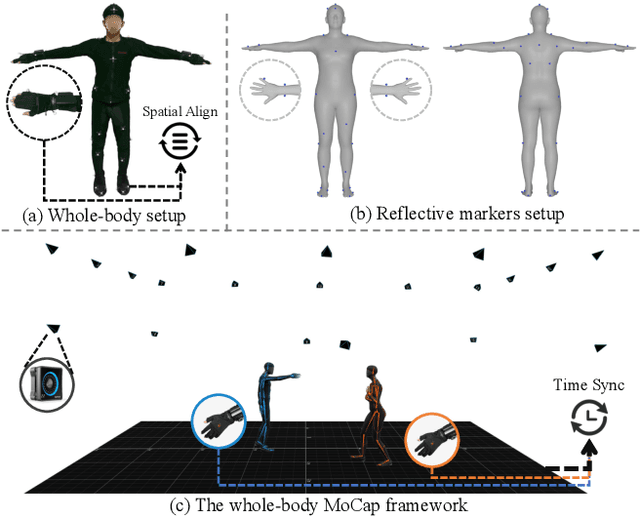
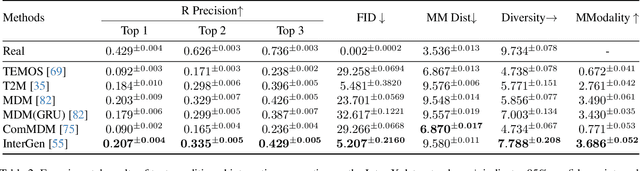
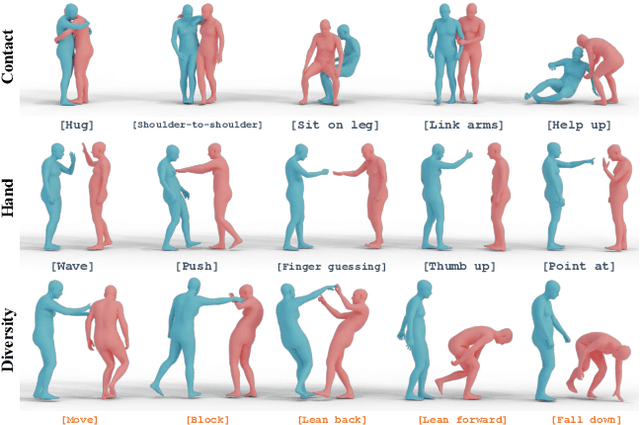
The analysis of the ubiquitous human-human interactions is pivotal for understanding humans as social beings. Existing human-human interaction datasets typically suffer from inaccurate body motions, lack of hand gestures and fine-grained textual descriptions. To better perceive and generate human-human interactions, we propose Inter-X, a currently largest human-human interaction dataset with accurate body movements and diverse interaction patterns, together with detailed hand gestures. The dataset includes ~11K interaction sequences and more than 8.1M frames. We also equip Inter-X with versatile annotations of more than 34K fine-grained human part-level textual descriptions, semantic interaction categories, interaction order, and the relationship and personality of the subjects. Based on the elaborate annotations, we propose a unified benchmark composed of 4 categories of downstream tasks from both the perceptual and generative directions. Extensive experiments and comprehensive analysis show that Inter-X serves as a testbed for promoting the development of versatile human-human interaction analysis. Our dataset and benchmark will be publicly available for research purposes.