 Add to Chrome
 Add to Firefox
 Add to Edge
NOC4SC: A Bandwidth-Efficient Multi-User Semantic Communication Framework for Interference-Resilient Transmission
Dec 10, 2025
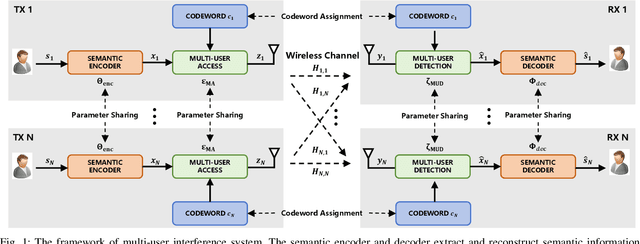
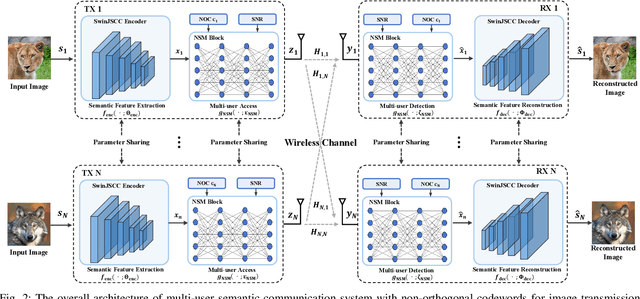
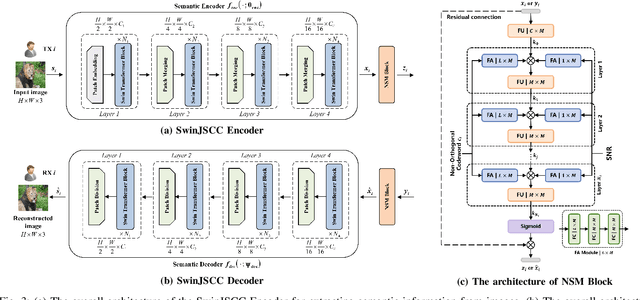
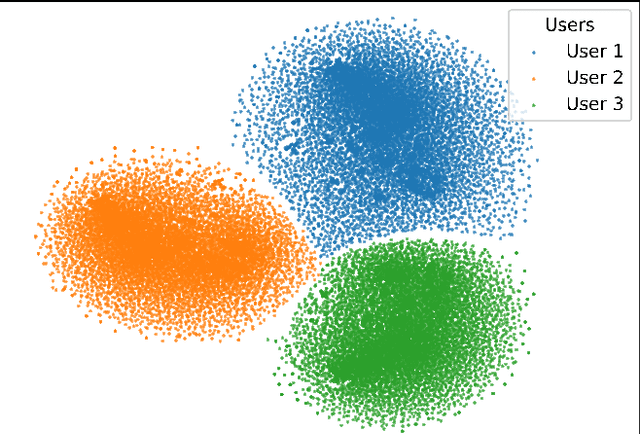
With the explosive growth of connected devices and emerging applications, current wireless networks are encountering unprecedented demands for massive user access, where the inter-user interference has become a critical challenge to maintaining high quality of service (QoS) in multi-user communication systems. To tackle this issue, we propose a bandwidth-efficient semantic communication paradigm termed Non-Orthogonal Codewords for Semantic Communication (NOC4SC), which enables simultaneous same-frequency transmission without spectrum spreading. By leveraging the Swin Transformer, the proposed NOC4SC framework enables each user to independently extract semantic features through a unified encoder-decoder architecture with shared network parameters across all users, which ensures that the user's data remains protected from unauthorized decoding. Furthermore, we introduce an adaptive NOC and SNR Modulation (NSM) block, which employs deep learning to dynamically regulate SNR and generate approximately orthogonal semantic features within distinct feature subspaces, thereby effectively mitigating inter-user interference. Extensive experiments demonstrate the proposed NOC4SC achieves comparable performance to the DeepJSCC-PNOMA and outperforms other multi-user SemCom baseline methods.

WiCo-PG: Wireless Channel Foundation Model for Pathloss Map Generation via Synesthesia of Machines
Nov 19, 2025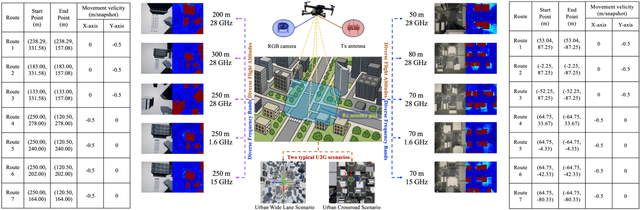
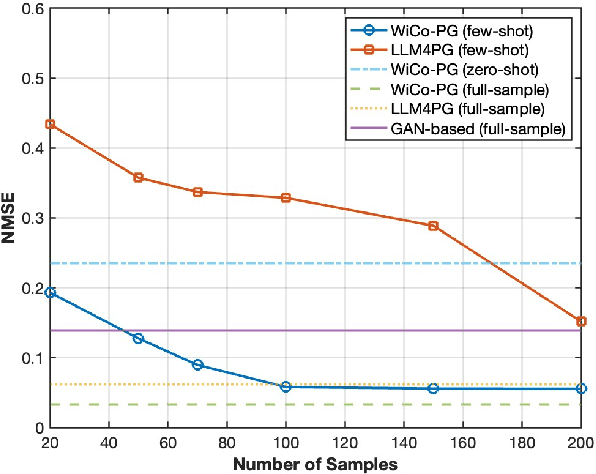
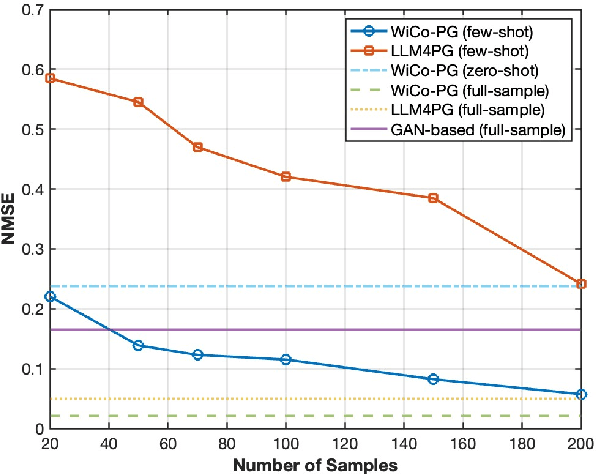
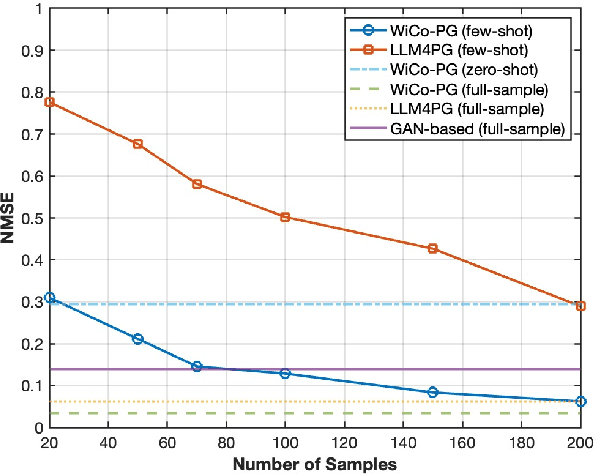
A wireless channel foundation model for pathloss map generation (WiCo-PG) via Synesthesia of Machines (SoM) is developed for the first time. Considering sixth-generation (6G) uncrewed aerial vehicle (UAV)-to-ground (U2G) scenarios, a new multi-modal sensing-communication dataset is constructed for WiCo-PG pre-training, including multiple U2G scenarios, diverse flight altitudes, and diverse frequency bands. Based on the constructed dataset, the proposed WiCo-PG enables cross-modal pathloss map generation by leveraging RGB images from different scenarios and flight altitudes. In WiCo-PG, a novel network architecture designed for cross-modal pathloss map generation based on dual vector quantized generative adversarial networks (VQGANs) and Transformer is proposed. Furthermore, a novel frequency-guided shared-routed mixture of experts (S-R MoE) architecture is designed for cross-modal pathloss map generation. Simulation results demonstrate that the proposed WiCo-PG achieves improved pathloss map generation accuracy through pre-training with a normalized mean squared error (NMSE) of 0.012, outperforming the large language model (LLM)-based scheme, i.e., LLM4PG, and the conventional deep learning-based scheme by more than 6.98 dB. The enhanced generality of the proposed WiCo-PG can further outperform the LLM4PG by at least 1.37 dB using 2.7% samples in few-shot generalization.
WiCo-MG: Wireless Channel Foundation Model for Multipath Generation via Synesthesia of Machines
Nov 19, 2025Precise modeling of channel multipath is essential for understanding wireless propagation environments and optimizing communication systems. In particular, sixth-generation (6G) artificial intelligence (AI)-native communication systems demand massive and high-quality multipath channel data to enable intelligent model training and performance optimization. In this paper, we propose a wireless channel foundation model (WiCo) for multipath generation (WiCo-MG) via Synesthesia of Machines (SoM). To provide a solid training foundation for WiCo-MG, a new synthetic intelligent sensing-communication dataset for uncrewed aerial vehicle (UAV)-to-ground (U2G) communications is constructed. To overcome the challenges of cross-modal alignment and mapping, a two-stage training framework is proposed. In the first stage, sensing images are embedded into discrete-continuous SoM feature spaces, and multipath maps are embedded into a sensing-initialized discrete SoM space to align the representations. In the second stage, a mixture of shared and routed experts (S-R MoE) Transformer with frequency-aware expert routing learns the mapping from sensing to channel SoM feature spaces, enabling decoupled and adaptive multipath generation. Experimental results demonstrate that WiCo-MG achieves state-of-the-art in-distribution generation performance and superior out-of-distribution generalization, reducing NMSE by more than 2.59 dB over baselines, while exhibiting strong scalability in model and dataset growth and extensibility to new multipath parameters and tasks. Owing to higher accuracy, stronger generalization, and better scalability, WiCo-MG is expected to enable massive and high-fidelity channel data generation for the development of 6G AI-native communication systems.
SynthSoM-Twin: A Multi-Modal Sensing-Communication Digital-Twin Dataset for Sim2Real Transfer via Synesthesia of Machines
Nov 14, 2025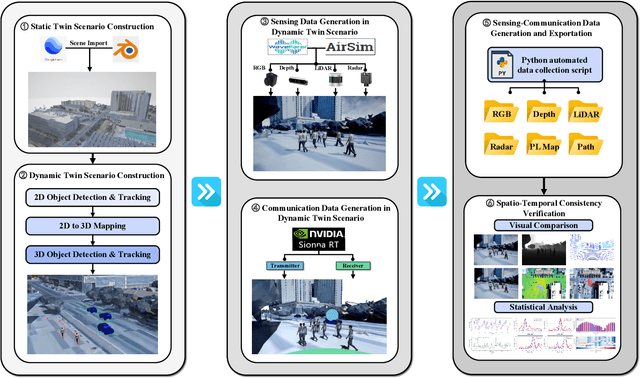
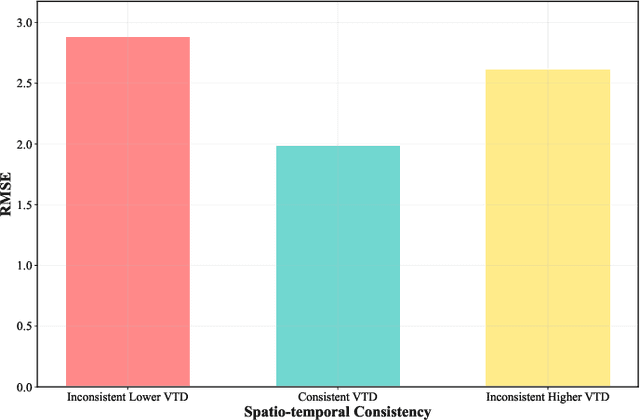
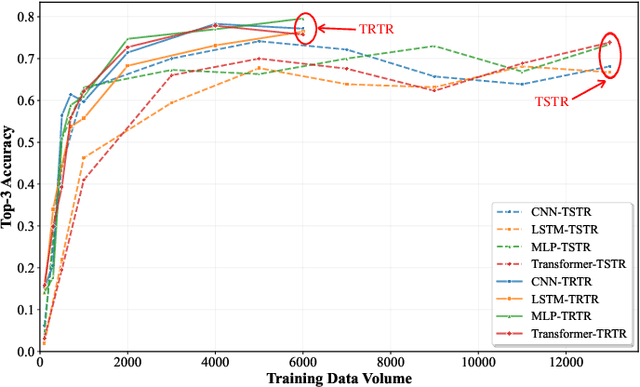
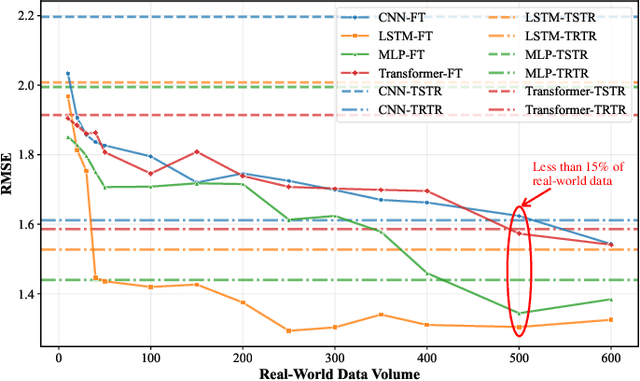
This paper constructs a novel multi-modal sensing-communication digital-twin dataset, named SynthSoM-Twin, which is spatio-temporally consistent with the real world, for Sim2Real transfer via Synesthesia of Machines (SoM). To construct the SynthSoM-Twin dataset, we propose a new framework that can extend the quantity and missing modality of existing real-world multi-modal sensing-communication dataset. Specifically, we exploit multi-modal sensing-assisted object detection and tracking algorithms to ensure spatio-temporal consistency of static objects and dynamic objects across real world and simulation environments. The constructed scenario is imported into three high-fidelity simulators, i.e., AirSim, WaveFarer, and Sionna RT. The SynthSoM-Twin dataset contains spatio-temporally consistent data with the real world, including 66,868 snapshots of synthetic RGB images, depth maps, light detection and ranging (LiDAR) point clouds, millimeter wave (mmWave) radar point clouds, and large-scale and small-scale channel fading data. To validate the utility of SynthSoM-Twin dataset, we conduct Sim2Real transfer investigation by implementing two cross-modal downstream tasks via cross-modal generative models (CMGMs), i.e., cross-modal channel generation model and multi-modal sensing-assisted beam generation model. Based on the downstream tasks, we explore the threshold of real-world data injection that can achieve a decent trade-off between real-world data usage and models' practical performance. Experimental results show that the model training on the SynthSoM-Twin dataset achieves a decent practical performance, and the injection of real-world data further facilitates Sim2Real transferability. Based on the SynthSoM-Twin dataset, injecting less than 15% of real-world data can achieve similar and even better performance compared to that trained with all the real-world data only.
TinyChemVL: Advancing Chemical Vision-Language Models via Efficient Visual Token Reduction and Complex Reaction Tasks
Nov 09, 2025While Vision Language Models (VLMs) have demonstrated remarkable capabilities in general visual understanding, their application in the chemical domain has been limited, with previous works predominantly focusing on text and thus overlooking critical visual information, such as molecular structures. Current approaches that directly adopt standard VLMs for chemical tasks suffer from two primary issues: (i) computational inefficiency of processing entire chemical images with non-informative backgrounds. (ii) a narrow scope on molecular-level tasks that restricts progress in chemical reasoning. In this work, we propose \textbf{TinyChemVL}, an efficient and powerful chemical VLM that leverages visual token reduction and reaction-level tasks to improve model efficiency and reasoning capacity. Also, we propose \textbf{ChemRxn-V}, a reaction-level benchmark for assessing vision-based reaction recognition and prediction tasks. Directly predicting reaction products from molecular images poses a non-trivial challenge, as it requires models to integrate both recognition and reasoning capacities. Our results demonstrate that with only 4B parameters, TinyChemVL achieves superior performance on both molecular and reaction tasks while demonstrating faster inference and training speeds compared to existing models. Notably, TinyChemVL outperforms ChemVLM while utilizing only 1/16th of the visual tokens. This work builds efficient yet powerful VLMs for chemical domains by co-designing model architecture and task complexity.
Tiny-WiFo: A Lightweight Wireless Foundation Model for Channel Prediction via Multi-Component Adaptive Knowledge Distillation
Nov 06, 2025The massive scale of Wireless Foundation Models (FMs) hinders their real-time deployment on edge devices. This letter moves beyond standard knowledge distillation by introducing a novel Multi-Component Adaptive Knowledge Distillation (MCAKD) framework. Key innovations include a Cross-Attention-Based Knowledge Selection (CA-KS) module that selectively identifies critical features from the teacher model, and an Autonomous Learning-Passive Learning (AL-PL) strategy that balances knowledge transfer with independent learning to achieve high training efficiency at a manageable computational cost. When applied to the WiFo FM, the distilled Tiny-WiFo model, with only 5.5M parameters, achieves a 1.6 ms inference time on edge hardware while retaining over 98% of WiFo's performance and its crucial zero-shot generalization capability, making real-time FM deployment viable.
Towards Agentic Self-Learning LLMs in Search Environment
Oct 16, 2025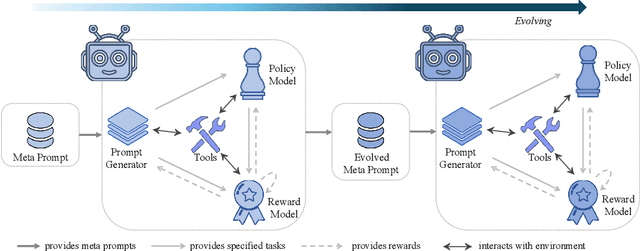
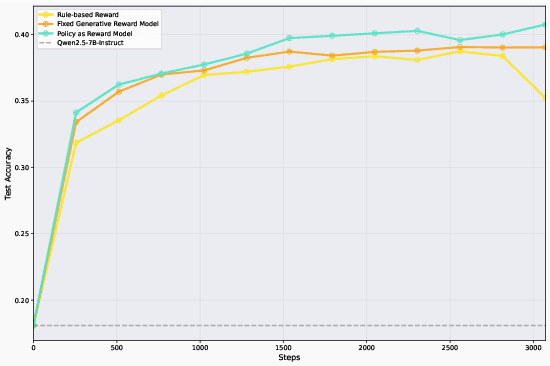
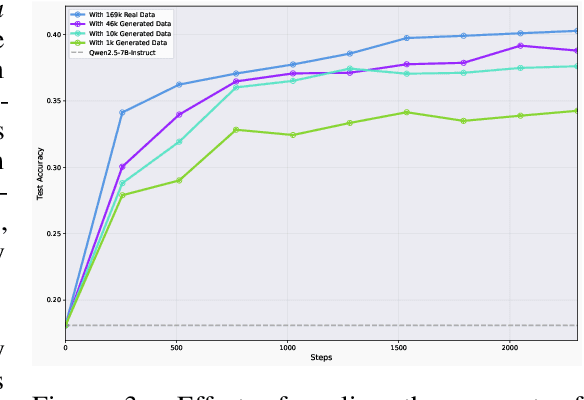
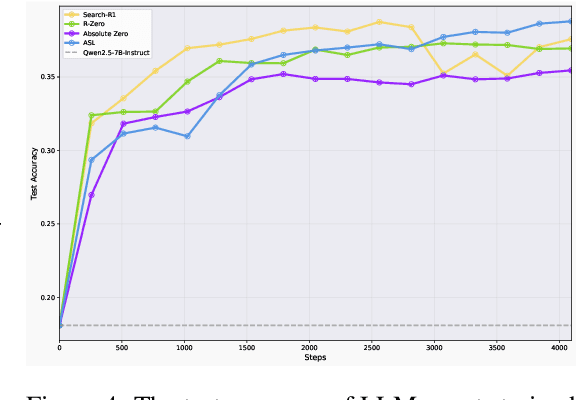
We study whether self-learning can scale LLM-based agents without relying on human-curated datasets or predefined rule-based rewards. Through controlled experiments in a search-agent setting, we identify two key determinants of scalable agent training: the source of reward signals and the scale of agent task data. We find that rewards from a Generative Reward Model (GRM) outperform rigid rule-based signals for open-domain learning, and that co-evolving the GRM with the policy further boosts performance. Increasing the volume of agent task data-even when synthetically generated-substantially enhances agentic capabilities. Building on these insights, we propose \textbf{Agentic Self-Learning} (ASL), a fully closed-loop, multi-role reinforcement learning framework that unifies task generation, policy execution, and evaluation within a shared tool environment and LLM backbone. ASL coordinates a Prompt Generator, a Policy Model, and a Generative Reward Model to form a virtuous cycle of harder task setting, sharper verification, and stronger solving. Empirically, ASL delivers steady, round-over-round gains, surpasses strong RLVR baselines (e.g., Search-R1) that plateau or degrade, and continues improving under zero-labeled-data conditions, indicating superior sample efficiency and robustness. We further show that GRM verification capacity is the main bottleneck: if frozen, it induces reward hacking and stalls progress; continual GRM training on the evolving data distribution mitigates this, and a small late-stage injection of real verification data raises the performance ceiling. This work establishes reward source and data scale as critical levers for open-domain agent learning and demonstrates the efficacy of multi-role co-evolution for scalable, self-improving agents. The data and code of this paper are released at https://github.com/forangel2014/Towards-Agentic-Self-Learning
LLM4MG: Adapting Large Language Model for Multipath Generation via Synesthesia of Machines
Sep 18, 2025Based on Synesthesia of Machines (SoM), a large language model (LLM) is adapted for multipath generation (LLM4MG) for the first time. Considering a typical sixth-generation (6G) vehicle-to-infrastructure (V2I) scenario, a new multi-modal sensing-communication dataset is constructed, named SynthSoM-V2I, including channel multipath information, millimeter wave (mmWave) radar sensory data, RGB-D images, and light detection and ranging (LiDAR) point clouds. Based on the SynthSoM-V2I dataset, the proposed LLM4MG leverages Large Language Model Meta AI (LLaMA) 3.2 for multipath generation via multi-modal sensory data. The proposed LLM4MG aligns the multi-modal feature space with the LLaMA semantic space through feature extraction and fusion networks. To further achieve general knowledge transfer from the pre-trained LLaMA for multipath generation via multi-modal sensory data, the low-rank adaptation (LoRA) parameter-efficient fine-tuning and propagation-aware prompt engineering are exploited. Simulation results demonstrate that the proposed LLM4MG outperforms conventional deep learning-based methods in terms of line-of-sight (LoS)/non-LoS (NLoS) classification with accuracy of 92.76%, multipath power/delay generation precision with normalized mean square error (NMSE) of 0.099/0.032, and cross-vehicular traffic density (VTD), cross-band, and cross-scenario generalization. The utility of the proposed LLM4MG is validated by real-world generalization. The necessity of high-precision multipath generation for system design is also demonstrated by channel capacity comparison.
Multi-Modal Intelligent Channel Modeling Framework for 6G-Enabled Networked Intelligent Systems
Sep 09, 2025The design and technology development of 6G-enabled networked intelligent systems needs an accurate real-time channel model as the cornerstone. However, with the new requirements of 6G-enabled networked intelligent systems, the conventional channel modeling methods face many limitations. Fortunately, the multi-modal sensors equipped on the intelligent agents bring timely opportunities, i.e., the intelligent integration and mutually beneficial mechanism between communications and multi-modal sensing could be investigated based on the artificial intelligence (AI) technologies. In this case, the mapping relationship between physical environment and electromagnetic channel could be explored via Synesthesia of Machines (SoM). This article presents a novel multi-modal intelligent channel modeling (MMICM) framework for 6G-enabled networked intelligent systems, which establishes a nonlinear model between multi-modal sensing and channel characteristics, including large-scale and small-scale channel characteristics. The architecture and features of proposed intelligent modeling framework are expounded and the key technologies involved are also analyzed. Finally, the system-engaged applications and potential research directions of MMICM framework are outlined.
Revisiting Chain-of-Thought Prompting: Zero-shot Can Be Stronger than Few-shot
Jun 17, 2025In-Context Learning (ICL) is an essential emergent ability of Large Language Models (LLMs), and recent studies introduce Chain-of-Thought (CoT) to exemplars of ICL to enhance the reasoning capability, especially in mathematics tasks. However, given the continuous advancement of model capabilities, it remains unclear whether CoT exemplars still benefit recent, stronger models in such tasks. Through systematic experiments, we find that for recent strong models such as the Qwen2.5 series, adding traditional CoT exemplars does not improve reasoning performance compared to Zero-Shot CoT. Instead, their primary function is to align the output format with human expectations. We further investigate the effectiveness of enhanced CoT exemplars, constructed using answers from advanced models such as \texttt{Qwen2.5-Max} and \texttt{DeepSeek-R1}. Experimental results indicate that these enhanced exemplars still fail to improve the model's reasoning performance. Further analysis reveals that models tend to ignore the exemplars and focus primarily on the instructions, leading to no observable gain in reasoning ability. Overall, our findings highlight the limitations of the current ICL+CoT framework in mathematical reasoning, calling for a re-examination of the ICL paradigm and the definition of exemplars.