 Add to Chrome
 Add to Firefox
 Add to Edge
You Only Debias Once: Towards Flexible Accuracy-Fairness Trade-offs at Inference Time
Mar 10, 2025
Deep neural networks are prone to various bias issues, jeopardizing their applications for high-stake decision-making. Existing fairness methods typically offer a fixed accuracy-fairness trade-off, since the weight of the well-trained model is a fixed point (fairness-optimum) in the weight space. Nevertheless, more flexible accuracy-fairness trade-offs at inference time are practically desired since: 1) stakes of the same downstream task can vary for different individuals, and 2) different regions have diverse laws or regularization for fairness. If using the previous fairness methods, we have to train multiple models, each offering a specific level of accuracy-fairness trade-off. This is often computationally expensive, time-consuming, and difficult to deploy, making it less practical for real-world applications. To address this problem, we propose You Only Debias Once (YODO) to achieve in-situ flexible accuracy-fairness trade-offs at inference time, using a single model that trained only once. Instead of pursuing one individual fixed point (fairness-optimum) in the weight space, we aim to find a "line" in the weight space that connects the accuracy-optimum and fairness-optimum points using a single model. Points (models) on this line implement varying levels of accuracy-fairness trade-offs. At inference time, by manually selecting the specific position of the learned "line", our proposed method can achieve arbitrary accuracy-fairness trade-offs for different end-users and scenarios. Experimental results on tabular and image datasets show that YODO achieves flexible trade-offs between model accuracy and fairness, at ultra-low overheads. For example, if we need $100$ levels of trade-off on the \acse dataset, YODO takes $3.53$ seconds while training $100$ fixed models consumes $425$ seconds. The code is available at https://github.com/ahxt/yodo.

More for Keys, Less for Values: Adaptive KV Cache Quantization
Feb 20, 2025This paper introduces an information-aware quantization framework that adaptively compresses the key-value (KV) cache in large language models (LLMs). Although prior work has underscored the distinct roles of key and value cache during inference, our systematic analysis -- examining singular value distributions, spectral norms, and Frobenius norms -- reveals, for the first time, that key matrices consistently exhibit higher norm values and are more sensitive to quantization than value matrices. Furthermore, our theoretical analysis shows that matrices with higher spectral norms amplify quantization errors more significantly. Motivated by these insights, we propose a mixed-precision quantization strategy, KV-AdaQuant, which allocates more bit-width for keys and fewer for values since key matrices have higher norm values. With the same total KV bit budget, this approach effectively mitigates error propagation across transformer layers while achieving significant memory savings. Our extensive experiments on multiple LLMs (1B--70B) demonstrate that our mixed-precision quantization scheme maintains high model accuracy even under aggressive compression. For instance, using 4-bit for Key and 2-bit for Value achieves an accuracy of 75.2%, whereas reversing the assignment (2-bit for Key and 4-bit for Value) yields only 54.7% accuracy. The code is available at https://tinyurl.com/kv-adaquant
Confident or Seek Stronger: Exploring Uncertainty-Based On-device LLM Routing From Benchmarking to Generalization
Feb 06, 2025Large language models (LLMs) are increasingly deployed and democratized on edge devices. To improve the efficiency of on-device deployment, small language models (SLMs) are often adopted due to their efficient decoding latency and reduced energy consumption. However, these SLMs often generate inaccurate responses when handling complex queries. One promising solution is uncertainty-based SLM routing, offloading high-stakes queries to stronger LLMs when resulting in low-confidence responses on SLM. This follows the principle of "If you lack confidence, seek stronger support" to enhance reliability. Relying on more powerful LLMs is yet effective but increases invocation costs. Therefore, striking a routing balance between efficiency and efficacy remains a critical challenge. Additionally, efficiently generalizing the routing strategy to new datasets remains under-explored. In this paper, we conduct a comprehensive investigation into benchmarking and generalization of uncertainty-driven routing strategies from SLMs to LLMs over 1500+ settings. Our findings highlight: First, uncertainty-correctness alignment in different uncertainty quantification (UQ) methods significantly impacts routing performance. Second, uncertainty distributions depend more on both the specific SLM and the chosen UQ method, rather than downstream data. Building on the insight, we propose a calibration data construction instruction pipeline and open-source a constructed hold-out set to enhance routing generalization on new downstream scenarios. The experimental results indicate calibration data effectively bootstraps routing performance without any new data.
Survey and Improvement Strategies for Gene Prioritization with Large Language Models
Jan 30, 2025


Rare diseases are challenging to diagnose due to limited patient data and genetic diversity. Despite advances in variant prioritization, many cases remain undiagnosed. While large language models (LLMs) have performed well in medical exams, their effectiveness in diagnosing rare genetic diseases has not been assessed. To identify causal genes, we benchmarked various LLMs for gene prioritization. Using multi-agent and Human Phenotype Ontology (HPO) classification, we categorized patients based on phenotypes and solvability levels. As gene set size increased, LLM performance deteriorated, so we used a divide-and-conquer strategy to break the task into smaller subsets. At baseline, GPT-4 outperformed other LLMs, achieving near 30% accuracy in ranking causal genes correctly. The multi-agent and HPO approaches helped distinguish confidently solved cases from challenging ones, highlighting the importance of known gene-phenotype associations and phenotype specificity. We found that cases with specific phenotypes or clear associations were more accurately solved. However, we observed biases toward well-studied genes and input order sensitivity, which hindered gene prioritization. Our divide-and-conquer strategy improved accuracy by overcoming these biases. By utilizing HPO classification, novel multi-agent techniques, and our LLM strategy, we improved causal gene identification accuracy compared to our baseline evaluation. This approach streamlines rare disease diagnosis, facilitates reanalysis of unsolved cases, and accelerates gene discovery, supporting the development of targeted diagnostics and therapies.
Dialogue is Better Than Monologue: Instructing Medical LLMs via Strategical Conversations
Jan 29, 2025Current medical AI systems often fail to replicate real-world clinical reasoning, as they are predominantly trained and evaluated on static text and question-answer tasks. These tuning methods and benchmarks overlook critical aspects like evidence-based reasoning and handling distracting information. To bridge this gap, we introduce a novel benchmark that simulates real-world diagnostic scenarios, integrating noise and difficulty levels aligned with USMLE standards. Moreover, we explore dialogue-based fine-tuning, which transforms static datasets into conversational formats to better capture iterative reasoning processes. Experiments show that dialogue-tuned models outperform traditional methods, with improvements of $9.64\%$ in multi-round reasoning scenarios and $6.18\%$ in accuracy in a noisy environment. Our findings highlight dialogue tuning as a promising approach for advancing clinically aligned and robust medical AI systems.
AD-LLM: Benchmarking Large Language Models for Anomaly Detection
Dec 15, 2024

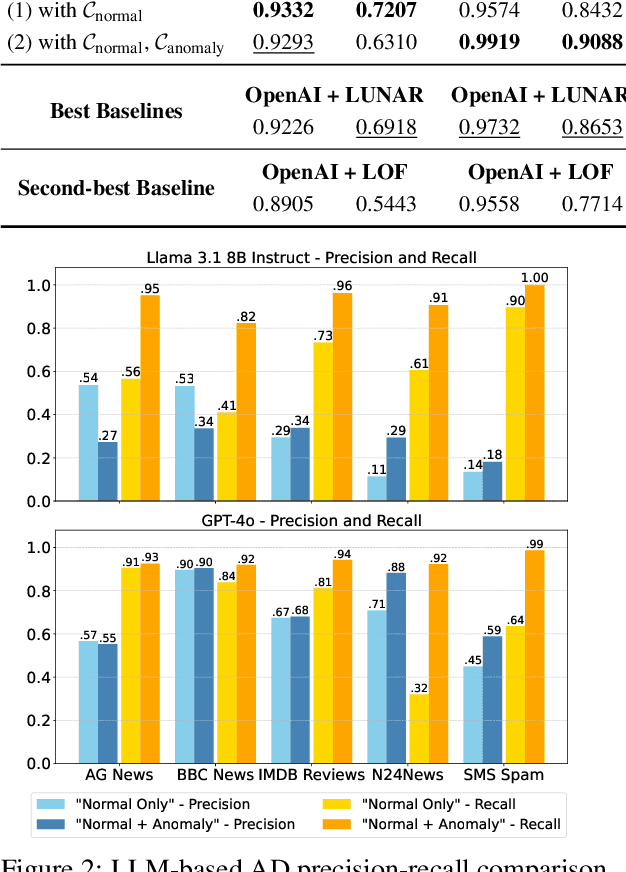

Anomaly detection (AD) is an important machine learning task with many real-world uses, including fraud detection, medical diagnosis, and industrial monitoring. Within natural language processing (NLP), AD helps detect issues like spam, misinformation, and unusual user activity. Although large language models (LLMs) have had a strong impact on tasks such as text generation and summarization, their potential in AD has not been studied enough. This paper introduces AD-LLM, the first benchmark that evaluates how LLMs can help with NLP anomaly detection. We examine three key tasks: (i) zero-shot detection, using LLMs' pre-trained knowledge to perform AD without tasks-specific training; (ii) data augmentation, generating synthetic data and category descriptions to improve AD models; and (iii) model selection, using LLMs to suggest unsupervised AD models. Through experiments with different datasets, we find that LLMs can work well in zero-shot AD, that carefully designed augmentation methods are useful, and that explaining model selection for specific datasets remains challenging. Based on these results, we outline six future research directions on LLMs for AD.
Weighted Diversified Sampling for Efficient Data-Driven Single-Cell Gene-Gene Interaction Discovery
Oct 21, 2024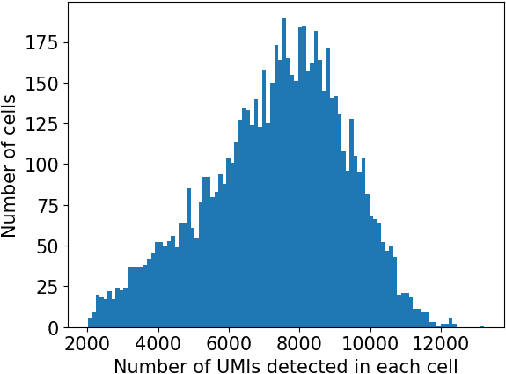


Gene-gene interactions play a crucial role in the manifestation of complex human diseases. Uncovering significant gene-gene interactions is a challenging task. Here, we present an innovative approach utilizing data-driven computational tools, leveraging an advanced Transformer model, to unearth noteworthy gene-gene interactions. Despite the efficacy of Transformer models, their parameter intensity presents a bottleneck in data ingestion, hindering data efficiency. To mitigate this, we introduce a novel weighted diversified sampling algorithm. This algorithm computes the diversity score of each data sample in just two passes of the dataset, facilitating efficient subset generation for interaction discovery. Our extensive experimentation demonstrates that by sampling a mere 1\% of the single-cell dataset, we achieve performance comparable to that of utilizing the entire dataset.
Gradient Rewiring for Editable Graph Neural Network Training
Oct 21, 2024


Deep neural networks are ubiquitously adopted in many applications, such as computer vision, natural language processing, and graph analytics. However, well-trained neural networks can make prediction errors after deployment as the world changes. \textit{Model editing} involves updating the base model to correct prediction errors with less accessible training data and computational resources. Despite recent advances in model editors in computer vision and natural language processing, editable training in graph neural networks (GNNs) is rarely explored. The challenge with editable GNN training lies in the inherent information aggregation across neighbors, which can lead model editors to affect the predictions of other nodes unintentionally. In this paper, we first observe the gradient of cross-entropy loss for the target node and training nodes with significant inconsistency, which indicates that directly fine-tuning the base model using the loss on the target node deteriorates the performance on training nodes. Motivated by the gradient inconsistency observation, we propose a simple yet effective \underline{G}radient \underline{R}ewiring method for \underline{E}ditable graph neural network training, named \textbf{GRE}. Specifically, we first store the anchor gradient of the loss on training nodes to preserve the locality. Subsequently, we rewire the gradient of the loss on the target node to preserve performance on the training node using anchor gradient. Experiments demonstrate the effectiveness of GRE on various model architectures and graph datasets in terms of multiple editing situations. The source code is available at \url{https://github.com/zhimengj0326/Gradient_rewiring_editing}
Learning to Route with Confidence Tokens
Oct 17, 2024


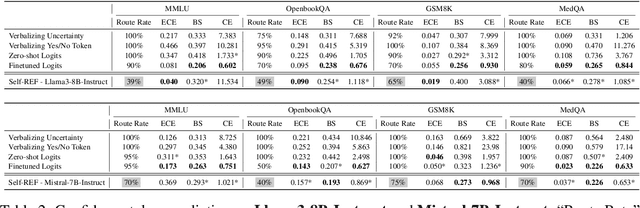
Large language models (LLMs) have demonstrated impressive performance on several tasks and are increasingly deployed in real-world applications. However, especially in high-stakes settings, it becomes vital to know when the output of an LLM may be unreliable. Depending on whether an answer is trustworthy, a system can then choose to route the question to another expert, or otherwise fall back on a safe default behavior. In this work, we study the extent to which LLMs can reliably indicate confidence in their answers, and how this notion of confidence can translate into downstream accuracy gains. We propose Self-REF, a lightweight training strategy to teach LLMs to express confidence in whether their answers are correct in a reliable manner. Self-REF introduces confidence tokens into the LLM, from which a confidence score can be extracted. Compared to conventional approaches such as verbalizing confidence and examining token probabilities, we demonstrate empirically that confidence tokens show significant improvements in downstream routing and rejection learning tasks.
Taylor Unswift: Secured Weight Release for Large Language Models via Taylor Expansion
Oct 06, 2024
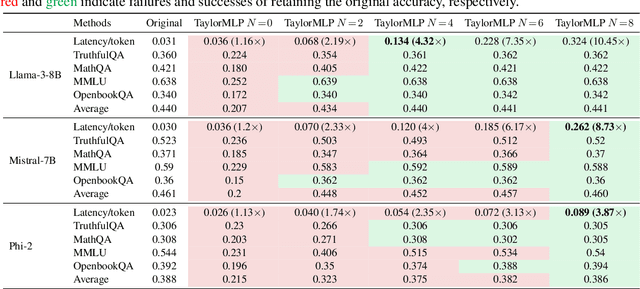


Ensuring the security of released large language models (LLMs) poses a significant dilemma, as existing mechanisms either compromise ownership rights or raise data privacy concerns. To address this dilemma, we introduce TaylorMLP to protect the ownership of released LLMs and prevent their abuse. Specifically, TaylorMLP preserves the ownership of LLMs by transforming the weights of LLMs into parameters of Taylor-series. Instead of releasing the original weights, developers can release the Taylor-series parameters with users, thereby ensuring the security of LLMs. Moreover, TaylorMLP can prevent abuse of LLMs by adjusting the generation speed. It can induce low-speed token generation for the protected LLMs by increasing the terms in the Taylor-series. This intentional delay helps LLM developers prevent potential large-scale unauthorized uses of their models. Empirical experiments across five datasets and three LLM architectures demonstrate that TaylorMLP induces over 4x increase in latency, producing the tokens precisely matched with original LLMs. Subsequent defensive experiments further confirm that TaylorMLP effectively prevents users from reconstructing the weight values based on downstream datasets.