 Add to Chrome
 Add to Firefox
 Add to Edge
A Synergistic CNN-Transformer Network with Pooling Attention Fusion for Hyperspectral Image Classification
Apr 26, 2026
In the hyperspectral image (HSI) classification task, each pixel is categorized into a specific land-cover category or material. Convolutional neural networks (CNNs) and transformers have been widely used to extract local and non-local features in HSI classification. Recent works have utilized a multi-scale vision transformer (ViT) to enhance spectral feature capture and yield promising results. However, most existing methods still face challenges in the effective joint use of spatial-spectral information and in preserving information across layers during the propagation process. To address these issues, we propose a synergistic CNN-Transformer network with pooling attention fusion for HSI classification, which collaboratively utilizes CNNs and ViT to process spatial and spectral features separately. Specifically, we propose a Twin-Branch Feature Extraction (TBFE) module, which employs 3D and 2D convolution in parallel to comprehensively extract spectral and spatial features from HSI. A hybrid pooling attention (HPA) module is designed to aggregate spatial attention. Moreover, a cascade transformer encoder is employed for global spectral feature extraction, and a simple yet efficient cross-layer feature fusion (CFF) module is designed to reduce the loss of crucial information in the previous network layers. Extensive experiments are conducted on several representative datasets to demonstrate the superior performance of our proposed method compared to the state-of-the-art works. Code is available at https://github.com/chenpeng052/SCT-Net.git.

FuXi-$γ$: Efficient Sequential Recommendation with Exponential-Power Temporal Encoder and Diagonal-Sparse Positional Mechanism
Dec 14, 2025Sequential recommendation aims to model users' evolving preferences based on their historical interactions. Recent advances leverage Transformer-based architectures to capture global dependencies, but existing methods often suffer from high computational overhead, primarily due to discontinuous memory access in temporal encoding and dense attention over long sequences. To address these limitations, we propose FuXi-$γ$, a novel sequential recommendation framework that improves both effectiveness and efficiency through principled architectural design. FuXi-$γ$ adopts a decoder-only Transformer structure and introduces two key innovations: (1) An exponential-power temporal encoder that encodes relative temporal intervals using a tunable exponential decay function inspired by the Ebbinghaus forgetting curve. This encoder enables flexible modeling of both short-term and long-term preferences while maintaining high efficiency through continuous memory access and pure matrix operations. (2) A diagonal-sparse positional mechanism that prunes low-contribution attention blocks using a diagonal-sliding strategy guided by the persymmetry of Toeplitz matrix. Extensive experiments on four real-world datasets demonstrate that FuXi-$γ$ achieves state-of-the-art performance in recommendation quality, while accelerating training by up to 4.74$\times$ and inference by up to 6.18$\times$, making it a practical and scalable solution for long-sequence recommendation. Our code is available at https://github.com/Yeedzhi/FuXi-gamma.
A Neural-network Enhanced Video Coding Framework beyond ECM
Feb 21, 2024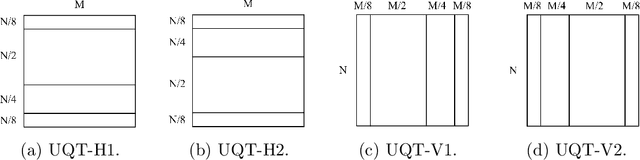
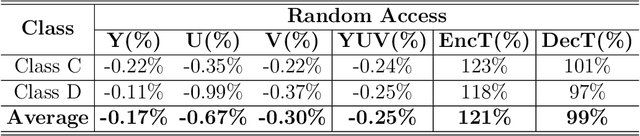
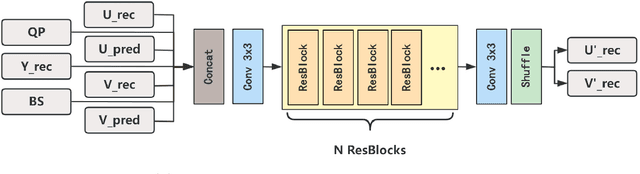
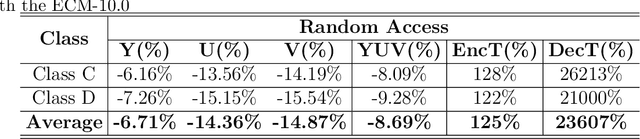
In this paper, a hybrid video compression framework is proposed that serves as a demonstrative showcase of deep learning-based approaches extending beyond the confines of traditional coding methodologies. The proposed hybrid framework is founded upon the Enhanced Compression Model (ECM), which is a further enhancement of the Versatile Video Coding (VVC) standard. We have augmented the latest ECM reference software with well-designed coding techniques, including block partitioning, deep learning-based loop filter, and the activation of block importance mapping (BIM) which was integrated but previously inactive within ECM, further enhancing coding performance. Compared with ECM-10.0, our method achieves 6.26, 13.33, and 12.33 BD-rate savings for the Y, U, and V components under random access (RA) configuration, respectively.