 Add to Chrome
 Add to Firefox
 Add to Edge
CodecArena: Codec Quality Assessment via Visual Reinforcement Learning
Aug 10, 2026
Video coding is advancing into the low and ultra-low bitrate regime, driven by end-to-end codecs that replace the hand-crafted pipeline with jointly optimized neural networks and generative codecs that exploit the priors of video generation models. Yet the dominant metrics, LPIPS and DISTS, measure feature and texture similarity rather than content fidelity: a reconstruction that hallucinates a wrong face or blurs text into convincing strokes can still score well, even when a human rejects it instantly. To address this, we propose CodecArena, the first vision-language framework for video coding quality assessment, casting codec evaluation as source-conditioned comparative reasoning between a reference and its reconstructions. We optimize CodecArena with Facet-GRPO, a visual reinforcement learning scheme that aligns pairwise codec preferences while grounding the verdict in five fidelity facets: identity, objects, text, texture, and temporal consistency. Its facet-anchored reward uses automatically derived facet directions as weak anchors, rather than human per-facet labels, to prevent any single sub-score from dominating the holistic preference and to yield interpretable fine-grained quality judgments. To support training and evaluation in this underexplored regime, we construct two complementary resources: CodecArena-1K, a fully automatic preference dataset of 1,500 comparison groups built from traditional, neural, and generative codec reconstructions with fused vision-language and objective supervision; and CodecArena-Bench, a human-ranked benchmark with source-disjoint videos for fair out-of-domain evaluation. Extensive experiments demonstrate that CodecArena achieves state-of-the-art agreement with human judgments on source-disjoint content across diverse codecs and bitrates, surpassing perceptual metrics and prior vision-language evaluators.

Advanced Learning-Based Inter Prediction for Future Video Coding
Nov 24, 2024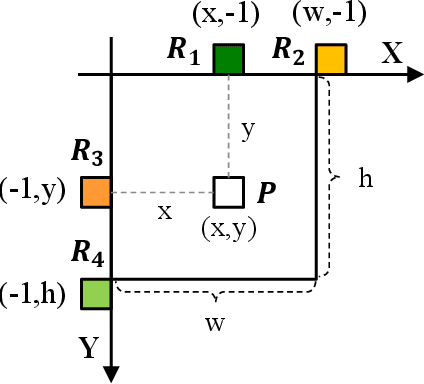
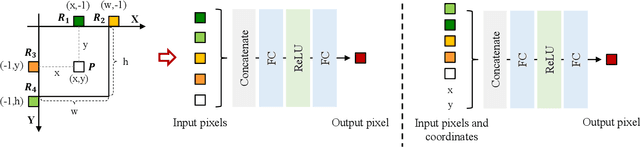
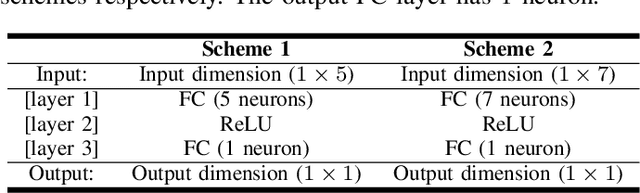
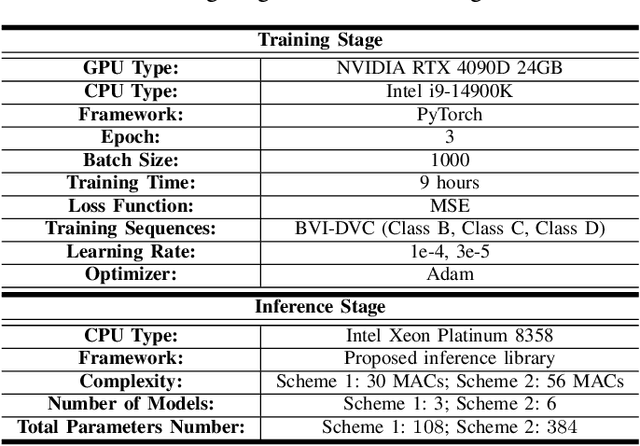
In the fourth generation Audio Video coding Standard (AVS4), the Inter Prediction Filter (INTERPF) reduces discontinuities between prediction and adjacent reconstructed pixels in inter prediction. The paper proposes a low complexity learning-based inter prediction (LLIP) method to replace the traditional INTERPF. LLIP enhances the filtering process by leveraging a lightweight neural network model, where parameters can be exported for efficient inference. Specifically, we extract pixels and coordinates utilized by the traditional INTERPF to form the training dataset. Subsequently, we export the weights and biases of the trained neural network model and implement the inference process without any third-party dependency, enabling seamless integration into video codec without relying on Libtorch, thus achieving faster inference speed. Ultimately, we replace the traditional handcraft filtering parameters in INTERPF with the learned optimal filtering parameters. This practical solution makes the combination of deep learning encoding tools with traditional video encoding schemes more efficient. Experimental results show that our approach achieves 0.01%, 0.31%, and 0.25% coding gain for the Y, U, and V components under the random access (RA) configuration on average.
A Neural-network Enhanced Video Coding Framework beyond ECM
Feb 21, 2024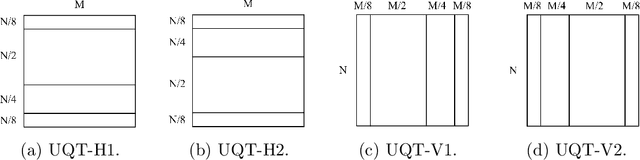
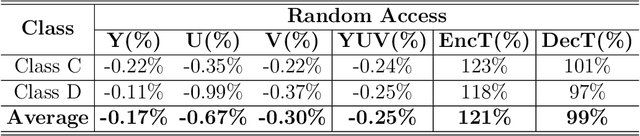
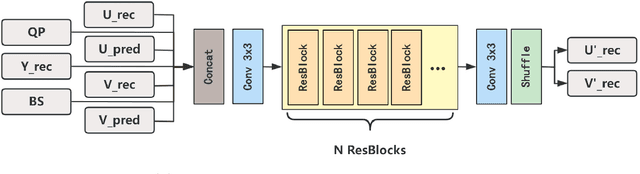
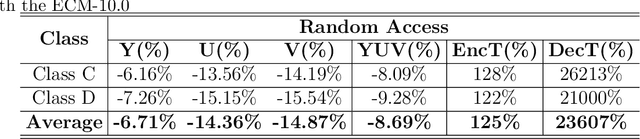
In this paper, a hybrid video compression framework is proposed that serves as a demonstrative showcase of deep learning-based approaches extending beyond the confines of traditional coding methodologies. The proposed hybrid framework is founded upon the Enhanced Compression Model (ECM), which is a further enhancement of the Versatile Video Coding (VVC) standard. We have augmented the latest ECM reference software with well-designed coding techniques, including block partitioning, deep learning-based loop filter, and the activation of block importance mapping (BIM) which was integrated but previously inactive within ECM, further enhancing coding performance. Compared with ECM-10.0, our method achieves 6.26, 13.33, and 12.33 BD-rate savings for the Y, U, and V components under random access (RA) configuration, respectively.