 Add to Chrome
 Add to Firefox
 Add to Edge
Revisiting RAG Retrievers: An Information Theoretic Benchmark
Feb 25, 2026
Retrieval-Augmented Generation (RAG) systems rely critically on the retriever module to surface relevant context for large language models. Although numerous retrievers have recently been proposed, each built on different ranking principles such as lexical matching, dense embeddings, or graph citations, there remains a lack of systematic understanding of how these mechanisms differ and overlap. Existing benchmarks primarily compare entire RAG pipelines or introduce new datasets, providing little guidance on selecting or combining retrievers themselves. Those that do compare retrievers directly use a limited set of evaluation tools which fail to capture complementary and overlapping strengths. This work presents MIGRASCOPE, a Mutual Information based RAG Retriever Analysis Scope. We revisit state-of-the-art retrievers and introduce principled metrics grounded in information and statistical estimation theory to quantify retrieval quality, redundancy, synergy, and marginal contribution. We further show that if chosen carefully, an ensemble of retrievers outperforms any single retriever. We leverage the developed tools over major RAG corpora to provide unique insights on contribution levels of the state-of-the-art retrievers. Our findings provide a fresh perspective on the structure of modern retrieval techniques and actionable guidance for designing robust and efficient RAG systems.

EpMAN: Episodic Memory AttentioN for Generalizing to Longer Contexts
Feb 20, 2025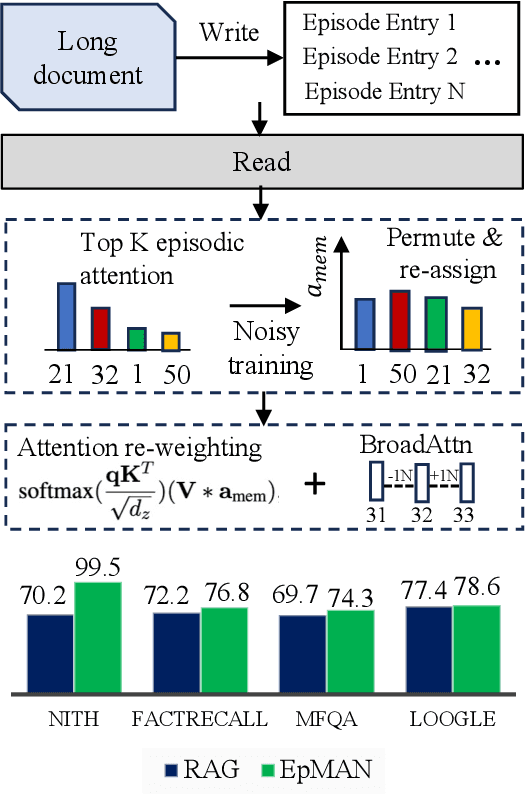
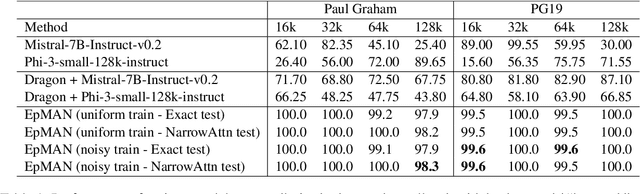
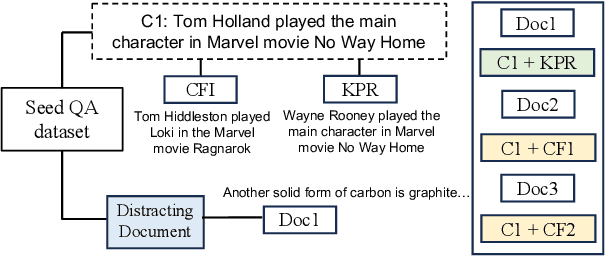
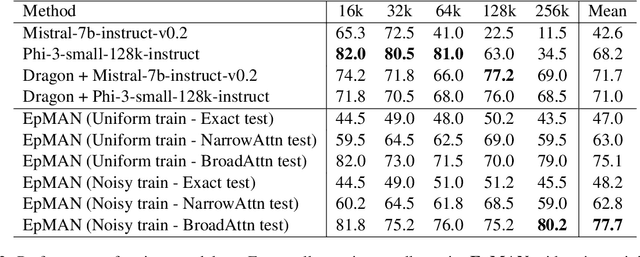
Recent advances in Large Language Models (LLMs) have yielded impressive successes on many language tasks. However, efficient processing of long contexts using LLMs remains a significant challenge. We introduce \textbf{EpMAN} -- a method for processing long contexts in an \textit{episodic memory} module while \textit{holistically attending to} semantically relevant context chunks. The output of \textit{episodic attention} is then used to reweigh the decoder's self-attention to the stored KV cache of the context during training and generation. When an LLM decoder is trained using \textbf{EpMAN}, its performance on multiple challenging single-hop long-context recall and question-answering benchmarks is found to be stronger and more robust across the range from 16k to 256k tokens than baseline decoders trained with self-attention, and popular retrieval-augmented generation frameworks.
Distributional Preference Alignment of LLMs via Optimal Transport
Jun 09, 2024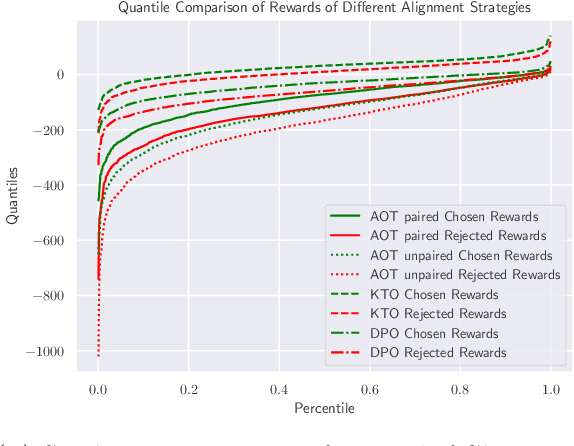

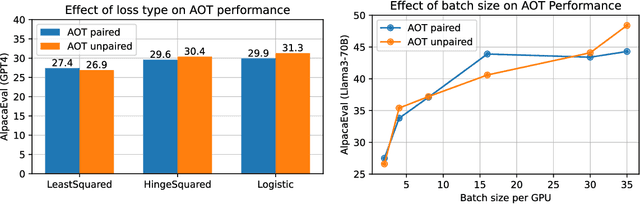

Current LLM alignment techniques use pairwise human preferences at a sample level, and as such, they do not imply an alignment on the distributional level. We propose in this paper Alignment via Optimal Transport (AOT), a novel method for distributional preference alignment of LLMs. AOT aligns LLMs on unpaired preference data by making the reward distribution of the positive samples stochastically dominant in the first order on the distribution of negative samples. We introduce a convex relaxation of this first-order stochastic dominance and cast it as an optimal transport problem with a smooth and convex cost. Thanks to the one-dimensional nature of the resulting optimal transport problem and the convexity of the cost, it has a closed-form solution via sorting on empirical measures. We fine-tune LLMs with this AOT objective, which enables alignment by penalizing the violation of the stochastic dominance of the reward distribution of the positive samples on the reward distribution of the negative samples. We analyze the sample complexity of AOT by considering the dual of the OT problem and show that it converges at the parametric rate. Empirically, we show on a diverse set of alignment datasets and LLMs that AOT leads to state-of-the-art models in the 7B family of models when evaluated with Open LLM Benchmarks and AlpacaEval.
Larimar: Large Language Models with Episodic Memory Control
Mar 18, 2024Efficient and accurate updating of knowledge stored in Large Language Models (LLMs) is one of the most pressing research challenges today. This paper presents Larimar - a novel, brain-inspired architecture for enhancing LLMs with a distributed episodic memory. Larimar's memory allows for dynamic, one-shot updates of knowledge without the need for computationally expensive re-training or fine-tuning. Experimental results on multiple fact editing benchmarks demonstrate that Larimar attains accuracy comparable to most competitive baselines, even in the challenging sequential editing setup, but also excels in speed - yielding speed-ups of 4-10x depending on the base LLM - as well as flexibility due to the proposed architecture being simple, LLM-agnostic, and hence general. We further provide mechanisms for selective fact forgetting and input context length generalization with Larimar and show their effectiveness.
Risk Assessment and Statistical Significance in the Age of Foundation Models
Oct 11, 2023


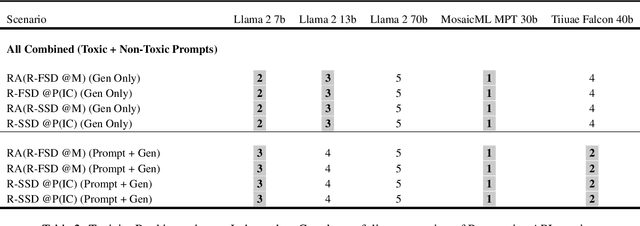
We propose a distributional framework for assessing socio-technical risks of foundation models with quantified statistical significance. Our approach hinges on a new statistical relative testing based on first and second order stochastic dominance of real random variables. We show that the second order statistics in this test are linked to mean-risk models commonly used in econometrics and mathematical finance to balance risk and utility when choosing between alternatives. Using this framework, we formally develop a risk-aware approach for foundation model selection given guardrails quantified by specified metrics. Inspired by portfolio optimization and selection theory in mathematical finance, we define a \emph{metrics portfolio} for each model as a means to aggregate a collection of metrics, and perform model selection based on the stochastic dominance of these portfolios. The statistical significance of our tests is backed theoretically by an asymptotic analysis via central limit theorems instantiated in practice via a bootstrap variance estimate. We use our framework to compare various large language models regarding risks related to drifting from instructions and outputting toxic content.
Auditing and Generating Synthetic Data with Controllable Trust Trade-offs
May 02, 2023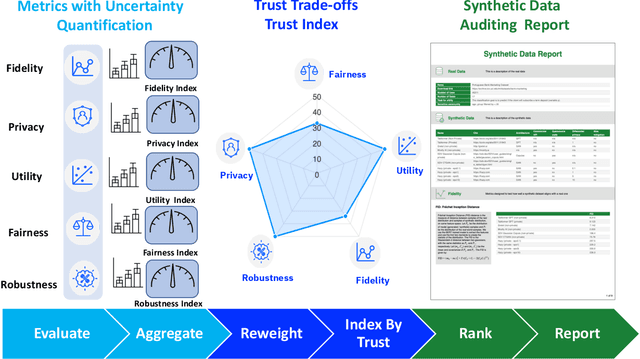
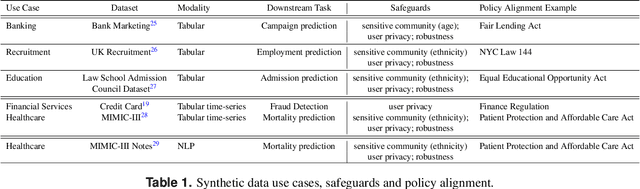
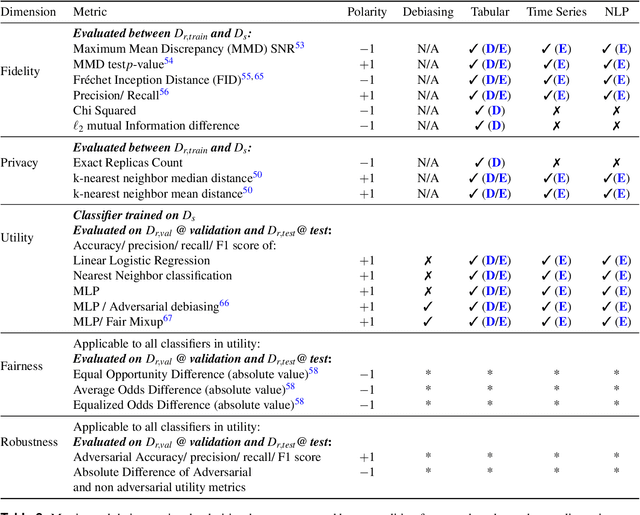
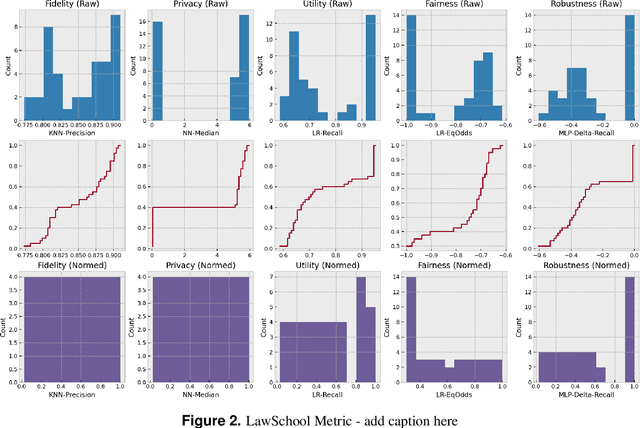
Data collected from the real world tends to be biased, unbalanced, and at risk of exposing sensitive and private information. This reality has given rise to the idea of creating synthetic datasets to alleviate risk, bias, harm, and privacy concerns inherent in the real data. This concept relies on Generative AI models to produce unbiased, privacy-preserving synthetic data while being true to the real data. In this new paradigm, how can we tell if this approach delivers on its promises? We present an auditing framework that offers a holistic assessment of synthetic datasets and AI models trained on them, centered around bias and discrimination prevention, fidelity to the real data, utility, robustness, and privacy preservation. We showcase our framework by auditing multiple generative models on diverse use cases, including education, healthcare, banking, human resources, and across different modalities, from tabular, to time-series, to natural language. Our use cases demonstrate the importance of a holistic assessment in order to ensure compliance with socio-technical safeguards that regulators and policymakers are increasingly enforcing. For this purpose, we introduce the trust index that ranks multiple synthetic datasets based on their prescribed safeguards and their desired trade-offs. Moreover, we devise a trust-index-driven model selection and cross-validation procedure via auditing in the training loop that we showcase on a class of transformer models that we dub TrustFormers, across different modalities. This trust-driven model selection allows for controllable trust trade-offs in the resulting synthetic data. We instrument our auditing framework with workflows that connect different stakeholders from model development to audit and certification via a synthetic data auditing report.
Knowledge Graph Generation From Text
Nov 18, 2022In this work we propose a novel end-to-end multi-stage Knowledge Graph (KG) generation system from textual inputs, separating the overall process into two stages. The graph nodes are generated first using pretrained language model, followed by a simple edge construction head, enabling efficient KG extraction from the text. For each stage we consider several architectural choices that can be used depending on the available training resources. We evaluated the model on a recent WebNLG 2020 Challenge dataset, matching the state-of-the-art performance on text-to-RDF generation task, as well as on New York Times (NYT) and a large-scale TekGen datasets, showing strong overall performance, outperforming the existing baselines. We believe that the proposed system can serve as a viable KG construction alternative to the existing linearization or sampling-based graph generation approaches. Our code can be found at https://github.com/IBM/Grapher
AlphaFold Distillation for Improved Inverse Protein Folding
Oct 05, 2022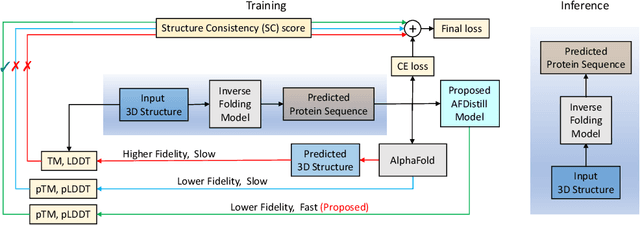
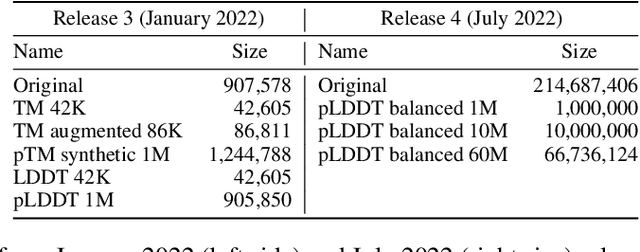
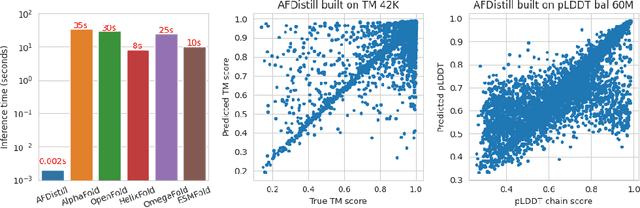
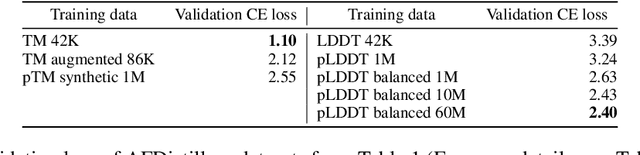
Inverse protein folding, i.e., designing sequences that fold into a given three-dimensional structure, is one of the fundamental design challenges in bio-engineering and drug discovery. Traditionally, inverse folding mainly involves learning from sequences that have an experimentally resolved structure. However, the known structures cover only a tiny space of the protein sequences, imposing limitations on the model learning. Recently proposed forward folding models, e.g., AlphaFold, offer unprecedented opportunity for accurate estimation of the structure given a protein sequence. Naturally, incorporating a forward folding model as a component of an inverse folding approach offers the potential of significantly improving the inverse folding, as the folding model can provide a feedback on any generated sequence in the form of the predicted protein structure or a structural confidence metric. However, at present, these forward folding models are still prohibitively slow to be a part of the model optimization loop during training. In this work, we propose to perform knowledge distillation on the folding model's confidence metrics, e.g., pTM or pLDDT scores, to obtain a smaller, faster and end-to-end differentiable distilled model, which then can be included as part of the structure consistency regularized inverse folding model training. Moreover, our regularization technique is general enough and can be applied in other design tasks, e.g., sequence-based protein infilling. Extensive experiments show a clear benefit of our method over the non-regularized baselines. For example, in inverse folding design problems we observe up to 3% improvement in sequence recovery and up to 45% improvement in protein diversity, while still preserving structural consistency of the generated sequences.
Cloud-Based Real-Time Molecular Screening Platform with MolFormer
Aug 13, 2022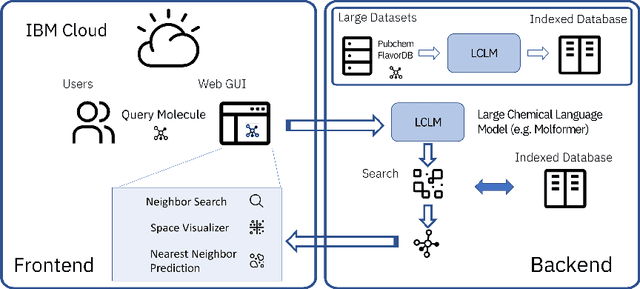
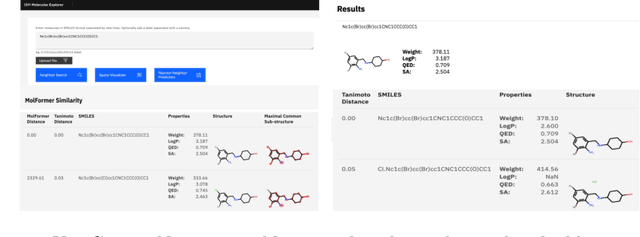
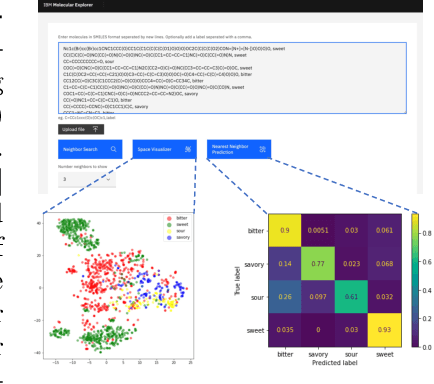
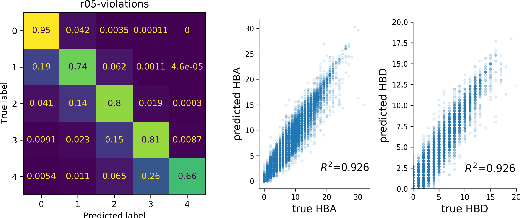
With the prospect of automating a number of chemical tasks with high fidelity, chemical language processing models are emerging at a rapid speed. Here, we present a cloud-based real-time platform that allows users to virtually screen molecules of interest. For this purpose, molecular embeddings inferred from a recently proposed large chemical language model, named MolFormer, are leveraged. The platform currently supports three tasks: nearest neighbor retrieval, chemical space visualization, and property prediction. Based on the functionalities of this platform and results obtained, we believe that such a platform can play a pivotal role in automating chemistry and chemical engineering research, as well as assist in drug discovery and material design tasks. A demo of our platform is provided at \url{www.ibm.biz/molecular_demo}.
Benchmarking deep generative models for diverse antibody sequence design
Nov 12, 2021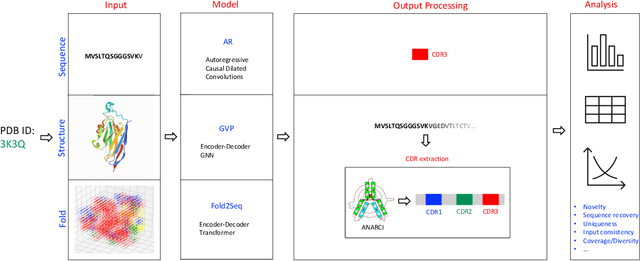
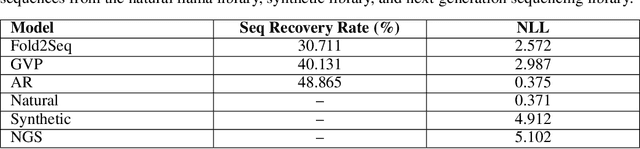
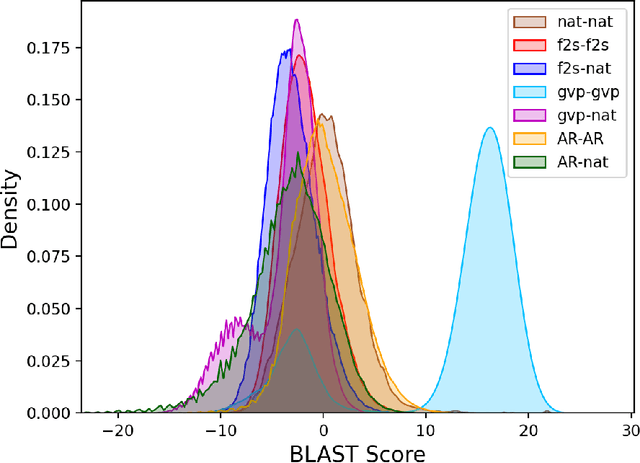
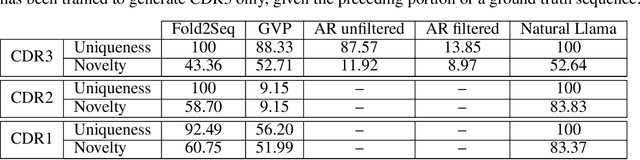
Computational protein design, i.e. inferring novel and diverse protein sequences consistent with a given structure, remains a major unsolved challenge. Recently, deep generative models that learn from sequences alone or from sequences and structures jointly have shown impressive performance on this task. However, those models appear limited in terms of modeling structural constraints, capturing enough sequence diversity, or both. Here we consider three recently proposed deep generative frameworks for protein design: (AR) the sequence-based autoregressive generative model, (GVP) the precise structure-based graph neural network, and Fold2Seq that leverages a fuzzy and scale-free representation of a three-dimensional fold, while enforcing structure-to-sequence (and vice versa) consistency. We benchmark these models on the task of computational design of antibody sequences, which demand designing sequences with high diversity for functional implication. The Fold2Seq framework outperforms the two other baselines in terms of diversity of the designed sequences, while maintaining the typical fold.