 Add to Chrome
 Add to Firefox
 Add to Edge
Omnidirectional Information Gathering for Knowledge Transfer-based Audio-Visual Navigation
Aug 20, 2023
Audio-visual navigation is an audio-targeted wayfinding task where a robot agent is entailed to travel a never-before-seen 3D environment towards the sounding source. In this article, we present ORAN, an omnidirectional audio-visual navigator based on cross-task navigation skill transfer. In particular, ORAN sharpens its two basic abilities for a such challenging task, namely wayfinding and audio-visual information gathering. First, ORAN is trained with a confidence-aware cross-task policy distillation (CCPD) strategy. CCPD transfers the fundamental, point-to-point wayfinding skill that is well trained on the large-scale PointGoal task to ORAN, so as to help ORAN to better master audio-visual navigation with far fewer training samples. To improve the efficiency of knowledge transfer and address the domain gap, CCPD is made to be adaptive to the decision confidence of the teacher policy. Second, ORAN is equipped with an omnidirectional information gathering (OIG) mechanism, i.e., gleaning visual-acoustic observations from different directions before decision-making. As a result, ORAN yields more robust navigation behaviour. Taking CCPD and OIG together, ORAN significantly outperforms previous competitors. After the model ensemble, we got 1st in Soundspaces Challenge 2022, improving SPL and SR by 53% and 35% relatively.

DREAMWALKER: Mental Planning for Continuous Vision-Language Navigation
Aug 14, 2023VLN-CE is a recently released embodied task, where AI agents need to navigate a freely traversable environment to reach a distant target location, given language instructions. It poses great challenges due to the huge space of possible strategies. Driven by the belief that the ability to anticipate the consequences of future actions is crucial for the emergence of intelligent and interpretable planning behavior, we propose DREAMWALKER -- a world model based VLN-CE agent. The world model is built to summarize the visual, topological, and dynamic properties of the complicated continuous environment into a discrete, structured, and compact representation. DREAMWALKER can simulate and evaluate possible plans entirely in such internal abstract world, before executing costly actions. As opposed to existing model-free VLN-CE agents simply making greedy decisions in the real world, which easily results in shortsighted behaviors, DREAMWALKER is able to make strategic planning through large amounts of ``mental experiments.'' Moreover, the imagined future scenarios reflect our agent's intention, making its decision-making process more transparent. Extensive experiments and ablation studies on VLN-CE dataset confirm the effectiveness of the proposed approach and outline fruitful directions for future work.
Bird's-Eye-View Scene Graph for Vision-Language Navigation
Aug 12, 2023Vision-language navigation (VLN), which entails an agent to navigate 3D environments following human instructions, has shown great advances. However, current agents are built upon panoramic observations, which hinders their ability to perceive 3D scene geometry and easily leads to ambiguous selection of panoramic view. To address these limitations, we present a BEV Scene Graph (BSG), which leverages multi-step BEV representations to encode scene layouts and geometric cues of indoor environment under the supervision of 3D detection. During navigation, BSG builds a local BEV representation at each step and maintains a BEV-based global scene map, which stores and organizes all the online collected local BEV representations according to their topological relations. Based on BSG, the agent predicts a local BEV grid-level decision score and a global graph-level decision score, combined with a sub-view selection score on panoramic views, for more accurate action prediction. Our approach significantly outperforms state-of-the-art methods on REVERIE, R2R, and R4R, showing the potential of BEV perception in VLN.
Clustering based Point Cloud Representation Learning for 3D Analysis
Jul 27, 2023Point cloud analysis (such as 3D segmentation and detection) is a challenging task, because of not only the irregular geometries of many millions of unordered points, but also the great variations caused by depth, viewpoint, occlusion, etc. Current studies put much focus on the adaption of neural networks to the complex geometries of point clouds, but are blind to a fundamental question: how to learn an appropriate point embedding space that is aware of both discriminative semantics and challenging variations? As a response, we propose a clustering based supervised learning scheme for point cloud analysis. Unlike current de-facto, scene-wise training paradigm, our algorithm conducts within-class clustering on the point embedding space for automatically discovering subclass patterns which are latent yet representative across scenes. The mined patterns are, in turn, used to repaint the embedding space, so as to respect the underlying distribution of the entire training dataset and improve the robustness to the variations. Our algorithm is principled and readily pluggable to modern point cloud segmentation networks during training, without extra overhead during testing. With various 3D network architectures (i.e., voxel-based, point-based, Transformer-based, automatically searched), our algorithm shows notable improvements on famous point cloud segmentation datasets (i.e.,2.0-2.6% on single-scan and 2.0-2.2% multi-scan of SemanticKITTI, 1.8-1.9% on S3DIS, in terms of mIoU). Our algorithm also demonstrates utility in 3D detection, showing 2.0-3.4% mAP gains on KITTI.
E^2VPT: An Effective and Efficient Approach for Visual Prompt Tuning
Jul 25, 2023As the size of transformer-based models continues to grow, fine-tuning these large-scale pretrained vision models for new tasks has become increasingly parameter-intensive. Parameter-efficient learning has been developed to reduce the number of tunable parameters during fine-tuning. Although these methods show promising results, there is still a significant performance gap compared to full fine-tuning. To address this challenge, we propose an Effective and Efficient Visual Prompt Tuning (E^2VPT) approach for large-scale transformer-based model adaptation. Specifically, we introduce a set of learnable key-value prompts and visual prompts into self-attention and input layers, respectively, to improve the effectiveness of model fine-tuning. Moreover, we design a prompt pruning procedure to systematically prune low importance prompts while preserving model performance, which largely enhances the model's efficiency. Empirical results demonstrate that our approach outperforms several state-of-the-art baselines on two benchmarks, with considerably low parameter usage (e.g., 0.32% of model parameters on VTAB-1k). Our code is available at https://github.com/ChengHan111/E2VPT.
Kefa: A Knowledge Enhanced and Fine-grained Aligned Speaker for Navigation Instruction Generation
Jul 25, 2023We introduce a novel speaker model \textsc{Kefa} for navigation instruction generation. The existing speaker models in Vision-and-Language Navigation suffer from the large domain gap of vision features between different environments and insufficient temporal grounding capability. To address the challenges, we propose a Knowledge Refinement Module to enhance the feature representation with external knowledge facts, and an Adaptive Temporal Alignment method to enforce fine-grained alignment between the generated instructions and the observation sequences. Moreover, we propose a new metric SPICE-D for navigation instruction evaluation, which is aware of the correctness of direction phrases. The experimental results on R2R and UrbanWalk datasets show that the proposed KEFA speaker achieves state-of-the-art instruction generation performance for both indoor and outdoor scenes.
Large-Scale Person Detection and Localization using Overhead Fisheye Cameras
Jul 17, 2023

Location determination finds wide applications in daily life. Instead of existing efforts devoted to localizing tourist photos captured by perspective cameras, in this article, we focus on devising person positioning solutions using overhead fisheye cameras. Such solutions are advantageous in large field of view (FOV), low cost, anti-occlusion, and unaggressive work mode (without the necessity of cameras carried by persons). However, related studies are quite scarce, due to the paucity of data. To stimulate research in this exciting area, we present LOAF, the first large-scale overhead fisheye dataset for person detection and localization. LOAF is built with many essential features, e.g., i) the data cover abundant diversities in scenes, human pose, density, and location; ii) it contains currently the largest number of annotated pedestrian, i.e., 457K bounding boxes with groundtruth location information; iii) the body-boxes are labeled as radius-aligned so as to fully address the positioning challenge. To approach localization, we build a fisheye person detection network, which exploits the fisheye distortions by a rotation-equivariant training strategy and predict radius-aligned human boxes end-to-end. Then, the actual locations of the detected persons are calculated by a numerical solution on the fisheye model and camera altitude data. Extensive experiments on LOAF validate the superiority of our fisheye detector w.r.t. previous methods, and show that our whole fisheye positioning solution is able to locate all persons in FOV with an accuracy of 0.5 m, within 0.1 s.
Segment and Track Anything
May 11, 2023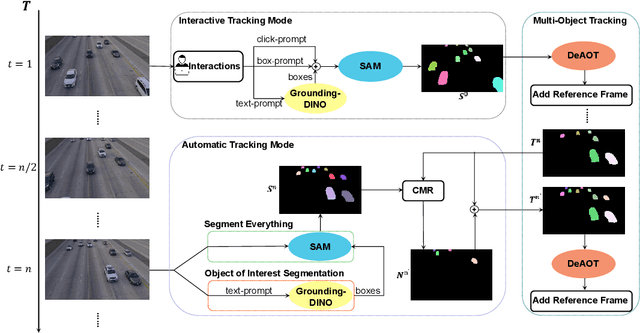
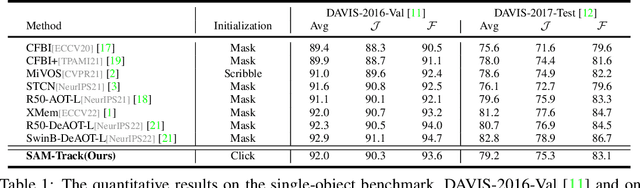
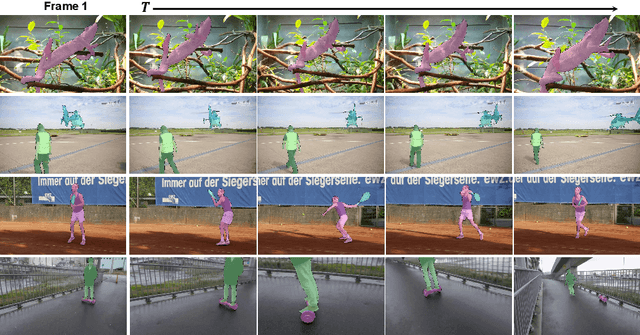
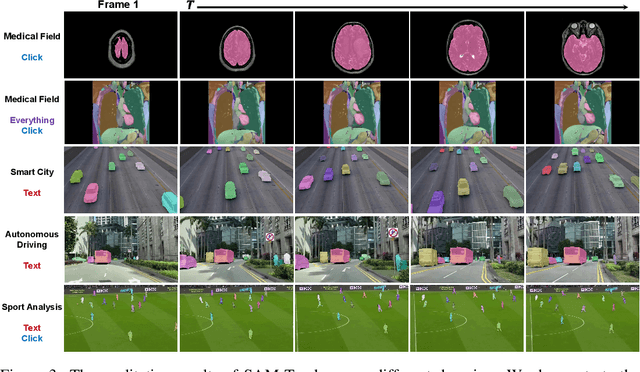
This report presents a framework called Segment And Track Anything (SAMTrack) that allows users to precisely and effectively segment and track any object in a video. Additionally, SAM-Track employs multimodal interaction methods that enable users to select multiple objects in videos for tracking, corresponding to their specific requirements. These interaction methods comprise click, stroke, and text, each possessing unique benefits and capable of being employed in combination. As a result, SAM-Track can be used across an array of fields, ranging from drone technology, autonomous driving, medical imaging, augmented reality, to biological analysis. SAM-Track amalgamates Segment Anything Model (SAM), an interactive key-frame segmentation model, with our proposed AOT-based tracking model (DeAOT), which secured 1st place in four tracks of the VOT 2022 challenge, to facilitate object tracking in video. In addition, SAM-Track incorporates Grounding-DINO, which enables the framework to support text-based interaction. We have demonstrated the remarkable capabilities of SAM-Track on DAVIS-2016 Val (92.0%), DAVIS-2017 Test (79.2%)and its practicability in diverse applications. The project page is available at: https://github.com/z-x-yang/Segment-and-Track-Anything.
CLUSTSEG: Clustering for Universal Segmentation
May 03, 2023We present CLUSTSEG, a general, transformer-based framework that tackles different image segmentation tasks (i.e., superpixel, semantic, instance, and panoptic) through a unified neural clustering scheme. Regarding queries as cluster centers, CLUSTSEG is innovative in two aspects:1) cluster centers are initialized in heterogeneous ways so as to pointedly address task-specific demands (e.g., instance- or category-level distinctiveness), yet without modifying the architecture; and 2) pixel-cluster assignment, formalized in a cross-attention fashion, is alternated with cluster center update, yet without learning additional parameters. These innovations closely link CLUSTSEG to EM clustering and make it a transparent and powerful framework that yields superior results across the above segmentation tasks.
Boosting Video Object Segmentation via Space-time Correspondence Learning
Apr 13, 2023Current top-leading solutions for video object segmentation (VOS) typically follow a matching-based regime: for each query frame, the segmentation mask is inferred according to its correspondence to previously processed and the first annotated frames. They simply exploit the supervisory signals from the groundtruth masks for learning mask prediction only, without posing any constraint on the space-time correspondence matching, which, however, is the fundamental building block of such regime. To alleviate this crucial yet commonly ignored issue, we devise a correspondence-aware training framework, which boosts matching-based VOS solutions by explicitly encouraging robust correspondence matching during network learning. Through comprehensively exploring the intrinsic coherence in videos on pixel and object levels, our algorithm reinforces the standard, fully supervised training of mask segmentation with label-free, contrastive correspondence learning. Without neither requiring extra annotation cost during training, nor causing speed delay during deployment, nor incurring architectural modification, our algorithm provides solid performance gains on four widely used benchmarks, i.e., DAVIS2016&2017, and YouTube-VOS2018&2019, on the top of famous matching-based VOS solutions.