 Add to Chrome
 Add to Firefox
 Add to Edge
BFLA: Block-Filtered Long-Context Attention Mechanism
May 12, 2026
This paper proposes Block-Filtered Long-Context Attention (BFLA), a training-free sparse prefill attention mechanism for long-context inference. BFLA adopts a two-stage design. In Stage 1, query and key sequences are compressed into coarse blocks, and lightweight block-level softmax mass estimation is performed to construct an input-dependent block importance mask. In Stage 2, the coarse mask is expanded to the Triton attention-tile grid. Several tile-level rescue strategies are applied to reduce information loss, where a fused sparse prefill kernel skips unimportant KV tiles while preserving exact token-level attention inside every retained tile. BFLA requires no retraining, calibration, preprocessing, or model modification and can be plugged into existing vLLM-style paged-attention workloads. Experiments on Gemma 4, Llama 3.1, Qwen 3.5, and Qwen 3.6 series models show that BFLA substantially accelerates long-context prefilling with minimal accuracy degradation compared to dense Triton FlashAttention. Project website: https://github.com/Alicewithrabbit/BFLA.

sparseGeoHOPCA: A Geometric Solution to Sparse Higher-Order PCA Without Covariance Estimation
Jun 10, 2025We propose sparseGeoHOPCA, a novel framework for sparse higher-order principal component analysis (SHOPCA) that introduces a geometric perspective to high-dimensional tensor decomposition. By unfolding the input tensor along each mode and reformulating the resulting subproblems as structured binary linear optimization problems, our method transforms the original nonconvex sparse objective into a tractable geometric form. This eliminates the need for explicit covariance estimation and iterative deflation, enabling significant gains in both computational efficiency and interpretability, particularly in high-dimensional and unbalanced data scenarios. We theoretically establish the equivalence between the geometric subproblems and the original SHOPCA formulation, and derive worst-case approximation error bounds based on classical PCA residuals, providing data-dependent performance guarantees. The proposed algorithm achieves a total computational complexity of $O\left(\sum_{n=1}^{N} (k_n^3 + J_n k_n^2)\right)$, which scales linearly with tensor size. Extensive experiments demonstrate that sparseGeoHOPCA accurately recovers sparse supports in synthetic settings, preserves classification performance under 10$\times$ compression, and achieves high-quality image reconstruction on ImageNet, highlighting its robustness and versatility.
ELFATT: Efficient Linear Fast Attention for Vision Transformers
Jan 10, 2025

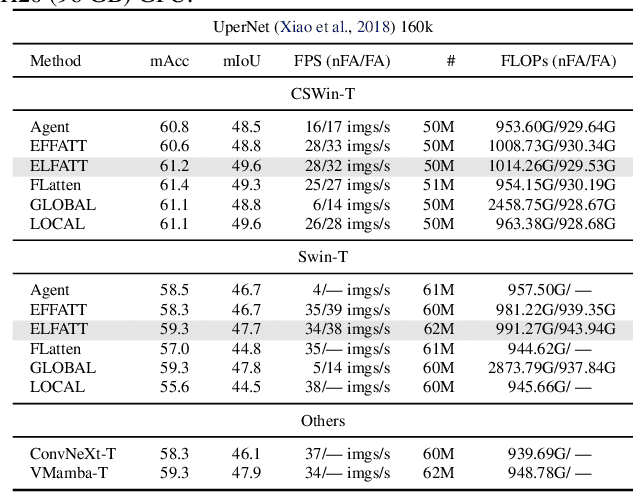

The attention mechanism is the key to the success of transformers in different machine learning tasks. However, the quadratic complexity with respect to the sequence length of the vanilla softmax-based attention mechanism becomes the major bottleneck for the application of long sequence tasks, such as vision tasks. Although various efficient linear attention mechanisms have been proposed, they need to sacrifice performance to achieve high efficiency. What's more, memory-efficient methods, such as FlashAttention-1-3, still have quadratic computation complexity which can be further improved. In this paper, we propose a novel efficient linear fast attention (ELFATT) mechanism to achieve low memory input/output operations, linear computational complexity, and high performance at the same time. ELFATT offers 4-7x speedups over the vanilla softmax-based attention mechanism in high-resolution vision tasks without losing performance. ELFATT is FlashAttention friendly. Using FlashAttention-2 acceleration, ELFATT still offers 2-3x speedups over the vanilla softmax-based attention mechanism on high-resolution vision tasks without losing performance. Even on edge GPUs, ELFATT still offers 1.6x to 2.0x speedups compared to state-of-the-art attention mechanisms in various power modes from 5W to 60W. The code of ELFATT is available at [https://github.com/Alicewithrabbit/ELFATT].